
Uncategorized
Nigeria Records over $50bn Crypto currency Transactions in One Year – SEC


By Tony Obiechina, Abuja
The Director-General of the Securities and Exchange Commission (SEC), Dr. Emomotimi Agama, has disclosed that over $50 billion worth of crypto currency transactions flowed through Nigeria between July 2023 and June 2024, underscoring the sophistication and risk tolerance of investors that the traditional market has yet to capture.
Agama in a lead paper titled Evaluating the Nigerian Capital Market Master plan 2015-2025 presented at the annual conference of the Chartered Institute of Stockbrokers, however raised concern over the alarmingly low participation of Nigerians in the traditional capital market, revealing that fewer than four percent of the country’s adult population are active investors.
He described the low participation rate as a major impediment to economic growth and capital formation.
He noted that while fewer than three million Nigerians invest in the capital market, more than 60 million engage daily in gambling activities, spending an estimated $5.5 million every day.
“This reveals a paradox, an appetite for risk clearly exists, but not the trust or access to channel that energy into productive investment.”
Agama also lamented that Nigeria’s market capitalization-to-GDP ratio stands at about 30 percent, far below South Africa’s 320 percent, Malaysia’s 123 percent, and India’s 92 percent, a disparity he said highlights the urgent need to deepen financial inclusion and rebuild investor confidence.
Recalling the vision of the ten-year CMMP launched in 2015, the SEC boss said it was designed to reposition Nigeria’s capital market as the engine of economic transformation by mobilizing long-term finance for infrastructure and enterprise development.
“Today, as we stand at the sunset of that ten-year plan, our task is not ceremonial; it is reflective and diagnostic. We must ask: what did we achieve, where did we fall short, and what lessons must anchor our next decade of reforms?” he stated.
Agama disclosed that less than half of the 108 initiatives under the CMMP were fully achieved, blaming limited alignment with national development plans, inadequate tracking metrics, and weak stakeholder ownership for the shortfall.
Despite progress in areas such as Green Bonds, Sukuk, fintech integration, and non-interest finance, he said market liquidity remains concentrated in a few large-cap stocks like Airtel Africa, Dangote Cement, and MTN Nigeria.
Agama, who listed six key challenges for the next phase of reforms, pointed at low retail participation, market concentration, falling foreign inflows, underutilized pension assets, untapped diaspora capital, and a widening infrastructure financing gap.
“Nigeria’s $150 billion annual infrastructure deficit far exceeds the market’s contribution, with only N1.5 trillion approved in PPP bonds. This shows a misalignment between financial innovation and national priorities,” he observed.
The DG called for a “reimagined SEC” that serves as both regulator and enabler of private-sector-driven growth, and added the next decade must focus on trust-building, transparency, and inclusion.
“Vision without execution is inertia — and reform without measurement is aspiration without accountability,” he declared.

The Centre for the Promotion of Private Enterprise (CPPE) has urged policymakers to prioritise targeted interventions to address uneasiness around cost of living to ensure Gross Domestic Product (GDP) growth translated into real improvements in citizens’ welfare.
The Founder, CPPE, Dr.
Muda Yusuf, gave the advice on Tuesday in Lagos in reaction to the country’s third quarter GDP report which grew by 3. 98 per cent.Yusuf noted that though the report showed slight moderation from the 4.3 per cent growth in the second quarter.
However, data confirms the economy remains firmly on a path of steady recovery and consolidation.
Yusuf said the performance highlighted the positive impact of ongoing economic reforms, especially in stabilising the exchange rate, moderating inflation, improving fiscal conditions and gradually restoring investors’ confidence.
According to him, these macroeconomic gains have strengthened business sentiment and supported activity across key sectors of the economy.
He, however, noted that in spite of improving fundamentals, the cost-of-living crisis remains a concern.
Yusuf said while disinflation was underway and prices of some food items and manufactured products were easing, the social outcomes of economic reforms continued to weigh on households.
“It is, therefore, imperative for policymaking to prioritise targeted interventions to address the uneasiness around cost of living and ensure that GDP growth and macroeconomic stability translate into real improvements in citizens’ welfare—particularly for vulnerable groups,” he said.
Yusuf said to consolidate the gains recorded in Q3 and unlock stronger, more inclusive growth, certain policy interventions were critical.
He emphasised the need to reduce structural bottlenecks, mitigate the cost of the living crisis, strengthen agricultural productivity, rebuild manufacturing competitiveness and address housing affordability.
Yusuf also called for increased funding for social sectors such as health and education, enhancement of non-oil exports, stabilised oil output and security of critical infrastructure.
He reaffirmed that targeted policies to ease cost-of-living pressures was crucial to making the reform process inclusive.

Uncategorized
Reps Order Forensic Audit of NMDPRA over Alleged Mismanagement of Gas Infrastructure Fund
By Ubong Ukpong, Abuja
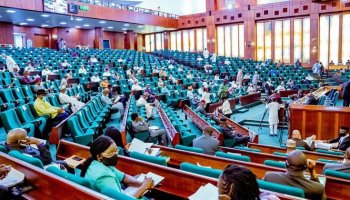
Public Accounts Committee (PAC), of the House of Representatives, on Monday, ordered a forensic audit of theMidstream and Downstream Gas Infrastructure Fund by the Nigerian Midstream and Downstream Petroleum Regulatory Authority (NMDPRA), over the alleged mismanagement of the Fund’s operations from 2021 to date.
The Committee Chaired by Representative Bamidele Salam on Monday made the decision after a motion, titled “Motion on the Urgent Need to Investigate Misapplication and Mismanagement of Midstream and Downstream Gas Infrastructure Fund by the Nigerian Midstream and Downstream Petroleum Regulatory Authority (NMDPRA) from Year 2021 to Date in Contravention of the Petroleum Industry Act (PIA) 2021,” was moved by Hon. Cyriacus Umeha and seconded by Hon. Kafilat Ogbara.The Committee noted that Section 52(1) of the Petroleum Industry Act (PIA) 2021 established the Midstream and Downstream Gas Infrastructure Development Fund, stating that its utilisation must be subjected to appropriation by the National Assembly.It further observed that Section 52(7a) stipulates that the fund should be financed through 0.5 percent of the wholesale price of petroleum products and natural gas sold in Nigeria, collected from wholesale customers in addition to levies outlined in Section 47(2)(c) of the Act.Lawmakers also drew attention to Sections 52(8) and (9) of the Act, which mandate the NMDPRA to ensure the prompt collection of all such sums into the Fund’s account within 21 days of the sale of petroleum products and natural gas in the country.The Committee highlighted that Order 20, Rule 6(5) of the House Standing Orders (11th Edition) empowers the Public Accounts Committee to investigate loss of public revenue, non-remittance of fees, and violations of financial laws in the administration of public funds.However, concerns were raised after the Public Accounts Committee, in a letter dated July 21, 2025, requested the NMDPRA to submit relevant information on the administration and utilization of the Fund and to appear before the Committee on August 12, 2025.According to the motion, the Authority neither responded to the request nor honoured the invitation.The Committee explained that it issued a final reminder on August 26, 2025, but the NMDPRA still failed to comply, raising further suspicion about the management of the fund.Lawmakers expressed alarm that several wholesale customers had defaulted in paying the mandatory 0.5 percent levy, despite Section 52(9) empowering the Authority to set regulations for late or non-payment.They also cited serious allegations of due process violations, disregard for financial regulations, and the absence of audit reports on the fund since its establishment.In response, the House resolved to mandate the Office of the Auditor-General for the Federation to conduct a comprehensive forensic audit of all funds collected by the NMDPRA since 2021.The Committee said the audit is expected to uncover the extent of alleged mismanagement, misappropriation, and fraudulent diversion of funds, as well as identify wholesale customers who failed to remit the required levy.PAC ordered the Auditor-General to report back to the Committee within 60 days.
From Ene Asuquo, Calabar
A youth leader in Effi, Okuni community in Ikom local government area of Cross River State, Alobi Ndifon has asked Executive Director Rainforest Resource and Development Center (RRDC), Prince Odey Oyama, to tender payment evidence for N40m compensation money that he allegedly collected from the Cross River State Government for superhighway on behalf of the community.
Ndifon made the accusation during an interactive session with our reporter in Calabar yesterdayHe accused Oyama of lacking the moral justification to accuse Okim, who is their community legal Adviser of not being transparent, as Oyama himself is not transparent accusing him of causing divisions within the community. He urged Oyama to stop spreading malicious propaganda against the Okim, accusing Oyama of fostering divisive tendencies rather than unity in the community.He said that Oyama’s claim of a secret agreement between Okim and Chinese nationals has been described as “totally unfounded” and lacking evidence to back his claims.Ndifon demanded that Oyama produce evidence to support his claims or retract his statements, saying that the allegations are damaging to Okim’s reputation.He accused Oyama of prioritizing his selfish interests over the well-being of the community, causing harm to the community’s unity and progress.Ndifon stated that Oyama’s actions are motivated by a desire to destroy Okim’s reputation and advance his own interests, rather than working towards the betterment of the Olulumo Community.Ndifon demanded that Oyama produce evidence to support his claims or retract his statements, saying that the allegations are damaging to Okim’s reputation.He accused Oyama of prioritizing his selfish interests over the well-being of the community, causing harm to the community’s unity and progress.Efforts to get Oyama to react on the issue failed as text messages and telephone calls put across to him after a failed attempt to speak with him, yielded no results as Oyama neither replied to the text message or replied to the telephone even when his phone ran several times.
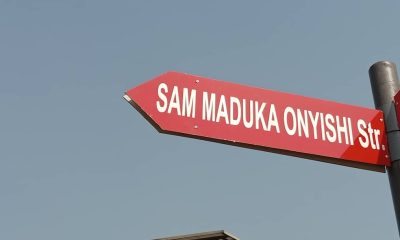

Street Named After Business Mogul, Sam Maduka Onyishi Unveiled in Asokoro
ShareBy David Torough, Abuja Authorities in the Federal Capital Territory on Saturday honoured renowned entrepreneur and philanthropist, Chief Dr. Sam...

Experts Task Government on Increase in Domestic Funding
ShareBy Laide Akinboade, Abuja Experts in the health sector, at the weekend agreed that even though foreign grants and aid...
BBNaija’s Queen Mercy Confirms crash of Her One-year Marriage
ShareBig Brother Naija reality show star, Queen Mercy Atang, has finally confirmed the crash of her one-year marriage. The single...

Obi, TCM Condemn Tinubu’s Distribution of Vehicles to Renewed Hope Ambassadors
ShareBy Mike Odiakose Abuja Presidential Candidate of the Labour Party, Peter Obi and a socio-political organisation, The Collective Movement (TCM),...

Bayelsa Urges NDDC to Complete Abandoned Akenfa Bridge Project
ShareFrom Mike Tayese, Yenagoa The Bayelsa State Government has called on the Niger Delta Development Commission (NDDC) to resume and...


Road Accident Claims Six Lives in Kogi
ShareFrom Joseph Amedu, Lokoja The Kogi State Government has expressed sadness over a tragic accident involving a bus conveying some...

Adebayo at 53 Young Enough to Lead Nigeria – Ighodalo
ShareBy Mike Odiakose, Abuja Pastor in charge of Trinity House, a non-denominational, Christian fellowship centre and founder, African Leadership Group...

Four Dies as Bandits Launches Attack in Kogi Community
ShareFrom Joseph Amedu, Lokoja Four persons were reportedly dead on Wednesday when suspected bandits launched an attack on Irunda Ile...
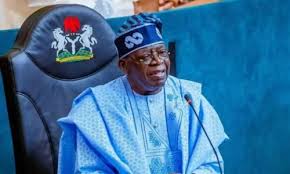

Musa Takes Oath, Vows United Front against Insecurity
ShareBy David Torough, Abuja President Bola Tinubu yesterday swore in former Chief of Defense Staff, General Christopher Musa (rtd), as...


OPay Secures Double Honors at Tech Innovation Awards
ShareIn a major recognition of its innovation and security leadership, OPay, Nigeria’s premier financial technology company, has been named Fintech...