
NEWS
Sit-at-home: Anambra Shuts New Auto Spare Parts Market


The Anambra Government has ordered the closure of the new Auto Spare Parts Market, Nkwo in Nnewi, over non-compliance with government directive for all markets to open for businesses on Mondays.
The shutdown was spearheaded by the Special Adviser to the Governor on Trade and Markets, Chief Evarist Uba.
Uba ordered that the market be shut down for a period of one week, saying that the move is aimed at restoring order and addressing economic sabotage across the state.
He explained that the enforcement exercise was carried out on the orders of Gov. Chukwuma Soludo.
He emphasised that the governor’s order signaled a firm stance on market governance within the state’s industrial hubs.
According to him, the decision to seal the market stems from several unresolved issues, especially non-compliance with a government directive that all markets across the state should open on Mondays.
“Not opening the market on Mondays is considered by the state government as an act of economic sabotage and will be treated as such.
“The market is expected to remain under government and security watch until the expiration of the one week mandate”, he said.
Uba said that during the one week period, stakeholders, traders and union leaders are expected to recalibrate as failure to adhere to government directive would result in the market being shut down for two weeks.

The Centre for the Promotion of Private Enterprise (CPPE) has faulted a World Bank recommendation advocating increased importation of petroleum products and food.
CPPE founder, Dr. Muda Yusuf, in a statement on Sunday, said the advice was misaligned with Nigeria’s reform path and threatened long-term development goals.
He maintained that industrialisation remained the most viable pathway to Nigeria’s economic transformation.
The World Bank projected about 4.2 per cent economic growth for Nigeria in 2026.
It also urged authorities to save oil windfalls, tighten monetary policy and avoid blanket subsidies to curb inflation.
Yusuf said that, as macroeconomic stability improves, priorities should consolidate gains through domestic production and value addition rather than import dependence.
He stressed that sustainable transformation was anchored on strong industrial capability.
According to him, increased importation to address supply constraints would undermine local production and weaken the real sector.
“What the Nigerian economy urgently requires is a coherent industrial strategy that expands domestic production capacity and strengthens manufacturing competitiveness,” he said.
Yusuf warned that import-driven solutions could accelerate de-industrialisation, limit job creation and expose the economy to external shocks.
He noted that domestic producers faced constraints including poor infrastructure, high energy costs, elevated lending rates and multiple taxation.
He said presenting import liberalisation as a competition tool ignored business realities and disadvantaged local investors.
Yusuf added that industrialisation required deliberate policies to reduce costs, improve logistics and strengthen industrial ecosystems.
He emphasised that Nigeria’s transition toward self-sufficiency in petroleum refining should be protected through supportive policies.
He warned that increased petroleum imports could weaken refining investments, heighten foreign exchange pressures and reverse sectoral gains.
On agriculture, Yusuf cautioned that excessive food imports could discourage local production, depress rural incomes and undermine food security.
He said Nigeria’s food system must be strengthened through improved productivity, value chain development and better market access.
Yusuf highlighted risks of import dependence, including pressure on reserves, exchange rate volatility and weakened industrial linkages.
He noted that many advanced economies now prioritise domestic production and supply chain resilience through strategic protectionism.
Yusuf urged the World Bank to refocus its advisory toward industrialisation-driven reforms supporting local refining, manufacturing and agriculture.
He listed priorities including reducing production costs, strengthening industrial clusters, promoting backward integration and addressing structural bottlenecks.
“Import liberalisation is not a sustainable solution. The focus should be on building a resilient, self-reliant and industrialised economy,” he said.

By David Torough, Abuja
A fresh territorial dispute has emerged in Nigeria’s coastal region as the Ode-Omi Kingdom in Ogun State formally petitioned the House of Representatives, copied to Sen. Gbenga Daniel, who represents Ogun East and Hon. Adegbesan who represents Ogun waterside local government, seeking official recognition as the rightful owner of Eba Island, a location recently approved for crude oil exploration.
The petition, submitted by Oba Folailu Adekunle Hassan and the people of Ode-Omi through their legal representatives, urges the National Assembly to affirm that Eba Island, also known as Eba Ebute Olokun, falls within the jurisdiction of Ogun State’s Ogun Waterside Local Government Area.
The move follows a motion by Joseph Adegbesan, which prompted an ongoing investigation into the ownership and territorial status of the island. The issue gained urgency after Bola Ahmed Tinubu approved crude oil exploration activities in the area, triggering competing claims from neighboring communities.
In the petition, the Ode-Omi Kingdom insists that Eba Island has, “from time immemorial,” been under its control, citing ancestral settlements, traditional authority, and administrative history as evidence.
The kingdom argued that several ruling houses from Ode-Omi have long-standing roots on the island and that past and present traditional rulers exercised authority over the area, including appointing local chiefs.
The petition also referenced a 2017 report by the Ijebu Traditional Council, which allegedly affirmed the authority of the Lenuwa of Ode-Omi over Eba settlements, including the disputed island.
According to the petitioners, colonial records, scholarly research and government recognitions, such as those tied to the Olokola Free Trade Zone—further support their claim.
However, the claim is being challenged by the Atijere Community in Ondo State’s Ilaje Local Government Area, whose traditional leadership has asserted host community status over the island.
The Ode-Omi petition dismisses this as “false and misleading,” arguing that the claim lacks historical, legal, and geographical backing.
The petitioners are asking the House to declare Eba Island part of Ode-Omi Kingdom, recognize the Lenuwa as the prescribed traditional authority and direct all relevant agencies to treat Ode-Omi as the host community for oil operations.
They warned that failure to resolve the dispute in line with historical and legal evidence could lead to avoidable conflict, stressing that the matter is a “test of respect for history and adherence to law.”
“Ogun State Government recognised Ode-Omi as host community in the Olokola Free Trade Zone project (OKFTZ) situate along the coastal area which also covers Eba Ebute Olokun (aka Eba island) and Ode-Omi only shares boundary with Irokun Community along that coastal line in Ogun Waterside Local Government Area and Ibeju-Lekki in Lagos State. Ode-Omi also shares a boundary with Imakun Omi, Ogun Waterside Local Government Area of Ogun State along the Alape River about seven (7) miles to Eba Ebute Olokun (aka Eba Island).
“The Ogun State Government during the tenure of His Otunba Gbenga Daniel requested that the then Awujale of Ijebu Ode late Alayeluwa oba (DR.) S. K. Adetona constitutes a panel on the development at Ode Omi and the role of late Oba Adenuga Okuniyi, Lenuwa of Ode-Omi (as he then was) which was held on 1st of September, 2009 at the Heritage Hall, Aafin, Ijebu Ode with a Report confirming Ode-Omi as the host community for the Olokola Free Trade Zone project (OKFTZ).
“Survey plan of Ebute Olokun, Okuniyi, Ojafoyewa family land at Ebute Olokun Village, Ogun Waterside Local Government Area, Ogun State with plan NO. JOO/06/22/2000 prepared by Jonas Okeke Registered Surveyor is the substantive survey plan of Eba Ebute Olokun popularly known as Eba Island.
“This constitutes modern administrative acknowledgment of ownership,” the petition aptly captured.
The House Committees on Petroleum Resources (Upstream) and Special Duties are expected to review the petition as part of the broader investigation.
By Laide Akinboade, Abuja
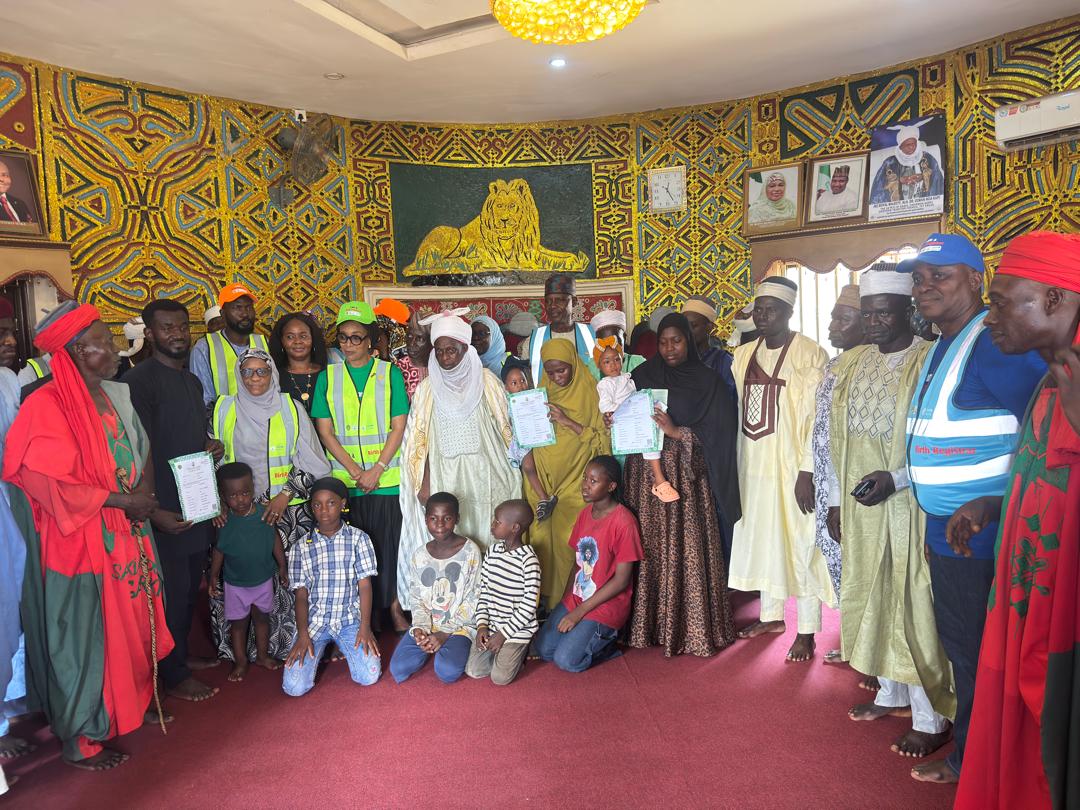
The Federal Capital Territory (FCT), Mandate Secretary, of women Affairs secretariat, Dr Adedayo Benjamins-Laniyi, on Monday, said the registration of every child born in Abuja would give them the important legal identity they deserve.
The Mandate Secretary Women Affairs Secretariats stated this at the , mobilisation of residents for birth registration, through the traditional rulers in Abuja Municipal Area Council, (AMAC).
At the Palace of Sapeyi (Chief) of Garki, Alh. Usman Nga-Kupi, in Abuja, she said the exercise is meant for all children from Zero to five years.
Benjamins-Laniyi, said the social mobilisation was to ensure all children between the ages of zero to five years were registered and issued a birth certificate as a legal means of identification.
She stressed that, the move is to ensure that no child is left behind in the efforts to ensure absolute protection of all children.
She said that the birth registration campaign was being coordinated by First Lady Oluremi Tinubu across the country.
She said that the mobilisation of the traditional leaders and community members began on March 28 in Abaji Area Council and extended to the remaining five area councils of the FCT.
The mandate secretary said that the women affairs secretariat and its partners had received the blessing and cooperation of the royal fathers in the 17 Chiefdoms of the FCT.
According to her, “Through this partnership, we have taken the message of birth registration into palaces, homes, and communities across the FCT.
“Together, under the watch of our royal fathers, we are restoring the dignity of our children by ensuring that every child in the FCT is seen, counted, registered and protected.
“When a child is registered, the child is recognised; and when a child is recognised, the child can thrive,” she said.
She said that the mobilisation was being implemented with support from the United Nations Children’s Fund (UNICEF) in collaboration with the National Population Commission (NPC) and National Orientation Agency.
She identified other partners as the National Identity Management Commission, FCT Primary Healthcare Board, FCT Area Council Secretariat and the Association of Local Government Employees of Nigeria.
The Director, Child Development in the secretariat, Dr Idris Attah, explained that the mobilisation was to scale up birth registration in all the nukes and crannies of the FCT.
Attah added that the move was to ensure immediate issuance of the new digital birth certificates to children between ages zero to one year and ages between ages one to five years.
According to him, the registration is free to all children under five years in the FCT.
Mr Charlse Awuna, Child Protection Officer, UNICEF, said that the social mobilization for the birth registration would ensure that every child in the FCT has a legal identity.
According to Awuna, without a birth certificate, the child is not counted as a member of the community and as a citizen of the country.
“This is in line with the Renewed Hope Initiative of the First Lady Oluremi Tinubu, and this is why we are partnering with FCT women affairs secretariat to ensure that all children are captured in the population database.”
Also, Alh. Sulaiman Gada, NPC Director, FCT, noted that FCT was left behind in the birth registration of children under five years and commended FCT Administration for the efforts.
Gada stressed the need to effectively use traditional structures in every community “to ensure that every child is reached, registered and issued with a birth certificate.
He advised caregivers against laminating the certificate to prevent loss of data when uploading the document but preserve and protect the legal document.
Giving his royal blessings, Nga-Kupi welcomed the development and promised to mobilise all ward, village and district heads to ensure that all children in their domain were registered.
The success of the mobilization was highlighted by the immediate registration of King David Agazor, a three-month-old infant. His mother, Uchechukwu Ikechukwu, expressed her delight at the ease of the process.
”I’ve been trying since the first day that I gave birth… but my husband has been procrastinating about it.
.
“When my neighbor told me that they are giving it for free, I rushed here—even without bathing the baby—and it was just easy. I’m very happy”, she shared



Otu, Retired Naval Chief Bag UNICAL Honorary Degrees
ShareFrom Ene Asuquo, Calabar The Governor of Cross River State, Prince Bassey Otu, has been conferred with an honorary doctorate...


Children Registration Gives Legal Identity, Says Benjamins-Laniyi
ShareBy Laide Akinboade, Abuja The Federal Capital Territory (FCT), Mandate Secretary, of women Affairs secretariat, Dr. Adedayo Benjamins-Laniyi on Monday...
Otu, Retired Naval Chief Bag UNICAL Honorary Degrees
ShareFrom Ene Asuquo, Calabar The Governor of Cross River State, Prince Bassey Otu, has been conferred with an honorary doctorate...
Misuse of Antibiotics Driving Drug-resistant TB – Expert
ShareA Professor of Paediatrics, Nnamdi Onyire said the growing misuse of antibiotics in treating common cough is fuelling the emergence...
New FRSC Sector Commander Pledges to Strengthen Road Safety Operations in Delta
ShareThe new Sector Commander, Federal Road Safety Corps (FRSC), Delta Sector Command, said he would consolidate on existing achievements while...


Police Arrest Officers, Drivers, POS Operators for Abduction, Extortion in Edo
ShareFrom Ikhazuagbe Ojeikere, Benin Operatives of the Edo State Police Command said four of its officers and three others have...


NDLEA Arrest Five Suspects with Illicit Drugs worth N724.5m in Edo
ShareFrom Ikhazuagbe Ojeikere, Benin The Edo State Command of the National Drug Law Enforcement Agency (NDLEA) has intercepted 7,245kilograms of...
Fadahunsi Rolls Out Food Items, Others in Osun East
ShareFrom Ayinde Akintade, Osogbo In a massive effort to tackle hunger and hardship, Senator Francis Adenigba Fadahunsi, representing Osun East...

Road Projects: Kaduna Targets Improved Access to FUAS, ABU
ShareKaduna State Government has intensified road infrastructure development at the Federal University of Applied Sciences, Kachia, and Ahmadu Bello University...


UNIABUJA to Graduate 12,624 Students at 29th, 30th Convocation Ceremonies
ShareA total of 12,624 students are set to graduate as the University of Abuja holds its combined 29th and 30th...