
Education
Sule Rewards First-Class Graduates, Honours Tanzania’s President at NSUK 8th Convocation

By Tambaya Julius, Abuja
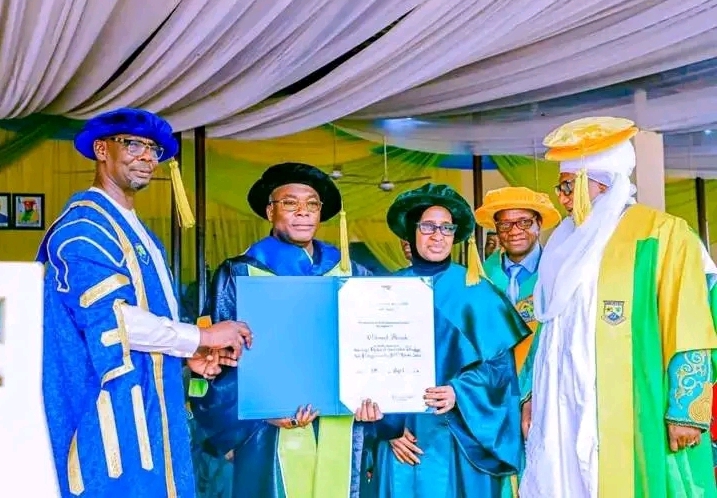
The Nasarawa State University, Keffi over the weekend celebrated its 25th silver jubilee anniversary and combined 8th convocation ceremony, where over 25,000 students were awarded with various academic degrees.
The grand event, held over the weekend at the school main Campus Keffi, was confirmed and honoured with Doctor of Philosophy (PhDs), Master’s degrees, First Degrees, and Postgraduate Diplomas on graduating students across different faculties.
The ceremony also confirmed honorary doctorate degrees on prominent personalities for their contributions to global leadership, business, and development.
Among the prominent personalities honoured were the President of Tanzania, Samia Suluhu Hassan; Abdul Samad Rabiu, Chairman of BUA Group; and Mahmood Ahmad.
The awards recognised their outstanding contributions to global leadership, development, and their roles in advancing socio-economic development both within Africa and globally.
During the ceremony, the Governor of Nasarawa State, Abdullahi Sule, awarded a cash prize of five hundred thousand Naira (N500,000) each to 82 first-class graduates, while the overall best graduating student was awarded N1 million.
The governor explained that the initiative was designed to promote excellence among students and aligns with the state government’s broader agenda of investing in education and human capital development. According to him, recognising academic achievement is essential in inspiring younger generations to pursue excellence.
Sule emphasised that rewarding hard work and dedication would encourage students across the state to strive for distinction in their academic pursuits. He noted that such incentives serve as a catalyst for improved performance and a stronger educational system.
As part of activities marking the institution’s 8th convocation and 25th anniversary celebrations, the governor commissioned several infrastructure projects at the University.
The newly inaugurated projects include the Alumni Secretariat, the Department of Accounting Postgraduate E-Library, as well as the university’s second gate and access road. He commended the university management for its commitment to infrastructural development and academic excellence.
The two-day celebration attracted a wide array of dignitaries from across Nigeria, including Governors, Ambassadors, Vice-chancellors, professors, traditional rulers, Business Men, and key stakeholders in the education sector.
In her address, the Vice-Chancellor of Nasarawa State University, Keffi, Prof. Sa’adatu Hassan Liman, warmly welcomed guests and expressed appreciation to the university’s leadership for their continued support.
She specifically acknowledged the Chancellor, HRH. Shehu Chindo Yamusa the Emir of Keffi, as well as the Pro-Chancellor, Prof. Atahiru Jiga, and members of the governing council for their impactful leadership.
Liman credited the institution’s progress to strong governance and visionary leadership, noting that both staff and students have benefitted from an enabling academic environment.
“I have acquired knowledge and experience in this institution due to impactful and good leadership,” she said.
She further urged students to prioritise their education and draw inspiration from the leadership and values upheld by the university. According to her, such commitment is essential for contributing meaningfully to Nigeria’s academic advancement and global competitiveness.
“Apply your knowledge positively, contributing to the advancement and educational success of Nigeria and the global community,” she appealed.

The West African Examinations Council has released the official timetable for the 2026 West African Senior School Certificate Examination for school candidates.
According to the final international timetable published on WAEC’s official X handle on Monday, the examination will commence on Tuesday, April 21, 2026, and end on Friday, June 19, 2026.
The council said the examination will begin with Foods and Nutrition 3 (Practical) Planning Session and Home Management 3 (Practical) Planning Session.
WASSCE serves as a critical qualification that secondary school students must pass to gain admission into university and other tertiary institutions.
The exam covers core subjects such as English Language and Mathematics, as well as a wide range of elective papers in sciences, arts, humanities, and vocational/technical areas.
It takes place across WAEC’s member countries, including Nigeria, Ghana, Liberia, Sierra Leone, and The Gambia.

An Information and Communication Technology (ICT) expert, Abiona Solomon, has cautioned students against over-reliance on Artificial Intelligence (AI), urging them to embrace practice and independent thinking in their academic work.
Solomon, the Chief Executive Officer of Solo InfoTech, gave the advice on Saturday in Ilorin during an interview.
He said that many students depend heavily on AI tools to handle their research and class assignments, a trend he noted was discouraging critical thinking.
According to him, the growing use of AI has made some students reluctant to engage their intellect, thereby promoting laziness.
“Many students now look for shortcuts to complete their tasks and no longer challenge themselves intellectually because of the availability of AI.
“This trend cuts across all levels of education, as students increasingly rely on AI instead of making efforts to think independently.
“Students should be encouraged to be self-reliant and always attempt solving problems on their own before turning to AI.
“Over-dependence on AI can weaken their ability to think critically,” he said.
Solomon, however, acknowledged that AI remains a valuable tool for learning, noting that it is vast and makes research easier.
He added that AI has simplified academic work and exposed students to global developments.
The expert, therefore, advised students to use AI responsibly and not abuse its benefits.
Education
Expert Urges Stronger Teacher-student Bonding to Curb Cultism, Bullying in Secondary Schools

An Education Evaluation expert at the University of Ibadan, Prof. Adams Onuka, has called for stronger teacher-student and parent-child relationships to curb cultism and bullying in secondary schools.
Onuka made the call in an interview recently in Ibadan, while reacting to the growing concerns over cult-related activities and bullying in schools.
He said that unfriendly attitudes by some teachers and weak parental bonding often pushed students toward cult groups and other harmful associations.
According to him, students who are not emotionally supported by teachers and parents can become vulnerable to manipulation by cult groups.
“Teaching can only be effective when there is a healthy relationship between teachers and students.
“If teachers relate well with students, the students will trust them, open up to them and such teachers can prevent them from joining cult groups,” he said.
However, the don said that when teachers bully, insult or intimidate students, they unknowingly create the kind of emotional gap that cult groups exploit.
He explained that some students joined cult groups in search of protection, especially when being bullied by peers or mistreated by adults in school.
Onuka said investigation had shown that the behaviour of some lecturers and workers contributed to students’ attraction to cult groups.
He said that the same pattern could be found in secondary schools.
Onuka stressed the need for school administrators, teachers and parents to deliberately build trust with students by being approachable, empathetic and genuinely interested in their welfare.
According to him, teachers should see students as important stakeholders in the education process and not as subordinates to be controlled through fear.
“We are not more important than the students; we are just first among equals.
“When teachers change their attitude and become approachable, students will be able to open up about their fears and challenges before they are lured into dangerous groups,” he said.
The education evaluation expert urged schools to create safe environments where cases of bullying could be reported early and addressed promptly before they escalated into violence or legal disputes.
The don also advised teachers to adopt flexible teaching methods, saying that students had different learning needs and should not be treated with a one-size-fits-all approach.
According to him, poor classroom engagement and insensitive teaching methods can alienate students and push them toward negative peer influences.
He further stressed that teachers must lead by example, noting that character formation was a critical part of education.
“Teaching is not only about building knowledge and skills; it is also about building character.
“Character is not taught only by words; it is displayed, and students learn by observing their teachers,” he said.
Onuka also said that children were more likely to confide in parents who were friendly, accessible and trustworthy.
He called for deliberate efforts by all stakeholders to create school cultures built on empathy, trust, discipline and mutual respect.



Justin Bieber Headlines Coachella with Nostalgia-fuelled Set
ShareJustin Bieber made a nostalgia-fuelled return to the major stage as Coachella’s much-anticipated headline act. The 32-year-old spent much of...

Sule Rewards First-Class Graduates, Honours Tanzania’s President at NSUK 8th Convocation
ShareBy Tambaya Julius, Abuja The Nasarawa State University, Keffi over the weekend celebrated its 25th silver jubilee anniversary and combined...


OPay Named Nigeria’s Most Trusted Digital Financial Company at 2026 ISO Awards
ShareOPay, a leading financial institution in Nigeria, has been awarded The Most Trusted Quality Mobile Money and Digital Financial Services...

Kogi Dismisses Claims of Ethnic Exclusion in Employment
ShareFrom Joseph Amedu, Lokoja The Kogi State Government has responded to a viral voice note allegedly recorded by a female civil servant,...
Prosperity Cup 2026: LGA Finals Get Dates
ShareFrom Mike Tayese, Yenagoa The Central Organizing Committee (COC) of Nigeria’s biggest grassroots football spectacle, the Bayelsa Governor’s Football Tournament,...


Trump Orders US Naval Blockade of Strait of Hormuz
SharePresident Donald Trump on Sunday ordered a US naval blockade of the Strait of Hormuz in response to Iran’s “unyielding” refusal to give up its nuclear ambitions during...
Psychiatrist Decries High Cost of Mental Illness Treatment, Seeks Interventions
ShareA Consultant Psychiatrist, Prof. Taiwo Obindo has decried the cost of care and drugs for individuals undergoing treatment for various mental health conditions, calling for interventions to reverse the...


ENSIEC Fixes 2026 Council Election Timetable Sept 26
Share From Sylvia Udegbunam, Enugu The Enugu State Independent Electoral Commission (ENSIEC) have released a revised timetable for the 2026 local...

Afreximbank Total Assets Grow to $48.5bn in 2025
ShareBy Tony Obiechina, Abuja The African Export-Import Bank (Afreximbank) said it has grown its total assets and contingencies to $48.5...

FG Tasks Dangote Sugar on 600,000MT Capacity Expansion
ShareBy Tony Obiechina, Abuja The Federal Government has urged the Dangote Group to expand the annual production capacity of its...