
NEWS
Over 270 Army Officers Sit for Senior Staff Course Qualifying Examination in Kaduna

The Nigerian Army has commenced the 2026 Senior Staff Course Qualifying Examination (SSCQE) for 274 officers at Jaji Military Cantonment, Kaduna State.
The examination, being conducted at the Headquarters Infantry Corps Centre, Jaji, is a major requirement for admission into the Senior Command and Staff Course.
Addressing the participants at the commencement of the examination on Sunday in Jaji, the Commander, Training and Doctrine Command, Nigerian Army (TRADOC NA), Maj.
-Gen. Peter Malla, urged the candidates to remain focused, confident and committed to maintaining the highest standards of integrity throughout the five-day exercise.Malla who is the President of the Examination Board said the examination was crucial to the career progression of the candidates and an important requirement for attending the Senior Command and Staff Course.
The commander said the examination was being conducted in line with the current syllabus approved by the Nigerian Army, with emphasis on subjects designed to enhance military leadership and professional competence.
Malla said the ongoing transformation in the Nigerian Army, particularly in professional military education, required candidates to demonstrate a high level of competence.
He expressed optimism that the candidates would perform excellently, adding that he expected nothing short of a 100 per cent pass rate.
The examination president also charged members of the Directing Staff to remain objective and professional in their assessments and strictly adhere to the rules and regulations governing the examination.
He urged the candidates to uphold discipline and integrity in line with the core values of the Nigerian Army.
Malla assured the candidates that the assessment would be objective, transparent and accountable, while urging them to put in their best.
He warned that any form of examination malpractice would attract disqualification and possible prosecution in accordance with the Nigerian Army Charter for Promotion Examinations (Revised) 2022 and the Armed Forces Act, CAP A20, Laws of the Federation of Nigeria, 2004.
The commander said the Chief of Army Staff would sustain the practice of rewarding the first, second and third best overall candidates with Certificates of Excellence, Letters of Commendation and cash gifts.
He added that best performers in individual subjects would also be rewarded in line with the Chief of Army Staff’s Command Philosophy of rewarding excellence and sanctioning incompetence.
Earlier, the Commander, Infantry Corps, Maj.-Gen. Godwin Mutkut, welcomed the candidates to Jaji and assured them that necessary arrangements had been made for a smooth conduct of the five-day exercise.
The event was attended by senior officers from Army Headquarters and formations across the Nigerian Army.
NEWS
Muslim World League Holds International Security Conference in Abuja as Tinubu Calls for Peace, Unity
By David Torough, Abuja
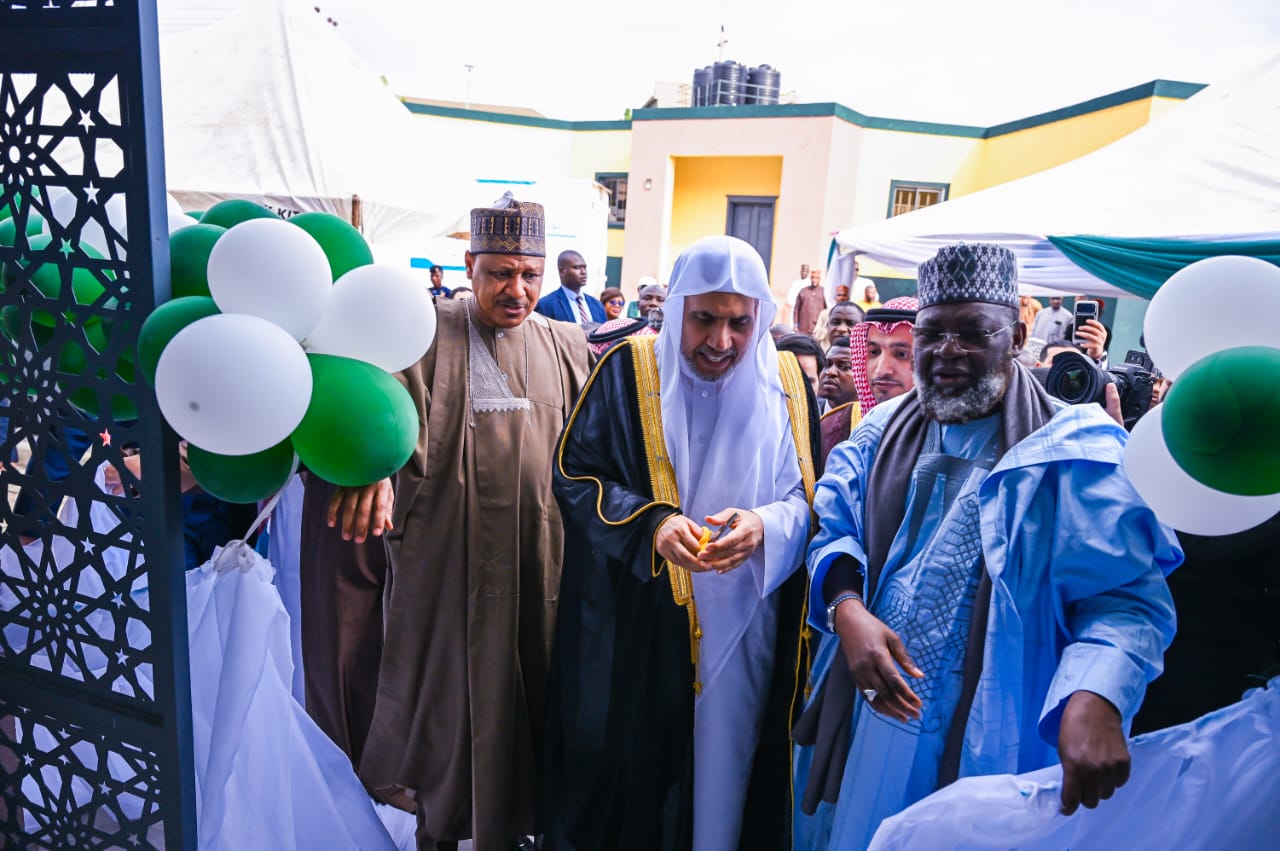
The Muslim World League, in collaboration with the Jama’atu Izalatil Bidiah Wa Iqamatus Sunnah (JIBWIS), will on Tuesday convene an international security conference in Abuja to promote peaceful coexistence, religious harmony, national unity and security.
The conference, scheduled to hold at the Bola Ahmed Tinubu International Conference Centre, will bring together religious leaders, policymakers and other stakeholders to examine the links between peace, security and socio-economic development.
The Minister of Information and National Orientation, Mohammed Idris, announced the conference on Monday during the inauguration of a newly constructed mosque in Abuja by the Secretary General of the Muslim World League and Chairman of the Organization of Islamic Scholars, Sheikh Mohammed bin Abdulkarim Al-Issa.
Idris said the conference was particularly timely as Nigeria strengthens its national security architecture while implementing reforms and investments designed to accelerate socio-economic development.
He reaffirmed President Bola Ahmed Tinubu’s commitment to peaceful coexistence, religious harmony and national unity, describing peace and security as essential to Nigeria’s prosperity and stability.
“The President is determined to ensure peace and tranquillity not just in Nigeria, but around the world. This is a clear demonstration of the path that President Bola Ahmed Tinubu is taking,” Idris said.
According to the minister, Nigeria, as Africa’s most populous country, has a responsibility to promote peace and stability across the continent. He added that a peaceful and secure Nigeria would have a positive impact on West Africa and Africa as a whole.
Idris said the conference would provide an opportunity for religious leaders and other stakeholders to exchange ideas and develop practical approaches to strengthening security, dialogue, peaceful coexistence and mutual understanding among Muslims, Christians and adherents of other faiths.
He commended the Muslim World League, JIBWIS, the Saudi Arabian Government and other stakeholders for facilitating Al-Issa’s visit to Nigeria and the establishment of the mosque.
Al-Issa, in his remarks, praised President Tinubu’s efforts to foster peaceful coexistence between Muslims and non-Muslims, saying peace and harmony in Nigeria would contribute significantly to stability in West Africa and beyond.
The Muslim World League secretary general said his visit was focused on promoting peace and peaceful coexistence, expressing confidence that the international conference would provide a significant platform for advancing dialogue and harmony in Nigeria and globally.
Al-Issa was received at the Nnamdi Azikiwe International Airport by several dignitaries, including Sokoto State Governor Ahmad Aliyu Sokoto; Minister of Health and Social Welfare, Prof. Muhammad Ali Pate; Minister of Labour and Employment, Muhammad Maigari Dingyadi; Senator Aliyu Magatakarda Wamakko; Senator Mohammed Danjuma Goje; and Senator Ahmed Sani Yerima.
The conference is expected to focus on practical measures for strengthening interfaith understanding, national cohesion and security while exploring how peace can support Nigeria’s socio-economic development.

Before sunrise, tens of millions of Nigerians are already making financial decisions that will shape the rest of their day. A trader prepares for the business day, a ride-hailing driver calculates fuel expenses, and a young professional checks his account balance before leaving for work.
Different lives, different ambitions, but one shared goal: building financial security in uncertain times.
That challenge has become more pressing as rising living costs continue to reshape household spending and saving habits. While many Nigerians want to save more, staying consistent remains difficult.It is against this backdrop that OPay has launched the 7 Savings Festival, powered by OWealth, a nationwide savings initiative designed to make disciplined saving simple, rewarding, and accessible.
Running from 10 August to 27 September 2026, the 49-day campaign encourages customers to create a Target Savings plan, save consistently towards their financial goals, and enjoy an interest rate of 27% per annum, along with daily interest and the opportunity to share in a ₦77 million additional interest pool.
More than a campaign, the initiative reflects a growing shift in Nigeria’s digital financial services industry, from helping people make payments to helping them build stronger financial habits.
The Festival allows customers to create a Target Savings plan ranging from ₦77,000 to ₦777,000. Participants who save consistently towards their goals and complete their Target without making an early withdrawal enjoy 27% interest per annum, qualify for daily interest, and become eligible for a share of the ₦77 million additional interest pool.
Beyond the financial rewards, the initiative is designed to encourage a culture of consistent saving. By rewarding discipline rather than one-off deposits, OPay aims to make saving a habit that delivers long-term financial value. The campaign also reflects the growing importance of trust in digital financial services. As more Nigerians embrace digital platforms, customers increasingly want products that not only help them transact but also enable them to save and grow their money with confidence.
Built on OWealth, OPay’s digital savings solution, the Festival gives customers clear visibility into their savings goals, progress, and rewards throughout the campaign, reinforcing transparency and accountability at every stage.
Commenting on the initiative, Elizabeth Wang, Chief Commercial Officer, OPay, said:
“The OPay 7 Savings Festival reflects our commitment to helping Nigerians build stronger financial habits. By saving consistently towards their goals, customers can enjoy rewarding benefits, including an interest rate of 27% per annum, while building financial confidence on a platform they can trust.”
The 7 Savings Festival is part of OPay’s broader commitment to supporting financial well-being by making saving easier, more rewarding, and more accessible. The company believes that stronger saving habits among individuals and small businesses will contribute to more financially resilient households and a stronger economy.
How to Join
Participating in the OPay 7 Savings Festival is simple: Open or log in to the OPay app, Go to the 7 Savings Festival page, Create a Target Savings plan between ₦77,000 and ₦777,000 and Save towards your goals and enjoy 27% interest per annum, daily interest, and a share of the ₦77 million additional interest pool.
The Festival opens on 10 August 2026, while new Target Savings plans can be created until 20 September 2026. Final interest earnings and distributions from the ₦77 million additional interest pool will be made on 27 September 2026.
At its core, the OPay 7 Savings Festival is about more than higher returns. It is about helping Nigerians build stronger financial habits through consistent saving while reinforcing OPay’s commitment to delivering trusted digital financial solutions that help customers not only move money, but also grow it.
About OPay
OPay was established in 2018 as a leading fintech company in Nigeria with the mission to make financial services more inclusive through technology. The company offers a wide range of payment services, including money transfers, bill payments, card services, airtime and data purchases, and merchant payments, among others. Renowned for its fast and reliable network and strong security features that protect customers’ funds, OPay is licensed by the CBN and insured by the NDIC with the same insurance coverage as commercial banks.
By Tony Obiechina, Abuja
The Dangote Petroleum Refinery emerged as the dominant beneficiary of Nigeria’s improved domestic crude supply in the second quarter of 2026, taking 52.
6 million barrels as the Federal Government’s Domestic Crude Supply Obligation (DCSO) recorded a 97. 4 per cent performance.Fresh data from the Nigerian Upstream Petroleum Regulatory Commission (NUPRC) showed that domestic refineries received 53.7 million barrels of crude oil and condensate between April and June, an increase of 25.2 million barrels, or 88.4 per cent, from the 28.
5 million barrels delivered in the first quarter.The sharp rise marks a major improvement in the implementation of the DCSO, with the Dangote refinery accounting for virtually all of the crude volumes offered to local refiners during the quarter.
According to the NUPRC, producers offered 68.1 million barrels of crude to the Dangote refinery against its requirement of 63 million barrels for the three-month period.
The refinery, however, accepted 52.6 million barrels, equivalent to about 77 per cent of the volume offered and 83.5 per cent of its stated requirement.
The 68.1 million barrels offered to Dangote represented 98 per cent of the total crude volumes offered to all domestic refineries during the quarter, underscoring the refinery’s dominant position in Nigeria’s emerging domestic crude market.
Despite receiving more than 63 million barrels in offers, Dangote took 10.4 million barrels less than its quarterly requirement. It also left about 15.5 million barrels of the crude offered to it unaccepted.
The figures highlight the distinction between crude volumes allocated or offered by producers and the quantities ultimately delivered and accepted by refiners under the DCSO framework.
The NUPRC, in a statement issued by its Head of Media and Corporate Communications, Eniola Akinkuotu, said the Q2 figures demonstrated that the domestic crude supply obligation was being actively administered and enforced.
The commission explained that it holds monthly consultations with crude producers and licensed domestic refiners before allocating specific crude volumes to producers for supply to local refineries.
However, the framework operates on a “willing buyer, willing seller” basis under the Petroleum Industry Act, meaning regulatory allocations do not automatically translate into completed transactions.
The improved Q2 performance nevertheless represents a significant turnaround from the first quarter, when domestic refineries received only 28.5 million barrels despite producers offering 68.7 million barrels.
In Q1, the NUPRC had allocated 61.9 million barrels to domestic refineries, but only about 46 per cent of the allocation was eventually delivered.
By Q2, actual deliveries had risen to 53.7 million barrels against an allocation of 55.1 million barrels, translating to 97.4 per cent performance.
While the volume allocated in Q2 was 6.8 million barrels, or 11 per cent, lower than the 61.9 million barrels allocated in Q1, producers offered slightly more crude. Their offers increased from 68.7 million barrels in Q1 to 69.3 million barrels in Q2.
The major improvement therefore came from the conversion of crude offers into actual physical deliveries.
In Q1, only about 41.5 per cent of the 68.7 million barrels offered by producers reached domestic refineries. In Q2, approximately 77.5 per cent of the 69.3 million barrels offered were actually supplied.
The NUPRC linked the improvement to increased crude oil production and the emergence of longer-term supply arrangements backed by bankable sales and purchase agreements between producers and domestic refiners.
The monthly figures showed significant fluctuations.
In April, producers were allocated 18.13 million barrels but offered 19.31 million barrels. Actual deliveries rose to 20.88 million barrels, representing 114.9 per cent performance against the allocation.
May recorded a weaker outcome. Although producers were allocated 18.78 million barrels and offered 23.19 million barrels, only 14.23 million barrels were supplied to local refiners, representing 75.8 per cent compliance.
Performance rebounded in June, when producers were allocated 18.17 million barrels and offered 26.84 million barrels. Domestic refiners eventually took 18.61 million barrels, representing 102.4 per cent performance.
For Dangote, the improved crude supply environment is particularly significant.
The 700,000-barrels-per-day refinery requires substantial and consistent feedstock to operate at high utilisation as Nigeria seeks to expand domestic refining and reduce its dependence on imported petroleum products.
The Q2 figures show that producers were able to offer crude volumes significantly above Dangote’s requirement. However, the difference between the 68.1 million barrels offered and the 52.6 million barrels accepted also shows that supply commitments do not necessarily translate into equivalent refinery intake.
The development comes against the backdrop of challenges that affected domestic crude supply in the first quarter.
The NUPRC had previously attributed much of the Q1 shortfall to pricing differences between crude producers and domestic refiners, stressing that the DCSO operates within the commercial principles of a willing buyer and willing seller.
By Q2, the commission said, the situation had improved as higher crude production and longer-term agreements helped narrow the gap between supply offers and actual deliveries.
“The Commission observed that the improvement in DCSO coincided with an increase in local oil production and the signing of the long-term crude supply agreement supported by a bankable Sales and Purchase agreement between the Producers and Domestic refiners,” the NUPRC said.
The stronger domestic crude supply is crucial to the success of Nigeria’s refining ambitions, particularly with the Dangote refinery positioned as the country’s largest domestic crude consumer.
For the Federal Government, sustained improvement in crude deliveries will be essential if Nigeria is to match its growing refining capacity with adequate local feedstock and reduce its reliance on imported refined petroleum products.
For Dangote, the Q2 data point to a considerably improved crude supply environment, but they also highlight the continuing challenge of converting producer offers into sufficient and consistent refinery intake.
The NUPRC said it would continue enforcing the DCSO while working to sustain growth in crude oil production and support the government’s objective of achieving greater energy sufficiency.The second-quarter figures therefore represent a major improvement for Nigeria’s domestic refining sector, with Dangote taking 52.6 million barrels and accounting for the overwhelming majority of crude offered to local refineries.


Over 270 Army Officers Sit for Senior Staff Course Qualifying Examination in Kaduna
ShareThe Nigerian Army has commenced the 2026 Senior Staff Course Qualifying Examination (SSCQE) for 274 officers at Jaji Military Cantonment,...


NAF Air Strike Kills 9 ISWAP Fighters, Top Commander in Borno
ShareThe Nigerian Air Force (NAF), has killed nine Islamic State West Africa Province (ISWAP) fighters in a precision air strike...


Troops Contain ISWAP Attack, Neutralize Terrorists, Recover Weapons in Borno
ShareBy David Torough, Abuja Troops of the Joint Task Force (North East) Operation HADIN KAI (OPHK) have successfully contained an...


Muslim World League Holds International Security Conference in Abuja as Tinubu Calls for Peace, Unity
ShareBy David Torough, Abuja The Muslim World League, in collaboration with the Jama’atu Izalatil Bidiah Wa Iqamatus Sunnah (JIBWIS), will...


Why OPay is Turning Savings into a National Movement
ShareBefore sunrise, tens of millions of Nigerians are already making financial decisions that will shape the rest of their day....

Dangote Takes 52.6m Barrels as Domestic Crude Supply Surges
ShareBy Tony Obiechina, Abuja The Dangote Petroleum Refinery emerged as the dominant beneficiary of Nigeria’s improved domestic crude supply in...

Osun Guber: ADC, Labour Raise the Alarm, Demand Free, Fair Election
ShareFrom Ayinde Akintade, Osogbo The race for the Osun State governorship has intensified ahead of Saturday’s election, as the African...
Nigeria Livestock Revolution Targets Aftica Leadership, Says Tinubu
ShareBy David Torough, Abuja President Bola Tinubu on Monday unveiled an ambitious economic expansion agenda anchored on transforming Nigeria’s livestock...


Makarfi Marks 70th Birthday Anniversary, Appreciates Massive Solidarity
ShareFormer Governor of Kaduna State, Senator Ahmed Mohammed Makarfi, has said he didn’t bargain for the “deluge” of good will...


NYSC Swears in 1,760 Corps Members in Bayelsa
ShareFrom Mike Tayese, Yenagoa The National Youth Service Corps (NYSC) has sworn in a total of 1,760 Corps members for...