
OPINION
Is Buhari a Failure?


By Niran Adedokun
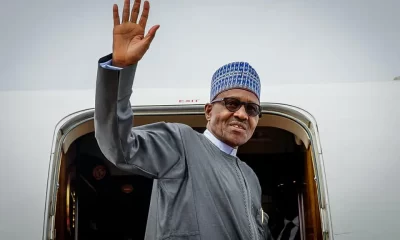
I find it interesting that the President, Major-General Muhammadu Buhari (retd.), says he does not want to leave office as a failure. Two weeks ago, this column raised the question about what legacy the president hopes to leave behind in 2023.
That question arose because, contrary to what many people think, big infrastructural projects would not count whenever Nigerians remember the president’s stewardship. So, with the recent manner of speaking, he seemed now conscious of what history would say about him, as should any man of his age and status.One is, of course, not unmindful that Buhari did not utter these words with his mouth.
The sound bite came from the National Security Adviser, Major General Babagana Monguno (retd.), after he emerged from a five-hour security meeting with the honcho, service chiefs and other members of the country’s security team. Monguno told journalists that Buhari “… also made it very, very clear that he’s not ready to exit government as a failure. He is not going to tolerate that; he’s made changes and is ready to make further changes if he is not satisfied. He is completely determined to ensure that there’s a turnaround in the fortunes in the theatre of operations.”The Yoruba say that words from the mouth of a masquerader can only be the contemplation of the gods. It is, therefore, safe to assume that Monguno conveyed the president’s true sentiment. It could also suggest that the man is honest with himself. The security of lives and property in Nigeria has become such a cofounding embarrassment that any must be thoroughly worried.
Some Nigerians, however, hold the opinion that the horse has already bolted from the stable. They reckon that having not achieved significant milestones in 75 months, the remaining 21 months of the regime would be too few for any meaningful reversal of what many consider to be the floundering of the Buhari tenure.
I find that position preemptively pessimistic. The president’s recent assent of the Petroleum Industry Act (warts and all), the prompt appointment of an implementation committee and the positive signals it sent to industry players are tell-tale signs that buying people’s trust isn’t necessarily rocket science.
A lot of time, seemingly simple but honest steps taken by leaders are all the people need to restore trust and support for the government of the day. So, when a government expresses its commitment to positive change and leaving the country better than it currently is, I would instead query its understanding of that promise and what it must do to achieve it, rather than how much time it has left. In managing people, little actions or words that cost leaders next to nothing can foster peace or war.
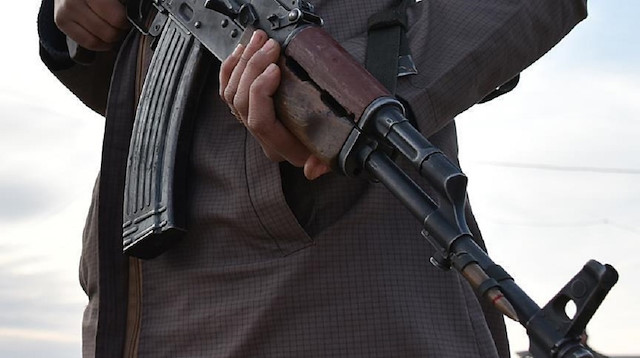
For example, President Buhari reportedly made this remark about the security situation in the country. He received briefings on troops’ exploits in the war against insurgency, which has led to the repentance of hundreds of terrorists. But Tuesday’s unprecedented event where the country’s apex military training institution, Nigerian Defence Academy, Kaduna, suffered a terrorist attack (even though the media still referred to the perpetrators as bandits) raises questions about the president’s grasp of the country’s troubles.
Governor Aminu Masari of Katsina State had days earlier asked his people to defend themselves against bandits! Between Friday when he vowed not to leave office a failure and Tuesday, “bandits” killed eight and abducted 25 people in Zamfara state; they killed 10 people in Kaduna State; and 14 in Buhari’s native Katsina state. The terrorists shot two officers dead and kidnapped a Major in operation, which sent shock waves down the polity. The city of Jos in Plateau state has also been on fire lately.
It has been two whole months now that the president promised to speak to separatist agitators and those who incite trouble in Nigeria in the “language they understand”. Yet, there has been no remarkable improvement in the situation.
At such junctures, one would imagine a reconsideration of strategy! If you can’t move forward in a journey, it makes sense to consider a retreat, so you can live to fight another day. The Jewish scientist, Albert Einstein, once pointed out the awkwardness of doing the same thing repeatedly and expecting a different result. And a president who wants to succeed in his remaining few days in office must take advice from this and become more hands-on.
As well-trained and effective as the Nigerian security agencies might be, it is evident that the level of conflict in the country is becoming overwhelming. Can we even tell that there are no elements in these agencies sympathetic to the cause of insurgents, terrorists, bandits, and others taking arms against the country? Therefore, it is unlikely that the military and other security agencies will ever comprehensively contain the security challenges that the country currently faces on the battlefield.
This suggests that it is time to employ the brain alongside the brawn in these security matters. Whether they call it carrot and stick or kinetic and non-kinetic, this regime needs to, at this stage, yank off its messianic mentality, bury its pride, seek help, and try all possible peaceful means of de-escalating tensions in Nigeria. The security of lives and property is the primary responsibility of the government, and citizens do not need to know how the government achieves this. People just want to sleep with their two eyes closed, and it is the least a government can do for its people. There are conflicts in this country that do not need the deployment of troops, a situation that honest conversations would put to final rest. These are the kind of opportunities that President Buhari should begin to pursue in this twilight personally.
Take the president’s grazing routes pet project as an instance. He recently set up a committee to review “with dispatch” 368 grazing sites that a previous committee identified. This action is despite the apparent stand of many state governors against grazing sites and the clear anachronism of the idea. Even if this concept is the only thing that can save Nigeria from the frequent clashes between farmers and herders, it would be more effective to call a meeting of all governors. At this meeting, Buhari must restrain himself from playing a know-it-all emperor but rub minds with them on dealing with the nagging challenge.
The realization of the import of collegial processes in tackling knotty national issues would determine whether Buhari’s wish to leave a legacy of success is a mere dream or vision, which he is determined to see through. It is unlikely that you would ever find anyone who does not wish to leave their world better than they met it; however, achieving the same requires willpower and the competence for execution. Otherwise, wishes would be like the proverbial horses, which beggars ride with abandon.
It is curious, for example, that President Buhari is comfortable with the ongoing industrial action by members of the National Association of Resident Doctors, which his ministers of health and employment are unable to resolve. That is when Nigeria is under the threat of the third wave of the COVID-19 pandemic alongside disgraceful afflictions like cholera, malaria and what have you.
According to a report in the media earlier this week, hospitals in Saudi Arabia recently had a recruitment exercise for specialist doctors in Nigeria. That exercise indicates that the reported 1:5,000 doctor to patient ratio in Nigeria is about to worsen. Yet, the president has not seen the need to galvanize action towards retaining doctors who are leaving the country in droves. He has not led any national initiative, which encourages governors to improve primary health care delivery standards and facilitate more accessible health care delivery through community health insurance.
The president wants to succeed, yet, he has not done much for education. Despite the increase in the numbers of higher institutions, more than one and a half million qualified candidates do not get admitted annually. Yet, there are no plans for that gap year, no vocational training to get their hands busy or empower them with sustainable skills.
Out-of-school children figure increases by the day. Those who go to school are abducted daily and left in the hands of bandits for months on end. Yet, these are the ones who should hold the future of the country. Nigeria just seems to have lost her soul as far as the welfare of its children is concerned.
The main gist here is that President Buhari can still do a few things to make Nigeria better and fulfill his dream for success. If he gets it right on the security front, but most of Nigeria’s children and youths are ill-equipped to face the future, and a significant number of Nigerians continue to grapple with a wobbly health system, this regime will still have failed Nigerians, who reposed so much confidence in it. There is still ample time to change this narrative if the will and knowledge are available.


By Uddin Ifeanyi
I am not an accountant, so my opinion on the NNPCL’s recently released 2025 annual financial report is a qualified one. It matters, therefore, that PwC, the audit and assurance firm which signed off on the report, has no doubt that it represents a true and fair view of the corporation’s performance under the country’s reporting standards.
Far more comforting was my former colleague’s response to the report’s release: “Wonderful! While I was working in the bank, as the Corporate Banking Group’s relationship manager for the NNPC, the ‘most recent’ financials we had was about 15 years old”.
That was some 15 years ago. In terms of accountability and public disclosure, then, Nigeria’s most important corporation over the last 49 years is making steady progress.That said, significant parts of the picture of a profitable company undergirded by improving production, which the report tries so convincingly to take, are out of focus. It is a fair argument that the report’s headline profit growth figure appears to overstate the improvement in the corporation’s underlying trading performance. Why this blur? The NNPC Group’s net profit rose by about 33 per cent to ₦7.2 trillion last year, despite a 23 per cent drop in revenue from ₦45.1 trillion in 2024, to ₦34.5 trillion last year.
Gross profit was down by equivalent percentage points to ₦9.4 trillion in the same period. While two different lines, a ₦5 trillion rise in other income, and a ₦1 trillion fall in general and administrative expenses, explain this seeming contradiction, the resulting problem is not that the increase in the corporation’s profit last year did not come from increased sales or gross profits. It is instead included in the answer to the question, “How repeatable will the ‘other income’ performance be in future accounting periods?”
The corporation’s balance sheet is a smorgasbord of paints off a similarly nuanced canvas. With a current ratio of about 0.85, the NNPCL’s short-term assets (₦28.1 trillion) do not quite make up for its short-term liabilities (₦33.2 trillion). With the right timing, depending on the nature of its account payables, and the makeup of its receivables, the corporation ought to be able to easily meet its obligations. This balance sheet structure has one other purpose: it helps make sense of the corporation’s cash pressure.
The group’s cash balance was down from ₦10.3 trillion in 2024 to ₦6.4 trillion by financial year end 2025. This, despite an increase in cash generated from operations to ₦12.9 trillion in 2025 from ₦11.0 trillion the previous year. Trade and other receivables fell from the ₦31.4 trillion at which it printed in 2024, but even at ₦19.7 trillion, last year, it remained substantial.
On the upside, there is plentiful evidence of a production recovery. Still the chorus of “Hallelujahs” are pressed in on two sides by the narrative section of the report’s claim of average crude and condensate production of 1.77 million barrels per day – a five-year high, and the financial highlights’ listing of 565.8 million barrels of crude oil production. On the face of it, annualised, the latter number translates into about 1.55 million barrels per day of production.
My guess is that these two figures address different scopes — i.e. national production as against the NNPCL’s own or equity production. Any which way, the report could have helped make this reconciliation easier. Equal levels of clarity could have been facilitated by tying natural gas production directly to segment revenue, investment returns, and cash generation.
Overall, the NNPCL report indicates considerable operating progress. Operating cash generation is especially impressive. Nonetheless, the dip in revenue and gross profit, the facts that profit growth is almost entirely the result of large other income performance, and that current liabilities swamp current assets, make the headline profit an incomplete gauge of the organisation’s financial strength.
For more than a decade now, the dominant presence in the room when the NNPC’s accounts are discussed is the extent of outgoings on the subsidy for the pump-gate price of petrol. And this is the main reason I paid this much attention to the corporation’s annual report for last year – to see how far the corporation’s numbers corroborate the federal government’s insistence that it has removed the subsidy completely.
How do the numbers stack up? The corporation’s financial statements continue to use categories such as “energy security” and “under-recovery.” These are not exactly identical terms. Energy security expenses may include more than petrol price support.
Interestingly, the NNPCL’s financial statement for 2024 reports ₦8.67 trillion as an “under-recovery” balance. Other coverage in the 2025 statement describes ₦8.67 trillion as a “federation receivable.” Both labels and reporting periods are not interchangeable, but if either means that the corporation continues to cover a gap between petrol’s supply cost and a managed selling price, and records the amount as recoverable from the federation, the economic burden from the fuel subsidy has not disappeared. It has simply been absorbed by the NNPCL or the federation, rather than fully passed on to consumers.
Uddin Ifeanyi, a journalist manqué and retired civil servant, can be reached @IfeanyiUddin.

By Mark Longyen
West Africa’s climate crisis is becoming harder to separate from the region’s familiar struggles with poverty, displacement, food insecurity, resource competition and violent conflict.
That convergence framed the ECOWAS Parliament’s Second 2026 Extraordinary Session and Second Parliamentary Seminar in Accra, Ghana.
It was themed “Climate Change as a Driver of Environmental Degradation, Population Displacement and Growing Insecurity in the ECOWAS Region.
”Beyond the speeches and warnings, the week-long meeting posed a harder question: can ECOWAS convert long standing climate commitments into funded, coordinated and measurable action?
The Parliament’s adopted resolutions offered one answer, urging ECOWAS leaders to consider establishing a regional fund dedicated to climate resilience and human security.
The lawmakers also called for climate resilience to be integrated into national budgets, development plans, land-use policies, conflict-prevention mechanisms and disaster-risk reduction strategies.
They further called for the ECOWAS Commission to develop a five-year implementation roadmap for translating the recommendations into practical measures.
These proposals attempt to move the regional climate conversation from declarations towards institutional mechanisms capable of producing measurable results.
Yet, the Parliament’s own assessment exposed the obstacles.
Speaker Hadja Mémounatou Ibrahima was blunt in her closing address.
“Our region doesn’t lack strategies nor instruments.
“What West Africa lacks are the financing and political will required to implement existing frameworks and transform them into visible and tangible assets for citizens,” she said.
That diagnosis goes to the heart of the region’s climate dilemma, where policies exist, but implementation frequently falls behind ambition.
Earlier, in her opening address, Ibrahima urged lawmakers to view climate disruption through its consequences for ordinary people rather than through statistics alone.
“Climate disruption can no longer be measured only in degrees, statistics or projections,” she said, citing declining land productivity, retreating coastlines, flooded neighbourhoods and displaced families.
For her, the fundamental question was how governments could protect citizens when environmental change was occurring faster than their capacity to adapt.
Ghana’s Vice-President, Prof. Jane Opoku-Agyemang, reinforced that perspective, saying climate change and environmental degradation were compounding pressures on livelihoods and food security.
“Climate change is both a development and a security challenge,” she said, urging ECOWAS states to move from reactive crisis management towards proactive resilience-building.
Her prescription included stronger early-warning systems, resilient agriculture, water management, coastal protection and clean-energy investment.
She also linked climate resilience to youth opportunities, arguing that education, skills and economic empowerment could help prevent environmental pressures from becoming drivers of insecurity.
The financial dimension emerged starkly in a presentation by Dr Derek Sarfo-Yiadom of Ghana’s Environmental Protection Authority.
He disclosed that Ghana would require an estimated 22.6 billion dollars by 2030 to implement its climate actions and strengthen resilience.
“When we put our climate reports together, we found out that we needed 22.6 billion dollars to accomplish our climate actions by the year 2030,” he said.
Sarfo-Yiadom argued that vulnerability assessments must identify not merely climate hazards, but the people exposed, barriers to recovery, responsible institutions, available budgets and measurable outcomes.
He called for stronger early-warning systems, improved drainage, resilient infrastructure and measures supporting rural livelihoods through climate services, crop diversity and better soil-water management.
At the regional level, ECOWAS climate expert Raoul Kouamé highlighted the challenge of translating commitments into implementation, especially where institutional capacities and financing remain uneven.
His argument reinforced a central lesson from the Accra conference; climate governance cannot succeed through isolated national interventions when rivers, ecosystems, migration routes and environmental risks cross borders.
Guinean parliamentarian Bademba Baldé said lawmakers identified effective implementation, financing and national ownership among the principal obstacles confronting regional climate action.
The Parliament consequently connected climate vulnerability with displacement, competition over land and water, pastoral mobility and resource-related conflicts.
That connection is especially important for West Africa, where environmental stress can amplify existing economic, social and security vulnerabilities.
The recommendations therefore went beyond environmental protection, seeking to embed climate resilience within development planning, conflict prevention and disaster-risk management.
For Nigeria and other vulnerable member states, the implications are substantial, given recurring floods, droughts, land degradation, food insecurity and competition over natural resources.
The Accra resolutions also raise an institutional question; how effectively can the ECOWAS Parliament drive implementation when its role remains principally consultative?
Nigerian lawmakers, including Sen. Ali Ndume and Awaji Abiante, argued that strengthening the Parliament’s legislative powers would enhance its ability to scrutinise regional and national responses.
That debate gives the climate question a governance dimension: ambitious recommendations require institutions with sufficient authority to monitor compliance, demand accountability and sustain political attention.
The Parliament itself recognised this when it stressed that its credibility would depend on decisions producing concrete and measurable improvements in citizens’ lives.
Its closing position was both ambitious and cautionary, noting that resolutions must not become another archive of unimplemented regional commitments.
The adoption of the seminar’s outcome document gave the climate agenda an institutional pathway.
The proposed regional resilience fund offers a potential financing mechanism, and the five-year roadmap, if effectively developed and monitored, could provide the continuity often missing from regional climate initiatives.
Stakeholders insist, however, that money alone will not resolve the crisis.
They say political ownership, institutional coordination, national legislation, community participation and credible monitoring will be equally decisive in translating commitments into action.
The Accra deliberations therefore shifted the focus from whether West Africa understands its climate crisis to whether governments and regional institutions are prepared to govern against it.
The real test now lies in whether governments, ECOWAS institutions and national parliaments will finance, implement and monitor the commitments reached.
For West Africa, the climate crisis is no longer waiting for another declaration. It is demanding decisions, resources and action.
Accra has provided the diagnosis and a framework.
The credibility of the ECOWAS Parliament’s climate push will ultimately be measured by what follows after the conference. (NAN)

By Mukhtar Dambatta
In Nigeria, an accusation of theft can turn a calm crowd into a dangerous mob within minutes.
Someone shouts, “Ole!” “Barawo!” “Onyeoshi!” or “Thief!” and people begin to gather.
Before anyone asks what happened or whether the allegation is true, sticks, stones, and other objects may become weapons.By the time the police arrive, the accused person may already be badly injured or dead.
Jungle justice, or mob violence, is an illegal act where a crowd bypasses the legal system to punish a suspect without a fair trial or formal proof of guilt
The practice has continued in spite of the existence of courts, police and other institutions established to investigate crimes and administer justice.
One of the cases that brought the issue sharply into national focus was the killing of the “Aluu Four”.
In October 2012, four students of the University of Port Harcourt, Chiadika Biringa, Ugonna Obuzor, Lloyd Toku and Tekena Elkanah were attacked and killed in Aluu community, Rivers, after they were accused of stealing.
They were beaten and set ablaze by a mob. Images of the incident circulated widely, prompting public outrage and renewed calls for an end to mob justice.
But similar incidents have continued.
In March 2025, 16 travellers were killed by a mob in Uromi, Edo, after being accused of being kidnappers.
Reports identified the victims as hunters travelling from the South to the North.
President Bola Tinubu condemned the killings and directed security agencies to investigate the incident and prosecute those responsible.
The Uromi killings again raised concerns about what can happen when suspicion and fear replace investigation.
On July 26, 25-year-old Ibrahim Mbaya, popularly known as “Ibee”, was allegedly attacked by a mob in Jos, Plateau, after being accused of stealing an iPhone 12.
He was later taken to the Jos University Teaching Hospital, where he was confirmed dead.
The Police Command in Plateau announced the arrest of suspects in connection with the incident.
Recently, the Inspector-General of Police (I-G), Mr Olatunji Disu, gave a directive that jungle justice would be treated as homicide.
A security advocacy group, the Security Situation Room (SSR) backed the group described mob action as an invitation to anarchy.
The President of SSR, Mr Douglas Ogbankwa, said perpetrators of extra-judicial killings must be held accountable for their actions.
He said that the directive was timely, considering the spate of mob attacks and extra-judicial killings in the country.
“Of course, this directive is timely. Allowing people to resort to strong-arm tactics in solving criminal activities is an invitation to anarchy.
“It is like taking the country to the Hobbesian state of nature, where life was nasty, brutish and short.”
Ogbankwa said the existence of government could be traced to the social contract theory, under which citizens surrendered certain liberties to enable constituted authorities to govern and protect them.
He said allowing individuals to take the law into their hands would undermine the purpose of government and the rule of law.
“The reason we have a government is traceable to the social contract theory, where the people agree to have people who will govern, protect them and take care of their welfare.
“So, if individuals are allowed to have the liberty of taking the law into their hands, then that is simply taking us to the Stone Age without laws,” he said.
The convener noted that every society was governed by laws, adding that the 1999 Constitution of the Federal Republic of Nigeria (as amended) provided lawful avenues for resolving grievances.
He said the Police Act 2020 empowered the police to detect and investigate crimes and arrest those suspected of committing offences within their jurisdiction.
Ogbankwa consequently called for strict adherence to the I-G’s directive, adding that individuals must learn to be personally accountable for their actions or inactions.
On a similar note, a security analyst, Ahmed Umar, said the response to suspected crime should begin with reporting and investigation rather than punishment by a crowd.
“Allowing people to take the law into their own hands could result in the killing of innocent people who might later be found not to have committed any offence,’’ he said.
More so, a legal practitioner, Yusuf Aliyu Yusuf, said an accusation was not the same as proof of guilt.He said the responsibility of determining whether a person had committed a crime belonged to the appropriate institutions established by law.
In his submission, Barau Kawu, a community leader, said communities also had a role to play in preventing mob attacks by discouraging rumours and immediately reporting suspected criminal activities to security agencies.
“Community members should avoid taking action based solely on allegations or information received from others,’’ he said.
Getting an accurate national figure for deaths resulting from jungle justice is difficult.
Human rights organisations and other researchers have documented hundreds of cases over the years, but the actual number is difficult to establish.
Many incidents, particularly in communities far from major towns, may never reach the police, courts or mainstream media.
Analysts say a major factor behind the practice is public distrust of law enforcement institutions.
Where citizens believe that suspects may escape justice or that criminal cases will not be handled effectively, some may become tempted to punish accused persons themselves.
The country’s worsening insecurity has also made people more suspicious of strangers and unfamiliar situations.
Kidnapping, banditry and other violent crimes have affected communities across the country. In such an environment, suspicion can spread quickly.
Section 33 of the 1999 Constitution protects the right to life, subject to the exceptions stated in the Constitution.
The law provides for allegations to be investigated and suspects to be tried in court.
That process cannot be replaced by a crowd.
The danger is that the person being attacked may not even be responsible for the alleged offence.
“A stolen phone may have been misplaced; a misunderstanding may have been mistaken for criminal behaviour; a person may have been wrongly identified.
“Once a mob attack begins, however, there is often little opportunity for the truth to emerge; ending jungle justice will require more than condemning each incident after it happens.
“It will require proper investigations, prosecution of those responsible and greater confidences in the justice system.
“Citizens also need to understand that reporting a suspected crime is different from punishing a suspect.
“The police and courts have the responsibility to investigate allegations and determine guilt according to the law,’’ a social commentator said.
For communities, the challenge is to resist acting on rumours and accusations before the facts are known.
Experts agree that criminal accusations must be legally investigated and tried in court. When justice is taken into the streets, a mere accusation can instantly become an irreversible death sentence.(NAN)




Portuguese Football Federation Backs Ronaldo to Continue with Portugal
ShareThe Portuguese Football Federation has reaffirmed its support for Cristiano Ronaldo’s continued involvement with the national team, with president Pedro...

A Nation Divided as Ronaldo Left with Big Decision on Portugal Future
ShareAs Lionel Messi prepares to get a hero’s farewell for his successful international career, Cristiano Ronaldo’s could have ended with...


FG Establishes 10 Radio Diagnostic Centres to Boost Healthcare Service Delivery
ShareThe Federal Government said it has established 10 radio diagnostic centres to enhance diagnosis and treatment of diseases in the...
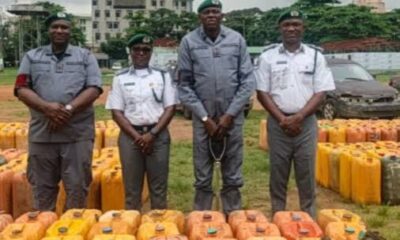

Customs Auctions 22,175 Litres of Seized Petrol for N32.1m
ShareBy Tambaya Julius, Abuja The Nigeria Customs Service (NCS) has auctioned 22,175 litres of Premium Motor Spirit (PMS) seized by...

NNPCL: Accounting for Fuel Subsidy
ShareBy Uddin Ifeanyi I am not an accountant, so my opinion on the NNPCL’s recently released 2025 annual financial report...

Can ECOWAS Parliament Turn Climate Commitments into Regional Action?
ShareBy Mark Longyen West Africa’s climate crisis is becoming harder to separate from the region’s familiar struggles with poverty, displacement,...

2027 Elections: INEC Voter Register Hits 103m
ShareBy Tambaya Julius, Abuja The Independent National Electoral Commission (INEC) said Nigeria’s voter register has risen to more than 103...
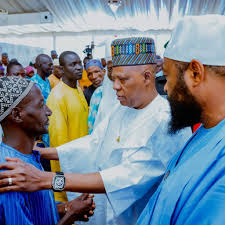

Niger 37: FG Pledges Accountability Over Deaths of Miners in NSCDC Custody
ShareBy Tambaya Julius, Abuja The Federal Government has assured families of the 37 suspected miners who died in the custody...


11-year-old Girl Found Dead in Suleja Well, Church Guard Arrested
ShareFrom Dan Amasingha, Minna The disappearance of 11-year-old Christabel Albert after she left home for a birthday celebration has ended...
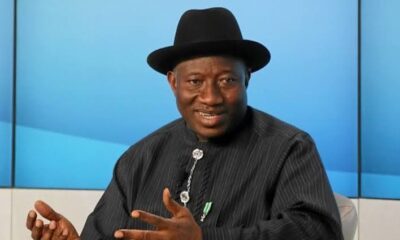

Jonathan Receives Bayelsa East APC Candidates
ShareFrom Mike Tayese, Yenagoa Former President of Nigeria, His Excellency, Dr. Goodluck Ebele Jonathan, has commended the quality, experience and...