
NEWS
Bayelsa Deputy Governor Appeals To IPOB, Others Over Sit-At-Home

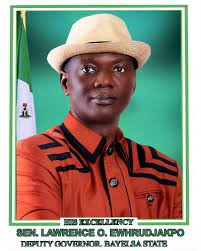
From Mike Tayese, Yenagoa
Bayelsa State Deputy Governor, Senator Lawrence Ewhrudjakpo, has called on the Indigenous People of Biafra(IPOB)and other separatist groups in the South East to reconsider their stand in the interest of peace and economic wellbeing of the region.
He also urged the church, particularly clergymen to be more sincere and fervent in seeking the face of God concerning the security, economic and political woes currently bedeviling the country.
Ewhrudjakpo made the call on Monday, while granting audience to a delegation from the Trinity Theological College, Umuahia, Abia State, in Government House, Yenagoa.
The Deputy Governor, in a statement by his Senior Special Assistant on Media, Doubara Atasi, pointed out that the Sit-At-Home order and other measures being employed by the various non-state actors had caused collosal damage to the South East economy and the country in general.
Expressing displeasure over the pains the situation is inflicting on ordinary citizens, especially in the South East, Senator Ewhrudjakpo appealed to all good spirited leaders across the country and beyond to come together and proffer solution to the crisis.
According to the Bayelsa Number Two Man, God still answers prayers and uses people in addressing problems that ordinarily seem beyond human comprehension and solution.
He, therefore, stressed the need for the church to always stand in the gap in prayers for the world and its leaders, particularly in troubled regions where war, turmoil and terrorism are holding sway.
His words “We need to talk about our society, because in Nigeria people pretend and when you pretend over your problem, it becomes hydra-headed. If you don’t solve that problem, it becomes two and multiplies from there.
“Unfortunately what is happening in the South East, we think it is only affecting the people of that region. No, it is gradually affecting the whole country indirectly.
“When you shutdown three states economy every Monday consecutively, you are not helping the society. So, those behind it should reconsider their position. What do you actually gain by inflicting pains on your own people?
“So, we really want to task you because there is nothing that is impossible with God. Anything God cannot do is not on earth. That is why the things God has done in the past and things that He is yet to do, are very many.
“I really want us to pray because I believe that prayers have helped countries and if there are people ready to pray, there is a God who is always ready to answer. But we must pray fervently and sincerely”
While thanking the delegation, which mainly consisted of students of the College for the visit, Senator Ewhrudjakpo, enjoined them to take their training seriously, stressing that a lot of spiritual and intellectual discipline is always required for one to become a thorough-bred orthodox priest.
He reiterated his appeal to gospel preachers not to emphasize prosperity at the detriment of salvation of man in their messages, adding that the pulpit should be used to promote morality in the best interest of God and society.
Speaking earlier, the Permanent Secretary of the Trinity Theological College, Umuahia, Rev. Chukwuka Ekejiuba, said the college was established in 1974 solely for the training of Anglican priests but it is now open to other denominations for learning purposes.
He expressed gratitude to the Bayelsa Deputy Governor for his open door policy and kind disposition towards them, and equally solicited the state government’s support to enable the College rehabilitate its dilapidated infrastructure as well as equip the information technology unit.



The Lagos State Traffic Management Authority (LASTMA) said a fatal road traffic collision on Ikorodu Road has claimed the lives of an eight-month-old baby and a female passenger.
The General Manager of LASTMA, Olalekan Bakare-Oki, said this in a statement on Sunday in Lagos.
Bakare-Oki noted that the collision occurred opposite Olabode House, between Anthony and Obanikoro.
“Preliminary findings indicate that a red Tata commercial bus, speeding from Palmgrove toward Anthony, suddenly lost mechanical and directional control.
“In a catastrophic sequence of events, the bus veered off its lane, broke through the median barrier, and collided with an oncoming Volkswagen commercial bus carrying passengers from Anthony to Palmgrove.
“The sheer violence of the impact resulted in the instantaneous death of an adult female passenger aboard the Volkswagen bus, while an eight-month-old female infant tragically succumbed to injuries sustained in the collision,” he said.
He added that LASTMA operatives, supported by well-meaning members of the public, immediately activated a coordinated rescue and recovery operation.
The LASTMA boss disclosed that a total of 10 victims, including the drivers of both vehicles, were successfully extricated from the mangled wreckage, all sustaining varying degrees of serious injuries.
“Six trapped passengers were rescued from the Volkswagen commercial bus, while four others were evacuated from the red Tata bus,” he said.
He stated that the Lagos State Ambulance Service (LASAMBUS) promptly transported the injured victims to nearby medical facilities for immediate attention, while officials of the State Environmental Health Monitoring Unit (SEHMU) evacuated the remains of the deceased infant and adult female.
He also noted that security operatives from the Ilupeju Police Division provided crucial security coverage throughout the rescue and recovery operation.
Bakare-Oki conveyed his condolences to the bereaved families, saying he was particularly concerned for the distraught mother of the deceased infant, who had sustained severe injuries and was receiving medical treatment.
He seized the occasion to warn all motorists, especially commercial drivers, to exercise utmost restraint, maintain heightened vigilance, and comply strictly with stipulated speed limits.
A mortuary attendant in the Upper Sakponba area of Ikpoba-Okha Local Government Area of Edo has landed in police net after allegations of missing vital organs from a corpse kept at Akugbe Mortuary.
This incident triggered a violent reaction from relatives of the deceased.
The situation reportedly escalated when angry family members and friends accused a mortuary attendant of harvesting organs from the body.
Relatives of the deceased were said to have raised alarm when they arrived at the mortuary on Friday to collect the body for burial and allegedly discovered that some vital organs were missing.
An eyewitness, Osaro Ivie, described the scene as chaotic, saying tempers flared after family members accused the attendant of engaging in ritual practices.
“The relatives claimed that the chest cavity of the deceased had been emptied and stuffed with nylon,” Ivie said.
He said the relatives threatened to lynch the attendant and set the facility ablaze before police operatives intervened to restore calm.
Confirming the incident on Sunday, ASP Eno Ikoedem, Public Relations Officer of the police command in Edo, said the command received a distress call that a mob was on the verge of attacking a suspect at the mortuary.
“The Command received a distress call that someone at Akugbe Mortuary was about to be lynched, and the Divisional Police Officer, Ugbekun Division, was immediately mobilised to rescue a mortuary attendant alleged to have harvested organs of a corpse,” Ikoedem said.
Ikoedem explained that the suspect was rescued from the crowd and subsequently to custody.
She added that he was currently being detained at the State Criminal Investigation Department (SCID), where investigations were ongoing to determine the circumstances surrounding the allegation.
Ikoedem assured the public that a thorough investigation would be conducted, urging residents to remain calm and allow due process to take its course.
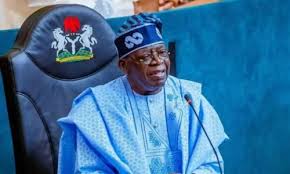
President Bola Tinubu on Sunday urged West African leaders to close ranks against fresh shocks to democracy, citing the recent coup attempt in the Benin Republic and renewed instability in Guinea-Bissau.
Tinubu, represented by Vice President Kashim Shettima, spoke when he gave the opening address at the 68th Ordinary Session of the ECOWAS Heads of State and Government at the State House, Abuja, on Sunday.
“The external threats confronting West Africa today demand nothing less than a united front, terrorism, violent extremism, unconstitutional changes of government, transnational organised crime, arms for liberation, cyber insecurity, climate shocks, food insecurity and irregular migration,” said Tinubu.
He framed the moment as an existential test for the bloc, warning that West Africa “is most vulnerable, not when challenged from outside, but when weakened from within.”
“We do not share geography by accident. We share it by design, by history and by the enduring logic of kinship. West Africa is not a random assemblage of borders grown by chance. It is a family bound by memory, culture, struggle and aspiration,” Tinubu affirmed.
He argued that Nigeria’s position is that persuasion and solidarity, not force, must steer ECOWAS through its current storms.
Reflecting on the governance crisis in the region, Tinubu said, “We have, in recent times, allowed our differences to shake the very foundations of our union.
“We remain persuaded that fraternity, not force, must define the future of our community. Yet history reminds us that ECOWAS can only fulfil its purpose or aspiration when every member state upholds the values of purity, justice and equality within its domestic affairs.
“A community is only as strong as its trust its members repose in one another. Our shared challenge is to ensure that internal divisions do not erode the collective sense we have built over decades.”
Linking the Benin and Guinea-Bissau scares to wider regional threats, he pressed for a single voice on security, governance and economics.
Tinubu said, “No single member state, regardless of size or theme, can achieve enduring stability in isolation. Our security, prosperity and resilience are better built together. We must sit at the same table, speak with one voice and act with shared results.”
Sunday’s meeting convenes after five turbulent years for West Africa, which saw coups in Mali (2020, 2021), Burkina Faso (twice in 2022), and Niger (2023).
The developments also fractured the regional order, with the juntas in Niger, Mali, and Burkina Faso announcing withdrawal from ECOWAS in early 2024.
The latest flashpoints include an attempted coup in Benin on December 7, 2025, and renewed instability in Guinea-Bissau, which former President Goodluck Jonathan described as a “ceremonial coup.”
Following the December 7 putsch attempt, Tinubu, responding to requests from the Béninoise government, ordered the deployment of jets and troops to quell the attacks.
On December 9, the Senate approved Tinubu’s request to send Nigerian troops to the Republic of Benin to help restore calm and stability.
Benin’s foreign ministry said about 200 West African soldiers, mainly from Nigeria and the Ivory Coast, are in the country to support the government.
Recognising the quick response of member states to the Benin incident, ECOWAS Chair, President Julius Bio of Sierra Leone, condemned the resurgence of unconstitutional power grabs in West Africa and warned that instability in one state endangers all.
“The instability in Guinea-Bissau and the attempted coup d’état in Benin remind us that democracy requires constant vigilance and principled action. On behalf of this Authority, I strongly condemn the unconstitutional change of government in Guinea-Bissau and the attempt to subvert the constitutional order in Benin.
“I commend the rapid mobilisation of ECOWAS troops and air assets, with Nigeria taking the lead to safeguard constitutional order in Benin”, he told leaders.
Bio said the collective response “reaffirms an essential principle: ECOWAS does not and will not compromise on democratic governance,” pledging solidarity with the peoples of Guinea-Bissau and Benin.
He framed the meeting as a hinge moment for the 50-year-old bloc as it confronts terrorism, violent extremism and organised crime spreading across borders.
“West Africa faces some of the most complex and evolving threats in its history. Our response must therefore be united and uncompromising. Security is not only a military obligation; it is a human imperative”, he said.
Bio also outlined steps to operationalise an ECOWAS Standby Force for counter-terrorism, backed by a sustainable financing plan.
“We must strengthen collective action, integrated intelligence systems, coordinated border operations and the operationalisation of ECOWAS Standby Force for counter-terrorism. Our ministers of finance and defence are advancing modalities for sustainable financing and preparing to raise a 1,650-personnel counter-terrorism brigade by the end of 2026,” he said.
Beyond security, the Sierra Leonean leader pressed for deeper economic integration to shore up public confidence in democracy, from harmonised trade rules and an ECOWAS single market aligned with AfCFTA to reviving the single currency target.
“The work of the ECOWAS Convergence Council has already brought renewed momentum to a single currency target by 2027,” he noted, calling a common currency a transformative tool to expand trade and competitiveness.
Bio also announced a travel-cost relief to make integration tangible for citizens.
He said, “Beginning January 1, 2026, our community will implement a landmark measure to reduce the cost of air travel across West Africa. Under this agreement, member states will abolish air transport taxes and reduce passenger and security charges by 25 per cent. By lowering these barriers, ECOWAS is demonstrating leadership that is practical, people-centred and responsive to the realities of everyday life.”
Meanwhile, President of the ECOWAS Commission, Dr Omar Touray, praised the bloc’s deployment of “moral and military might” to foil the December 7 attempt to upend civilian rule in Benin Republic.
“The Chair of Authority, President Julius Maada Bio, in coordination with his peers, President Bola Tinubu, President John Mahama and President Alassane Ouattara, as the Commanders-in-Chief of their Armed Forces, led their Republican Armed Forces to join the Republican Armed Forces of Benin to thwart the attempted coup.
“May I invite Your Excellencies to recognise this feat with your applause,” said Touray.
He revealed that the Authority would also issue decisions beyond routine budget and programme matters as it confronts shifting geopolitics and security headwinds that threaten the bloc’s Vision 2050 targets.
He explained, “Besides the usual institutional memorandum relating to the community work programme, budget and performance. The Authority will also be making pronouncements on the different issues affecting our community as part of the ongoing consultations on the future of our community. The attainment of our Vision 2050 is today impacted by changes in the global landscape and dynamics within the sub-region.”
Touray argued that the challenge to multilateralism, the rise of multipolarity and the pressure on African countries to make choices about partnerships, new technologies and the entrenchment of terrorism and violent extremism in the Sahel, among others, have profound effects on ECOWAS’ ability to attain the 2050 Vision objectives.
“Your pronouncement on the future will be about the revitalisation of our integration process,” he told leaders.
Touray announced the take-off of the ECOWAS Business Council to deepen private-sector-led integration, with industrialist Aliko Dangote accepting to serve as the pioneer chair.
“We are reinvigorating our economic integration objectives by moving forward with the operationalisation of the ECOWAS Business Council. Alhaji Aliko Dangote has gracefully accepted our invitation to serve as the pioneer chairperson.
“Through the Council, we hope to get the private sector actors to help with mobilising regional capital and developing the comparative advantage of our member states,” he noted.
He said the Council would become the formal platform for government–business dialogue and promised a West African economic investment summit “in the near future.”
“Hopefully, we will be having our own Davos-like platforms for our community, where regional economic investment will be coordinated and progress regularly monitored,” he added.
Sunday’s session is a special debate on the future of the Community.


Baby, Female Passenger Die in Ikorodu Road Crash
ShareThe Lagos State Traffic Management Authority (LASTMA) said a fatal road traffic collision on Ikorodu Road has claimed the lives...

Mortuary Attendant in Police Net over Alleged Organ Harvesting in Edo
ShareA mortuary attendant in the Upper Sakponba area of Ikpoba-Okha Local Government Area of Edo has landed in police net...

Tinubu Urges ECOWAS’ Unity to Resist Coups, Ensure Regional Stability
SharePresident Bola Tinubu on Sunday urged West African leaders to close ranks against fresh shocks to democracy, citing the recent...
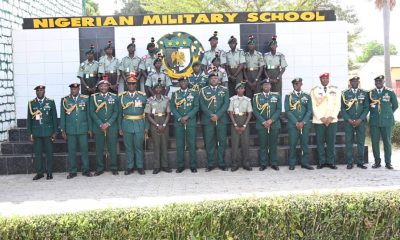

COAS Urges NMS Students to Uphold Discipline, Excellence, Promises Better Learning Environment
ShareBy David Torough, Abuja The Chief of Army Staff (COAS), Lieutenant General Waidi Shaibu, has charged students of the Nigerian...


Gov Adeleke Didn’t Join APC Because Osun People Already Hated the Party – Jackson Ojo
Share…Says Defectors to Ruling Party Will Regret By Mike Odiakose, Abuja A former chieftain of the All Progressives Congress (APC),...


COAS Charges 3,439 New Army Recruits on Loyalty, Discipline
ShareBy David Torough, Abuja The Chief of Army Staff (COAS), Lieutenant General Waidi Shaibu (NAM), has charged 3,439 newly trained...


CBN Revamps Agric Guarantee Scheme, Targets Smallholder Farmers
Share The Central Bank of Nigeria (CBN) has launched a major overhaul of the Agricultural Credit Guarantee Scheme Fund (ACGSF),...
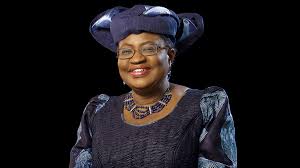

Okonjo-Iweala, Others Urge Youths to Drive Reforms, Strengthen Civic Action
ShareNational leaders have challenged youths to lead Nigeria’s renewal, warning that meaningful change now depends on young citizens organizing, demanding...


Eight Students Die, Three Injure in Jos Road Crash
ShareFrom Jude Dangwam, Jos The Vice Chancellor of the University of Jos, Prof. Ishaya Tanko has confirmed the sad death...


ShareUNICEF Hails Bayelsa as Champion of Primary Healthcare Devt in Nigeria From Mike Tayese, Yenagoa The United Nations Children’s Fund...