
NEWS
Banks Resume Naira Cards Use Abroad as FX Improves


By Samuel James, Abuja
Several Nigerian Deposit Money Banks (DMBs) have restored the use of naira cards for overseas transactions, setting varying spending limits as the foreign exchange (FX) situation shows signs of improvement.
The banks that have so far reactivated these services include: Providus Bank, First Bank of Nigeria, Guaranty Trust Bank (GTBank), United Bank for Africa (UBA), and Wema Bank.
GTBank has announced a quarterly international spending limit of $1,000 for its Naira card users.
The breakdown shows that customers can withdraw up to $500 from ATMs abroad and spend up to $1,000 across online platforms and POS channels within a three-month period.At First Bank, the international usage limit is set at $500 monthly, with defined transaction frequencies across different channels. According to the bank, cardholders can carry out up to 10 cross-border ATM withdrawals per month, with a charge of N5,000 per withdrawal. They can also perform up to 20 transactions monthly each on POS and web platforms at no additional cost.
Providus Bank informed its customers that they can now enjoy an increased international spending limit during the summer, specifically with its Platinum Naira Card, though the bank did not specify the exact ceiling.
Wema Bank has also resumed international transactions on its naira-denominated debit cards with a monthly spending limit of $500. The bank announced that customers can now use their Wema Mastercard, ALAT Mastercard, and Visa cards for foreign transactions, including online purchases, point-of-sale payments, and ATM withdrawals outside Nigeria. This move is part of ongoing efforts by Nigerian banks to ease access to foreign exchange for customers and restore confidence in cross-border payment capabilities.
The ease of bank restrictions abroad marks a reversal from 2022, when Nigerian banks were forced to slash international spending limits on naira cards from $100 to as low as $20 monthly.
That decision was driven by a chronic shortage of dollars and the struggle of manufacturers and other real sector operators to access FX through official channels.
At that time, the official exchange rate stood at N430 per dollar at the Investors and Exporters (I&E) window. As of July 4, 2025, the exchange rate stood at N1,528.56 per dollar in the Nigerian Foreign Exchange Market (NFEM), highlighting the major shift in Nigeria’s FX landscape.
This recent move by banks follows months of suspended cross-border transactions due to FX volatility and persistent dollar shortages. The resumption of naira card usage abroad signals a renewed confidence in FX liquidity and a more predictable currency environment, analysts say.
Analysts view the development as a significant boost to consumer and investor sentiment. It provides much-needed relief to customers who use naira cards for services such as online subscriptions, travel and shopping on foreign platforms.
‘Aligns with IMF recommendation’
Managing director and chief economist for Africa and the Middle East at Standard Chartered Bank, Razia Khan noted that this step aligns with policy recommendations from the International Monetary Fund (IMF).
She said, “It was one of the measures suggested in the latest Article IV consultation. The idea is that with a floating exchange rate regime, Nigeria no longer needs to maintain certain capital control measures.”
Echoing that view, an investment professional and managing director/chief business officer at Optimus by Afrinvest, Ayodeji Ebo described the development as evidence that current FX reforms are working.
He added that the recent appreciation of the naira in the past few weeks has added to market optimism. “This move adds to the growing confidence that the currency may remain relatively stable in the short- to medium-term, which is encouraging for businesses and investors alike.”
The restrictions on international transactions using Naira cards severely disrupted Nigerians’ ability to access essential foreign goods and services. From January 2023, some banks suspended or capped usage, first reducing limits to as low as $20/month, then halting all cross-border spending with naira cards. This choked individuals and businesses alike: students struggled to pay for visa fees, professionals saw domain and hosting renewals fail, and content subscriptions like Microsoft 365, Apple Music, and Netflix became inaccessible.
E-commerce startups and small businesses faced higher costs and inefficient workarounds, turning to expensive parallel market FX and fintech alternatives, all while limiting growth and deterring foreign investment.
The limits also fuelled Nigeria’s parallel (black) FX market and fintech sector. Many Nigerians turned to dollar-denominated virtual cards or domiciliary accounts, often funded at inflated black‑market rates, sometimes double official rates, driving further pressure on the naira.
Higher costs for ordinary consumers, disrupted business operations, and a permanent shift toward unofficial exchange channels all undermined confidence in formal banking and stability in the FX market.
Chief executive officer of the Centre for the Promotion of Private Enterprise (CPPE), Muda Yusuf attributed the recent resumption of international transactions with Naira cards by Nigerian banks to improved liquidity and stability in the foreign exchange (FX) market.
According to him, these developments have restored confidence in the system, both for financial institutions and their customers.
He emphasized the practical benefits for Nigerians, especially those who travel abroad. “As a Nigerian who’s travelling abroad, you don’t need to be carrying dollars in your pocket or in your bag. Sometimes, people have been embarrassed because of that. So, with your naira card, you can do whatever transactions you want,” he said.
as it’s urges Nigerians to look out for eachother and not giveup
By Laide Akinboade, Abuja
The Christian Association of Nigeria (CAN) on Sunday said it is time for Nigeria to rise above its challenges.
President, CAN Archbishop Daniel Okoh, stated this in his message for the Easter celebration, in Abuja.
He said Easter reminds everyone of a simple, enduring truth: no matter how hard life has been, rising again is always possible.
Especially, when hope, seemed lost, life after despair, a new beginning after a difficult moment.
“It is a message that speaks directly to Nigeria today”, he said.
The CAN boss lamented, “Across the country, people are weary. Families are anxious. Many do not feel safe; others are struggling just to get by. For some, hope has grown faint. But Easter tells us this is not the end. We do not have to remain where we are. We can rise, rebuild, and move forward, together”.
Okoh, speaking to Nigeria leaders, he said “For those in leadership, this is a test of purpose. People must feel leadership, not just hear it. They are looking for action, for empathy, for visible efforts to improve their lives. That is how a nation begins to rise”.
He added for the Church, this is a moment to stand firm and speak clearly. People are searching for hope they can hold on to. The Church must be present; standing with the struggling, offering direction, and helping to light the way forward.
“And for Nigerians everywhere, this is no time to give up on one another. There may be those intent on keeping the rest of us in fear, but we must resist; not with panic or division, but with courage, solidarity, and a shared belief in one another. Hard times can divide, but they can also unite. If we choose unity over suspicion and look out for one another, change becomes not just possible, but certain”, he said.
He concluded, by saying, Easter is more than celebration but rather a decision to rise above the challenges.
“Easter is more than a celebration; it is a decision. A decision to rise above our differences, to stand together, and to confront what holds us back. And if we make that choice, together, then Nigeria will rise again”, he said.
By Laide Akinboade, Abuja
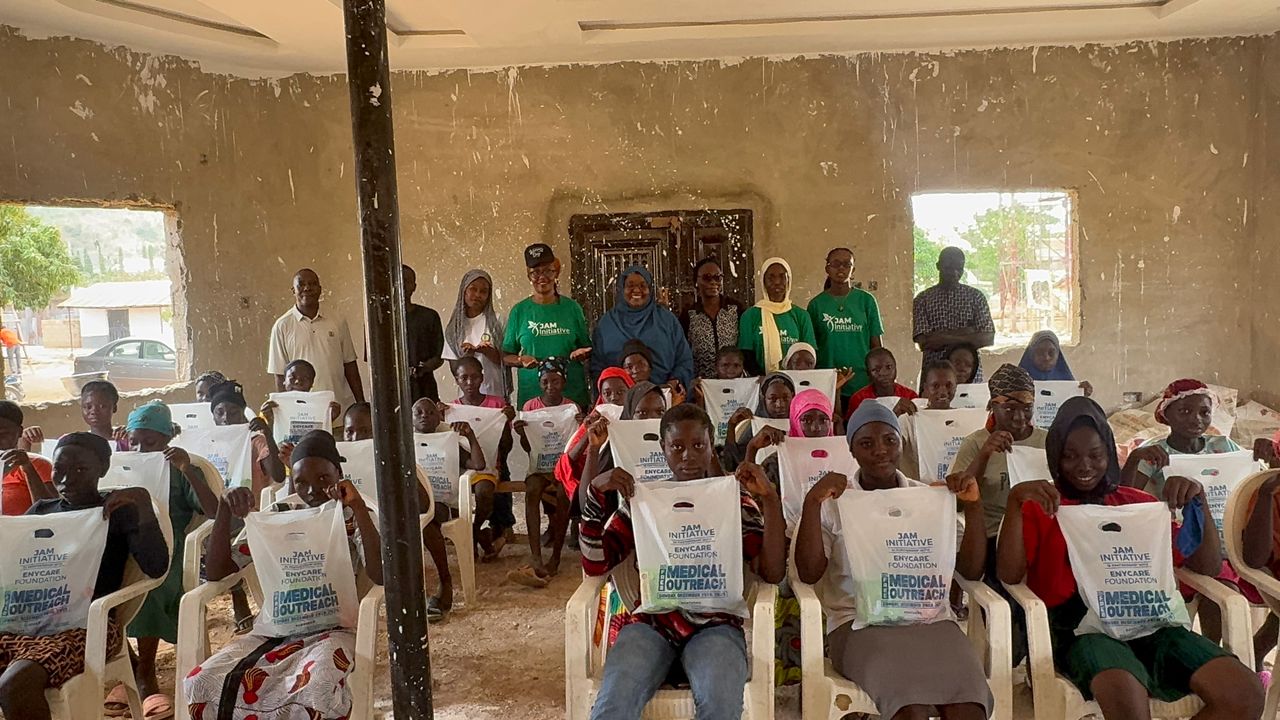
An expert in education, has urged adolescents girls in Abuja, to ensure they acquire vocational Skills ,in addition to their education, this can help them earn extra money.
Hadjia Hauwa Wambai, PhD, made this appeal at a one day, One Day Mentorship program for Adolescent Girls, organized by JAM Intervention For Vulnerable Children And Climate Change Initiative (JAM), in Pegi, Abuja.
In her Keynote address, Hadjia Wambai, Founder, Al- Masareef Foundation spoke to the girls about the importance of acquiring Skills that can help them earn extra money.
She said Students must read for at least One hour everyday after School.
This she said will help to pass their exams effortlessly instead of leaving the Studies till a few days to exam period.She explained the importance of hygiene during the Menstrual Cycle and the need to ensure that as Girls and young Women, they are neat, focused, skilled ,hardworking and well behaved.
According to her, these are hallmarks of leadership and the Girls are expected to grow up to be leaders in their respective fields of endeavors.
The one day programme that was in commemoration of the 2026 International Women’s Day 2026, with the theme ‘Justice. Rights. Action with the Sub- theme; Give To Gain’.
Earlier in her address, the Founder Of JAM-Initiative, Josie Mudasiru JP, said that mentoring the Girls by educating them on their Rights and opportunities available to them is her own way of giving back to the Society.
Mudasiru, encouraged the Girls to ensure that they impact their siblings and family members with the knowledge they have acquired at the Mentorship program.
She urged them to concentrate on their academic work and be enticed by yahoo Boys.
” Be focused, be hardworking and God fearing. That is the only way to good Success. Dare to dream and with hardwork and perseverance, all your dreams will become a reality.
While speaking one of the participants,
14 year old Salome Markus said She wanted to an Astronaut but the Father said that the profession was reserved for Men, but the Mentorship program has inspired her not to give on her dreams.
Another 14 year old Adolescent Girl, Suweiba Haruna said the program has motivated her to be more serious with her Academics .
The Village Head of Pegi Village, Chief Irimiya Nisana who volunteered the use of his Palace for the program said he was elated that his Community was choosen for such an important event.
He said JAM- Initiative and other ngos are welcomed to his Community because he is interested in the growth and development of all members of his Community; especially the Girl Child.
The Girls Were given a package containing Exercise Books, a Pack of Sanitary pads and refreshment.

From Joseph Amedu, Lokoja
Kogi state Governor, Usman Ododo has launched the renovation of 728 Government-owned Public Schools under the Adolescent Girls Initiative for Learning and Empowerment (AGILE) intervention across the three Senatorial Districts of the state.
Ododo while performing the flag off ceremony at the Government House, Lokoja on Thursday, gave an assurance that his administration will continue to accord education sector topmost priority.
The Governor who was represented by his Deputy, Joel Oyibo, reaffirmed his unwavering commitment to the transformation of the education sector in Kogi State.
Ododo commended Kogi AGILE for its intervention programme in the state particularly in the promotion of Girl Child education.
It is a statement that every child in Kogi State deserves a decent place to learn.
It is a statement that our teachers deserve an environment that supports excellence.
And it is a statement that this administration is determined to leave a lasting legacy in the education sector.
To the Technical Service Providers, let me be clear this administration expects quality, transparency, and timely delivery. There will be no compromise on standards.
“The work you do here will speak for years to come, and you must rise to that responsibility.
As we flag off this initiative today, we are not just starting construction work; we are igniting transformation. We are restoring confidence in our public schools, improving learning conditions, and creating opportunities for thousands of young people across Kogi State.
“My administration will continue to prioritize education and ensure that every intervention delivers real and measurable impact.
Together, we will build a system that works for all; one that empowers our children, strengthens our communities, and secures the future of our State”
Earlier, the Kogi State Project Coordinator of Adolescent Girls Initiative for Learning and Empowerment (AGILE), Tijani Oricha disclosed that the renovation intervention is aimed at providing conducive learning environments and the needed comfort for teachers and students to enhance effective teaching and learning.
According to him, the effort would also go a long way in strengthening school systems generally across the state.
He appreciated the First Lady of Kogi State, Hajia Sefinat Usman Ododo, whose passion for the empowerment of the girl child has been greatly inspiring.
“As the Mother of the AGILE Project in Kogi State, your advocacy and dedication have continued to give life and direction to this initiative and we are deeply grateful for your continued support.
“We respectfully acknowledge and appreciate our revered Royal Fathers and Religious Leaders whose influence in shaping values, guiding communities, and mobilizing support at the grassroots level is invaluable. We count on your continued support to ensure that this intervention is protected, sustained, and embraced by the communities it is meant to serve.
“The renovation and rehabilitation of 728 government-owned schools across Kogi State represents one of the most far-reaching investments in the education sector in recent times. This is not just a number, it is 728 opportunities to change learning environments, 728 platforms to restore dignity to education, and 728 communities that will experience renewed hope.
“This initiative will directly impact thousands of students and teachers across the State. It will improve safety, enhance attendance, boost teacher morale, and ultimately lead to better learning outcomes. For the girl child in particular, it creates a more inclusive and supportive environment that encourages retention, participation, and success. Ladies and gentlemen, this is how we build the future intentionally, inclusively, and sustainably.
“To the School-Based Management Committees, this is actually a defining moment for you as the custodians of this crucial intervention at the community level. I charge you to take full ownership of these projects. Protect them, monitor them, and ensure that every resource deployed translates into visible and lasting impact. The success of this initiative at the grassroots level depends largely on your commitment and vigilance.
“We have carefully chosen 30 Technical Service Providers to commence the first phase of intervention in 150 selected schools across Kogi State. And we urged the TSPs to be conscious of the moral and professional responsibilities that come with this important engagement. The structures you build today will shape the experiences of generations to come.
“We expect nothing short of quality, adherence to standards, and timely delivery. Accountability, transparency, and excellence must guide your work at every stage.
“Let me also emphasize that this project will be closely monitored. Every kobo invested must deliver value. Every structure must meet standard. Every community must feel the impact. That is why you joined the SBMC to signed the indemnity instrument to entrench commitment to service delivery”
“Kogi State Governor, Alhaji Ahmed Usman Ododo has done very well in ensuring that children have access to quality education hence the need for AGILE to complement that effort”.



Easter: ‘Nigeria Must Rise, This Is Our Moment’ — CAN
Shareas it’s urges Nigerians to look out for eachother and not giveup By Laide Akinboade, Abuja The Christian Association of...


Nigerian Military Reports Major Gains in Nationwide Anti-Terror Operations
ShareBy David Torough, Abuja The Armed Forces of Nigeria has announced significant operational successes in its ongoing counter-terrorism and anti-crime...

Group trains 50 girls on Menstrual hygiene, skill acquisition etc
ShareBy Laide Akinboade, Abuja An expert in education, has urged adolescents girls in Abuja, to ensure they acquire vocational Skills...

SDP Leader, Adebayo Urges Nigeria to Reconnect With Independence-era Ideals at Stakeholders’ Summit
ShareBy Mike Odiakose, Abuja The national leadership and former presidential candidate of the Social Democratic Party (SDP), Prince Adewole Adebayo,...

Ododo Flags Off 728 Government-owned Renovated Public Schools in Kogi
ShareFrom Joseph Amedu, Lokoja Kogi state Governor, Usman Ododo has launched the renovation of 728 Government-owned Public Schools under the Adolescent Girls Initiative for Learning...


Super Eagles Set for Poland, Portugal Friendlies Ahead of World Cup
ShareThe Super Eagles will face Poland and Portugal in international friendlies in June as part of preparations for upcoming global competitions, the Nigeria Football...


Iran Threatens U.S, Israel with Harsher Attacks
ShareIran has warned the United States (U.S.) and Israel that it would launch further and more severe attacks, escalating tensions amid ongoing hostilities. A spokesman for...


EFCC Seeks Final Forfeiture of 57 Properties Linked to Malami
ShareThe Economic and Financial Crimes Commission, on Thursday, urged the Federal High Court in Abuja to order the permanent forfeiture...


Easter: NSCDC Deploys 57,000 Personnel Nationwide
ShareThe Nigeria Security and Civil Defence Corps (NSCDC) has deployed 57,000 operatives nationwide to ensure security of lives and property...


NSIA Grows Net Asset Value to $3.40bn in 2025
ShareBy Tony Obiechina, Abuja Nigeria Sovereign Investment Authority(NSIA) has announced its 2025 Group Financial Performance posting a net Asset value...