
NEWS
Dangote Hikes Petrol Price to N1,275, Diesel N1,950

The Dangote Petroleum Refinery has again increased the gantry price of petrol and diesel, further tightening pressure on consumers and businesses across Nigeria.
A top official at the refinery, who confirmed the development to our correspondent on Tuesday night, said the facility adjusted its pricing in response to prevailing international crude oil benchmarks and market realities.
The new pricing template shows that petrol rose by N75 per litre to N1,275, representing an increase of about 5.
02 per cent, while diesel jumped by N200 per litre to N1,950.This marks a sharp increase from last month’s prices of N1,200 per litre for petrol and N1,750 for diesel, signalling that diesel is now on track to breach the N2,000 per litre mark at the pump, further intensifying cost pressures across the economy.
“The adjustment is in line with global market trends. You are aware of the ongoing tensions in the Middle East and how they have impacted crude oil prices. These are external factors that directly influence refined product pricing,” the official said.
He added, “Petrol has been reviewed upward by N75 to N1,275 per litre, which is about a five per cent increase, while diesel has increased more significantly by N200 to N1,950 per litre. These changes reflect the realities of the international market.”
Market data from Petroleumprice.ng corroborated the development, indicating that the latest petrol price reflects a 5.02 per cent increase at the gantry level.
The development comes at a time when stakeholders had hoped that increased local refining capacity would help stabilise domestic fuel prices. However, Nigeria remains exposed to global oil price volatility due to its reliance on international crude benchmarks for pricing.
The latest hike could trigger a fresh wave of increases in pump prices nationwide, with marketers expected to pass on the additional cost to consumers in the coming days.
Global oil markets have remained volatile in recent weeks due to escalating tensions in the Middle East, a region that accounts for a significant share of the world’s crude oil supply. Any disruption or perceived risk to supply routes often leads to price spikes, which in turn affect refined petroleum products globally.
Nigeria, despite being an oil-producing country, operates a deregulated downstream sector where fuel prices are largely determined by market forces. This means that local prices are influenced by international crude prices, exchange rates, logistics costs, and refinery operations.
The Dangote Petroleum Refinery, Africa’s largest, was expected to reduce Nigeria’s dependence on imported fuel and help stabilise prices.
However, experts note that as long as crude oil pricing remains tied to global benchmarks, domestic fuel prices will continue to fluctuate in response to international developments.
The latest increase also comes amid concerns over affordability, with consumers already grappling with high energy and transportation costs.
A sustained price increase could worsen inflationary pressures and slow economic recovery.

The Nigerian Maritime Administration and Safety Agency (NIMASA) said it has received over 60 applications since launching the Cabotage Vessel Financing Fund (CVFF) in January.
The agency disclosed this in a statement issued by its Head of Public Relations, Edward Osagie, on Tuesday in Lagos.
Director-General, Dr.
Dayo Mobereola, assured that the CVFF disbursement process would be transparent and strictly monitored.Mobereola said this followed a sectoral meeting with the Minister of Marine and Blue Economy, Dr Adegboyega Oyetola, and the signing of performance bonds by agencies.
He reaffirmed NIMASA’s commitment to accountability, improved performance, and sustained maritime sector growth through its 2026 Sectoral Performance Bond.
“The performance bond is a key governance instrument for tracking deliverables, strengthening accountability, and aligning operations with national priorities,” Mobereola said.
He added that ongoing reforms were driven by purposeful leadership and ministerial support, noting alignment with President Bola Tinubu’s Renewed Hope Agenda.
On maritime security, Mobereola said Nigeria recorded zero piracy incidents in territorial waters over the past four years.
He attributed the achievement to enhanced surveillance systems and improved inter-agency collaboration.
Mobereola said NIMASA was at an advanced stage of automating ship registry processes to improve efficiency, reduce delays, and boost global competitiveness.
He noted that Nigeria had deposited three conventions with the International Maritime Organization, with three others awaiting Federal Executive Council approval.
According to him, Nigeria’s election into Category C of the IMO Council in November 2025 restored its voice in global maritime governance.
In his remarks, Oyetola reiterated the Federal Government’s commitment to using the maritime sector to drive economic diversification, job creation, and foreign exchange earnings.
“The performance bonds are binding commitments that will be closely monitored. Accountability is not optional,” Oyetola said.
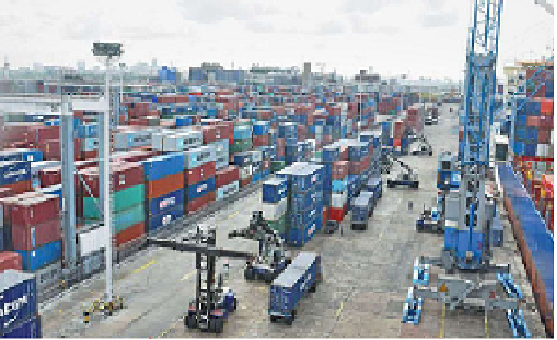
The Nigerian Ports Authority (NPA) said it facilitated export of over 500,000 tonnes of petroleum products from Dangote Refinery to African countries in March.
NPA Managing Director, Dr Abubakar Dantsoho, disclosed this in a statement issued on Tuesday by Ikechukwu Onyemekara, General Manager (Corporate Communications and Strategy).
Dantsoho spoke at a stakeholders’ engagement organised by the Ministry of Marine and Blue Economy in Lagos.
He said in spite of the Middle East conflict affecting global vessel movement, Nigeria remained resilient in supplying petroleum products locally and for export.
He attributed the achievement to the implementation of the One-Stop-Shop (OSS), introduced by the Minister of Marine and Blue Economy, Dr Adegboyega Oyetola.
According to him, the OSS ensures all stakeholders operating at the Dangote Refinery align seamlessly in their operations.
“In many countries today, workers operate remotely, while others face energy queues, but Nigeria has not experienced such disruptions.
“As a matter of fact, in the past month, we exported over 500,000 tonnes of petroleum products from Dangote Refinery to African countries.
“The exports are handled by ships, supported by the NPA’s capacity in port and cargo operations,” Dantsoho said.
He said the policies driving the achievement were approved by the minister, including the OSS hosted by the NPA.
“This system operates similarly to the National Single Window, ensuring efficiency and coordination,” he said.
Dantsoho noted that all stakeholders now operate in sync with Dangote Refinery’s distribution framework.

The National Insurance Commission (NAICOM) has issued new guidelines for the collection, management and administration of the Insurance Policyholders’ Protection Fund (IPPF), to strengthen protection for policyholders in the country.
In a circular dated April 7, 2026, and addressed to all insurance institutions, the commission said the directive was in exercise of its powers under the Nigerian Insurance Industry Reform Act 2025 and other extant laws.
The circular was signed by John Falade, Deputy Director, Special Risk and Security Analysis, NAICOM, on behalf of the Commissioner for Insurance.
NAICOM stated that the guidelines provide a comprehensive regulatory framework to ensure clarity, enhance compliance and streamline the administration of the fund across the insurance sector.
According to the commission, the fund serves as a statutory safety net designed to protect policyholders in the event of distress or insolvency of a licensed insurer or reinsurer.
It added that the guidelines also include provisions for the reimbursement of loans by insurers and reinsurers under the scheme.
The commission directed that IPPF assessment returns for the 2025 financial year must be submitted on or before May 31.
It noted that subsequent submissions would be made in line with Section 4.3 of the guideline on the Insurance Policyholders’ Protection Fund.
NAICOM urged all insurers, reinsurers and other relevant institutions to ensure strict compliance with the new guidelines.


NIMASA Records 60 CVFF Applications, Pledges Transparency
ShareThe Nigerian Maritime Administration and Safety Agency (NIMASA) said it has received over 60 applications since launching the Cabotage Vessel...
NPA Facilitates 500,000 Tonnes Petroleum Export from Dangote Refinery
ShareThe Nigerian Ports Authority (NPA) said it facilitated export of over 500,000 tonnes of petroleum products from Dangote Refinery to...

NAICOM Issues Guidelines on Policyholders’ Protection Fund
ShareThe National Insurance Commission (NAICOM) has issued new guidelines for the collection, management and administration of the Insurance Policyholders’ Protection...

Navy Seeks Partnerships to Boost Indigenous Shipbuilding, Operations
ShareThe Nigerian Navy has expressed readiness to partner with relevant organisations to strengthen indigenous shipbuilding capacity and enhance naval operations....

Dangote Hikes Petrol Price to N1,275, Diesel N1,950
ShareThe Dangote Petroleum Refinery has again increased the gantry price of petrol and diesel, further tightening pressure on consumers and...


Bandits Abduct Couple on Farm in Kaduna
ShareBandits have abducted a man, Bitrus Jayawa and his wife, Martha Bitrus, from a farm in Katambi community in Kachia...


NBTE Inaugurates Nigeria’s First Chip Design Training Programme
ShareThe National Board for Technical Education (NBTE) has inaugurated Nigeria’s first chip design training programme, aimed at equipping young Nigerians...


Enugu Says Science Transformed Health System’s Delivery, Outcomes
ShareFrom Sylvia Udegbunam, Enugu The Enugu State Government said science has transformed the health system’s delivery and general outcomes in...


NSCDC Arrests 20 Foreign Nationals in Kano over Illegal Entry
ShareThe Kano State Command of the Nigeria Security and Civil Defence Corps (NSCDC) has arrested 20 foreign nationals in the...

FG Unveils Digital Platform to Showcase Nigeria’s Culture, Tourism Destinations
ShareThe Federal Government has unveiled a new digital platform, NITOUREY, aimed at showcasing Nigeria’s rich cultural heritage and tourism destinations...