
OPINION
Democracy Without Voters: The Origin of Nigeria’s Insecurity Crisis


By Chidi Anselm Odinkalu
On 26 January 2009, Mamman Bello Ali died. He was the governor of Yobe State in north-east Nigeria. At around the same time, an anti-terrorism campaign by the government of Nigeria in Yobe State and its neighbour, Borno State, was about to make a murderous transition into a full-blown insurgency.
AsGovernor Mamman Ali made his earthly transition in a Florida hospital, his deputy, Ibrahim Gaidam assumed office on the same day as the new governor of Yobe State. Today, as minister of Police Affairs in the federal government, Mr Gaidam, whose life in politics has included a stint as a member of the Senate, has high responsibility for policing the country. He is so ineffectual in this role that few Nigerians notice his existence.Around 9 November 2014, a suicide-bomber dressed as a student detonated himself in the middle of school assembly at the Government Boys Secondary School in Potiskum, Yobe State. The police confirmed that the attack “left 47 people dead, including the suicide bomber. Another 79 were wounded. Dozens of students were injured so severely medics were unable to save them.” It was a tragedy on an unspeakable scale. The blame for the attack fell on Jama’atu Ahlis-Sunna Lidda’Awati Wal-Jihad (the Islamist insurgency better known as Boko Haram). Ibrahim Gaidam was still governor.The following day, President Goodluck Jonathan’s campaign was in full swing as he sought the support of the country for his re-election in 2015, under the banner of the then ruling Peoples Democratic Party. The All Progressives Congress, then newly formed as an opposition alliance, was quick to take political advantage. It described Jonathan’s campaign launch as “insensitive and callous” and accused him and the PDP of “dancing on the graves of the pupils as well as of all the victims of Boko Haram insurgency.” The APC took the opportunity to recall another mass-casualty bombing incident in Nyanya on the outskirts of Abuja in April 2014 and said that following that incident, “President Jonathan went dancing ‘Azonto’ in Kano less than 48 hours later.”In the period from 2009 to 2014, when Islamist violence of Boko Haram in north-east Nigeria transitioned into a full-blown insurgency, the Peoples Democratic Party (PDP) was in power. Educational infrastructure bore a major brunt of the attacks by the group, which built a brand in murderous violence by campaigning against Western education. The worst-affected states – Borno and Yobe – happened to be outside the orbit of the ruling party. In the half-decade to 2014, the violence accounted for at least 611 teachers reportedly killed and another 19,000 forced to flee. In 2014 alone, the insurgency killed over 6,644 persons in the affected states.In May 2014, the United Nations Security Council listed Boko Haram as a terrorist organisation. Three years earlier, the Gaji Galtimari Presidential Committee on the Security Challenges in the North-East Zone of Nigeria had reported that the group “started as an innocuous non-violent group” around 2003.This rise in Boko Haram’s campaign of mass-casualty violence was both new and shocking. The response of the then ruling government appeared slow, ponderous, and mal-adapted. It was also a political season. The escalation in the attacks and killings from the Islamist insurgency in north-east Nigeria in 2014 coincided with the run-up to Nigeria’s 2015 general elections.For the PDP in power at the time, it was a struggle to manage the optics of campaigning in the midst of growing carnage. The APC, then a new opposition formation, relished in its role, making political capital out of the situation. Its forceful critique of the PDP’s management of the Boko Haram insecurity or lack of it was central in ensuring the defeat of the ruling party in the 2015 election.The popular narrative of Muhammadu Buhari, the APC candidate for the presidency in 2015, as a no-nonsense soldier, did more than any other thing in reassuring Nigerians that the party would bring competence to the handling of the crisis of insecurity in the country. Instead, since then, insecurity in Nigeria has metastasised under the successive presidencies of President Muhammadu Buhari and his successor, Bola Ahmed Tinubu. The violence, which was mostly confined to the states of the north-east one decade ago, has become hydra-headed under various nomenclatures all over the country.In its latest Conflict Barometer (2024) report, the Heidelberg Institute for International Conflict Research identified at least 10 sites of active, conflict-related killings in Nigeria, at least five of which fall into the highest classifications of seriousness.In the north-east, Boko Haram has mutated into a confederacy of mass murder under different appellations, each seeking supremacy in an Olympiad of mass casualty violence.In North-Central Nigeria, the party chose to mis-characterise as “farmer-herder” clashes, a methodical campaign of land-grabbing by people described by the government mostly as “foreigners.”Under the watch of the APC government, in 2021, the north-west overtook the northeast in mass casualty atrocities. Unable to manage the situation in the region, the government took to labeling the perpetrators of the atrocities in the north-west as “bandits.”Unlike the north-east, where improvised explosive devices (IEDs) and suicide-bombers were major features of the insurgency and insecurity, the major items in the violence in the north-west are motor bikes and Kalashnikovs. Yet, the government cannot account for how these bikes and guns get into the hands of those who use them to habitually liquidate Nigerians on an industrial scale.Kaduna was central in this shift. Installed in power in 2015 in the APC Tsunami as the new APC governor of strategically significant Kaduna State, Nasir El-Rufai was voluble in promoting mass murder as profitable, incredibly proclaiming on national television how he paid the killers of Nigerians in order to encourage them to stop killing. The casual malevolence of his proferred justification was beyond shocking: “We got a group of people that were going round trying to trace some of these people in Cameroon, Niger and so on to tell them that there is a new governor who is Fulani like them and has no problem paying compensations for lives lost and he is begging them to stop the killing.”Even worse, the mis-management of the insecurity under the government of the APC has smacked of a level of indifference, cynicism, and lack of empathy that the PDP would never have dreamed of. In Benue State last week, all of this was on show. Forced by public opinion finally to re-route himself to visit victims of mass liquidation in Benue State, in Nigeria’s Middle Belt, President Bola Ahmed Tinubu first had children line up in the rain to be splashed with mud by his majestic convoy, before the obligatory serenading from uniformed women living in internal displacement from the violence. It was right out of the manual of political narcissism jointly authored by Louis VIX and Marie Antoniette.While the country burns, the president has curiously eloped to Saint Lucia, a territory of about 179,000 persons described by the Global Organised Crime Index as “a key Caribbean transit hub for cocaine shipments bound mainly for the US, Europe or Canada.” To the Nigerians concerned about the optics of all this, it is as if all he can offer is the middle finger.The only thing more abysmal than the indifference of the ruling APC government to the current crisis of mass murder across the country has been the disgraceful abdication by the political opposition. In the midst of all this carnage, little has been heard from them. Instead, opposition politicians have been hyper-active in the political transfer season herding into the APC.Those who expect the police, armed and security services to shoot the country out of this crisis are unlikely to get their wish. The durability of Nigeria’s insecurity crisis is essentially a crisis of irresponsible political leadership. The security services can only implement a strategy set by the politicians. At the moment, the politicians are fixated on 2027. By then, in many parts of Nigeria, there may be no voters left and many of those in place would have been displaced from their voters’ cards. But the politicians do not have to care because they do not need voters to get into office. That is the original sin of insecurity in Nigeria.Chidi Anselm Odinkalu, a lawyer, teaches at the Fletcher School of Law and Diplomacy and can be reached through chidi.odinkalu@tufts.edu.
By Uji Wilfred
Right from the foundations of the Independence struggle that led to self-rule, political party formations in Nigeria were crafted majorly for the capture of political power through periodic elections.
Political Parties never had ideological foundations that defined the boundaries of political recruitment and participation.
Political parties in their formation, leadership structure and ownership, belonged more to the ruling oligarchs than the people or the masses.In the First Republic, political parties had little ideological bent, framed along regional and ethnic sentiments, but little of rallying the entire nation along in a unified polity.
In the general elections of 1954 – 1956, each of the ruling political party, the Northern People’s Congress, the Action Group and the National Council of Nigerian Citizens emerged as regional parties in terms of the demographic voting pattern as well as the control of political seats.The First Republic suffered from a contradiction of centripetal and centrifugal forces within the framework of the tripartite system which eventually led to the collapse of that republic.
Political parties as well as the leadership recruitment reflected a regional and ethnic bias more than the need for the national integration of Nigeria.
Decamping across political lines, irrespective of ideological leanings, were the basic norms of the First Republic with political parties splitting out from the major political party. Formation of new political parties to fragment the dominant hold of ruling political parties were common political vices of the political class at that time. For example, Chief Akintola, despite the ideological soundness of the Action Group, splitted up the party with the formation of a new political party.
Chief Akintola’s desire was fired more by ambition than the issues of ideology and national interest.
In Northern Nigeria, the ruling Northern People’s Congress waged a war of suppression and dominance against other minority political parties with strong ideological bent that inspired minority ethnic nationalism.
The NPC through its slogan of One North, One Destiny, suppressed minority political parties such as the United Middle Belt Congress led by Joseph Tarkaa.
The point is that Nigeria from her foundations inherited a political culture where political parties have weak ideological roots as well as party and leadership recruitment.
Since 1999, Nigeria has witnessed the recycling of bourgeoisie Political Party Formation and leadership recruitment through a process of metamorphosis that defiles ideological lines and national interest.
Political participation and leadership recruitment has been centered on the urgent need to capture power at the center using political parties owned by a few powerful oligarchs.
The People’s Democratic Party in its formation and foundation was a fraternity of past and serving military generals and their civilian equivalent.
The PDP since its inception has been led by past military officers like David Mark and Atiku Abubakar, the civilian equivalent of the military.
The dream of the PDP led by these retired military generals under the leadership of former President Olusegun Obasanjo was the enthronement of Africa’s biggest political party that was to last for a century.
As good as the dream of the party was, the PDP, like the experience of the First and Second Republics lacked deep ideological roots that defined the boundaries of political recruitment and participation.
The triumph of the People’s Democratic Party forced the rival All People’s Party and the Action Congress of Nigeria into a state of collapse and submission leading up to the bourgeoisie metamorphosis that resulted to the formation of the All Progressive Congress on the eve of 2015 with the sole objective to unseat President Good luck Jonathan.
The APC was a metamorphosis and amalgamation of opposition parties including some dissenting faction of the PDP to reclaim the so called birth right of the far right North in Nigeria to produce the President of Nigeria.
Political recruitment and leadership struggle in Nigeria has never been defined by ideological needs to salvage or emancipate Nigeria as a nation. Political struggle has always been a recycling of that section of the bourgeoisie, through a process of metamorphosis, whose objective is to capture political power at the center.
The present protest and political struggle by the African Democratic Congress, the faction led by David Mark and Atiku Abubakar, is a recycling of bourgeoisie metamorphosis not too different from the experience of 2015.
At best, the David Mark and Atiku Abubakar led protest represents that desperate struggle entrenched in the thinking of the Far Right of Far Northern Nigeria, that political leadership resides in the ancestral birth right of the aristocratic ruling political class of the North.
David Mark and Atiku Abubakar perhaps are suffering from a dementia that has made them forget that they were the agents that destroyed the foundations of democracy in Nigeria through the sacking of former President Good luck Jonathan of the People’s Democratic Party.
These men formed the All Progressive Congress and wrestled power from a democratic government exploiting the dynamics of national security and developmental challenges.
In 2015, Nigerians believed their opinions and through the ballot removed Good luck Jonathan.
However, since then, has Nigeria fared better under the APC that was enthroned by oligarchs leading in the present protest under the auspices of the ADC.
Perhaps, David Mark and Atiku Abubakar may assume that Nigeria suffers from a collective dementia that has forgotten the past so soon.
There is an adage that says, he who comes to justice and equity must come with clean hands. The same forces that enthroned bad governance in Nigeria factored in the APC, through a metamorphosis, want to rebirth another Nigeria through the ADC.
In ideological terms, this does not make sense, the ADC Protest is the same old thing of old wine in a new wine bottle.
If Nigeria must experience a change, let it come through some revolutionary medium that will not exploit the people’s trust and betray them once in power.
Over the past decades, the betrayal of public trust, exploiting the innocence of the people, perhaps the naivety of the people, is what we have seen and experienced through the circles of bourgeoisie metamorphosis and political leadership recruitment.
By Raphael Atuu
Benue State, fondly referred to as the “Food Basket of the Nation,” was created on February 3, 1976, by the military administration, carved out of the old Plateau State. From its inception, the state was administered by a succession of military administrators, followed by civilian governors in Nigeria’s evolving political landscape.
Over the decades, leadership passed through several hands each leaving varying degrees of impact on the state’s trajectory.
In its early years, Benue was widely regarded as a peaceful and united society. Communities coexisted in harmony, bound by shared values, cultural pride, and a strong sense of collective identity.
The economy was largely driven by agriculture, with fertile lands producing yams, rice, cassava, and other staple crops. Institutions like the Benue Cement Company also contributed to economic activity and employment.In those days, the government was distant from the daily struggle of the average citizen. Few people concerned themselves with the affairs of Government House. Wealth and dignity were derived from hard work, farming, trading, and craftsmanship not political patronage.
The people spoke with one voice, celebrated their traditions with pride, and upheld communal respect as a guiding principle.
However, the return of democracy in 1999 marked a significant turning point, one that would reshape the state’s social and political fabric in ways few anticipated.
With democratic governance came new opportunities, but also new challenges. Politics gradually became the most attractive path to wealth and influence.
For many, Government House transformed from a symbol of public service into a gateway to personal enrichment.
The perception of politics shifted from service to self-interest.
As political competition intensified, unity began to erode. Divisions along ethnic, local government, and party lines deepened. The once cohesive voice of the Benue people became fragmented, often drowned in partisan conflicts and power struggles.
Perhaps more troubling was the subtle transformation in societal values.
The Benue man, once admired for courage, resilience, and industry, began though not universally to exhibit tendencies toward dependency and political loyalty over merit.
Sycophancy started to replace integrity, and the dignity of labor was gradually overshadowed by the allure of quick gains through political connections.
Elected officials rose to positions of authority and influence, becoming key decision-makers in society.
Yet, for many citizens, the dividends of democracy remained elusive. Infrastructure development lagged, agricultural potential remained underutilized, and poverty persisted despite abundant natural resources.
The irony is striking: a state so richly endowed, yet struggling to translate its potential into tangible progress.
Beyond economics, insecurity and communal clashes in recent years have further strained the social fabric.
The peace that once defined Benue has been challenged, forcing many communities to confront displacement and uncertainty.
While these issues are complex and multifaceted, the role of political leadership in addressing or failing to address them cannot be ignored.
So, where did the politicians get it wrong?
They lost sight of the essence of leadership service to the people. Governance became more about control than development, more about personal gain than collective good.
Long term planning gave way to short term political calculations. Investments in agriculture, which should have remained the backbone of the state’s economy, were neglected in favor of less sustainable ventures.
Moreover, the failure to foster unity and inclusive governance widened the gap between leaders and the led. Politics became a tool for division rather than a platform for progress.
Yet, all hope is not lost.
Benue still possesses immense potential, fertile land, vibrant culture, and resilient people, what is needed is a return to the values that once defined the state: hard work, unity, integrity, and community driven development.
Leadership must be reimagined, not as an avenue for wealth, but as a responsibility to uplift the people.
The story of Benue State is not just one of decline it is also one of possibility.
With the right vision, commitment, and collective will, the state can reclaim its place as a model of peace, productivity, and progress.
The question remains: will its leaders and its people rise to the occasion?
If you want, I can.

By Tanimu Yakubu
Nigeria is not collapsing; it is confronting long-avoided economic realities. The current hardship, though undeniable, reflects a deliberate process of correcting structural imbalances that have persisted for years. Distress is evident, but it must not be mistaken for systemic failure.
Countries in true economic collapse do not unify exchange rates, rebuild external reserves, regain access to international capital markets, or improve fiscal performance.
Nigeria, despite significant pressures, is making measurable progress across these indicators.Ending a Distorted Economic Order
For years, Nigeria operated under an economic framework that projected stability while masking deep inefficiencies.
Artificially suppressed fuel prices, multiple exchange rate windows, and expansionary fiscal practices incentivized arbitrage over productivity.These distortions disproportionately benefited a narrow segment of the population while imposing hidden costs on the broader economy.
Their removal has revealed the true cost structure of the system. While this transition has triggered inflationary pressures, it has also restored policy transparency and enhanced the credibility of economic management.
Strengthening the Fiscal Base
Recent fiscal data indicates a strengthening foundation. Distributable revenues to the Federation Account have risen by over 40 percent following subsidy removal, reflecting improved remittance discipline and reduced leakages.
Nigeria’s public debt remains below 30 percent of GDP, a relatively moderate level compared to peer emerging markets, according to the International Monetary Fund. Meanwhile, external reserves have surpassed $40 billion, based on figures from the Central Bank of Nigeria.
At the subnational level, increased fiscal inflows are enabling more consistent salary payments, with some states introducing inflation adjustments, an indication of gradually expanding fiscal space.
Inflation: A Transitional Challenge
Inflation remains the most immediate and visible consequence of ongoing reforms. It is being driven by exchange rate adjustments, energy price corrections, and longstanding supply-side constraints.
Global experience suggests that such inflationary spikes are often temporary when reforms are sustained. The greater risk lies not in reform itself, but in policy inconsistency or reversal.
Interpreting the Present Moment
Public frustration is both expected and understandable. Nigerians are justified in demanding tangible improvements in living standards. However, it is important to distinguish between short-term hardship and systemic collapse.
Nigeria’s institutional framework remains intact, fiscal capacity is improving, and macroeconomic reforms are actively progressing. This phase represents adjustment, not disintegration.
From Stabilisation to Impact
The next phase of reform must translate macroeconomic gains into measurable improvements in citizens’ welfare.
Strategic investments in healthcare, education, and targeted social protection will be essential to sustaining public confidence.
Ultimately, the credibility of these reforms will be judged not by policy intent, but by their impact on everyday life.
Conclusion: The Imperative of Consistency
Nigeria has long recognised its economic challenges; what has often been lacking is sustained policy execution. The greatest threat at this juncture is not reform fatigue, but reform reversal.
Abandoning the current course would erode credibility, deter investment, and reintroduce the very distortions that hindered growth.
This moment demands patience, discipline, and resolve. Nigeria is not collapsing, it is undertaking a necessary correction and laying the foundation for a more resilient economic future.
Tanimu Yakubu is DG, Budget Office of the Federation.


INC Elections: CITRE defends suspension of polls, insists on constitutional order
Share From Mike Tayese, Yenagoa The Council of Ijaw Traditional Rulers and Elders (CITRE) has defended its action suspending the election...

UN Secretary General Visits Benue Condemns Incessant Attacks On Communities, Killings.
ShareFrom Attah Ede Makurdi United Nations Deputy Secretary-General Dr. Amina Mohammed, on Friday condemned the incessant conflicts killings in Nigeria,...

President Tinubu commissions 60 megawatts gas turbine, other projects in bayelsa
ShareFrom Mike Tayese, Yenagoa The much awaited 60 megawatts Gas Turbine embarked upon by the administration of Governor Douye Diri...
Ijaw Traditional Rulers, elders suspend INC elections
Share The National Conference of Ijaw Traditional Rulers and Elders (N-CITRE-INC) has suspended the Ijaw National Congress (INC) elections till...

Experts Advocate Digital Economy, Governance Reforms as Pathway to Inclusive Growth
ShareBy David Torough, Abuja Stakeholders at the 2026 Academic Staff Union of Polytechnics (ASUP) International Conference in Bida have called...


Digital Economy, Good Governance Key to Unlocking Inclusive Growth in Developing Nations — Expert
ShareBy David Torough, Abuja At the 2026 Academic Staff Union of Polytechnics (ASUP) National Conference held at the Federal Polytechnic...
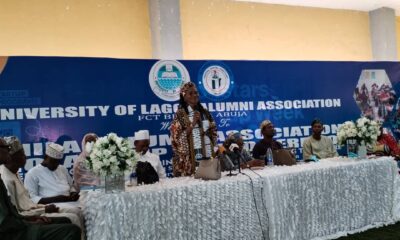

UNILAG Alumni awards scholarship to 28 indigent students
ShareBy Laide Akinboade, Abuja The University of Lagos Alumni Association, Federal Capital Territory (FCT), chapter on Thursday, awarded scholarship to...


JAMB Releases 2026 UTME Examination Slips for Candidates
ShareThe Joint Admissions and Matriculation Board (JAMB) has announced that candidates who registered for the 2026 Unified Tertiary Matriculation Examination (UTME) can now print...
Lobi Stars Target Promotion to NPFL in 2026/2027 Season
ShareThe Chairman of Lobi Stars Football Club of Makurdi, Simon Ikya, said the club’s sole target is to gain promotion...

Gambia Appoints British Barrister to Prosecute Gruesome Jammeh-era Crimes
ShareBritish barrister Martin Hackett has been appointed as The Gambia’s first special prosecutor to try those responsible for human rights abuses carried out...