
NEWS
Deputy Speaker, Kalu Urges Institutional Collaboration for Judicial Reforms


By Ubong Ukpong, Abuja
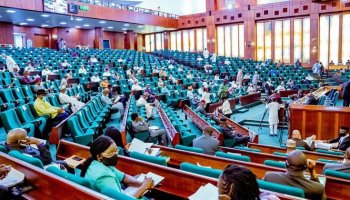
Deputy Speaker of the House of Representatives, Rt Hon. Benjamin Kalu has called on the Nigerian Bar Association (NBA) to strengthen its collaboration with the legislature in advancing justice reforms and professional standards.Kalu made the call when he received the delegation from the Nigerian Bar Association (NBA) led by the President, Mazi Afam Osigwe (SAN) who paid him a courtesy visit at the National Assembly on Wednesday.
The Deputy Speaker who doubles as Chairman House Committee on Constitution Review, said that the legislative agenda placed the justice sector at the heart of national development and through motions, bills, and oversight, the 10th House is restoring public confidence in justice delivery. He said that the ongoing alteration process was designed to be inclusive and evidence-based, noting that the lawmakers actively sought stakeholders input on various justice reform bills, geared toward achieving timely justice delivery, expanding court capacity, remuneration increase and generally improving public confidence in the judicial system.Kalu commended the Nigerian Bar Association for its steadfast commitment to justice, nation-building, and the defence of constitutional values.He said, “It is a privilege to welcome the Nigerian Bar Association to the 10th House of Representatives, which we call the People’s House. This visit by the NBA, under the able leadership of Mazi Afam Osigwe, SAN, reaffirms that the House of Representatives and the Bar share a common ancestry in justice, and a common destiny in nation-building. As lawyers, we are bound by the conviction that the law is not a mere instrument of order, but the architecture of democracy and justice.”The Nigerian Bar Association has stood for decades as the vanguard of constitutionalism and the voice of conscience in turbulent times. From the dawn of our independence to the present, the NBA has not only defended the law buthas defined it, holding power accountable, preserving human rights, and nurturing public trust in the justice system.Today, that historic compact is more vital than ever. According to the WorldJustice Project, Nigeria ranked 120th out of 142 countries on the 2024 Rule of Law Index, the same position it held in 2023. This tells us that reform, though slow, is possible when the Bar and Parliament work together. It reminds us that the rule of law must be treated as a continuous discipline of governance, not a one-off achievement.”As one who served as a lawyer for many years before becoming a legislator, I learnt early that the strength of any democracy lies in the quality of its laws and the integrity of those who interpret them. As Deputy Speaker and Chairman of the House Committee on Constitution Review, I have observed that good laws donot emerge from brilliant minds alone; they are born from broad consultations, tested by experience, and refined by justice. That is why our Constitution Review process has been designed to be both inclusive and evidence-based. We have consulted widely with legal institutions, practitioners, the judiciary, and civil society in shaping this review. I am proud to say that the Bar has not been a mere observer in this journey; it has been a co-architect. And I deeply appreciate the steadfast support, thoughtful submissions, and constructive engagement the committee has received throughout this process.”The House of Representatives have advanced key reforms to strengthen our justice system. I sponsored the High Court of the FCT (Amendment) Bill to increase the number of judges and enhance judicial efficiency. The Judicial Office Holders(Salaries and Allowances) Bill promotes fair remuneration for the bench, while amendments to the Legal Aid Council and National Legal Education Acts expand access to justice and modernise legal training. Also, ongoing harmonisation of the Constitution (Fifth Alteration) Bill further deepens judicial reforms through clearer separation of powers and stronger accountability.”These efforts embody the conviction of the 10th House that the rule of law is not sustained by courts alone; it is sustained by a culture of justice that flows from Parliament to the people. When justice works, society thrives. This is why our Constitution Review process is not about abstract clauses; it is about the concrete well-being of Nigerians. A Vision of Synergy In the 10th House, we believe in institutional synergy, not rivalry. The legislature makes the law, the judiciary interprets it, and the executive enforces it, but all three must be guided by a single compass: service to the people.”







By Laide Akinboade, Abuja
An expert in education, has urged adolescents girls in Abuja, to ensure they acquire vocational Skills ,in addition to their education, this can help them earn extra money.
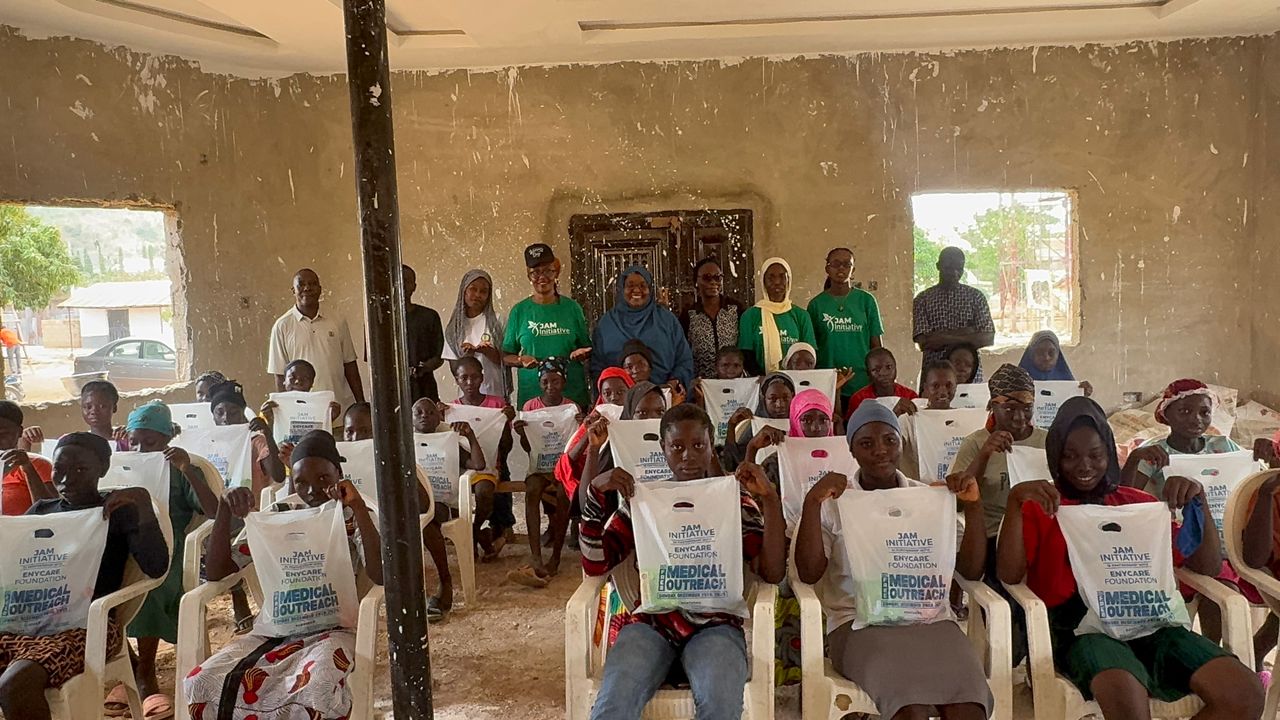
Hadjia Hauwa Wambai, PhD, made this appeal at a one day, One Day Mentorship program for Adolescent Girls, organized by JAM Intervention For Vulnerable Children And Climate Change Initiative (JAM), in Pegi, Abuja.
In her Keynote address, Hadjia Wambai, Founder, Al- Masareef Foundation spoke to the girls about the importance of acquiring Skills that can help them earn extra money.
She said Students must read for at least One hour everyday after School.
This she said will help to pass their exams effortlessly instead of leaving the Studies till a few days to exam period.She explained the importance of hygiene during the Menstrual Cycle and the need to ensure that as Girls and young Women, they are neat, focused, skilled ,hardworking and well behaved.
According to her, these are hallmarks of leadership and the Girls are expected to grow up to be leaders in their respective fields of endeavors.
The one day programme that was in commemoration of the 2026 International Women’s Day 2026, with the theme ‘Justice. Rights. Action with the Sub- theme; Give To Gain’.
Earlier in her address, the Founder Of JAM-Initiative, Josie Mudasiru JP, said that mentoring the Girls by educating them on their Rights and opportunities available to them is her own way of giving back to the Society.
Mudasiru, encouraged the Girls to ensure that they impact their siblings and family members with the knowledge they have acquired at the Mentorship program.
She urged them to concentrate on their academic work and be enticed by yahoo Boys.
” Be focused, be hardworking and God fearing. That is the only way to good Success. Dare to dream and with hardwork and perseverance, all your dreams will become a reality.
While speaking one of the participants,
14 year old Salome Markus said She wanted to an Astronaut but the Father said that the profession was reserved for Men, but the Mentorship program has inspired her not to give on her dreams.
Another 14 year old Adolescent Girl, Suweiba Haruna said the program has motivated her to be more serious with her Academics .
The Village Head of Pegi Village, Chief Irimiya Nisana who volunteered the use of his Palace for the program said he was elated that his Community was choosen for such an important event.
He said JAM- Initiative and other ngos are welcomed to his Community because he is interested in the growth and development of all members of his Community; especially the Girl Child.
The Girls Were given a package containing Exercise Books, a Pack of Sanitary pads and refreshment.

From Joseph Amedu, Lokoja
Kogi state Governor, Usman Ododo has launched the renovation of 728 Government-owned Public Schools under the Adolescent Girls Initiative for Learning and Empowerment (AGILE) intervention across the three Senatorial Districts of the state.
Ododo while performing the flag off ceremony at the Government House, Lokoja on Thursday, gave an assurance that his administration will continue to accord education sector topmost priority.
The Governor who was represented by his Deputy, Joel Oyibo, reaffirmed his unwavering commitment to the transformation of the education sector in Kogi State.
Ododo commended Kogi AGILE for its intervention programme in the state particularly in the promotion of Girl Child education.
It is a statement that every child in Kogi State deserves a decent place to learn.
It is a statement that our teachers deserve an environment that supports excellence.
And it is a statement that this administration is determined to leave a lasting legacy in the education sector.
To the Technical Service Providers, let me be clear this administration expects quality, transparency, and timely delivery. There will be no compromise on standards.
“The work you do here will speak for years to come, and you must rise to that responsibility.
As we flag off this initiative today, we are not just starting construction work; we are igniting transformation. We are restoring confidence in our public schools, improving learning conditions, and creating opportunities for thousands of young people across Kogi State.
“My administration will continue to prioritize education and ensure that every intervention delivers real and measurable impact.
Together, we will build a system that works for all; one that empowers our children, strengthens our communities, and secures the future of our State”
Earlier, the Kogi State Project Coordinator of Adolescent Girls Initiative for Learning and Empowerment (AGILE), Tijani Oricha disclosed that the renovation intervention is aimed at providing conducive learning environments and the needed comfort for teachers and students to enhance effective teaching and learning.
According to him, the effort would also go a long way in strengthening school systems generally across the state.
He appreciated the First Lady of Kogi State, Hajia Sefinat Usman Ododo, whose passion for the empowerment of the girl child has been greatly inspiring.
“As the Mother of the AGILE Project in Kogi State, your advocacy and dedication have continued to give life and direction to this initiative and we are deeply grateful for your continued support.
“We respectfully acknowledge and appreciate our revered Royal Fathers and Religious Leaders whose influence in shaping values, guiding communities, and mobilizing support at the grassroots level is invaluable. We count on your continued support to ensure that this intervention is protected, sustained, and embraced by the communities it is meant to serve.
“The renovation and rehabilitation of 728 government-owned schools across Kogi State represents one of the most far-reaching investments in the education sector in recent times. This is not just a number, it is 728 opportunities to change learning environments, 728 platforms to restore dignity to education, and 728 communities that will experience renewed hope.
“This initiative will directly impact thousands of students and teachers across the State. It will improve safety, enhance attendance, boost teacher morale, and ultimately lead to better learning outcomes. For the girl child in particular, it creates a more inclusive and supportive environment that encourages retention, participation, and success. Ladies and gentlemen, this is how we build the future intentionally, inclusively, and sustainably.
“To the School-Based Management Committees, this is actually a defining moment for you as the custodians of this crucial intervention at the community level. I charge you to take full ownership of these projects. Protect them, monitor them, and ensure that every resource deployed translates into visible and lasting impact. The success of this initiative at the grassroots level depends largely on your commitment and vigilance.
“We have carefully chosen 30 Technical Service Providers to commence the first phase of intervention in 150 selected schools across Kogi State. And we urged the TSPs to be conscious of the moral and professional responsibilities that come with this important engagement. The structures you build today will shape the experiences of generations to come.
“We expect nothing short of quality, adherence to standards, and timely delivery. Accountability, transparency, and excellence must guide your work at every stage.
“Let me also emphasize that this project will be closely monitored. Every kobo invested must deliver value. Every structure must meet standard. Every community must feel the impact. That is why you joined the SBMC to signed the indemnity instrument to entrench commitment to service delivery”
“Kogi State Governor, Alhaji Ahmed Usman Ododo has done very well in ensuring that children have access to quality education hence the need for AGILE to complement that effort”.

Iran has warned the United States (U.S.) and Israel that it would launch further and more severe attacks, escalating tensions amid ongoing hostilities.
A spokesman for the country’s armed forces headquarters said yesterday that Iran’s adversaries underestimated its military capabilities.
”You know nothing about our very extensive and strategic capabilities,” the spokesman said, adding that recent strikes by the U.
S. and Israel had failed to significantly weaken Iran’s military strength.The spokesman dismissed the importance of previously targeted sites, describing them as insignificant, and insisted that key military production facilities remained intact and beyond the reach of foreign forces.
He also rejected claims that Iran’s strategic weapons programmes, including missile systems, long-range drones, air defence technologies and electronic warfare capabilities had been seriously damaged.
The warning signals a potential intensification of the conflict, with the spokesman stating that military operations would continue until Iran’s opponents “capitulate”.
Syria rejects forced deportations from Germany amid migration debate
Syria has rejected proposals for the large-scale return of its nationals from Germany, warning against any forced deportations amid an ongoing migration debate in Europe.
Syrian Foreign Minister, Asaad al-Shaibani, said Syrians living abroad should be viewed as “strategic resources, not a burden”, dismissing suggestions that they should be compelled to return.
”We categorically reject any attempts at forced deportation. Authorities are working with international partners to rebuild infrastructure and create conditions for a voluntary and dignified return,” he wrote on X.
At a joint press conference, German Chancellor Friedrich Merz had said that up to 80 per cent of the more than 900,000 Syrians living in Germany could return home within three years.
He said that returnees would be needed to support reconstruction efforts, while noting that well-integrated Syrians would be allowed to remain.
The remarks sparked criticism across Germany’s political spectrum.
A day later, Merz said the figure had been cited by al-Sharaa, a claim the Syrian leader rejected during an event in London.
Al-Sharaa insisted that any return of refugees must be voluntary and linked to improvements on the ground in Syria, warning that forced deportations could trigger further displacement.
Germany has hosted more Syrians than any other European Union country since the outbreak of the Syrian civil war, which lasted 14 years.
Following the ousting of longtime ruler Bashar al-Assad in late 2024 by a rebel alliance led by al-Sharaa, calls have intensified among conservative politicians in Germany for refugees to return.
U.S. Military Strikes Over 12,300 Targets in Iran, Says Centcom
The U.S. military on Wednesday said that it had struck more than 12,300 targets in Iran during the conflict, which has been ongoing for just over a month.
The U.S. Central Command (CENTCOM), which oversees U.S. forces in the region, said in an update on Wednesday that its forces “Damaged or Destroyed” more than 155 Iranian vessels among the more than 12,300 targets struck since the start of the war.
“CENTCOM forces are striking targets to dismantle the Iranian regime’s security apparatus, prioritising locations that pose an imminent threat,” the command said.
The Israeli military said on Wednesday that Israel had so far carried out more than 800 strikes in Iran.
Israel and the United States have been attacking Iran since Feb. 28, with Iran responding with attacks on Israel and U.S. allies in the Gulf region.



Nigerian Military Reports Major Gains in Nationwide Anti-Terror Operations
ShareBy David Torough, Abuja The Armed Forces of Nigeria has announced significant operational successes in its ongoing counter-terrorism and anti-crime...

Group trains 50 girls on Menstrual hygiene, skill acquisition etc
ShareBy Laide Akinboade, Abuja An expert in education, has urged adolescents girls in Abuja, to ensure they acquire vocational Skills...

SDP Leader, Adebayo Urges Nigeria to Reconnect With Independence-era Ideals at Stakeholders’ Summit
ShareBy Mike Odiakose, Abuja The national leadership and former presidential candidate of the Social Democratic Party (SDP), Prince Adewole Adebayo,...

Ododo Flags Off 728 Government-owned Renovated Public Schools in Kogi
ShareFrom Joseph Amedu, Lokoja Kogi state Governor, Usman Ododo has launched the renovation of 728 Government-owned Public Schools under the Adolescent Girls Initiative for Learning...


Super Eagles Set for Poland, Portugal Friendlies Ahead of World Cup
ShareThe Super Eagles will face Poland and Portugal in international friendlies in June as part of preparations for upcoming global competitions, the Nigeria Football...


Iran Threatens U.S, Israel with Harsher Attacks
ShareIran has warned the United States (U.S.) and Israel that it would launch further and more severe attacks, escalating tensions amid ongoing hostilities. A spokesman for...


EFCC Seeks Final Forfeiture of 57 Properties Linked to Malami
ShareThe Economic and Financial Crimes Commission, on Thursday, urged the Federal High Court in Abuja to order the permanent forfeiture...


Easter: NSCDC Deploys 57,000 Personnel Nationwide
ShareThe Nigeria Security and Civil Defence Corps (NSCDC) has deployed 57,000 operatives nationwide to ensure security of lives and property...


NSIA Grows Net Asset Value to $3.40bn in 2025
ShareBy Tony Obiechina, Abuja Nigeria Sovereign Investment Authority(NSIA) has announced its 2025 Group Financial Performance posting a net Asset value...


ADC, APC Clash over INEC Role as Leadership Crisis Deepens
ShareBy David Torough, Abuja A fresh political storm erupted on Thursday as the African Democratic Congress (ADC) and the All...