
NEWS
‘Ember Month’: FRSC counsels motorists on rules, regulations of driving

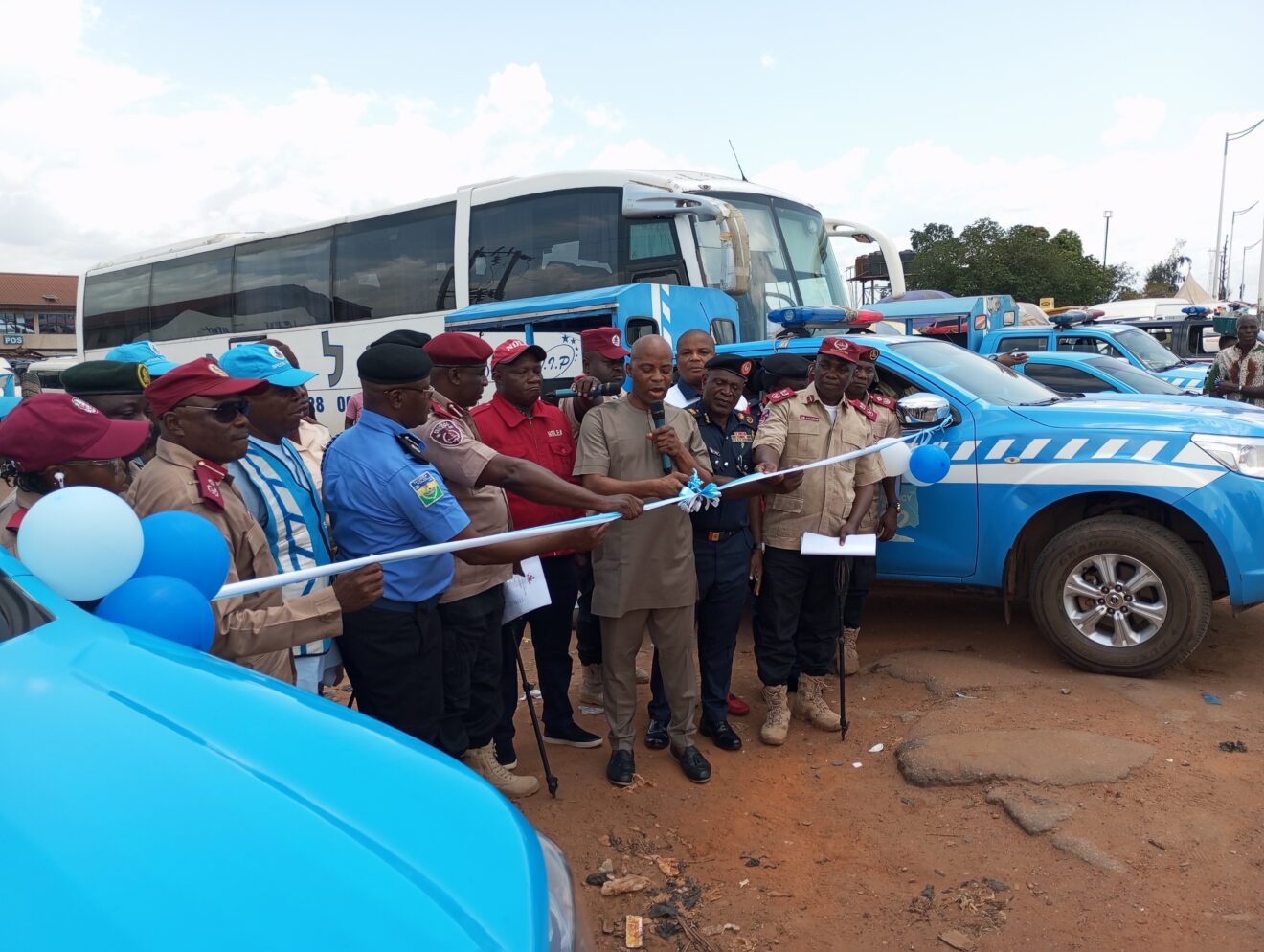
The Federal Road Safety Corps(FRSC), Delta State Command, advises motorists to obey traffic rules and regulations to stem crashes on highways during and after the ember months.
Mr Bassey Eshiet, the Sector Commander of FRSC Delta Command, gave the advice on Thursday at the flag-off of Ember Months Campaign 2023 entitled: “Speed Thrills, Speed Kills, Drive Responsibly and Avoid Overloading”.
According to him, toward the end of every year the volume of traffic increases, coupled with high incidences of road traffic infractions.
“These infractions include route violation, excessive speeding, dangerous driving, wrongful overtaking, overloading, drunk driving, drivers fatigue and making call while driving.
“These risk factors result in Road Traffic Crashes with fatalities, and the high vehicular volume due to surge in movement of people results in traffic gridlock, fatigue and sometimes Road Traffic Crash amongst others.
“The Corps’ determination to check these trends and ensure free flow of traffic culminated in 2023 Ember months road safety campaign prior to the commencement of year 2023 End of year Special Patrol Operation from December 2023 to January 2024.
“The aim of the campaign is to immensely reduce crashes and to ensure as much as possible the elimination of death from crashes that may occur if any,” he said.
Eshiet noted that the higher the speed of a vehicle, the shorter the time a driver had to stop and avoid a crash adding that speeding contributed to the severity of the impact when a collision occur.
According to him, controlling vehicle speed can prevent crashes and reduce the impact when they do occur, lessening the severity of injuries sustained by the victim.
“What is obvious to you may not be to others, most people don’t think `Road Safety’ as long as they have a good vehicle and a reasonable stretch of road.
“A car travelling at 50km/h will typically require 13 metres to stop, while a car travelling at 40km/h will stop in less than 8.5 metres.
“An increase in average speed of 1 km/h typically results in a 37 per cent higher risk of a crash involving injury, with a four per cent to five per cent increase for crashes that result in fatalities.
“For car occupants in a crash with an impact speed of 80km/h, the likelihood of death is 20 times what it would have been at an impact speed of 30km/h.
“The relationship between speed and injury severity is particularly critical for vulnerable road users such as pedestrians and cyclists.
“Pedestrians have been shown to have a 90 per cent chance of survival when struck by a car travelling at 30km/h or below, but less than 50 per cent chance of surviving an impact at 45km/h.
“Pedestrians have almost no chance of surviving an impact of 80km/h,” he said.
The Delta Governor, Sheriff Oborevwori, represented by Vincent Ehiwario, Director, Vehicle Inspection Service (VIS), identified lack of maintenance culture as a major cause of crashes on the road
“Many people fail to engage in simple maintenance check and servicing of their vehicle such as the break, tires, steering etc.
“It is important to check these things because they are major causes of road crashes, and checking them can prevent loss of lives and properties,” he said.
Mr Silas Omobude, Assistant Director, Narcotics, National Drug Law Enforcement Agency (NDLEA), warned motorists to desist from illicit use of drugs on steering, drunk-driving during and after the “ember” month.
“Most of the road crashes that occur during the ’ember’ months are caused by bad attitudes of drivers.
“Drunk-driving, illicit use of drugs is not allowed during, before and after ’ember’ months.
“Motorists should ensure effective functioning of the steering system, headlights, brake, wipers and tyres, for safety,” he said.(NAN)


The Joint Admissions and Matriculation Board (JAMB) has announced that candidates who registered for the 2026 Unified Tertiary Matriculation Examination (UTME) can now print their examination notification slips.
The board disclosed this in a statement signed by its Public Communication Adviser, Fabian Benjamin, on Thursday in Abuja.
Benjamin said the examination would commence on April 16, urging candidates to print their slips to confirm their examination date, venue and time.
He advised candidates to visit the board’s website, www.jamb.gov.ng, and click on “2026 UTME Slip Printing” to access and print their notification slips.
According to him, candidates are encouraged to print the slips early and familiarise themselves with their examination centres ahead of the examination date to avoid inconvenience.
He said each candidate had been assigned a specific examination schedule, adding that candidates should arrive at their centres ahead of time to allow for proper screening and accreditation before the commencement of the examination.
Benjamin added that enhanced security measures had been introduced for the 2026 UTME to curb examination malpractice.
He warned candidates and centre operators to desist from any form of misconduct, stressing that strict sanctions would be applied against offenders.
British barrister Martin Hackett has been appointed as The Gambia’s first special prosecutor to try those responsible for human rights abuses carried out during the 22-year rule of ex-President Yahya Jammeh, which ended when he went into exile in 2017.
Hackett will head a newly created office charged with dealing with the cases from a period characterised by widespread repression, enforced disappearances and extrajudicial killings.
The Truth, Reconciliation and Reparations Commission (TRRC) was set up to document the extent of the alleged abuses.
In its final report, handed to current President Adama Barrow in 2021, it identified those most responsible and recommended their prosecution.
The TRRC, which heard harrowing testimony from victims, former security operatives and other witnesses, also called for reparations to be paid to the victims, warning that failure to act risked entrenching impunity.
The TRRC has started phased compensation payments, starting with victims of abuses committed shortly after the 1994 coup when Jammeh first came to power.
But for many survivors, financial compensation is secondary to accountability.
Among the most notorious cases highlighted by the TRRC were the 2004 killing of journalist Deyda Hydara and the murder of more than 50 mainly West African migrants, executed by security forces after being wrongly accused of plotting a coup.
A handful of perpetrators have already been convicted abroad under the principle of universal jurisdiction, including former members of the notorious paramilitary unit and death squad known as “the Junglers” – some of whom have been jailed in Germany and the US.
The appointment of Hackett, who has previously served at the UN-backed Special Tribunal for Lebanon and who investigated war crimes committed by senior military commanders during the Kosovo war, is seen as a decisive step towards domestic accountability.
Attorney General Dawda Jallow was quoted as saying that Hackett had a four-year mandate and was chosen from a wide selection of candidates.
Jammeh, who refused to co-operate with the TRRC, only left power at the insistence of regional leaders.
They sent in troops to The Gambia when he refused to step down after his shock election defeat in December 2016.
Now aged 60, Jammeh has previously denied wrongdoing and is believed to be living in exile in Equatorial Guinea.
Justice Peter Lifu of the Federal High Court, Abuja, on Thursday, sentenced a Boko Haram victim, Ali Kolo, to nine years’ imprisonment after over a decade in detention, but ordered his immediate release.
Kolo, who was shot in the right leg by Boko Haram insurgents in Borno State while attempting to report their activities to the military, was found guilty of failing to disclose information about the terrorist group to security agencies.
He was arraigned by the Federal Government on four counts but pleaded guilty to a single charge bordering on concealment of information on terrorist activities.
The prosecution counsel, David Kaswe, told the court that the defendant, in 2017, failed to relay information on insurgents’ activities to the military or any security agency, contrary to the provisions of the Terrorism Prevention and Prohibition Act, 2013.
Kaswe, a Deputy Director in the Federal Ministry of Justice, tendered the defendant’s extra-judicial statement and an investigation report, both of which indicted him. The exhibits were admitted without objection from defence counsel, A.O. Usman.
The prosecution subsequently urged the court to impose a 10-year jail term on the defendant, citing his guilty plea and confessional statement.
However, Kolo told the court that he was attacked and shot with an AK-47 rifle while on his way to report the insurgents, leaving him hospitalised and unable to fulfil the obligation.
His counsel pleaded for leniency, arguing that his failure to report the terrorists was due to circumstances beyond his control.
In his judgment, Justice Lifu agreed that the defendant failed to report the activities of the insurgents but held that the omission was influenced by factors beyond his control.
The judge sentenced him to nine years’ imprisonment but ruled that the sentence should take effect from 2017, when he was first detained.
He noted that the convict had already spent over 10 years in custody and ordered his immediate release to enable him to seek medical attention for injuries sustained during the attack.
Despite reservations expressed by the prosecution, the court maintained that Kolo was not convicted for terrorism or membership of a terrorist group, but solely for concealment of information.
Justice Lifu held that the defendant had “suffered enough” and warned that continued detention would amount to double jeopardy.
In a related development, the court sentenced a Borno State-based bricklayer, Ibrahim Buba, also known as Baba Gana, to 10 years’ imprisonment for failing to disclose information on Boko Haram activities.
Buba admitted in court that he knew two members of the terrorist group but failed to report them. He told the court that he fled from Borno to Mubi in Adamawa State and later relocated to Onitsha, Anambra State, where he was arrested in 2023.
He pleaded for leniency, but the court sentenced him to 10 years’ imprisonment, rejecting the prosecution’s request for a 20-year term.
Justice Lifu ordered that the sentence should take effect from March 24, 2023, the date of his arrest and detention.


UNILAG Alumni awards scholarship to 28 indigent students
ShareBy Laide Akinboade, Abuja The University of Lagos Alumni Association, Federal Capital Territory (FCT), chapter on Thursday, awarded scholarship to...


JAMB Releases 2026 UTME Examination Slips for Candidates
ShareThe Joint Admissions and Matriculation Board (JAMB) has announced that candidates who registered for the 2026 Unified Tertiary Matriculation Examination (UTME) can now print...
Lobi Stars Target Promotion to NPFL in 2026/2027 Season
ShareThe Chairman of Lobi Stars Football Club of Makurdi, Simon Ikya, said the club’s sole target is to gain promotion...

Gambia Appoints British Barrister to Prosecute Gruesome Jammeh-era Crimes
ShareBritish barrister Martin Hackett has been appointed as The Gambia’s first special prosecutor to try those responsible for human rights abuses carried out...

Court Frees Terror Victim, Jails another 10 Years
ShareJustice Peter Lifu of the Federal High Court, Abuja, on Thursday, sentenced a Boko Haram victim, Ali Kolo, to nine years’ imprisonment...
Lassa Fever Deaths Rise in Nigeria —NCDC
ShareThe Nigeria Centre for Disease Control and Prevention (NCDC), said Lassa fever fatalities have risen sharply in 2026, in spite of a decline in...


Recapitalisation: CBN Demands Tougher Risk Discipline, Governance Reforms
Share The Central Bank of Nigeria (CBN) said strong governance and risk discipline are critical to the success of Nigeria’s...

DHQ Confirms Terrorists, Soldiers Deaths in Borno Base Midnight Attack
ShareBy David Torough, Abuja A fierce overnight assault on a military base in Benisheikh, Borno State, has left several soldiers...


Nigeria’s Democracy Must Thrive, Obasanjo, Jonathan Declare
ShareBy David Torough, Abuja Former Presidents Olusegun Obasanjo and Goodluck Jonathan have issued a strong call for national unity, institutional...
Akpabio Steps in to Unveil Lagos Projects on Tinubu’s Behalf
ShareSenate President Godswill Akpabio has inaugurated the new Open-Mende-Ojota Link Bridge Project and the Multi-agency complex, Alausa, now known as...