
security
Joint Security Operatives Arrest 113 Suspected Kidnappers in Edo

From Jude Dangwam, Jos
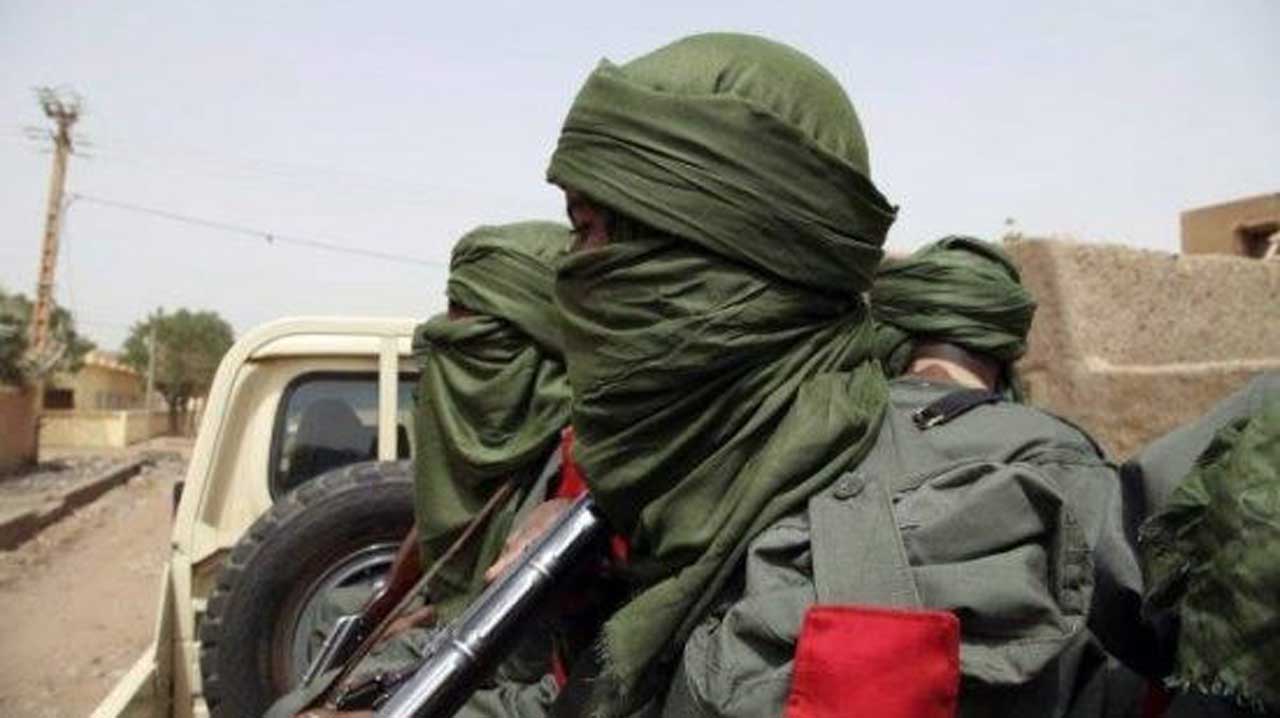
Heightened security concerns gripped parts of the country on Thursday as authorities in Plateau State, Edo State and Osun State rolled out coordinated responses to killings, kidnapping and human trafficking.
In Jos, the Vice Chancellor of the University of Jos, Prof.
Ishaya Tanko, directed staff and students to heighten vigilance following recent attacks and killings in several Plateau communities that have escalated tension in the state capital.In a statement issued by the institution’s Deputy Registrar, Information and Public Relations, Emmanuel Madugu, management urged members of the university community to avoid unnecessary movement, especially in the early hours, and to promptly report any breach of peace to the University Security Division.
Security agencies, including soldiers and police, have been deployed to strategic locations across Jos metropolis as authorities work to restore calm.Also reacting to the deteriorating security situation, the President of the Plateau Initiative for the Development and Advancement of the Natives (PIDAN), Amb. Nanpon Danjuma Sheni, condemned the growing trend of highway blockades during violent outbreaks. He cautioned youths against mob actions, stressing that such protests inflict hardship on innocent travellers and damage the state’s image.
Sheni called on community, traditional and religious leaders to intensify peace advocacy and discourage reprisals, insisting that sustainable peace can only be achieved through the rule of law and professionalism of security agencies.
While Plateau battled tension, security operatives in Edo recorded a major breakthrough against kidnapping networks. The Nigeria Police Force, working with the Nigerian Army, the Nigeria Security and Civil Defence Corps, vigilante groups and local hunters, arrested 113 suspected kidnappers and collaborators in early-morning raids on settlements in Agbede and Iruekpen communities.
Police spokesperson Eno Ikoedem said the intelligence-driven operation targeted locations allegedly used for coordinating ransom payments and regrouping. The suspects are undergoing profiling to determine their involvement, as the Commissioner of Police reaffirmed the command’s resolve to dismantle kidnapping syndicates and prosecute offenders.
In Osun, operatives of the State Intelligence Department of the Nigeria Police Force rescued 15 young persons suspected to be victims of a human trafficking syndicate during a raid on a residence in Osogbo. The victims, said to have been lured from Niger, Togo and the Benin Republic with false promises of employment, were found lodged in a three-bedroom apartment under suspicious circumstances.
Police spokesperson Abiodun Ojelabi confirmed that one suspect has been arrested while others remain at large. The rescued victims are receiving care in protective custody as authorities work to reunite them with their families and track down fleeing members of the syndicate.
Across the affected states, security agencies reiterated calls for vigilance and public cooperation, assuring residents that sustained operations are underway to restore peace, dismantle criminal networks and safeguard lives and property.

By David Torough, Abuja
A former Nigerian senator and diplomat, Iyorwuese Hagher, has accused armed herdsmen and bandits of carrying out what he described as a “genocide” in the Sankera axis of Benue State, alleging that more than 2,600 people have been killed and over half a million displaced since 2015.
Addressing journalists on Wednesday, Hagher said the violence across Sankera, a chiefdom in Benue northeastern, amounts to crimes against humanity under international law.
He claimed that 3,580 square kilometres of land, nearly 59 percent of the area, had been seized by armed groups, leaving vast stretches of once-thriving farming communities deserted.
“The scale of this genocide is undeniable,” Hagher said, arguing that the sustained attacks on villages, mass displacement, and destruction of livelihoods reveal a systematic campaign targeting civilian populations.
Hagher recounted an emotional visit on February 18 to his ancestral home in Kasar, in Katsina-Ala Local Government Area, after years of being unable to access it due to insecurity.
Accompanied by Nigerian soldiers, he said he traveled through what he described as a “corridor of silence”, abandoned villages, charred homes, and freshly dug graves.
“There were no humans except decomposing corpses protruding from a pit on the main road,” he told reporters. “This was organised violence and terror that emptied an entire corridor of human civilisation.”
He described Kasar as the “epicentre” of the atrocities, adding that multiple wards across Katsina-Ala, Ukum, and Logo local government areas had been overrun.
Hagher accused the Benue State Government of downplaying the crisis and misdirecting resources. He criticised a recent request by the state government seeking federal approval to establish a rehabilitation centre for bandits, arguing that such a move prioritises perpetrators over victims.
He further alleged that official silence and inadequate documentation have obscured the scale of the crisis, warning that denial could amount to complicity under the Genocide Convention, which Nigeria has signed.
While noting that the administration of President Bola Ahmed Tinubu is collaborating with the United States on counterterrorism support, Hagher said efforts must focus first on returning displaced communities to their homes and ensuring justice.
According to Hagher, more than one million people have been displaced across Benue State, including in Gwer West, Gwer East, Guma, Agatu, and Kwande local government areas. Border communities near Cameroon were also described as occupied.
He cited reports from UNICEF indicating alarming levels of malnutrition and stunted growth among displaced children. Many schools and health facilities across Sankera, he said, have been closed for nearly a decade, leaving children without access to education and exposing young girls to forced marriages and boys to recruitment by armed groups.
“Benue State is Nigeria’s food basket. A war on farmers is a war on food,” Hagher said, warning that prolonged instability threatens regional food security in West Africa.
Hagher called on the Federal Government to declare a state of emergency in the Sankera axis and deploy sufficient, rights-respecting security forces to restore control. He also urged the establishment of an independent judicial peace and reconciliation commission to investigate atrocities and ensure accountability.
Beyond Nigeria, he appealed to the African Union, Economic Community of West African States, and the United Nations Human Rights Council to conduct fact-finding missions and review the situation.
“If fifty square kilometres of once-thriving communities can vanish in silence, the world’s moral architecture is at risk,” Hagher said. “Let this mark the end of silence and the beginning of the global conscience’s response.”
From Yagana Ali, Yola
Suspected Boko Haram terrorists have launched a brutal assault on the towns of Shuwa and Kirchiga in Madagali Local Government Area of Adamawa State, leaving at least 10 people dead and several homes razed.
The attack, which occurred in the late hours of Tuesday, has forced residents to flee into nearby bushes for safety.
Eyewitnesses describe chaotic scenes of smoke, gunshots, and devastation as the insurgents overran the communities, setting buildings ablaze and shooting sporadically.
The terrorists also targeted Kirchiga market, where Nigerian military troops engaged them in fierce fighting, but were reportedly repelled.
The attack is the latest in a string of assaults by Boko Haram in Adamawa State, highlighting the ongoing security challenges in the region.
Meanwhile Governor Ahmadu Umaru Fintiri has issued a stern warning to perpetrators of recent attacks in Madagali and Hong LGAs, describing the acts as “cowardly terrorism” that won’t be tolerated. “We will not let terrorists undermine our efforts to restore peace and stability,” he declared.
Fintiri reassured citizens of the government’s unwavering commitment to defeating terrorism, saying, “We have done this before, and we’re determined to do it again.” He promised to collaborate with security agencies to protect citizens and bring perpetrators to justice.
“Go about your business, we have your back,” Fintiri urged residents. “We’ll protect you and your livelihoods.” He commended security agencies for their bravery and pledged continued government support.
The Governor appealed to Adamawa people to support the government, saying, “Together, we’ll triumph over terrorism and build a brighter future.” His message was clear: Adamawa is open for business, and hoodlums are not welcome.
By David Torough, Abuja
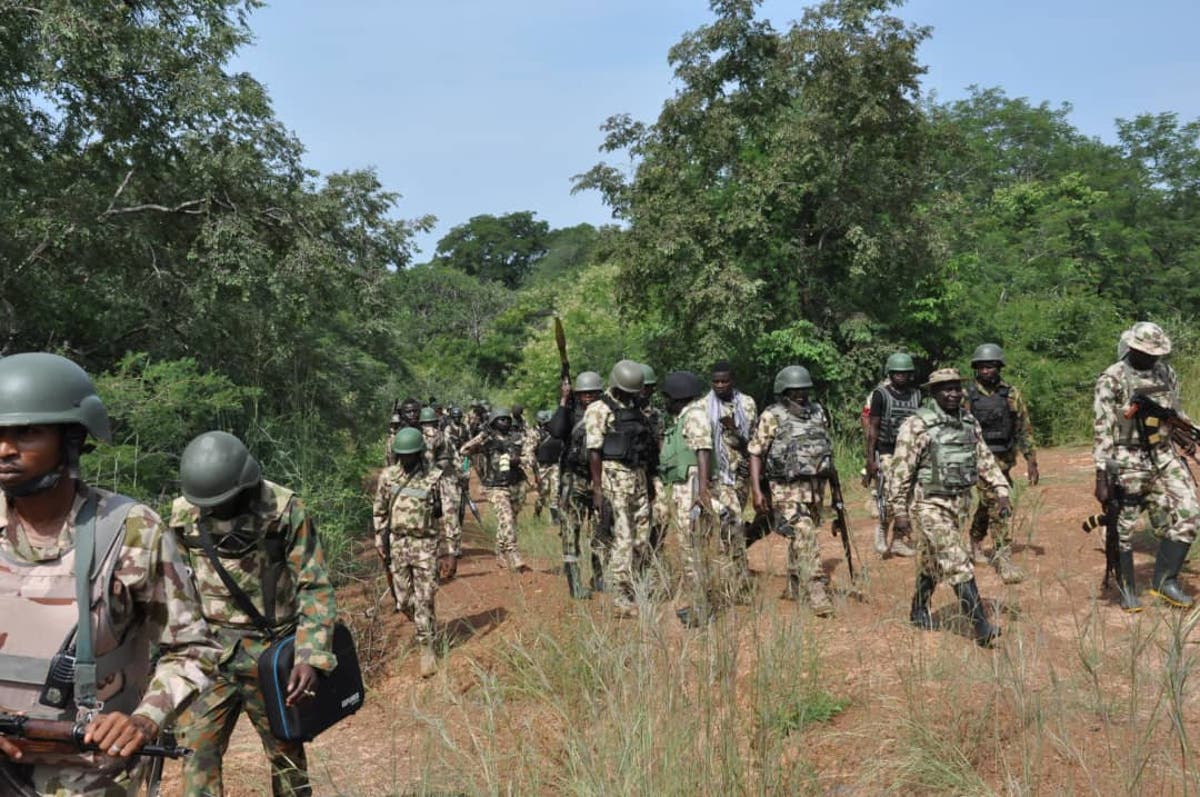
Troops of Operation Hadin Kai have killed 29 terrorists and repelled coordinated attacks in Borno and Yobe states, as the Federal Government declared that many of those behind recent killings in Nigeria are foreign nationals who infiltrated the country through porous borders.
The military operations, conducted between Saturday and Sunday, targeted insurgent strongholds in Lamusheri Village in Gujba Local Government Area of Yobe State, as well as the Forward Operating Base (FOB) Limankara and Kukawa in Borno State.
In a statement, the Media Information Officer of the Joint Task Force, North East, Operation Hadin Kai, Lt.
Col. Sanni Uba, said the troops demonstrated “clear combat superiority” in thwarting the attacks.According to him, 15 terrorists were neutralised in Gujba during a precision raid under Operation Desert Sanity V. Acting on intelligence supported by surveillance and reconnaissance platforms, troops stormed Lamusheri Village — identified as a key logistics hub for insurgents — in the early hours of February 22.
Despite coming under fire, soldiers, working in synergy with the Civilian Joint Task Force, outflanked the insurgents and cut off their escape routes. Fifteen terrorists were killed, while several others fled with gunshot wounds.
At FOB Limankara, troops repelled an attempted infiltration without suffering casualties or equipment losses, although human intelligence sources confirmed significant casualties among the attackers.
In Kukawa, insurgents launched a coordinated, multi-pronged assault but were overpowered by superior firepower and air support. Fourteen terrorists were killed during the engagement. However, one soldier was killed in action, and some equipment was destroyed by rocket fire. Injured personnel were evacuated and are reported to be in stable condition.
During follow-up exploitation, troops recovered 13 AK-47 rifles, 16 loaded magazines, three handheld radios and other items. Military authorities said the sustained and synchronised offensives underscore their resolve to degrade the terrorists’ operational capacity across the theatre.
Meanwhile, the Federal Government has maintained that many of those perpetrating attacks in the country are foreigners.
Speaking at the First Plenary of the Catholic Bishops’ Conference of Nigeria (CBCN) in Abuja, Secretary to the Government of the Federation, George Akume, said intelligence reports indicated that numerous suspects arrested in connection with recent violence were not Nigerians.
“Many of these people who have been arrested don’t speak English. They speak very poor Hausa, but they speak French. Do we speak French in Nigeria? No,” he said.
Akume acknowledged that insecurity remains a major challenge but noted that the crisis predates the current administration and reflects a global trend.
While clarifying that extremist groups such as Boko Haram originated within Nigeria, he insisted that several of the fighters currently operating in forests and rural communities — particularly in parts of Niger State and other affected areas — are from outside the country.
He added that Nigeria’s recent designation as a Country of Particular Concern (CPC) over security and religious freedom issues has strengthened international collaboration, especially with the United States.
Akume disclosed that President Bola Tinubu recently visited Turkey to procure additional military hardware, including drones, to reinforce the nation’s security architecture.
“The main reason the President was in Turkey was to purchase more armaments. This includes drones. So we are not just sitting idle,” he said.
The SGF also clarified that attempts to reintegrate former insurgents were initiated under a previous administration but did not advance significantly and were eventually halted after resistance from stakeholders.
As military operations intensify in the North-East, authorities say the combined strategy of sustained ground offensives, air support and international cooperation is aimed at restoring stability and curbing cross-border terrorism.




ShareBPE Projects N189.1bn Revenue in 2026 By Tony Obiechina, Abuja The Bureau of Public Enterprises (BPE) said it has an...

Joint Security Operatives Arrest 113 Suspected Kidnappers in Edo
ShareFrom Jude Dangwam, Jos Heightened security concerns gripped parts of the country on Thursday as authorities in Plateau State, Edo...


Electoral Act: Atiku, Obi, Amaechi, Mark, Others Reject Amendment
ShareBy David Torough, Abuja Leaders of the African Democratic Congress (ADC) and the New Nigeria Peoples Party (NNPP) have called...
Lugbe Residents Appeal to Tinubu over Deteriorating Roads in Area
ShareConcerned residents and road users in Lugbe, Abuja, have appealed to President Bola Tinubu to urgently intervene in the deteriorating...


Reps Summon REA MD, Demand Written Response within 48 Hours
ShareBy Ubong Ukpong, Abuja The House of Representatives Committee on Renewable Energy has directed the Managing Director of the Rural...

ShareDele Giwa: Alive in Words By Sam Akpe Finally, here it is! Dele Giwa, the late journalism icon, is back...
Disarmament and Demobilization of Armed Groups and Violent Extremism in Benue State?
ShareBy Uji, Wilfred The idea of disarmament and demobilization of armed and military groups dates back to the United Nations...


Do Nigerians Really Deserve The Leadership They Get?
ShareBy Pius Mordi Although the American media portrayed him as an advocate of violent resistance in the civil rights struggle,...
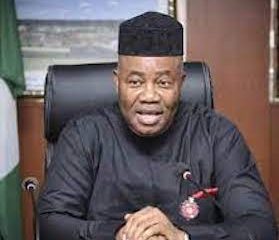

Electoral Act 2026 As Legacy of Akpabio-led 10th Assembly
ShareBy Ola Awoniyi Parliaments are remembered by the signature Bills that they passed. For the Godswill Akpabio-led 10th National Assembly,...


Hagher Alleges Genocide in Benue’s Sankera, Urges Federal Emergency Rule
ShareBy David Torough, Abuja A former Nigerian senator and diplomat, Iyorwuese Hagher, has accused armed herdsmen and bandits of carrying...