
DEFENCE
Police seek rescheduling of FCT workers’ protest


The Police Command in the Federal Capital Territory (FCT) has appealed to the FCT Council of the Nigeria Labour Congress (NLC) to shelve its planned strike slated for Feb. 3.
The Police Public Relations Officer in the FCT, SP Josephine Adeh, made the appeal in a statement on Monday in Abuja.
She said the appeal followed intelligence reports of possible infiltration and hijacking of the peaceful protest by members of the proscribed Islamic Movement of Nigeria and other non-state actors.
“In the overriding interest of public safety, the Police Command in the FCT respectfully appeals to the organisers of the protest to consider rescheduling the activity to a later date and time.
“This measure is aimed at forestalling any breakdown of law and order.
“It is also to ensure that the rights of other residents to safety, freedom of movement, and the conduct of lawful daily activities are not infringed upon,” she said.
Adeh said the appeal was in recognition of the constitutional rights of citizens to peaceful assembly and protest.
She pledged the commitment of the command to providing adequate security for all lawful activities.
Adeh said the command would not relent in its efforts to the protection of lives and property.
She enjoined residents to continue to cooperate with law enforcement agencies in their collective effort to maintain peace and security. (NAN)
DEFENCE
Nigerian Army Adopts Intelligence-Led, Multi-Domain Strategy Against Evolving Security Threats

By David Torough, Abuja
The Nigerian Army has reaffirmed its commitment to an intelligence-driven, technology-enabled and multi-domain approach to countering asymmetric threats confronting the country.
Chief of Army Staff (COAS), Lieutenant General Waidi Shaibu, made this known on Tuesday while delivering a strategic lecture to participants of the National Defence College (NDC), Course 34, in Abuja.
The lecture was titled “Combating Asymmetric Threats to National Security in Nigeria: The Nigerian Army in Perspective. ”Lieutenant General Shaibu said the global security landscape has shifted significantly from conventional state-on-state warfare to complex intra-state conflicts driven largely by non-state actors.
These include terrorists, insurgents, bandits, cybercriminals and transnational organised crime networks that exploit governance gaps, social vulnerabilities and emerging technologies.In response, he explained that the Nigerian Army has recalibrated its operational doctrine and force posture through a comprehensive multi-domain strategy. The approach combines kinetic operations with intelligence fusion, inter-agency collaboration, joint operations with sister services and sustained international partnerships.
“Asymmetric threats thrive on adaptability, anonymity and the deliberate targeting of civilians to erode public confidence and state authority,” the COAS said. “Our response must therefore be equally adaptive, proactive, intelligence-led and collaborative.”
He noted that Army operations across Nigeria’s geo-political zones are tailored to local threat dynamics. In the North-East, sustained counter-insurgency operations have continued to weaken terrorist groups through offensive manoeuvres, intelligence-led strikes and population-focused stabilisation efforts.
In the North-West, wide-ranging joint operations have intensified pressure on bandit groups, disrupted their logistics and financing networks and improved the protection of vulnerable communities. Meanwhile, in the North-Central region, stabilisation efforts have focused on area domination, civilian protection and the containment of communal and militia-related violence.
Lieutenant General Shaibu also highlighted the role of advanced technologies, improved training and deeper jointness with sister services in enhancing situational awareness, operational reach and overall mission effectiveness. He stressed that modern national security goes beyond territorial defence to include economic security, cyber resilience, environmental stability and human security.
According to the Army Chief, lasting peace can only be achieved when military operations are complemented by effective governance, justice delivery and inclusive socio-economic development.
He urged participants of NDC Course 34, whom he described as Nigeria’s future strategic and operational leaders, to adopt integrated and forward-looking security frameworks that address both the symptoms and root causes of conflict.
The COAS reassured Nigerians of the Army’s resolve to defend the nation’s sovereignty, protect lives and property and secure critical national infrastructure amid the evolving and increasingly complex security environment.
By Chuks Oyema
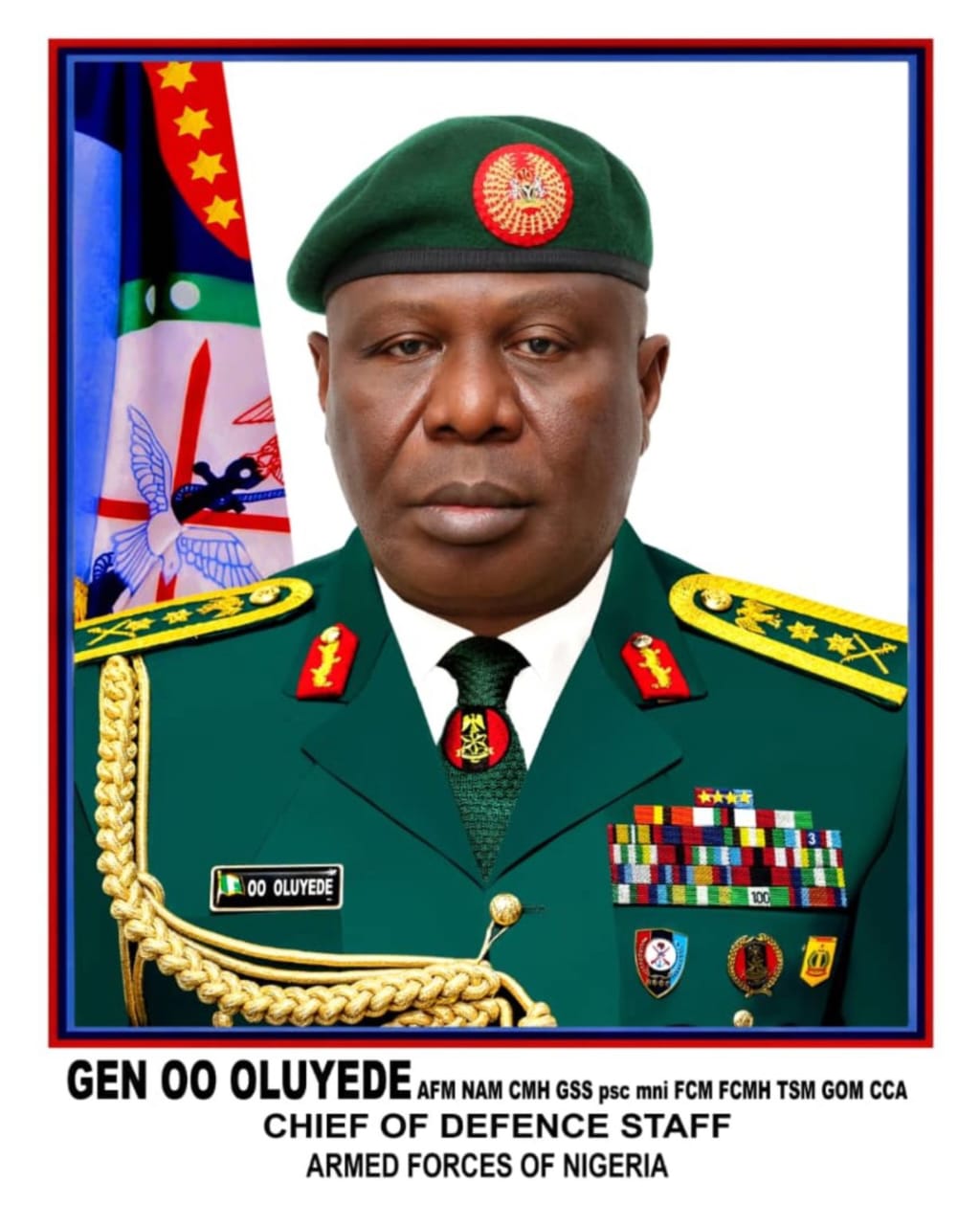
As Nigeria’s Chief of Defence Staff (CDS), General Olufemi Oluyede, marks his first 100 days in office, early signals from Defence Headquarters suggest a tenure defined by coordination, renewed momentum, and a deliberate push to weld the Armed Forces into a more cohesive and professional fighting force.
From the outset, Gen.
Oluyede made synergy among the Nigerian Army, Navy, Air Force and other security agencies a central plank of his leadership. Defence watchers say this emphasis has translated into tighter joint planning, improved intelligence sharing and more integrated operations across theatres of conflict. Rather than operating in silos, the services are increasingly being deployed as complementary arms of a single national security strategy.This joint approach has been particularly evident in counter-terrorism operations. In the North East and North West, coordinated air and ground actions have aimed to degrade terrorist networks, disrupt logistics and deny insurgents freedom of movement.
Senior officers point to a clearer command-and-control structure and faster decision-making as key outcomes of the CDS’s early reforms.
Beyond kinetic operations, Gen. Oluyede has also placed strong emphasis on building a military that is firmly loyal to the Constitution and anchored on respect for human rights and the rule of law.
In directives to commanders and troops, he has underscored the Armed Forces’ role as protectors of democracy and the civilian population, stressing that operational effectiveness must go hand in hand with professionalism and accountability.
Training and engagement initiatives under his watch are aimed at reinforcing civil-military relations and ensuring that operations are conducted within internationally accepted human rights standards.
In addition, the CDS has placed renewed focus on economic security, especially the long-running challenge of crude oil theft and pipeline vandalism in the Niger Delta.
Under his watch, the anti-oil theft security measures have been strengthened and aligned more closely with land-based and aerial surveillance. This multi-layered posture is intended to protect critical national assets, curb illegal bunkering and restore investor confidence in the oil and gas sector.
In internal engagements, Gen. Oluyede has reportedly stressed discipline, troop welfare and ethical conduct, reflecting his belief that morale, legitimacy and effectiveness are inseparable.
By engaging commanders across formations and theatres, he has sought to ensure that strategic directives from Defence Headquarters are clearly understood and uniformly implemented.
While Nigeria’s security challenges remain complex and deeply rooted, analysts say the tone of Gen. Oluyede’s first 100 days reflects a leadership intent on unity of effort, constitutional loyalty and sustained pressure on threats to national stability. As his tenure progresses, many will be watching to see how these early initiatives translate into lasting gains on the ground.
For now, the consensus in defence and security circles is that the CDS has used his opening months to lay a solid foundation—one built on cooperation among the services, respect for human rights, and a clear-eyed focus on terrorism and oil theft as critical fronts in Nigeria’s security landscape.
Chuks Oyema wrote in from Abuja
By David Torough, Abuja
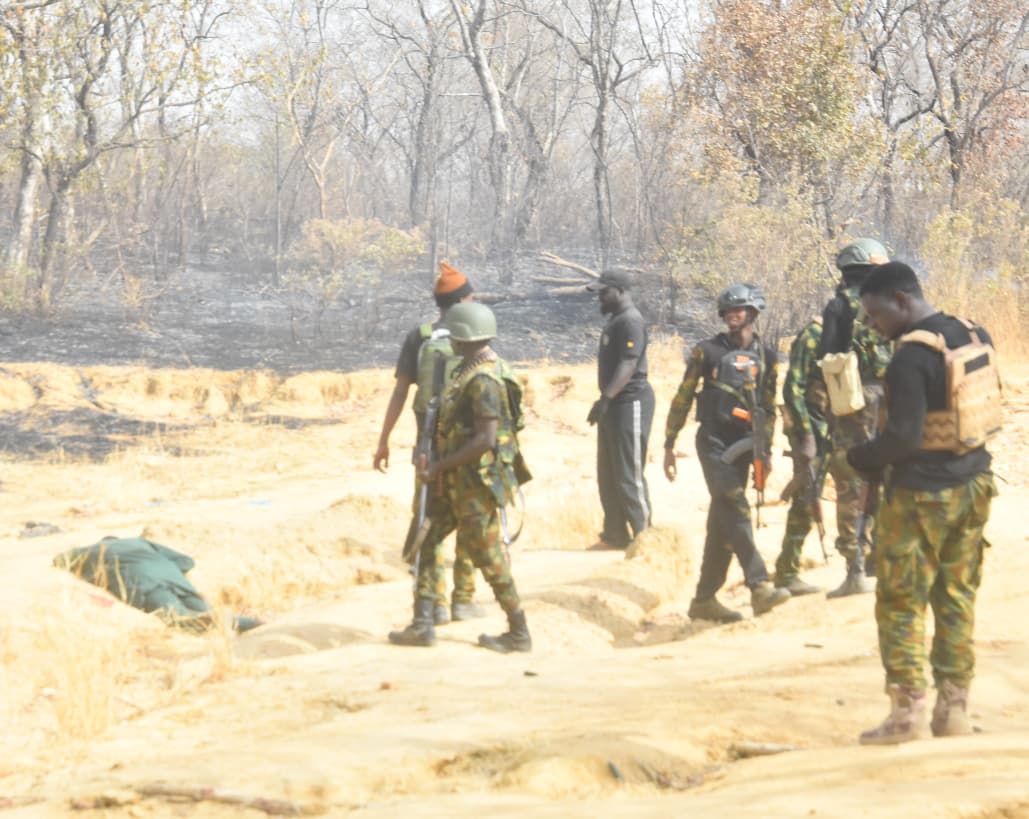
Troops of the Nigerian Army’s 8 Division, operating under Sector 2 of Operation FANSAN YAMMA, have killed scores of bandits during a major offensive against the stronghold of notorious bandit leader Gwaska Dan Karmi.
The operation followed credible intelligence indicating that more than 100 bandits had converged at the camp to plan coordinated attacks on nearby communities and military supply routes.
After days of sustained surveillance, ground forces, supported by the Nigerian Air Force (NAF), moved in and intercepted the group on January 31, 2026.
According to the Army, a fierce firefight erupted as the bandits attempted to flank and encircle advancing troops.
The assault was repelled, with soldiers overwhelming the fighters through superior firepower. While many of the bandits were killed during the encounter, others fled the area with gunshot wounds. The camp was subsequently set ablaze before troops withdrew from the location.
The NAF is continuing interdiction missions to track and neutralise fleeing remnants, while ground forces maintain control and dominance of the surrounding area.
The Army confirmed that some soldiers were killed in action during the engagement, describing them as gallant troops who paid the “supreme price” in the line of duty. One combat enabler vehicle was also struck by an enemy rocket-propelled grenade and destroyed by fire.
In a statement signed by Lieutenant Colonel Olaniyi Osoba, Acting Deputy Director of Army Public Relations for 8 Division, the Nigerian Army said combat efficiency remains high and reaffirmed its commitment to dismantling bandit networks and disrupting their supply chains across the region.



Nigerian Army Adopts Intelligence-Led, Multi-Domain Strategy Against Evolving Security Threats
ShareBy David Torough, Abuja The Nigerian Army has reaffirmed its commitment to an intelligence-driven, technology-enabled and multi-domain approach to countering...


Trump Threatens to Sue Comedian Trevor Noah over Grammys Epstein Joke
ShareU.S. President Donald Trump has threatened to sue Grammys host, Trevor Noah after a joke he made about disgraced financier...


NYSC Urges Corps Members to Serve with Patriotism
ShareThe NYSC Director of Internal Audit, Dr. Levi Agim, has urged corps members in Rivers to serve the state with...

Access Bank appoints Osime as Board Chair
Share Access Bank Plc has appointed Mrs Ifeyinwa Osime as Chairman Board of Directors, following the retirement of Mr Paul Usoro,...

Peter Obi Slams Tinubu over Multiple Budgets
ShareBy Mike Odiakose, Abuja Chieftain of the African Democratic Congress (ADC), Peter Obi, has criticised the administration of President Bola...

Bala Declares Tuesday Work Free Day to Celebrate Bauchi at 50th
ShareFrom Ajiya Ayuba, Bauchi Bauchi State Governor, Bala Mohammed Abdulkadir, has declared tomorrow Tuesday as free work day in both...


NASENI’s Fertilizer Plants to End Import Dependence, Enhance Food Security, Reduce Emissions, Tanko Advices
ShareBy David Torough, Abuja In a major boost to Nigeria’s agricultural transformation, the National Agency for Science and Engineering Infrastructure...


Measles Cases Spike to 13,989 in Mongolia
Share Mongolia National Center for Communicable Diseases (NCCD) on Tuesday announced that 22 new cases of measles infection have been...
Lagos Splashes Millions on Gateway Games Medallists
ShareAthletes who represented Lagos State at the 22nd National Sports Festival Gateway Games held in Abeokuta, Ogun State, in May 2025, have...
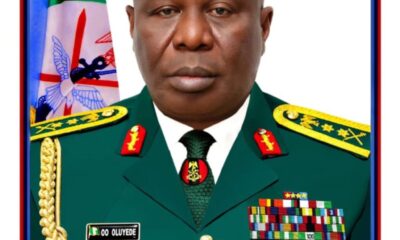

Gen Oluyede at 100 Days: Steering a United Front Against Insecurity
ShareBy Chuks Oyema As Nigeria’s Chief of Defence Staff (CDS), General Olufemi Oluyede, marks his first 100 days in office,...