
NEWS
Shasha Market Represents Unity, Says Osinbajo

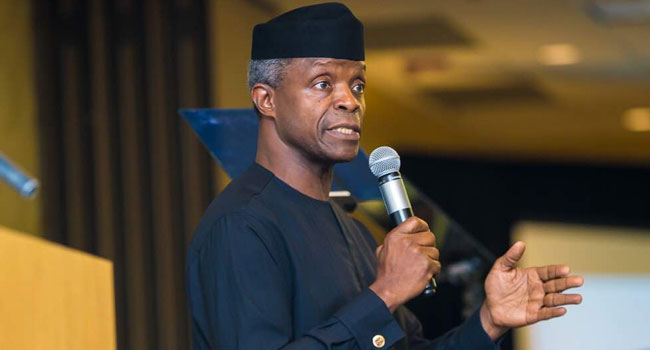
Vice President Yemi Osinbajo says the recent clash among traders in Shasha market, Ibadan, Oyo State, is unfortunate as the market represents unity.
Osinbajo expressed this view while fielding questions from newsmen on Sunday in Lagos shortly after paying a condolence visit to the late Lateef Jakande family in Ilupeju.
The clash among traders in Shasha market was recorded on Feb.
11.Gov. Seyi Makinde of Oyo state has ordered an indefinite closure of the market.
“I have heard about the unfortunate mayhem and the tragic loss of lives at the Shasha market in the past few days.
“Shasha market has been a melting pot for traders bringing foodstuff from the North to the Southwest for decades.
“For decades traders from the North have done business with their brothers from the Southwest and they have lived in peace and even inter-married; Shasha represents unity.
“So when a disagreement arises between individuals or a criminal act is committed by one against the other, we must ensure that we see it for what it is, a criminal act, which must be punished according to law; not an ethnic conflict.’’
According to the vice president, every Nigerian has a constitutional right to live, work and enjoy their lives in safety and peace under the law.
He said it was the duty of government through the police and other law enforcement agencies to arrest and prosecute any person who committed a crime against a citizen of the nation.
Osinbajo added that it was the role of the citizen to assist the police to identify the criminals.
“We must never take the law into our own hands, if we do we will be promoting chaos, and a breakdown of law and order, and all of us especially the most vulnerable amongst us, will be at risk.
“ I urge all community leaders to work together to preserve the brotherly co-existence that our people from different parts of the country have enjoyed in Shasha market for several decades.
“I commend the governor for his swift and decisive action and all the law enforcement agencies for their prompt intervention,’’ he said. (NAN)




From Abel Zwanke, Lafia
Nasarawa State secured domestic and foreign direct investments totaling $1,008,529,220 between January and December 2025. The figure is separate from other investments attracted within the same period by various Ministries, Departments, and Agencies of the state government.
A report detailing the Nasarawa Investment and Development Agency’s 2025 investment portfolio made available to journalists on Monday indicates that the total amount comprises $505.
7 million actualised investments, representing 50.14%, and $502.8 million announced investments, accounting for 49.86%.Announced investments refer to public declarations or formal commitments such as Memorandums of Understanding (MoUs) and Letters of Intent made by investors, companies, or institutions expressing their intention to invest in the state. Actualised investments, on the other hand, represent deals that have progressed to the implementation stage.
The report shows that the announced investments totaling $502.8 million span key sectors including mining, agriculture, energy, manufacturing, among others.
The sectoral breakdown of announced investments includes: Mining – $300 million; Agriculture – $800,000; Energy – $70 million (13.9%); Manufacturing – $130 million; and Others – $2 million, respectively.
For actualised investments, eight companies injected a combined $505.7 million into priority sectors of the state’s economy.
The breakdown of actualised investments shows: Mining – $400 million; Agriculture – $48.8 million; Manufacturing – $46 million; Technology – $16.6 million; and Education – $10.9 million, respectively.
These investments are distributed across six Local Government Areas of the state: Kokona, Nasarawa, Akwanga, Keffi, Lafia, and Toto.
Kokona recorded investments worth $45.5 million (8.9%), followed by Nasarawa with $400 million (79%); Akwanga with $31 million (6.12%); Keffi with $25.9 million (5.2%); Lafia with $16.6 million (0.08%); and Toto with $3.3 million (0.7%).
Among the investing companies is Euphoria Press Limited, which operates in agriculture and manufacturing across three local government areas Kokona, Akwanga, and Keffi.
Other companies include Diamond New Energy Company LTD; Advent Integrated Service Limited; Saro Africa Agric Value Chain; Sequoia Cassava Farms; and China Witent Technology Co Ltd.
According to the report, companies that have announced investment plans and are actively working toward resource deployment include Nichi Mine Limited; Nok Motors Limited Electric; Caspian Pacific Africa Green Energy Limited; CMIG Drawin Nig. Ltd; EGTA Environmental Limited; and Maiyamco Investment Nig. Limited.
The document further reveals that a total of 22,645 jobs are projected to be created across the various sectors.
According to the report, breakdown of the projected employment figures shows that Agriculture will generate 10,025 jobs; Manufacturing – 6,600; Education – 5,000; Mining – 1,000; and Technology – 20, respectively.
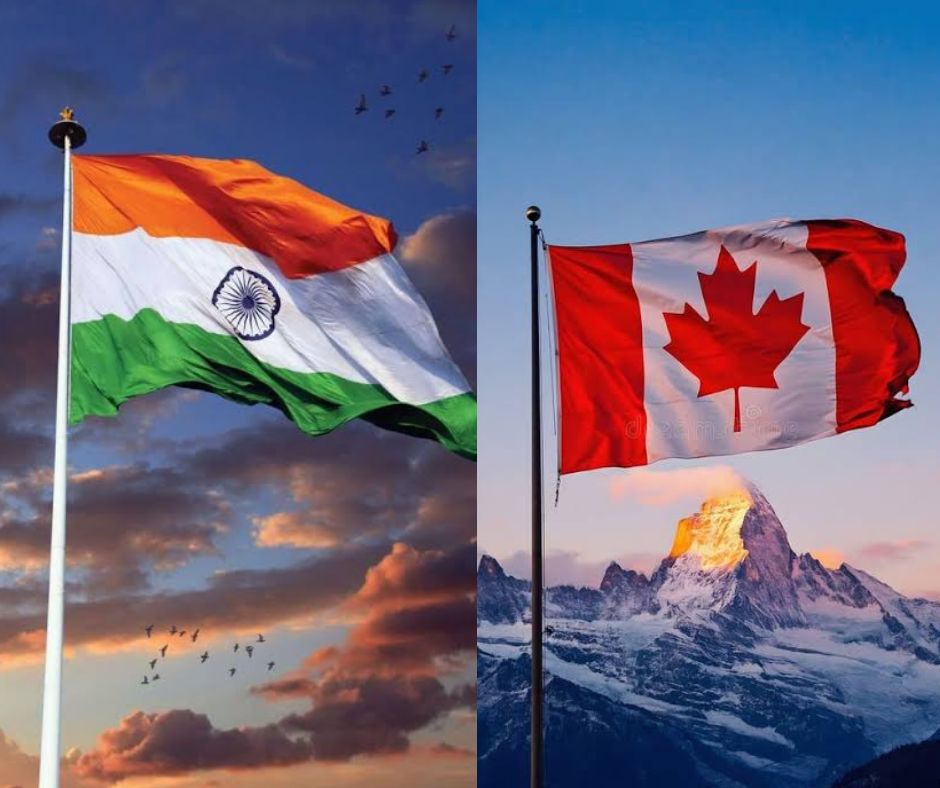
India and Canada have announced a host of agreements, including a 10-year nuclear energy deal, after their prime ministers met in Delhi to reset ties that plummeted due to diplomatic tensions.
Narendra Modi and Mark Carney also struck agreement in areas such as technology, critical minerals, space, defence and education.
Carney said they agreed to conclude a free trade deal, years in the making, by the end of 2026.
Both countries want to reduce exposure to punitive US trade tariffs.Under Carney, the two governments are trying to repair ties that were strained when his predecessor accused Delhi of a link to the 2023 assassination of Sikh separatist Hardeep Singh Nijjar on Canadian soil.
India vociferously rejected the allegation by Justin Trudeau. Trade and diplomatic relations almost came to a standstill as both sides expelled each other’s diplomats and cancelled visa services. Canada hosts a huge expatriate Indian community.
But since Carney took office last year, the relationship has been cautiously rebuilt, helped by the fact that his government has said it believes India is not currently linked to violent crimes or threats on Canadian soil.
The case of four men charged over Nijjar’s killing is still before the courts. At talks in Delhi, both Carney and Modi underscored India and Canada’s long-standing relationship, mutual goals and close people-to-people ties.
“In civil nuclear energy, we have reached a landmark deal for long-term uranium supply. We will also work together on small modular reactors and advanced reactors,” Modi told reporters after their meeting at Hyderabad House in Delhi.
He described the two countries as “natural partners in technology and innovation” and said they would enhance co-operation in AI, supercomputing and semiconductors, as well as jointly host a renewable energy summit.
Carney said Canada was well positioned to contribute to energy-hungry India’s nuclear fuel needs and added that the two countries were launching a strategic energy partnership.
He hailed the progress made in rebuilding relations. “There has been more engagement between the Canadian and Indian governments in the last year than there has been in more than two decades combined,” he said.
On trade, Modi said: “Our target is to reach $50bn in bilateral trade. This is why we have decided to finalise a comprehensive economic partnership soon.”
Carney said he wanted to reach a deal on the “ambitious agreement” by the end of the year. It’s been discussed on-and-off for the past 15 years so concluding it would be a significant achievement.
Analysts say that Carney’s decision to put diplomatic tensions behind him and extend an olive branch to India is a pragmatic one, based on present day geopolitical shifts.
The same holds true for India, which is looking to forge new trade partnerships to diversify its imports and also reduce its reliance on Russia for its energy needs.
Carney met India’s Foreign Minister S Jaishankar where the two discussed charting a “forward-looking partnership”.
Carney’s four-day trip began with a visit to the financial capital, Mumbai, where he met business leaders and ministers on 28 February with a view to boost trade and investment in India.
After concluding his trip in Delhi, Carney is set to travel to Australia and then Japan as part of his strategy to diversify Canada’s trade and invite new investments.

From Dan Amasingha, Minna.
The Academic Staff Union of Universities (ASUU) at the Federal University of Technology, Minna (FUTMINNA) has strongly condemned what it described as a desperate and unlawful attempt by the Niger State Government to take over the institution’s historic Bosso Campus.
The protest, which took place at the entrance gate of the Bosso Campus, saw lecturers and students marching in solidarity under the leadership of ASUU and the Student Union Government, warning that any attempt to forcefully acquire the land would disrupt academic activities and violate federal laws.
Speaking to journalists after the demonstration, the FUTMINNA ASUU Chairperson, Comrade Professor Lukman Kunle Oyewobi, described the alleged move as “an unholy act,” insisting that the university community would resist any plan to dispossess the institution of its facilities.
Oyewobi disclosed that state government officials had reportedly visited the campus to initiate acquisition procedures without the consent of the university, prompting the emergency protest.
He rejected claims that the land was under temporary lease, citing a 1983 purchase agreement in which the Federal Government allegedly paid ₦2.8 million for full ownership of the property.
According to him, the campus originally a Roman Catholic missionary school handed to the state and later sold to FUTMINNA is now a vital federal asset.
“This property belongs to the Federal Government. It is not idle land for political grabs,” Oyewobi said, adding that the campus houses more than 25 research centres, advanced science laboratories, staff quarters, hostels, clinics, libraries, and religious centres.
Pioneer student and Professor of Animal Production, Abdubanji Tijani, also challenged the state’s legal claim to the land, maintaining that the property was lawfully acquired in 1982 and cannot be reclaimed by the state government.
The controversy is believed to be linked to an alleged plan by the state government to establish a state-owned medical school on the Bosso Campus.
However, the university community pointed out that FUTMINNA has already launched its own medical school using facilities within the same campus.
Dean of Student Affairs, Professor Bashir Ganiyu, expressed concern over reports that students, particularly female undergraduates, had been asked to vacate their hostels. With a total student population of about 25,000 and accommodation space for only about 5,000 students across campuses, he questioned the feasibility and safety implications of such a directive.
“Where do they want these students to go? Are they to be chased into the streets?” he asked.
Similarly, Mohamed Ramas, a 500-level student and Vice President of the Student Union, raised alarm over the safety of female students if evicted abruptly.
“We don’t have alternatives. Where do they want us to go? We are ladies. They cannot toy with our safety,” she lamented.
ASUU called on the National Assembly, the National Universities Commission (NUC), and civil society organisations to intervene and halt what it termed an assault on academic freedom and constitutional rights.
The union also urged Governor Mohammed Umar Bago, an honorary doctorate recipient of the university, to reconsider the move and seek alternative sites within the state, which is Nigeria’s largest by landmass.
Efforts to get official reaction from the Niger State Government were ongoing as of the time of filing this report.




Nasarawa Secures $1.008bn in Domestic, Foreign Investments
ShareFrom Abel Zwanke, Lafia Nasarawa State secured domestic and foreign direct investments totaling $1,008,529,220 between January and December 2025. The figure is separate from other investments attracted within the...


India, Canada Reset Ties with Landmark Nuclear Energy Deal
ShareIndia and Canada have announced a host of agreements, including a 10-year nuclear energy deal, after their prime ministers met in Delhi to reset ties that...

ASUU, Students Protest Alleged Move to Seize FUT Minna Bosso Campus.
ShareFrom Dan Amasingha, Minna. The Academic Staff Union of Universities (ASUU) at the Federal University of Technology, Minna (FUTMINNA) has strongly condemned what it described...

Niger Recruits 5,000 Health Workers, Commissions Specialist Hospital
ShareFrom Dan Amasingha, Minna The Niger State Government has announced plans to recruit up to 5,000 health workers as part of a sweeping reform of its healthcare delivery...

FCT-IRS Urges Residents to File Individual Returns before March 31
ShareBy Laide Akinboade, Abuja The Federal Capital Territory Internal Revenue Service (FCT-IRS) has advised all taxable individuals including those in employment, elected and appointed public...

Nigeria’s Net Reserves Rises to $34.8bn – Cardoso
ShareBy Tony Obiechina, Abuja The Governor of the Central Bank of Nigeria (CBN), Olayemi Cardoso, Nigeria’s gross and net foreign...

Benue Spends Over N1.2bn on Resettlement of Yelewata IDPs, Others
ShareFrom Attah Ede, Makurdi The Benue State Government on Monday said it has judiciously spent not more than N1.275 billion...

Executive Order: FG Begins Direct Remittance of Oil Revenues to FAAC
ShareBy Tony Obiechina, Abuja The Federal Government has begun implementing Executive Order 9 of 2026 mandating the direct remittance of...

Tinubu Needs Second Term to Complete Reforms, Says Oyetola
ShareThe Minister of Marine and Blue Economy, Dr. Adegboyega Oyetola, says President Bola Tinubu needs a second term to complete...


Oyo APC Urges Members to Disregard Fake Exco Lists in Circulation
ShareThe leadership of the All Progressives Congress (APC) in Oyo state has urged members and the general public to disregard...