
Science & Tech
2021 Expo, Platform That Showcases Ideas to Transform Nigeria’s Economy-Minister


The Minister of Science and Technology, Dr Ogbonnaya Onu, has said that the 2021 Technology and Innovation Expo is a platform to showcase ideas that will transform Nigeria’s economy from commodities to knowledge based.
Onu said this during a news briefing on Saturday at the Eagle Square, Abuja, after a facility tour and inspection of the progress of work done in preparation for the expo.
The minister noted that ideas rule the world and that the country had relied entirely on commodity based economy for a long time which was not helping the country.
He said the sixth edition of the 2021 expo, which is an annual event, is scheduled to begin from March 15 until March 19.
Onu expressed optimism that the 2021 expo would help to move the nation’s economy to one that was dependent on knowledge and also innovation driven.
He further said that the expo was critical, not just in helping to commercialise research and innovation findings, but also to help in the fight against poverty.
The minister maintained that the fight against poverty would come by job and wealth creation and also to ensure that Nigeria became self reliant.
“With over 200 million citizens and the largest economy in Africa we cannot continue to be importing things we need from outside.
“ We should be able to produce many of these things in Nigeria and meet our needs then export the surplus to other countries,’’ Onu said.
He said that the African Continental Free Trade Area (AfCFTA) would give Nigeria a wide scope to trade with other African countries and beyond with enormous possibilities.
However, Onu explained that the upcoming expo should not be confused for a trade fair where people could come for the sole purpose of buying and selling.
“This expo is unique and very important for our nation because it brings together our scientists, researchers, our innovators, with investors, everybody coming together to know the work that is going on,’’ he said.
Accordingly, Onu also said the the work in Nigerian universities, research institutions, polytechnics and secondary schools in the country should be aptly showcased at the expo.
“We have many people in the formal sector who are very creative and who have come up with great inventions and innovations.
“Therefore, the essence of this expo is to explore ways in which we can commercialise our research findings,’’ the minister said.
He further noted that the most important thing was to make sure that there would be availability of job opportunities for young and old being very important to President Muhammadu Buhari’s administration. (NAN)





From Mike Tayese, Yenagoa
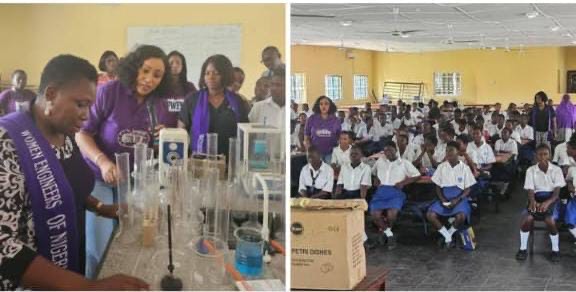
The Association of Professional Women Engineers of Nigeria (APWEN) Bayelsa Chapter led by their Chairman, Engr. Dr. Amalate Ann-Jonathan Obuebite FNSE, visited St. Judes Girls Secondary School, Yenagoa in commemoration of the 2026 International Day of Women and Girls in Science, donates laboratory equipment.
The donation, which includes pH meters, weighing scales, measuring cylinders, viscometers, volumetric and conical flasks, beakers, and pipettes is meant to support and encourage the study of Science, Technology, Engineering, and Mathematics (STEM) courses.
Presenting the items to the principal, Mrs. Josephine Imbiakpa, Dr.
Obuebite emphasized APWEN’s commitment to promoting STEM education among girls.Mrs. Imbiakpa expressed immense gratitude to APWEN BAYELSA for the donation, stating that it would motivate students to pursue STEM careers.
The event aimed to inspire girls to explore STEM fields and bridge the gender gap in these areas in line with the theme for this year.

NRS chair, Adedej
The Executive Chairman of the Nigerian Revenue Service (NRS), Zacch Adedeji, has described technology as a crucial factor in the implementation of the new tax laws in the country.
Adedeji stated this on Wednesday while delivering the maiden convocation lecture of the Federal Polytechnic, Ayede, Ogo-Oluwa Local Government Area of Oyo State.
In a statement by his Technical Assistant on Print Media, Sikiru Akinola, Adedeji listed some of the most fundamental challenges confronting taxation to include infrastructure, skills, trust and resistance.
In the lecture entitled ‘The Role of Technology in Implementing Nigeria’s New Tax Laws: Challenges, Prospects, and Implications for National Development,’ the NRS chairman said each of these challenges would be addressed with the imminent upgrading of the country’s tax system for a digital environment.
“Nigeria has recently enacted a new set of tax laws, representing the most significant restructuring of our nation’s fiscal legislation in 50 years. While public conversation often frames these changes as legal reforms, and that is true, it is also an incomplete picture.
“These laws are not merely changing rates, definitions, or administrative powers. They are quietly redefining how authority operates within the tax system. This is a complete structural overhaul, signaling the end of tax collection as a manual task and the beginning of tax intelligence.
“If you read the new laws carefully, you will notice a subtle but profound assumption woven throughout their fabric. They presuppose the existence of reliable taxpayer identification, integrated data across institutions, traceable transactions, automated processes, and scalable enforcement.
“In other words, these laws are built for a digital environment. They cannot function properly in a manual, fragmented, paper-based system. The implication is clear: without technology, the laws remain aspirational. With technology, they become operational.
“This transition is central to the mandate of the Nigeria Revenue Service as we implement this new legal framework. Historically, tax administration relied heavily on human discretion over who is registered, who is assessed, who is audited, and who is penalized.
“While discretion is not inherently evil, excessive discretion creates inconsistency, which in turn breeds mistrust and drives non-compliance,” Adedeji said.
Speaking further, he noted that when infrastructure improves, capacity grows, trust is protected, and resistance is managed just as technology begins to do what policy alone cannot.
“One of the most important prospects of a technology-driven tax administration is the ability to expand the tax base without increasing tax rates. This matters deeply in a society where citizens already feel overburdened.
“By improving visibility and bringing previously unseen economic activity into view, technology levels the playing field. When compliance broadens, the pressure on the existing base reduces,
fairness improves, and legitimacy grows. This is how modern tax systems grow revenue sustainably,’ he added.
In his remark, the Speaker of the House of Representatives, Tajudeen Abass, encouraged the graduating students to be good ambassadors of the institution.
Represented by AbdulFatai Buhari, senator representing Oyo North, Abass charged them not to relent in their bid to acquire more knowledge.
He also commended the tax boss for leading the change in tax administration in the country.
The institution’s governing council chair, Yakubu Datti commended Adedeji for leading the re-engineering of Nigeria’s tax architecture.
The Rector of the institution, Dr. Taofeek Adekunle Abdul-Hameed, charged the graduating students to emulate Adedeji who, he said, began his journey from a polytechnic.

The Ministry of Communications, Innovation and Digital Economy has partnered with Meta to launch the Llama Impact Accelerator, promoting impactful AI development in Nigeria.
The Minister, Dr Bosun Tijani, confirmed this in a statement released on Tuesday by Ms Sade Dada, Head of Public Policy for Anglophone West Africa at Meta.
Tijani described the partnership as a significant step in Nigeria’s mission to nurture a thriving AI ecosystem and drive national development through innovation.
He said the government views AI as a key tool for addressing national challenges. The programme will equip innovators with vital tools and expert guidance.
“This initiative forms part of Meta’s broader effort to democratise responsible AI and foster local innovation across Nigeria’s growing technology landscape,” the minister noted.
Tijani added that collaboration with government, academia and civil society will help cultivate a more inclusive, forward-looking AI community in the country.
Dada stated that Meta also partnered with the National Centre for Artificial Intelligence and Robotics (NCAIR) and the National Information Technology Development Agency (NITDA).
She explained that the eight-month programme targets early-stage startups using open-source Llama models to tackle national and regional challenges in four key areas.
The priority sectors include agriculture, security and safety, healthcare, and a ‘wild card’ category for high-impact innovations in any other field.
“The wild card category encourages bold and creative AI applications that could bring substantial impact to underserved sectors,” Dada said.
She added that the programme starts with a six-week incubation phase, offering technical training and mentorship from industry leaders and AI professionals.
This is followed by six months of extended support, including access to further technical resources and relevant opportunities for growth and scaling.
Dada said Meta was thrilled to collaborate with FMCIDE on this initiative, recognising Nigeria’s strong innovation ecosystem and growing pool of AI talent.
She added that Meta aims to empower communities through open-source AI, tailored to address Nigeria’s unique development challenges.
“The accelerator offers local talent the infrastructure, tools and mentorship needed to build responsible solutions using open-source models like Meta’s Llama,” she said. (NAN)



Otu, Retired Naval Chief Bag UNICAL Honorary Degrees
ShareFrom Ene Asuquo, Calabar The Governor of Cross River State, Prince Bassey Otu, has been conferred with an honorary doctorate...


Children Registration Gives Legal Identity, Says Benjamins-Laniyi
ShareBy Laide Akinboade, Abuja The Federal Capital Territory (FCT), Mandate Secretary, of women Affairs secretariat, Dr. Adedayo Benjamins-Laniyi on Monday...
Otu, Retired Naval Chief Bag UNICAL Honorary Degrees
ShareFrom Ene Asuquo, Calabar The Governor of Cross River State, Prince Bassey Otu, has been conferred with an honorary doctorate...
Misuse of Antibiotics Driving Drug-resistant TB – Expert
ShareA Professor of Paediatrics, Nnamdi Onyire said the growing misuse of antibiotics in treating common cough is fuelling the emergence...

New FRSC Sector Commander Pledges to Strengthen Road Safety Operations in Delta
ShareThe new Sector Commander, Federal Road Safety Corps (FRSC), Delta Sector Command, said he would consolidate on existing achievements while...


Police Arrest Officers, Drivers, POS Operators for Abduction, Extortion in Edo
ShareFrom Ikhazuagbe Ojeikere, Benin Operatives of the Edo State Police Command said four of its officers and three others have...


NDLEA Arrest Five Suspects with Illicit Drugs worth N724.5m in Edo
ShareFrom Ikhazuagbe Ojeikere, Benin The Edo State Command of the National Drug Law Enforcement Agency (NDLEA) has intercepted 7,245kilograms of...
Fadahunsi Rolls Out Food Items, Others in Osun East
ShareFrom Ayinde Akintade, Osogbo In a massive effort to tackle hunger and hardship, Senator Francis Adenigba Fadahunsi, representing Osun East...


Road Projects: Kaduna Targets Improved Access to FUAS, ABU
ShareKaduna State Government has intensified road infrastructure development at the Federal University of Applied Sciences, Kachia, and Ahmadu Bello University...


UNIABUJA to Graduate 12,624 Students at 29th, 30th Convocation Ceremonies
ShareA total of 12,624 students are set to graduate as the University of Abuja holds its combined 29th and 30th...