
FEATURES
X-raying Wike’s First Year as FCT Minister

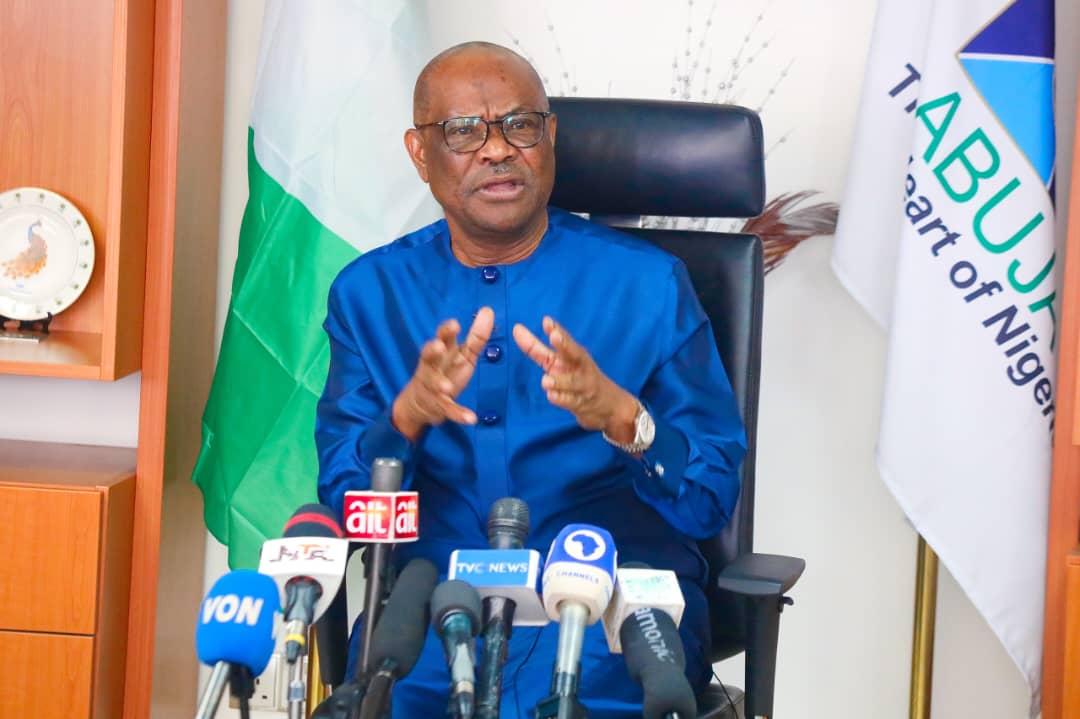
Shortly after assuming office as FCT minister on Aug. 21, 2023, Mr Nyesom Wike announced short, medium, and long-term plans to restore the Abuja Master Plan.
Wike, along with FCT minister of state Mariya Mahmoud, explained that overhauling the FCT would reposition it to be among the best cities in the world in line with President Bola Tinubu’s “Renewed Hope Agenda”.
He added that emphasis would be placed on infrastructural development, taking one project at a time, to restore the city to its glory.
The minister said that development would also be extended to the six Area Councils as part of strategies to decongest the city and open rural economy.
Sadly, Wike was confronted with the sight of abandoned projects that characterised the capital city.
The minister noted that FCT had, over the years, witnessed foundation laying ceremonies of several structures worth billions, only to be abandoned midway or at advanced stages of the construction.
While assessing them, he pointed out that some of the contracts were awarded in 2007, some in 2011, while others were awarded between 2015 and 2017, with all abandoned.
Confronting the challenge, Wike said that revenue leakages would be blocked so as to mobilise the needed resources for infrastructural development in the FCT.
“I will ensure that Abuja gets the best. You will see projects upon projects, and projects that will be completed and not abandoned.
“I am not a party to abandoned projects. I start a project when there is money as such we will look into our finances before we begin any project,” the minister had said.
Innovatively, Wike got most of the contractors back to site after agreeing on a payment plan with money from the FCT Internally Generated Revenue (IGR) and 2023 Supplementary Budget.
To improve IGR, the minister inaugurated a Task Force on the issuance of Certificates of Occupancy for mass housing developments and the recovery of land use contravention fees in the FCT.
He equally introduced innovations and enforced the payment of outstanding ground rents and other taxes in the FCT, a decision that increased the territory’s revenue generation significantly.
This is evident with the recent declaration of N126.54 billion collected and remitted between January and June by the FCT Internal Revenue Service.
The then acting Executive Chairman of the service, Mr Haruna Abdullahi, said that the figure was 53.5 per cent higher than the N82.46 billion collected in the first half of 2023.
The minister also secured the approval of Tinubu to withdraw FCTA from Treasury Single Account, to enable the administration to access funds from financial institutions to fund projects.
These initiatives paid off, as nine months later, the Wike-led FCTA announced the completion of numerous projects which were inaugurated in May to celebrate Tinubu’s one year in office.
Some of the projects included the official residence of the Vice President, the Abuja Rail Mass Transit system, Inner Southern Expressway from the Outer Southern Expressway to the Southern Parkway.
Others are full scope development of about 6.7km of 10 lanes Outer Southern Expressway from Villa Roundabout to Ring Road 1 Junction, and construction of Southern Parkway from the Christian Centre to Ring Road 1, named after President Bola Tinubu.
Equally inaugurated were the completed B6 (Constitution Avenue)/B12 (Independence Avenue) roads in Central Area, and Wuye interchange bridge.
The full scope development of the Arterial Road, N-20, from Shehu Musa Yar’Adua Expressway to Murtala Mohammed Expressway, was also partly completed and named after noble laurel Wole Soyinka.
Another milestone of the Wike-led FCTA was the completion of engineering infrastructure in Guzape District Lot II, and the resurfacing of 189 roads covering 57km within Abuja city centre among others.
He assured that other ongoing projects would be completed by December 2024, including the rehabilitation and resurfacing of 366 roads in Wuse, Garki, Asokoro and Maitama Districts, covering 117 km.
Also ongoing are the rehabilitation of District Hospital Gwarimpa, Cottage Hospital Gwagwalada and District Hospital Utako, Greater Abuja Water Supply Project and rehabilitation of 19 public primary and secondary schools across the territory.
The minister also recently inaugurated the construction of three bus terminals in the FCT to ensure a secure and convenient travel experience for commuters in the FCT.
He also inaugurated the construction of the Abuja Division of the Court of Appeal Complex to strengthen the administration of justice.
Road users and residents described the feat as unprecedented, saying that Wike was the best thing that had happened to FCT.
“I have been living in Abuja for 16 years but never witnessed a speedy delivery of road projects until Wike happened.
“Look at the road to Asokoro from Apo, which was under construction for several years, but Wike delivered it in just eight months,” said a resident, Mr Andrew Moses.
Similarly, Mr Shuabu Yunusa, a taxi driver said, “It is now seamless going to Asokoro from Apo. The Tinubu-led administration is really working and deserved our commendation.”
In keeping to his promise not to leave rural communities behind in the development agenda, the minister has inaugurated the construction of rural roads of more than 42.2km across the six Area Councils and promised to complete them by December.
Similarly, the minister has also handed over Staff of Office to four newly coronated Chiefs of Karu, Kwali, Pai, and Yaba, as part of measures to strengthen traditional institutions and improve governance in communities.
According to him, the traditional rulers are expected to draw the attention of the government to any development, security and other issues that require government attention and response.
Beyond infrastructural development, stakeholders said that Wike has carved his name in gold by ensuring the implementation of the FCT Civil Service Commission (CSC), 2018, against all odds.
The minister, on Oct. 13, 2023, announced President Tinubu’s approval for the establishment of CSC for the FCTA, in line with the provisions of the law.
This, he said, was to allow career progression for civil servants in the Administration, from director to permanent secretary and, hopefully, Head of Civil Service.
On March 12, Wike announced Tinubu’s approval for the appointment of Mr Udo Atang, as pioneer Head of Civil Service of the FCTA.
Mr Emeka Ezeh was also appointed Chairman of the Commission’s Board, along with six others as commissioners, representing the six geopolitical zones.
Similarly, 10 other directors in the FCTA were appointed as pioneer Permanent Secretaries for various Secretariats of the Administration.
The excited pioneer head of FCT civil service, described the development as a demonstration of the reality of the renewed hope agenda of the Tinubu-led government.
Commending Tinubu and Wike for renewing the hope of FCT workers, Atang said: “the staff of the Administration have never had it this good.
“In the new FCTA system, every member of staff is a potential permanent secretary and head of service.”
To ensure gender equality, as well as women and youth participation in governance, Wike, within one year in office, has created Women Affairs Secretariat and Youth Development Secretariat.
This has increased the number of secretariats in the FCTA from eight to 10 with a view to ensure inclusive governance.
On security, the Wike-led FCTA has supported security agencies, including vigilante groups, with motorcycles and operational vehicles, fitted with modern communication gadgets.
This, according to him, is to enable security agencies to navigate hard-to-reach communities in rural areas and improve security operations within the city.
Wike equally inaugurated a Joint Task Force, consisting of all security agencies in the FCT, to curb the menace of “one chance” and another to curtail the activities of arm rubbers, kidnappers and all forms of crimes within the FCT and its environment.
While assessing the performance of the Wike-led FCTA on security, Mr Adamu Gwary, Director, Security Services Department, FCTA, argued that the impact was impressive, considering the reduced incidents of security breaches.
Sharing Gwary’s view, Prof. Kailani Muhammed, Director-General of the Confederation of All Progressives Congress said that FCT had become a safe haven where residents could afford to sleep with their two eyes closed.
Despite the laudable feats within one year in office, stakeholders have stressed the need to invest more on people-oriented projects such as provision of clean water, quality health services and transportation system.
This, according to them, will impact significantly on the lives of the common residents of the FCT. (NANFeatures)
By Joan Odafe
In the quiet farmlands of Chibok in northeastern Nigeria, the steady rhythm of women cracking groundnuts and sorting harvests now carries a meaning deeper than livelihood.
For the mothers whose daughters were abducted during the 2014 school attack by terrorists, the work has become both survival and healing.
What began as a response to grief has gradually grown into a small but meaningful enterprise, one rooted in farming, peanut processing and the determination of mothers to rebuild their lives and secure a future for their children.
Their story is documented in the film, ‘Mothers of Chibok’, by Nigerian filmmaker, Joel Kachi Benson, which moves beyond the moment of the abduction to focus on the everyday lives of the women who continue to live with its consequences.
In the film, the camera lingers on the rhythm of daily labour: women tending farms, negotiating land prices, planting corn and groundnuts, and later selling the groundnuts that have become central to their community enterprise.
One scene captures a mother negotiating to rent farmland. The landowner initially demands N100,000 but after persistent bargaining the woman brings the price down to N35,000, a small victory that reflects her determination to keep farming in spite of financial hardship.
Groundnuts have become the backbone of their livelihood. After harvest, the women sort, roast and process the peanuts, adding value before they are sold.
The enterprise not only sustains their farming activities but also provides income to support their families and pay school fees for their children.
Scenes in the documentary show women sitting together in courtyards and fields, cracking shells and drying harvests under the sun.
The work is demanding but it carries a quiet sense of solidarity among the mothers.
For many of them, motherhood remains the strongest source of motivation.
In one scene, a mother sits with her children during a home lesson, gently encouraging them through their reading.
“Myself well done. Try it another day. Mango and banana for Mau,” she sings as a reward for a lesson completed.
In spite of the trauma that reshaped their lives, education remains central in the community.
The mothers continue to send their children to school, determined that fear will not define the future of the next generation.
The film also captures moments that reveal the emotional weight many of the women still carry.
In one poignant sequence, a mother receives a phone call informing her that her daughter has been rescued and will soon return home.
Earlier in the film, she had been shown carefully arranging her daughter’s clothes, preserving them as if preparing for the day she will come back.
Elsewhere, another mother breaks down after learning that her daughter was not among those rescued.
Through these moments, the documentary presents the mothers not as symbols of tragedy but as women navigating grief, hope and everyday survival.
Benson said the film took about three years to complete, allowing the production team to build trust within the community and document realities that rarely make headlines.
“When you spend time, you see things,” he said.
The producer explained that the intention of the film was to shift attention toward the strength and resilience of the women rather than presenting them solely through the lens of tragedy.
“The idea was to show them as strong, resilient women who are rebuilding their lives and supporting their families,” he said.
Beyond the film, the mothers’ groundnut enterprise is gradually reaching wider markets.
Their products are now available at a few outlets, including ‘The Gather House’, a concept store that showcases women-owned African brands and products with strong community stories.
By connecting the Chibok women’s produce to urban consumers, the initiative is helping transform their small-scale processing into a sustainable livelihood.
For the mothers, every bag of processed peanuts sold represents more than income. It reflects their determination to rebuild stability for their families and create economic security for their children.
Their story carries particular resonance during moments such as International Women’s Day and Mother’s Day, occasions that celebrate women’s strength and the enduring power of motherhood.
In Chibok, those ideals are lived daily in the fields and courtyards where the women work.
Through farming, enterprise and collective resilience, the Mothers of Chibok are gradually transforming a painful chapter of history into a story of dignity, survival and hope. (NAN)
By Ebuka Ukoh
If Nigeria is serious about reform, it must study not only who the late Right Reverend
Jesse Jackson was, but also how he operated. He did not merely protest injustice; he built lasting institutions to sustain his quest for justice.
Born in 1941, Jackson emerged from the civil rights movement under the leadership of Dr Martin Luther King, Jr.
He marched in Selma. He organised in Chicago. He founded Operation PUSH and later the Rainbow Coalition. In 1984 and 1988, he ran for President of the United States, becoming the first African American to mount a serious national campaign and win millions of votes across racial lines.He did not win the presidency.
But he definitely expanded the imagination of who could lead. And sometimes that is how structural change begins.Jackson understood something that Nigeria is still struggling to internalise. Protest without structure is noisemaking. Structure without moral vision is empty. A nation requires both structure and vision.
Architecture of Moral Language
Jackson brought moral language into the centre of political discourse. He spoke of dignity, economic justice, inclusion, and accountability. He challenged corporate
America and government policy with the vocabulary of conscience.
Nigeria is deeply religious. Churches and mosques overflow. Sermons are powerful. Yet our politics often lacks moral restraint. We speak the language of faith but operate the mechanics of patronage. We invoke God but rarely demand ethical clarity from those in office.
Jackson’s example forces a question. What would Nigerian politics look like if leaders were pressed not only on strategy and tribe but on justice and responsibility? What if we evaluated leadership not just by who benefits, but by who is protected?
Coalitions Across Difference
Jackson’s Rainbow Coalition was not a slogan. It was a deliberate attempt to unite
Black Americans, Latinos, labour unions, farmers, and low-income communities under a shared platform of economic and social justice. It required negotiation. It required compromise. It required maturity.
Nigeria is a federation of identities – ethnic, religious, and regional. Yet our coalitions are often temporary arrangements built for elections, not for transformation. They dissolve after victory. They fracture under pressure. We have ethnic champions. We have party loyalists and chieftains. We have influencers…but we lack bridge builders who can gather citizens around shared interests rather than shared enemies.
Jackson’s campaigns proved that diversity is not a weakness. It becomes a weakness only when leaders exploit it instead of organising it. Jackson understood something many movements forget: protest is emotional energy, but institutions are stored power.
Nigeria has seen this before. The resistance that followed the annulment of the June 12, 1993, election did not survive on outrage alone. It survived because labour unions, pro-democracy coalitions, student movements, journalists, religious leaders, and civil society groups worked in uneasy alignment. The pro-democracy movement of the 1990s was not a hashtag. It was infrastructure. It was a coalition. It was architecture.
Without that web of organised actors, military rule might have endured longer.
Even the fuel subsidy protests years later revealed the same pattern. When labour federations coordinated action, the nation listened. When the organisation fractured, momentum faded. History keeps teaching the same lesson. Energy without structure exhausts itself. That is the lesson Nigeria must not ignore.
From Protest to Policy
The civil rights movement did not end with marches. It produced legislation. The Civil
Rights Act of 1964. The Voting Rights Act of 1965. Structural outcomes followed sustained pressure.
Nigeria trends outrage quickly, hashtags rise, emotions flare. Then the moment fades.
What often does not follow is institutional design, policy literacy, electoral strategy, budget scrutiny, and local organising.
Jackson moved from the streets to the ballot. He did not see activism and governance as enemies. He saw them as stages of the same struggle. Nigeria does not need fewer passionate voices. It needs more disciplined movements. It needs citizens who understand that democracy is not event-based. It is process-based.
What made Jesse Jackson’s life particularly instructive was not merely his charisma. It was the ecosystem that produced him.
He emerged from a dense network of Black institutions in America that did not operate in isolation. The African Methodist Episcopal Church laid spiritual and organizational foundations. Prince Hall Freemasons built mutual aid networks and leadership pipelines. Historically Black Colleges and Universities trained generations of professionals. The Divine Nine fraternities and sororities cultivated bonds of service and activism. The NAACP reshaped legal strategy. The Urban League advanced economic mobility.
These were not parallel stories. They were interdependent systems. Leadership moved between them. Resources circulated among them. Victories in one strengthened the others. Remove one pillar, and the structure weakens. This is precisely the argument of our joint bookwork, Built By The Ancestors. Most historical accounts treat such institutions as separate chapters. They are not. They are ecosystems. The durability of a people rests not on one hero but on coordinated pillars of faith, education, economics, law, and civic action.
Jackson was not an accident. He was the architecture itself. Nigeria must ask itself an uncomfortable question: Where is our architecture?
Economic Justice as Stability
Jackson consistently linked race and poverty to economic exclusion. He argued that political rights without economic access produce fragile democracies.
Nigeria is learning that lesson the hard way. Youth unemployment, insecurity, inflation, and regional instability are not isolated crises. They are symptoms of exclusion. When large segments of the population feel economically locked out, frustration becomes combustible. Economic justice is not charity. It is national security.
Hope as Strategy
Perhaps Jackson’s most enduring contribution was not a policy but a posture. He believed in what he called the “architecture of hope.” Not optimism detached from reality. Not a denial of hardship. But structured belief that systems can be changed when people organise deliberately.
Nigeria often oscillates between two extremes: Cynicism and magical thinking. Either nothing will ever change, or change will come through a single election or saviour.
History suggests something different. Change requires sustained effort. It requires a coalition. It requires moral clarity paired with institutional work.
Movements, Not Moments
Jesse Jackson’s presidential campaigns did not end racism. But they shifted representation. They expanded political possibilities. They prepared the ground for future breakthroughs.
Nigeria must learn this lesson. Not every attempt at reform will succeed immediately.
Not every campaign will win. But disciplined participation builds capacity. Capacity builds influence, and Influence builds reform.
We cannot afford to be a country of moments only. Moments trend, but movements transform.
If Nigeria desires a different future, it must cultivate leaders who can speak with moral courage and organise with strategic patience. It must nurture citizens who understand that democracy demands more than applause or outrage. It demands structure.
Before we ask why the system does not work, we must ask whether we are building systems strong enough to hold our hopes.
Jackson’s life offers Nigeria a mirror. A nation does not change because it feels injustice. It changes because it organises against it. And that work begins long before the next election cycle. We have voices. We have anger. We have talent. What we have not consistently built is a system strong enough to outlive any one leader.
Jackson’s life reminds us that movements mature when they become institutions. And institutions endure when they are interdependent.
Before we ask whether Nigeria will produce another charismatic reformer, we must ask whether Nigeria is building the pillars that can sustain one. Nations do not rise on moments. They rise on structures. And without structure, even the loudest cry fades into silence.
Mr Ukoh, an alumnus of the American University of Nigeria, Yola, and PhD student at Columbia University, writes from New York.

By Jane Eze
Lucky Elohor was still conscious when they placed her in the ambulance.
The 29 year old founder of Digital Creator Chic had built her career connecting young Nigerians to digital opportunity. After a serious road accident in Ilorin, doctors suspected spinal cord and head injuries.
To know the full extent of the damage, they needed an MRI scan.They did not have reliable access to one.
Ilorin, a major state capital, could not provide immediate, functional and accessible MRI imaging in that critical moment. The decision was made to stabilise her and transfer her to another city. She died before reaching definitive imaging.
Her death highlights a national problem that extends far beyond one tragedy.
A National Deficit
Nigeria has about 58 MRI machines for roughly 218 million people. That equals 0.3 scanners per one million citizens.
By comparison: Ghana has about 0.48 per million, The United States has nearly 39 per million and Japan has more than 50 per million
Even more troubling is distribution. Nearly all MRI machines are located in urban centres. Rural Nigeria has virtually none.
Within cities, access is unequal. Many scanners are in private facilities where a single scan costs between fifty thousand and two hundred thousand naira. In a country where most healthcare expenses are paid out of pocket, this cost alone delays or prevents care.
In public hospitals, unstable electricity is a major obstacle. The Nigerian Association of Resident Doctors has repeatedly warned that erratic power supply leaves many public hospital MRI machines non-functional. MRI systems require constant power and cooling. Voltage fluctuations damage sensitive components.
A machine on record is not the same as a machine that works in an emergency.
Geography Determines Survival
Advanced imaging in Nigeria is concentrated in a few cities such as Lagos, Abuja and Port Harcourt, with smaller numbers in other major urban centres. Patients from smaller states often travel hundreds of kilometres for scans.
For conditions such as stroke, traumatic brain injury, spinal cord damage and cancer staging, delay in imaging can mean permanent disability or death.
Studies show that more than seventy percent of cancer cases in Nigeria present at late stages. Limited access to diagnostic tools contributes to that delay. Tens of thousands of cancer related deaths occur annually, many with poorer outcomes because of late detection.
For families, the economic burden is severe. When public facilities cannot provide imaging, patients are forced into private centres. A single scan can equal months of income. Some delay testing. Others never receive it.
Why the Gap Persists
MRI machines require more than purchase funds. They demand uninterrupted power supply, specialised rooms with shielding, stable cooling systems, liquid helium, trained technologists and biomedical engineers.
A new 1.5 Tesla MRI machine can cost between two and three million dollars before installation. Even refurbished machines remain expensive. Without maintenance and stable electricity, they deteriorate quickly.
Policy choices have also shaped the crisis. Investment in advanced diagnostics has not matched population growth. Public private partnership models have concentrated high end imaging in profit driven centres, reinforcing inequality. This means hose who can pay are scanned. Those who cannot travel, wait or gamble with time.
What Must Be Done
Solutions are practical and achievable: Conduct a national audit to determine which of the 58 MRI machines are functional and which can be restored.
Stabilise power supply at designated MRI centres before purchasing additional machines.
Ensure every federal teaching hospital has at least one reliably functional MRI unit.
Mandate insurance coverage for medically indicated MRI scans to improve affordability.
Invest in local training for biomedical engineers and MRI technologists to reduce downtime.
Deploy mobile MRI units to underserved state capitals while permanent infrastructure is developed.
A Question of Priorities
Lucky Elohor’s story is not only about a road accident. It is about diagnostic distance. It is about a country where access to lifesaving imaging still depends on geography and income.
The MRI crisis is not a technical mystery. The machines can be bought. The expertise can be trained. The infrastructure can be built.
What remains uncertain is whether access to advanced diagnosis will be treated as a national priority or continue as a privilege.
Jane N Eze is a Research and Data Analyst.



CAN Denies Split, Says No Relief Funds Missing, Warns Against False Claims
ShareBy Laide Akinboade, Abuja The Christian Association of Nigeria (CAN) on Wednesday, denied alleged division within the Association along Northern...


NBA Makurdi Condemns Detention of Lawyer, Demands Immediate Action
ShareBy David Torough, Abuja The Nigerian Bar Association (NBA), Makurdi Branch, has strongly condemned the arrest and continued detention of...


The Weight of “Permission” from the Law
ShareBy Alu Azege, Abuja The first thing Kessy noticed was the silence. Silence that felt like an entity, leaving her...


Son Kills Father While Defending Mother in Niger
ShareFrom Dan Amasingha, Minna A tragic domestic incident has left a 60-year-old man dead after he was allegedly assaulted by...


Man City, Inter, Chelsea, Juventus Face Off in Hong Kong for Preseason
ShareEnglish and Italian football giants Manchester City, Chelsea, Inter Milan and Juventus will square up for pre-season friendlies in Hong Kong in August, the clubs...

Pope Leo XIV Pays Tribute to Predecessor on Anniversary of His Death
SharePope Leo XIV commemorated the first anniversary of the death of his predecessor, Francis, as he addressed worshippers in Equatorial Guinea yesterday. The pontiff paid tribute to his...

Labour Party Fixes National Convention April 28
ShareThe Labour Party has fixed its national convention for April 28 in Umuahia, Abia. The party also officially released the list of chairmen and members of its electoral sub-committees for the forthcoming...


Cross River Confirms Case of COVID-19
ShareFrom Ene Asuquo, Calabar The Cross River State Government has confirmed a case of COVID-19 and swiftly activated its public health emergency response mechanisms to contain any potential...


Nigeria Imports 61.7m Barrels US Crude In Two Years
ShareNigeria imported about 61.7 million barrels of crude oil from the United States between January 2024 and January 2026, underscoring...

FG Slams 13-Count Charge against Alleged Coup Plotters
ShareBy David Torough, Abuja The Federal Government has filed a 13-count charge before the Federal High Court in Abuja against...