
NEWS
Minister Vows to Eliminate Exam Malpractices in Education System


By Tony Obiechina, Abuja
The minister of education, Dr Tunji Alausa has vowed that henceforth, the issue of examination malpractices will be a thing of the past in Nigeria.Speaking after receiving a report from the “Committee on the Improvement of Quality Examination in Nigeria,” at the weekend in Abuja, Alausa described the current situation as “Alarming.
”He highlighted that at least one out of four students score below 200 out of 400 in JAMB, with many others abandoning efforts to study for their exams. The committee, headed by Prof Ishaq Oloyede, Registrar of Joint Admission and Matriculation Board (JAMB) was tasked with the critical objectives of eliminating exam leaks and other forms of malpractice, and preventing identity theft during exams.Alausa cautioned that allowing the trend of exam malpractice to persist risks producing a generation of millions of poorly educated teenagers, severely handicapping their future prospects.He said: “They might have certificates like WAEC with numerous A1 grades, but they will not be critical thinkers or problem solvers, nor will they be equipped to make informed life decisions.“We have no choice but to restore integrity to our examination system. Rather than facilitating malpractice, so-called ‘miracle centres’ should focus on providing quality education to students, thereby securing their future prospects.“We must dismantle the entrenched ecosystem of cheating and exam malpractice that has developed over several decades, involving principals, teachers, invigilators, parents, and students.“This committee has been working tirelessly for the past five months to address this issue, and I assure Nigerians that we will overcome this challenge and make exam malpractice a relic of the past.”According to the Minister, the 17-member committee was deliberately composed of experts from all areas of the education system to provide a holistic solution to the issue of examination malpractice.Responding, Prof. Oloyede expressed gratitude for the opportunity to serve and commended the minister for his valuable input throughout the report’s drafting process.Reading part of the report, Oloyede said: “The Committee recommends as follows: “All documents, including certificates, registration and result slips, etc., should contain NIN, photograph and date of birth to guard against identity theft and impersonation.“All Invigilators and Supervisors must register through NIN and subscribe to the Examination body’s Short Code, using the same pattern of 55019/66019 of JAMB in order to track and have full information about the examination officials, including examiners, supervisors and invigilators.“The Committee recommends that swapping of invigilators and supervisors, rather than candidates, should commence from the 2025 private SSCE. This decision follows strong objections from WAEC, NECO, NABTEB, and NBAIS regarding security, logistics, and the inclusion of centre details on candidate certificates.The report further reads: “At the point of entry into Basic School, every pupil must generate a unique code which is linked to his/her NIN which must be identified with the pupil throughout his/her educational journey in Nigeria.“The Federal Ministry of Education should interface with the National Assembly to enact an Act to establish a National Examination Malpractice Court/Tribunal for prompt prosecution of examination malpractices to serve as deterrent for others.“The non-implementation of the 1999 Examination Malpractice Act suggests either a lack of political will or non-implementability. Consequently, the Committee recommends a review of the Act in such a manner that it can be immediately implemented to curb examination malpractice.“The Committee endorsed the policy directive of the Minister that, rather than wait till 2027 as initially suggested, the CBE should be implemented for objective questions in 2025 private examinations and in full for school candidates in 2026.“The 30% Continuous Assessment component in the Senior Secondary Certificate Examinations has become a veritable source of competition in the examination system due to the fraudulent process of inputting the scores in arrears.“It is therefore recommended that the Nigerian Educational Research and Development Council(NERDC) and any other FME agency, which must have recommended the policy for the approval of the National Council on Education(NCE), should immediately be requested to review the Continuous Assessment System for the purpose of reducing or eliminating its abuse.”NEWS
OnTiv Professionals Rejects Proposed Ranching Pilot in Benue, Demands Resettlement of Displaced Communities

By David Torough, Abuja
The OnTiv Professionals Association (OPA), Abuja, has rejected the Federal Government’s proposed national ranching pilot scheme in Benue State, insisting that the priority should be the return and protection of communities displaced by attacks linked to farmer-herder conflicts.
The Federal Government recently selected Benue, Plateau, Nasarawa, Kaduna and Adamawa states, alongside the Federal Capital Territory, for the pilot phase of the ranching initiative being championed by the Federal Ministry of Livestock Development.
According to the government, the scheme is intended to end open grazing, reduce violent clashes and displacement, and promote modern livestock production.
But in a statement signed by its President, Engr. Abraham O. Aku, and General Secretary, Jacob Gwaza Akaanan, the OPA argued that the proposed location of ranches must take into account the comparative advantages and existing land-use realities of the selected states.
The group maintained that northern states possess stronger advantages for large-scale commercial livestock production because of their vast landmass, established livestock markets, irrigation infrastructure, crop-residue availability and long-standing livestock traditions.
It particularly questioned why Benue, a state predominantly known for crop farming, should be made a major testing ground for another federal livestock policy.
The association recalled that the Benue State Government enacted the Open Grazing Prohibition and Ranches Establishment Law in 2017 under former Governor Samuel Ortom, with the objective of ending open cattle grazing and promoting ranching as a means of reducing farmer-herder conflicts.
OPA alleged that the Federal Government opposed the law and failed to provide adequate security support for its effective implementation.
The association further claimed that more than three million Benue residents had been displaced from their ancestral communities as a result of persistent attacks, leaving many survivors in internally displaced persons camps across the state.
It said government authorities had received repeated appeals to secure affected communities, remove illegal occupants and facilitate the safe return of displaced residents, but that adequate action had yet to be taken.
OPA therefore challenged the Federal Government to explain whether the proposed ranches would be established on lands from which Benue communities had been displaced.
“Before any discussion on the national ranching pilot scheme, all Benue people sacked from their ancestral homes must first be resettled to their various communities with adequate security,” the association said.
The group stressed that it was not opposed to ranching, but insisted that livestock production in Benue should be voluntary, locally driven and carried out within the state’s existing legal and land-use framework.
It rejected any arrangement that would involve bringing non-indigenous populations into the state under the guise of establishing ranches or transferring community land without the consent of affected communities.
OPA also called for clear safeguards, including community consultation, secure land titles, equal access to justice, independent monitoring and guarantees against the transfer or confiscation of community land.
The association argued that the Federal Government’s role should be limited to setting national standards, coordinating animal health, supporting investment and developing livestock markets, while states retain their constitutional authority over land-use decisions.
It also urged the government to consider northern states with stronger commercial livestock advantages for large-scale integrated ranching rather than imposing a uniform model on states with different agricultural priorities.
The group warned against the unrestricted movement of cattle into farmlands and called for strict enforcement of existing laws against activities that undermine farmers’ rights and food production.
OPA equally urged Benue State Governor Hyacinth Alia to defend the state’s constitutional powers and protect the interests of its citizens in any negotiations with the Federal Government over ranching.
The association asked the governor to uphold the state’s Open Grazing Prohibition and Ranches Establishment Law and ensure that no agreement involving land or ranching was reached without adequate consultation with affected communities.
“If the Federal Government genuinely wants ranching in Benue State, let it come to the state as a partner, facilitator and enabler, not as a landlord dictating its script on how to establish ranches in Benue State,” the association said.
The group maintained that ending insecurity, restoring displaced communities and protecting agricultural production must come before any new ranching initiative in Benue State.

By David Torough, Abuja
Precious Adugbo, a member of The Master’s Place International Church, has condemned what he described as a misleading portrayal of Pastor Korede Komaiya’s sermon titled “Supernatural Speed,” urging the public to listen to the full message before drawing conclusions.
Adugbo, who said he was present at the service, argued that portions of the sermon currently circulating online had been taken out of context and presented in a way that distorted the overall message.
The controversy followed a testimony in which Pastor Komaiya spoke about the transformative power of God and made statements including: “If you do what I teach, you will be a millionaire in 90 days, if not shorter.
If you do what I teach, you will cross billions in six months.”According to Adugbo, focusing exclusively on those remarks without considering the broader spiritual context of the sermon has created what he described as a “false narrative.”
“People must take the time to listen to Pastor Komaiya’s teachings for themselves. Anyone who does will discover that his messages are impactful, transformational, and entirely free from the ambiguity being forced upon them,” Adugbo said.
He called on Nigerians to disregard what he characterized as agenda-driven publications and instead seek the complete sermon from the original source.
Adugbo further defended Pastor Komaiya’s contribution to society, describing him as a leader whose work extends beyond social media controversies.
“Men like Pastor Korede Komaiya are not theorists, neither are people who are chasing social media validation,” he said, adding that such leaders “deserve our prayers, our support, and our protection from reckless misrepresentation.”
Adugbo’s comments come amid ongoing online discussions surrounding the sermon, with the debate highlighting the importance of considering public statements in their full context rather than relying solely on isolated excerpts.
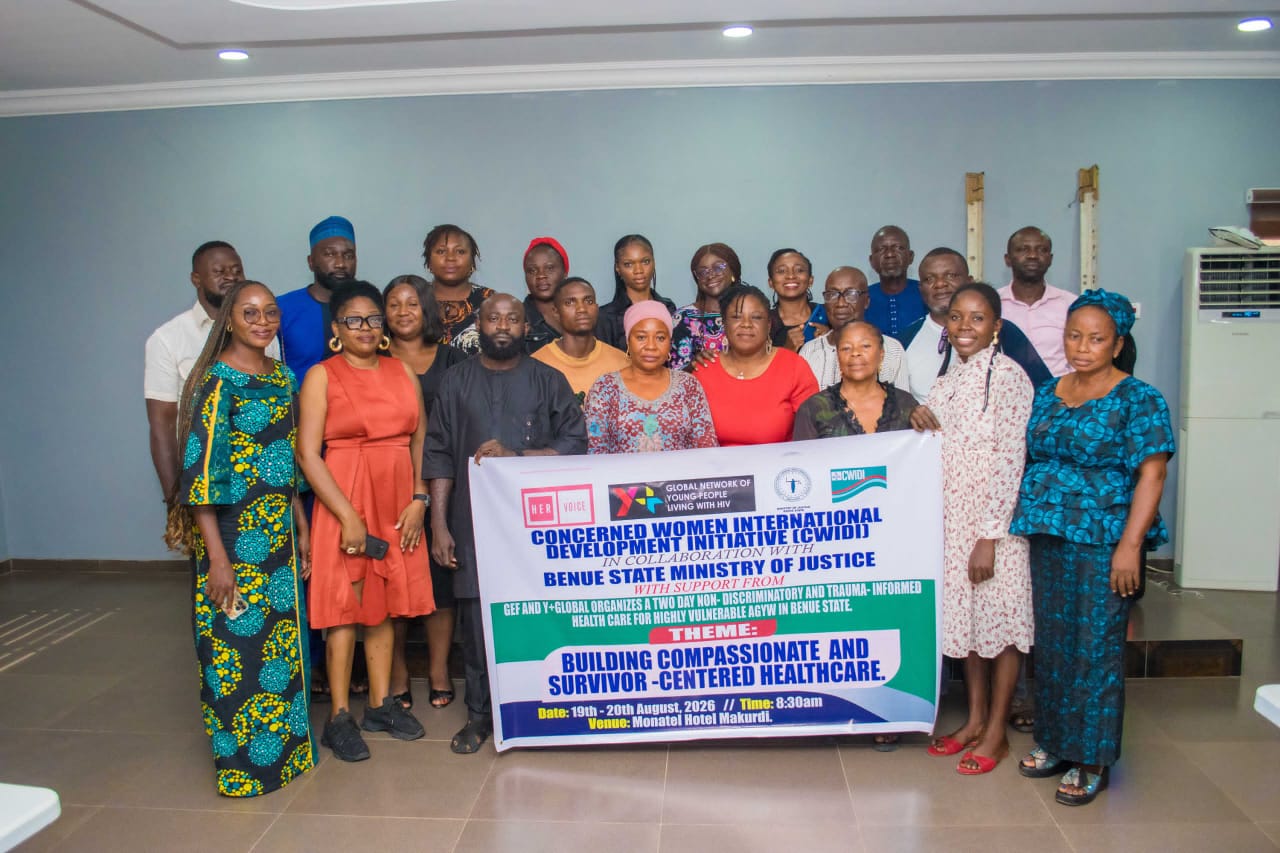
By Attah Ede, Makurdi
The Benue State Government has reaffirmed its commitment to protecting the dignity and rights of Adolescent Girls and Young Women (AGYW), ensuring equality and improving their access to justice and non-discriminatory healthcare services.
The Attorney General and Commissioner for Justice, Benue State, Prof.
Timothy Ornguga, stated this in Makurdi during a two-day training on “Non-Discriminatory and Trauma-Informed Healthcare for Highly Vulnerable AGYW in Benue State.”The training, organised by the Concerned Women International Development Initiative (CWIDI) in collaboration with the Benue State Ministry of Justice, with support from GEF and Y+ Global, was held at Monatel Hotel, Makurdi, under the theme: “Building Compassionate and Survivor-Centred Healthcare.
”Addressing participants, facilitators, partners and other stakeholders, Ornguga said healthcare workers have a responsibility to ensure that every girl or young woman who seeks medical attention is treated with dignity, regardless of her circumstances.
“It gives me pleasure to welcome all participants, facilitators, partners and stakeholders to this important training. For healthcare workers, this means that a girl or young woman who comes to a health facility must be received as a person with rights and dignity, not as a problem, moral offender or mere case file,” he said.
The Commissioner stressed that no AGYW should be discriminated against on the basis of age, sex, clothing, marital status, disability, economic circumstances, displacement, alleged conduct or any other personal circumstance.
He urged healthcare workers to limit questioning to information necessary for safe care, documentation and appropriate referral, warning against questions or comments that could embarrass, shame or morally judge survivors.
According to him, the health facility is often a survivor’s first point of contact before the police, lawyer or court, and the treatment received at that stage can determine whether the survivor feels safe enough to pursue protection and justice.
Ornguga cited a recent decision of the Delhi High Court of India in State vs. Sajid Ali, delivered on August 10, 2026, by Hon. Justice Chandrasekharan Sudha, saying the court condemned cross-examination focused on a survivor’s clothing and emphasised that a woman’s choice of attire should not be regarded as justification or condonation for unlawful conduct.
“That principle has a wider lesson for every professional institution: clothing is not consent, and a survivor’s dignity must not become collateral damage in the search for an explanation for another person’s misconduct,” he said.
He noted that Benue State’s legal framework, including the Violence Against Persons (Prohibition) Law and the Child Rights Law, provides important safeguards against violence, abuse and exploitation.
However, he stressed that the protections contained in these laws must be translated into everyday professional practice.
The Justice Commissioner urged healthcare workers to uphold confidentiality, informed communication, accurate documentation, respectful treatment and effective referral pathways. He also encouraged participants to approach the training with openness and a willingness to critically examine existing practices.
He said healthcare facilities should be places where survivors can seek help without fear of humiliation, stigma or blame.
Ornguga commended CWIDI for organising the programme and said the fight against gender-based violence could not succeed if healthcare workers, the Ministry of Justice, psychosocial service providers and social protection agencies worked in isolation.
He pledged the continued support of the Ministry of Justice for partnerships and programmes aimed at improving access to justice and protection for women, girls and other vulnerable persons.
Speaking on the objective of the training, the Executive Director of CWIDI, Becky Gbihi, said the programme was designed to ensure that healthcare workers protect human dignity while providing services to AGYW, particularly those considered highly vulnerable.
She identified adolescent orphans, girls with disabilities, sex workers and girls living in Internally Displaced Persons (IDP) camps among those who may face heightened vulnerability.
“Those categories are more vulnerable, and because they are already traumatised, whenever they receive negative treatment or comments from health workers, they withdraw, and this could cause them to break down further.
“So, the essence is for health workers to deliver services with a human face by respecting and protecting the dignity of AGYW seeking healthcare, ensuring that they have access to holistic healthcare and referring them appropriately,” Gbihi explained.
She expressed optimism that the training would equip participants to go beyond immediate medical treatment by appropriately directing survivors to other essential services, including psychosocial support.
In a presentation titled “Understanding Gender, Equality, Gender-Based Violence, GBV, and Violence Against Women and Girls,” a representative of the Ministry of Justice, Timothy Tion, explained gender roles, social norms, equality and the different forms of gender-based violence.
Tion also took participants through relevant provisions of the Benue State Violence Against Persons Prohibition (VAPP) Law of 2019 and the Child Rights Law of 2008.
He stressed the importance of equal opportunities, noting that denying people opportunities on the basis of gender violates fundamental human rights and perpetuates inequality.
Also speaking, Dr. Kwasedoo Ngbea, a Senior Lecturer in the Department of Psychology, Moses Orshio Adasu University, Makurdi, delivered a paper titled “Understanding the Health, Psychological and Social Impact of GBV on AGYW and Principles of Survivor-Centred Care: Safety, Confidentiality, Respect, Non-Discrimination and Informed Consent.”
Ngbea said the rights, needs, safety, dignity, choices and autonomy of survivors must remain paramount in the provision of healthcare.
She advocated respectful, confidential and non-judgmental support for survivors, noting that the health, psychological and social consequences of gender-based violence on AGYW can be severe and long-lasting when not properly addressed.
Participants at the training commended the organisers for strengthening their capacity and called for increased awareness campaigns to educate young girls about their rights and available support services.
They said equipping frontline workers with the right knowledge and skills would help reduce stigma, encourage reporting and ensure that survivors receive holistic care without fear of discrimination, humiliation or judgment.




OnTiv Professionals Rejects Proposed Ranching Pilot in Benue, Demands Resettlement of Displaced Communities
ShareBy David Torough, Abuja The OnTiv Professionals Association (OPA), Abuja, has rejected the Federal Government’s proposed national ranching pilot scheme...


Precious Adugbo Condemns Alleged Distortion of Pastor Komaiya’s ‘Supernatural Speed’ Sermon
ShareBy David Torough, Abuja Precious Adugbo, a member of The Master’s Place International Church, has condemned what he described as...


Military Rescues 48 Kidnap Victims, 47 Terrorist Family Members Surrender Nationwide – DHQ
ShareBy David Torough, Abuja The Armed Forces of Nigeria (AFN) rescued at least 48 abducted persons, neutralised several terrorists and...


Atiku Slams Tinubu Over Fuel Subsidy Policy
ShareBy David Torough, Abuja Former Vice President Atiku Abubakar has criticised President Bola Tinubu over the removal of petrol subsidy,...

Benue Gov’t Restates Commitment to Protection of AGYW, Non-Discriminatory Healthcare
ShareBy Attah Ede, Makurdi The Benue State Government has reaffirmed its commitment to protecting the dignity and rights of Adolescent...

UNICEF Training: Communication experts charge media practitioners to champion child-rights protection
ShareFrom Attah Ede and Sylvia udegbunam, Port Harcourt Seasoned communication experts and veteran broadcasters, on Thursday, enjoined media practitioners both...


UNICEF Trains Journalists on Ethical Reporting
ShareFrom Attah Ede and Sylvia Udegbunam, Port Harcourt The United Nations Children’s Fund (UNICEF), on Wednesday, opened a two- day...


Grammy-winning Singer, Angelique Kidjo Immortalised on Hollywood Walk of Fame
ShareFive-time Grammy winner, Angelique Kidjo, has become the first African musician to be honoured with a star on the Hollywood...


Singers Wande Coal, Davido Clash over Unreleased Collaboration, ‘Come My Way’
ShareNigerian singers Wande Coal and Davido have clashed on social media over an unreleased collaboration,“Come My Way”. The disagreement was...


Tonto Dikeh to Renovate Churches in Birthday Tribute to Pastor Jerry Eze
ShareActress and humanitarian Tonto Dikeh has announced a church support initiative through The New Wine Prophetic Tabernacle to mark the...