
FEATURES
Governor Sule: Driving Economic Reforms from Policy to People in Nasarawa State


From Leo Zwanke, Lafia
In Nigeria’s evolving governance, few leaders have gained as much recognition for reform-driven innovation at the subnational level as Governor Abdullahi Sule of Nasarawa State. From fiscal prudence to industrialisation, agricultural transformation to human capital development, the engineer-turned-technocrat has steadily positioned Nasarawa as a model for how subnational governments can translate macroeconomic reforms into tangible benefits for their citizens.
At the recent Nigeria Development Update (NDU), organised by the World Bank in Abuja with the theme “From Policy to People: Bringing the Reform Gains Home,” Governor Sule was a panellist alongside national and international development leaders.
He was introduced as a governor whose economic insight and governance style exemplify how reform implementation at the grassroots can sustain the federal government’s policy direction.“Governor Sule represents the bridge between Nigeria’s macroeconomic reforms and how these policies are domesticated at the state level,” said Shubham Chaudhuri, the World Bank Country Director for Nigeria. “He’s not only talking about reforms; he is implementing them in ways that citizens can feel.”
Before venturing into politics, Abdullahi Sule built a career in engineering, energy, and industry—serving as Managing Director of Dangote Sugar Refinery and leading other private sector initiatives. His private sector exposure, as many observers note, shaped his pragmatic approach to governance.
“The Governor came into office with a technocrat’s mind,” noted Dr. Ahmed Mohammed, an economist and lecturer at Nasarawa State University, Keffi. “He understands that policy documents mean little unless they are converted into livelihood gains.”
That philosophy—bridging policy with the people—is evident across his governance initiatives, aligning seamlessly with the World Bank’s recent development theme.
Agriculture remains Nasarawa’s economic backbone, engaging over 70 percent of its population. Governor Sule’s administration has revitalised the sector through targeted mechanisation, input distribution, and market linkage interventions.
Through partnerships with the African Development Bank (AfDB) and the World Bank’s Agro-Climatic Resilience in Semi-Arid Landscapes (ACReSAL) project, the state has distributed modern tractors, improved seedlings, and irrigation facilities to thousands of farmers.
In Yamaltu Deba, a community in Awe Local Government Area, farmer Mallam Abdullahi Umar explained how the tractorisation scheme has transformed their operations.
“Before, we used hoes and cutlasses. It took us two weeks to plough a hectare. Now, with tractors, we do that in one day. Our yields have doubled,” he said proudly.
Governor Sule himself often emphasises the need for “commercially viable farming” and “agriculture as a business, not a subsistence activity.” His administration has created a framework for farmer clusters, linking smallholder producers with large-scale processors, thereby addressing one of Nigeria’s major agricultural bottlenecks—post-harvest loss.
These interventions are not isolated. They feed into the national agenda of improving food security, generating rural employment, and reducing inflation. In Nasarawa, farmers are reporting higher incomes and expanded market access, a reflection of the governor’s commitment to inclusive growth.
Often called the “Home of Solid Minerals,” Nasarawa State is richly endowed with tin, lithium, barite, and other minerals. Yet, for decades, the sector remained largely informal, with little contribution to state revenue.
Governor Sule has changed that narrative through policy reforms that encourage private sector participation and responsible mining. Under his administration, Nasarawa has developed a solid minerals development policy, created a one-stop investment office, and attracted both domestic and foreign investors.
Earlier this year, the governor led an investment mission to India, where he met with industrial leaders and promoted opportunities in Nasarawa’s mining, energy, and agricultural value chains. The result was a flurry of interest from companies seeking to establish operations in the state.
“Governor Sule’s investment drives are opening Nasarawa to the world,” said Mr. Nabil Saleh, a consultant in mining development. “For the first time, there’s a clear structure and transparency around mining licences, community agreements, and environmental safeguards.”
In Karu and Keffi, local youths who previously relied on artisanal mining now participate in formalised mining cooperatives supported by state-led training programmes. This not only ensures environmental safety but also helps the state retain a greater share of mining revenue.
Additionally, Governor Sule’s administration has set up an Industrial Development Plan anchored on the establishment of industrial parks in Lafia, Doma, and Karu. The parks are designed to host agro-processing, mineral refining, and light manufacturing industries. This initiative ties directly into the World Bank’s message of translating macro-level reforms into job creation and improved livelihoods at the subnational level.
Economic reforms cannot thrive without functional infrastructure. In Nasarawa, infrastructure development has been a cornerstone of the Sule administration.
From the dualisation of major highways connecting the state to Abuja, to the ongoing construction of feeder roads linking rural communities with markets, the administration has prioritised roads as key drivers of commerce.
The Mararaba–Udege–Uke feeder road, completed in 2024, now connects thousands of farmers to urban markets, significantly reducing transport costs and spoilage.
“It used to take us two hours to reach Lafia with our goods; now it’s less than 40 minutes,” said Mrs. Asabe Luka, a tomato farmer from Obi LGA. “We no longer lose our produce on bad roads.”
Power and energy are also central to Nasarawa’s reform narrative. Through collaboration with the Nigeria Electrification Project (NEP) and independent power producers, the state is expanding rural electrification, powering small businesses and industries.
Governor Sule’s energy policy aims to make Nasarawa a net supplier of power to neighbouring states, leveraging its hydro and solar potential.
“Access to power is central to our industrial ambition,” the governor said at a recent state economic forum. “Without energy, reforms remain theoretical. That’s why we’re integrating renewable energy solutions into our development plan.”
For Governor Sule, economic growth is only sustainable when accompanied by human capital development. The state has, therefore, increased investment in education, healthcare, and social protection programmes.
In 2025, the governor flagged off the integrated Measles-Rubella and Polio Immunisation Campaign in Akwanga, with support from UNICEF and the World Health Organisation (WHO). This campaign, which is said to reaching over 1.37 million children, was part of the administration’s wider commitment to preventive healthcare.
“We are determined to eliminate vaccine-preventable diseases and ensure that every child in Nasarawa can live a healthy life,” Governor Sule declared during the flag-off.
The state has also revitalised its primary healthcare centres, constructed new hospitals, and initiated the Nasarawa Health Insurance Scheme (NHIS), which now covers over 120,000 residents.
In education, Nasarawa has built and renovated hundreds of classrooms, recruited teachers, and introduced digital learning tools in partnership with donor agencies.
Mrs. Rachael Musa, a teacher in Keana, described how digital education is changing learning outcomes:
“We now use tablets to teach basic science and mathematics. The children are more interested, and parents are beginning to value education even more.”
The Nasarawa State Scholarship Board has been revamped to ensure fair and transparent allocation of bursaries, especially for female students pursuing science and technology courses.
According to the chief press Secretary to the Governor, Ibrahim Addra who noted that the Nasarawa State Governor, His has been honoured with the prestigious Platinum Award and recognition as Education Ambassador in Lagos Nigeria.
He said the honour bestowed on Governor Sule is at the instance of the Independent Newspaper which referenced the Governor’s “investment, advocacy and promotion of child education in Nasarawa State which resonate across the country.”
In a letter notifying the Governor of the award, Independent Newspaper said, “If Sir Ahmadu Bello were to look back from his grave, he would no doubt be proud of Governor Abdullahi Sule for sustaining the legacy of free primary education.”
The award ceremony was held on Thursday, October 9, 2025, at the Eko Hotel and Suites, Victoria Island, Lagos.
Governor Sule has since expressed gratitude to the Daily Independent for recognising the efforts of his administration to give the education sector the deserved attention through huge budgetary provision, innovation, supervision, and uncommon commitment.
These social investments and Educational Reforms directly support the World Bank’s reform agenda, which emphasises human capital as the foundation of economic transformation.
Under Governor Sule, Nasarawa has emerged as one of the most fiscally disciplined states in Nigeria. The State Fiscal Transparency, Accountability, and Sustainability (SFTAS) initiative—a joint programme of the Federal Government and the World Bank—ranked Nasarawa among the top-performing states in financial reporting, budget transparency, and citizens’ engagement.
The administration has digitised the state’s revenue collection system, introduced e-procurement, and created a Public Procurement Bureau to monitor contract awards. These reforms have improved public trust and investor confidence.
“Governor Sule’s approach to governance is evidence-based,” noted Dr. Joy Adamu, a governance analyst. “His administration publishes budget details online and invites civil society to track spending. That’s rare in many states.”
The 2025 budget, valued at over ₦149 billion, focuses heavily on capital expenditure, targeting agriculture, infrastructure, and education. The governor has described it as a ‘budget of continuity and consolidation’, aimed at completing legacy projects and sustaining fiscal reforms.
The Nigeria Development Update’s message is the need to ensure that macroeconomic reforms such as subsidy removal, foreign exchange unification, and fiscal tightening translate into visible improvements in citizens’ welfare.
Governor Sule’s Nasarawa model aligns perfectly with this philosophy. His state’s economic agenda mirrors national priorities while remaining locally driven.
“Reforms must touch the lives of people directly,” the governor said during the World Bank panel. “That is why we design our programmes to impact farmers, traders, miners, and small businesses, not just government statistics.”
By investing in production, transparency, and human capital, the Sule administration demonstrates that subnational governments can serve as catalysts for national reform success.
In Nasarawa, the story of reform is not just told in government memos—it’s lived by ordinary people.
In Doma, cassava processor Mrs. Maimuna Adogi recounted how a state grant enabled her to expand her processing mill.
“Before the grant, I employed only two people. Now, we are ten. I can feed my family and even save for my children’s school,” she said.
In Keffi, youth entrepreneur Tanimu Musa described how the Nasarawa Enterprise Development Scheme (NEDS) helped him scale his small welding business.
“The state gave us training and small loans. Now I get contracts from local construction firms,” he explained.
These micro-level testimonies echo the theme of “From Policy to People,” proving that reforms are only successful when their impact is measurable in people’s lives.
Governor Abdullahi Sule’s reform trajectory provides a powerful case study in how subnational leaders can domesticate and sustain national reforms. His administration’s blend of technocratic precision, fiscal responsibility, and citizen-focused programmes stands out in Nigeria’s subnational governance landscape.
As Nigeria seeks to stabilise its economy and build inclusive growth, the Nasarawa model offers valuable lessons in investing in sectors that touch people directly, agriculture, education, and health, while pursuing transparency and accountability as the foundation for investor trust, and engaging communities in policy design and delivery.
From the fields of Doma to the classrooms of Keana, and the mining pits of Udege to the industrial estates in Lafia, the gains of reform are becoming visible.
In the words of the governor himself: “When people begin to feel government policies in their pockets and in their homes, that’s when reforms become meaningful. That’s what we are doing in Nasarawa.”


By David Torough
It has become very safe, perhaps, to conclude that the Executive Secretary and Chief Executive Officer(CEO) of Nigerian Shippers’ Council(NSC), Dr. Pius Akutah is the only maritime agency head who has become not only media but stakeholder-friendly.
He is easily accessible and gives ears to complaints while being ready to receive visitors on short notice.
He does not discriminate. It does not presuppose that he is not busy with schedules. It simply means that he understands what leadership entails.In Nigeria, any agency CEO that has bills before the National Assembly, awaiting passage is worth being sympathized with because he has no time of his, and must always be on his or her toes to source unbudgeted or budgeted funds to service the nauseating financial demands of the legislators on both chambers.
Therefore, Dr. Akutah deserves all the sympathy he can get for choky schedules with external and internal office demands.
Navigating the passage of the Council’s Nigerian Port Economic Regulatory Agency(NPERA) Bill at the National Assembly, only is time consuming not to talk of the Minister’s attention and his immediate constituency’s calls.
Surprisingly, with a plane to catch at the airport for an international trip, he found it rewarding to hold a media lunch with Maritime Editors and Reporters, penultimate Saturday in Ikeja, Lagos.
He gives account of his brief stewardship since assuming office, putting paid to the insinuation that the Council has been in comatose as a result of an unfounded story of a political ambition. He presents in financial terms the intervention of the Council in the port industry, while laying bare the future outlook of the agency.
The report is good enough for personal assessment of the agency. We present the full report unabridged. Enjoy it.
Since assuming office in November 2023, the Management of the Nigerian Shippers’ Council (NSC), “Under my leadership, has pursued a focused reform agenda to strengthen the Council’s role as Nigeria’s Port Economic Regulator and reposition it as a modern, efficient and globally competitive institution”.
Guided by the Renewed Hope Agenda of His Excellency, President Bola Ahmed Tinubu, GCFR, and the policy direction of the Honourable Minister of Marine and Blue Economy, His Excellency Adegboyega Oyetola, CON, the Council has delivered measurable progress in economic regulation, consumer protection, trade facilitation, digital transformation, institutional renewal and stakeholder engagement.
Within the period under review, the Council protected over ₦90.60 billion and US$1.348 million in economic value for Nigerian shippers and the national economy.
This includes preventing ₦86.06 billion in unjustified demurrage payments and securing savings of ₦4.54 billion and US$1.348 million through Alternative Dispute Resolution(ADR) and regulatory interventions.
The Council also achieved major institutional milestones, including the passage of the Nigerian Port Economic Regulatory Agency (NPERA) Bill by both Chambers of the National Assembly, approval of its statutory funding mechanism through the 2025 Appropriation Act, active participation in the National Single Window Project and resolution of key issues delaying implementation of the International Cargo Tracking Note (ICTN).
These reforms are improving regulatory certainty, reducing the cost of doing business and supporting the Federal Government’s vision of building a US$1 trillion economy by 2030.
Key Achievements at a glance include: Prevented over ₦86.06 billion in unjustified demurrage payments, Saved Nigerian shippers more than ₦4.54 billion and US$1.348 million through ADR and regulatory interventions, Received 558 complaints and resolved 295 commercial disputes, Harmonised bonded terminal invoice charges from 18 charge categories to six, Facilitated passage of the NPERA Bill, now awaiting Presidential Assent, Secured statutory funding for the Council for the first time since 1978, Advanced implementation of the National Single Window and ICTN, Deployed the Enterprise Content Management System and introduced the Leadership and Succession Planning Project and Substantially concluded preparations for the 18th International Maritime Seminar for Judges.
The passage of the NPERA Bill by both Chambers of the National Assembly represents a landmark reform in Nigeria’s maritime sector.
Once assented to, the legislation will establish an independent Port Economic Regulator with enhanced powers to regulate tariffs, service standards, competition and commercial conduct, thereby strengthening transparency and investor confidence across the port industry.
Another significant milestone is the approval of the Council’s statutory funding mechanism, captured in the 2025 Appropriation Act for the first time since the Council’s establishment in 1978.
This provides a sustainable framework for effective regulation, with collection to be integrated into the National Single Window platform.
The Council has actively supported the National Single Window Project, which is expected to simplify cargo clearance, improve coordination among government agencies and reduce the time and cost of doing business at Nigerian ports.
Similarly, outstanding issues delaying implementation of the ICTN have been resolved. Once operational, the ICTN will strengthen cargo visibility, improve trade intelligence, enhance supply chain security and support regulatory compliance.
As Nigeria’s Port Economic Regulator, the Council has continued to promote fairness, transparency and efficiency in port operations through effective economic regulation and consumer protection.
During the period under review, the Council reviewed and approved tariff requests for shipping companies, terminal operators and Inland Dry Ports after rigorous regulatory assessment.
It also continued to confirm the reasonableness of freight rates, charter party fees and vessel demurrage for foreign exchange transactions, as well as freight charges on export cargoes, thereby supporting transparency and helping to curb capital flight.
To improve pricing transparency, terminal operators were directed to publicly display approved tariffs, while shipping companies were required to establish holding bays outside the ports to facilitate the return of empty containers and reduce congestion along port access roads.
The Council also abolished unauthorised surcharges introduced by some shipping lines, developed minimum service standards for shipping companies and terminal operators, and collaborated with the Nigerian Ports Authority and the Federal Ministry of Marine and Blue Economy to assess compliance with Port Concession Agreements and Key Performance Indicators.
A major achievement was the prevention of over ₦86.06 billion in unjustified demurrage payments through regulatory oversight.
The Council also harmonised bonded terminal invoice charges, reducing charge categories from 18 to 6, thereby eliminating duplication and improving billing transparency.
Through stakeholder engagement and collaboration with key regulatory agencies, including the Federal Competition and Consumer Protection Commission and the Nigeria Customs Service, the Council has deepened compliance and reinforced confidence in Nigeria’s port regulatory framework.
The Council also facilitated a landmark Collective Bargaining Agreement between the Maritime Workers’ Union of Nigeria and employers in the shipping industry, resulting in a new ₦200,000 minimum wage for junior workers after almost two decades of negotiations. Discussions on an agreement for senior staff are at an advanced stage.
Alternative Dispute Resolution(ADR) remains one of the Council’s most effective mechanisms for protecting Nigerian shippers and reducing the cost of doing business.
Between the fourth quarter of 2023 and the second quarter of 2026, the Council received 558 complaints, resolved 295 cases and secured savings exceeding ₦4.54 billion and US$1.348 million.
The disputes covered container deposits, demurrage, detention charges, terminal charges, cargo claims, export fraud and related commercial matters.
The Council also concluded out-of-court settlements involving APM Terminals Nigeria Limited, CMA CGM and Maersk Nigeria Limited in matters arising from charges paid above approved tariffs.
These interventions protected Nigerian shippers, reduced litigation and reinforced confidence in the Council’s dispute resolution framework.
The Council continues to promote an integrated multimodal transport system through the development of Inland Dry Ports, Vehicle Transit Areas and Border Information Centres.
Operational Inland Dry Ports in Kaduna, Kano and Funtua continue to improve cargo movement, support customs operations and stimulate economic activity in inland regions.
Vehicle Transit Areas complement this strategy by supporting orderly movement and temporary storage of imported vehicles outside congested port environments.
The Border Information Centre Programme is also being expanded. Following the completion of the Idiroko Centre in Ogun State, work is advancing on new Centres in Jigawa, Benue, Borno and Kebbi States, while existing Centres along Nigeria’s major border corridors are being upgraded.
Following the destruction of the Jibia Centre by a heavy rainstorm in June 2026, the Council prioritised its reconstruction as part of its infrastructure renewal programme.
To provide more sustainable facilities, the Council has commenced engagement with State Governments for land to develop permanent Border Information Centre complexes.
These facilities will improve trade information services, strengthen regulatory coordination and support legitimate cross-border trade under the African Continental Free Trade Area, while reducing logistics bottlenecks and positioning Nigeria as a preferred maritime and logistics hub in West and Central Africa.
Council has continued to implement internal reforms aimed at building a modern, technology-driven and high-performing regulatory institution.
A major milestone is the deployment of the Enterprise Content Management System, which has transformed records and document management through the digitisation of thousands of legacy files, automation of workflows, improved document security and faster retrieval of official records.
This has reduced dependence on paper-based processes and improved operational efficiency.
The Council has also strengthened its Performance Management System by aligning individual targets with institutional goals, while prioritising local and international training, professional certification, workforce planning and competency-based deployment.
A key initiative introduced during the period is the Leadership and Succession Planning Project, designed to identify and prepare future leaders for critical management positions.
This is supported by the Middle Management Leadership Retreat, which is equipping emerging leaders with strategic, managerial and leadership competencies.
Staff welfare has also been enhanced through timely promotion exercises, confirmation of appointments, career progression, recognition of long-serving officers, retirement appreciation programmes and improved communication between Management and staff.
As part of preparations for the transition to NPERA, Management has undertaken organisational restructuring, reviewed departmental functions, strengthened HR governance, updated HR policies and reinforced compliance with Public Service Rules.
The Nigerian Shippers’ Council remains committed to strengthening maritime jurisprudence as a foundation for a modern, efficient and globally competitive maritime industry.
In July 2024, the Council successfully hosted the 17th International Maritime Seminar for Judges in Abuja under the theme, “Navigating the Intersection of Admiralty Law and Environmental Sustainability: Charting a Course for Nigeria’s Blue Economy.”
The seminar brought together judicial officers, maritime law practitioners, regulators, academics and industry stakeholders to deliberate on emerging legal issues affecting the maritime sector.
Building on that success, the Council is fully prepared to host the 18th International Maritime Seminar for Judges, scheduled to hold from 22 to 24 July 2026 in Abuja.
Organised in collaboration with the National Judicial Institute and the Nigerian Maritime Law Association, the seminar will bring together Justices of the Supreme Court, Court of Appeal, Federal and State High Courts, senior maritime law practitioners, academics, regulators and maritime experts from Nigeria and other African countries.
Invitations have also been extended to the Chief Justices of Ghana, The Gambia, Sierra Leone, Liberia and Kenya.
The seminar will promote legal certainty, support harmonisation of maritime business laws, strengthen investor confidence and advance the implementation of the African Continental Free Trade Area.
Preparations have been substantially concluded, with venue, logistics and faculty arrangements in place.
Going forward, the Nigerian Shippers’ Council will continue to deepen port economic regulation, strengthen consumer protection, accelerate digital transformation, expand trade facilitation infrastructure and promote multimodal transport.
“The Council will support the implementation of the National Single Window and the International Cargo Tracking Note, while consolidating the transition to the Nigerian Port Economic Regulatory Agency once the NPERA Bill receives Presidential Assent.
“Priority will also be given to the development of permanent Border Information Centre facilities, leadership development, succession planning, workforce transformation and stronger collaboration with stakeholders across the maritime value chain.
“Our objective is clear: to build a transparent, efficient and globally competitive port economic regulatory system that protects Nigerian shippers, promotes fair competition, improves port efficiency, attracts investment and supports Nigeria’s emergence as the leading maritime and logistics gateway in West and Central Africa,” Akutah stated.
The achievements recorded since November 2023 demonstrate the Nigerian Shippers’ Council’s commitment to effective regulation, institutional excellence, trade facilitation and national economic development.
“The Council is entering a new phase of institutional growth. Our focus is not only to regulate the port environment, but to help build a more transparent, competitive and investment-friendly maritime economy that delivers measurable value to businesses, consumers and the nation.
“We will continue to work closely with government, industry stakeholders, development partners and the media to sustain these reforms and ensure that Nigeria fully harnesses the enormous opportunities in the Marine and Blue Economy.
“The Council deeply appreciates the enduring partnership of the maritime media. Your role in informing the public, educating stakeholders and promoting accountability remains vital to the growth of the maritime sector.
“We remain committed to transparency, constructive engagement and continued partnership as we work together to build a stronger, more competitive and globally respected maritime economy for Nigeria,” Akutah Concluded.

By Tambaya Julius, Abuja
The Nigeria Customs Service (NCS) has graduated 50 officers from the Nigeria Customs Command and Staff College (NCCSC), Gwagwalada, with two officers from the Service’s National Public Relations Unit emerging as the Overall Best and Second Best Graduating Students in Senior Course 14/2026.
A major highlight of the graduation ceremony, held at the Ahmed Makarfi Hall of the College on Friday, 26 June 2026, was the emergence of Chief Superintendent of Customs Ridwan Yusuf as the Overall Best Graduating Student and Chief Superintendent of Customs Nuruddeen Sa’idu as the Second Best Graduating Student.
Both officers serve in the Service’s Public Relations Unit.In his message to the graduating officers, the Comptroller-General of Customs, Adewale Adeniyi, represented by the Commander, Training and Doctrine Command (TRADOC), Deputy Comptroller-General of Customs Sulaiman Chiroma, congratulated them on completing one of the Service’s most demanding professional training programmes.
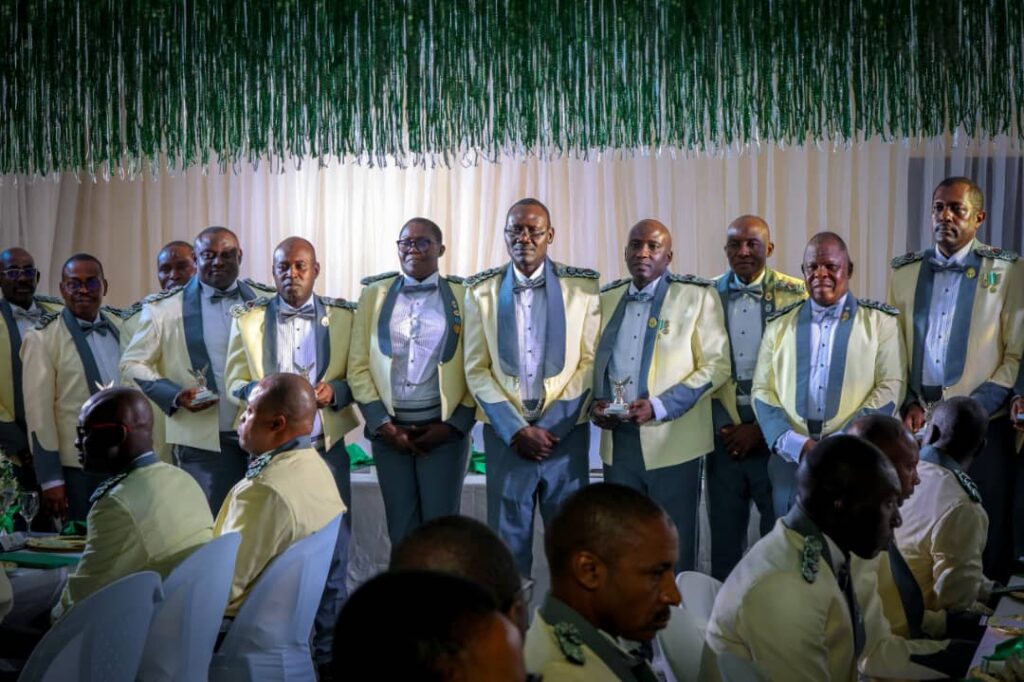
DCG Chiroma charged the officers to uphold the highest standards of professionalism, discipline and courage, saying, “To whom much is given, much is expected. On behalf of the Comptroller-General of Customs, I urge you to remain mission-focused and continue to serve the nation with honesty, integrity and dedication.”
Earlier, the Commandant of the College, Assistant Comptroller-General of Customs Duwoh Gaura, reaffirmed the institution’s commitment to producing competent officers in line with the Comptroller-General’s vision of a more efficient, technology-driven and professional NCS.

The graduation marked another milestone in the Service’s commitment to developing highly skilled officers capable of meeting the evolving demands of Customs administration and border management.
The College had earlier, on Wednesday, 24 June 2026, held a Regimental Dinner at the NCCSC Hotel, Gwagwalada, in honour of the graduating officers. The event was attended by members of the Service’s Management Team, senior officers and guests. It was graced by the Comptroller-General of Customs, Adewale Adeniyi, represented by DCG Sulaiman Chiroma.

By Prof Uche Uwaleke
The Federal Government’s recent decision to draw the first tranche of about $1.5 billion from a $5 billion financing arrangement with the United Arab Emirates’ First Abu Dhabi Bank (FAB) marks another important chapter in Nigeria’s search for innovative ways to finance its budget and manage its growing debt obligations.
The transaction has generated considerable public interest because it departs from the conventional methods through which governments usually borrow money.Instead of issuing Eurobonds or taking a straightforward syndicated loan, Nigeria has opted for a sophisticated financial instrument known as a Total Return Swap (TRS).
While such arrangements are common in advanced international financial markets, they remain relatively unfamiliar to many Nigerians and even to a number of financial market participants. The complexity of the structure has attracted both praise and caution, with supporters viewing it as a creative financing solution while critics warn that it introduces new risks that deserve careful consideration.
To appreciate the significance of this development, it is important to understand the difficult financial environment in which the Federal Government currently operates. Like many developing countries, Nigeria faces a widening gap between government revenue and public expenditure. Large investments are required to build roads, railways, power infrastructure, healthcare facilities and schools, while debt service obligations continue to consume a substantial portion of government revenue.
At the same time, borrowing from the international capital market has become considerably more expensive following the sharp increase in global interest rates over the past few years. Investors have become more selective in lending to emerging and frontier economies, demanding higher returns to compensate for perceived risks. Consequently, issuing new Eurobonds has become significantly costlier than it was only a few years ago.
Against this background, the Federal Government has been exploring alternative sources of external financing that could provide access to large amounts of foreign exchange without immediately returning to the Eurobond market. It is within this context that the financing arrangement with First Abu Dhabi Bank should be understood. According to reports, the recently accessed $1.5 billion represents only the first drawdown under a broader facility of up to $5 billion, which may be accessed in stages over time depending on the government’s financing requirements and the satisfaction of agreed conditions.
The financing itself is structured as a Total Return Swap. Although the name sounds highly technical, the underlying concept can be explained in relatively simple terms. A conventional loan is straightforward. A lender gives money to a borrower, who agrees to repay the principal with interest over an agreed period. A Total Return Swap, however, is not a conventional loan. It is a derivative contract, a financial agreement whose value depends on another financial asset.
Perhaps the simplest way to understand the arrangement is to imagine someone who wishes to borrow money from a bank but instead of merely signing a loan agreement, also pledges valuable investment assets as security while agreeing to exchange the financial returns generated by those assets under a separate contractual arrangement. In effect, the lender provides the required cash while the borrower commits specified financial assets to support the transaction. The arrangement therefore combines elements of borrowing, collateral management and risk sharing into one integrated financial structure.
In Nigeria’s case, the Federal Government receives United States dollar funding from First Abu Dhabi Bank while providing naira-denominated Federal Government securities as collateral. These securities remain government obligations but become encumbered for the duration of the transaction, meaning they cannot be freely used or traded because they have effectively been pledged to support the financing arrangement. This is one of the major distinctions between the facility and a conventional sovereign loan.
One reason governments sometimes prefer such structures is that they can unlock substantial funding even when traditional borrowing channels become less attractive or more expensive. Countries such as Angola and Senegal have previously utilized similar arrangements after conditions in the international capital markets became more challenging. For Nigeria, the facility offers another avenue to obtain foreign exchange without immediately issuing another Eurobond, thereby diversifying its funding sources.
Another feature attracting attention is the pricing of the transaction. When the arrangement was first announced earlier this year, the interest cost was estimated at approximately SOFR plus 3.95 to 4.00 percentage points, together with certain transaction fees. Since then, global interest rates have moderated somewhat. The Secured
Overnight Financing Rate (SOFR), which serves as the benchmark for this transaction, currently stands at roughly 3.6 to 3.7 per cent, compared with over 5 per cent when discussions around the facility first became public. Consequently, the all-in borrowing cost on the current drawdown is now around 7.6 to 7.7 per cent, excluding certain fees and transaction costs.
To many Nigerians, expressions such as SOFR and basis points may sound unnecessarily technical, yet the underlying idea is actually straightforward. SOFR is simply the benchmark interest rate used by financial institutions around the world when pricing many United States dollar loans. It measures the cost at which financial institutions borrow money overnight using United States Treasury securities as collateral. Because these Treasury securities are regarded as among the safest financial assets in the world, SOFR is generally considered a near risk-free base interest rate for dollar transactions.
Whenever an international borrower such as Nigeria raises funds, lenders add an additional percentage above SOFR to compensate for the risks associated with lending to that particular country. This additional charge is known as the credit spread or risk premium. In Nigeria’s case, the premium of about 4 percentage points reflects investors” assessment of sovereign credit risk, exchange rate uncertainty, liquidity considerations and prevailing market conditions. In other words, while the United States government can borrow at rates close to SOFR because it is regarded as one of the safest borrowers in the world, countries perceived to carry greater economic or financial risks must pay an additional premium to attract lenders.
Viewed from this perspective, Nigeria’s current borrowing cost sends two messages simultaneously. On one hand, it confirms that international lenders are still willing to provide substantial financing to the country despite prevailing global uncertainties.
Maintaining access to international credit markets is itself an important positive signal because it demonstrates that investors continue to regard Nigeria as creditworthy.
On the other hand, the relatively wide spread above SOFR also reflects the higher level of risk that international markets currently associate with the Nigerian economy. Countries with stronger credit ratings typically pay much smaller premiums, while frontier economies often pay significantly higher spreads.
Supporters of the transaction argue that, judged against prevailing international market conditions, the pricing remains competitive. One aspect of the pricing that has received comparatively little public attention is the arranger’s fee of 1.5 per cent attached to the facility. Although such fees are common in large international financing transactions, the magnitude of this charge deserves careful consideration. If the entire $5 billion facility is eventually drawn, a 1.5 per cent fee would amount to approximately $75 million. Even if the fee is applied proportionately to individual drawdowns, it still represents a substantial additional financing cost over and above the interest payable on the facility.
From a public finance perspective, the relevant issue is not whether an arranger’s fee should exist but whether its size is justified by the complexity of the transaction and consistent with prevailing market practice for comparable sovereign financing arrangements. When combined with the interest spread above SOFR, the arranger’s fee increases the effective economic cost of the facility and should therefore form part of any comprehensive assessment of whether the transaction represents good value for Nigeria.
Be that as it may, the government maintains that the cost compares favourably with what the country might have paid through other external borrowing options and that the financing will assist ongoing efforts to refinance more expensive debt, strengthen fiscal management and provide additional resources for critical infrastructure projects.
The attraction of the arrangement therefore lies not only in the amount of money available but also in its flexibility. Unlike a single lump-sum borrowing, the facility allows drawdowns to be made in stages as funding needs arise. This means the government does not necessarily incur interest charges on the entire $5 billion immediately but only on the amounts actually accessed. Such flexibility can improve cash flow management and potentially reduce unnecessary financing costs.
Nevertheless, attractive features should never be confused with the absence of risk.
Financial markets rarely provide significant benefits without corresponding obligations.
Indeed, many of the concerns being expressed by international institutions such as the International Monetary Fund, Fitch Ratings and Moody’s do not arise because the facility is inherently inappropriate, but because its complexity introduces obligations that are less obvious than those associated with ordinary government borrowing. Some of these obligations could become significant if economic conditions deteriorate unexpectedly, particularly if the naira weakens sharply, domestic interest rates rise considerably or Nigeria’s sovereign credit rating comes under renewed pressure.
Understanding these less visible obligations is essential to forming an objective assessment of the transaction. While the first drawdown undoubtedly provides valuable foreign exchange at a time when fiscal pressures remain intense, the long-term success of the arrangement will ultimately depend not only on the government’s ability to manage the financial risks embedded in the structure but also on whether the borrowed funds are invested in projects capable of generating sufficient economic returns to comfortably meet future repayment obligations.
If the benefits of the facility are relatively easy to appreciate, the obligations embedded in the transaction require a little more explanation because they represent the very issues that have attracted caution from international financial institutions and credit rating agencies. These risks are not necessarily reasons to reject the financing arrangement outright. Rather, they underscore the importance of understanding that sophisticated financial instruments often contain obligations that become more demanding when economic conditions deteriorate.
Perhaps the most distinctive feature of the arrangement is the requirement for Nigeria to provide collateral in the form of Federal Government securities denominated in naira. At first glance, this may appear entirely unremarkable since lenders routinely demand collateral to protect themselves against possible default. However, the amount of collateral required under this arrangement is considerably larger than the amount actually borrowed.
The agreement requires what is known as a 25 per cent haircut on the pledged securities.
The term “haircut”; can easily be misunderstood because it does not imply that Nigeria is paying an additional fee. Rather, it refers to the discount the lender applies when valuing the collateral. If securities worth one hundred dollars are pledged, the lender does not recognize their full market value but instead treats them as being worth only seventy-five dollars for lending purposes. In practical terms, every dollar borrowed must therefore be backed by approximately one dollar and thirty-three cents worth of government securities. Consequently, if Nigeria eventually draws the full five billion dollars under the facility, it would need to pledge government securities worth the equivalent of roughly six billion, six hundred and seventy million dollars.
This over-collateralization provides additional comfort to the lender but comes at a cost to the borrower. The pledged securities become tied to the transaction and are no longer freely available for other financing operations during the life of the agreement. Although the government continues to own the securities, their use becomes restricted because they now serve as security for the financing. In effect, valuable financial assets become locked into the transaction.
The implications become even more significant because the value of these securities is not fixed throughout the life of the facility. Instead, they are reviewed regularly under a process known as margining. In simple language, this means that the lender periodically reassesses whether the pledged collateral remains sufficient to support the outstanding loan. If market conditions change in a manner that reduces the recognized value of the collateral, Nigeria must provide additional securities to restore the agreed level of protection.
An everyday illustration may help explain this concept. Suppose a bank lends money against a house whose market value subsequently falls sharply. The bank may require the borrower to provide additional security because the original collateral no longer offers adequate protection. The same principle applies here, except that instead of property, the collateral consists of government securities whose value fluctuates with movements in financial markets and the exchange rate.
This feature introduces one of the most important risks associated with the arrangement.
Since the loan itself is denominated in United States dollars while the collateral consists of naira-denominated securities, changes in the exchange rate become critically important. If the naira depreciates substantially against the dollar, the dollar value of the pledged securities may decline even if their naira value remains unchanged. Should that happen, the lender may require Nigeria to pledge additional securities in order to maintain the agreed collateral coverage.
The consequences could become particularly challenging during periods of economic stress. Exchange rate depreciation often occurs at precisely the time when governments are already under pressure from declining revenues, rising inflation and tighter financial conditions. Having to identify additional collateral during such periods could further strain public finances and reduce policy flexibility.
The value of the collateral may also decline for reasons unrelated to the exchange rate.
Government bond prices fluctuate continuously in response to movements in domestic interest rates. When interest rates rise, the market prices of existing bonds generally fall.
If Nigerian interest rates increase significantly, the market value of the pledged securities may decline sufficiently to trigger additional collateral requirements even if the exchange rate remains relatively stable.
This is one reason Fitch Ratings has warned that dollar-denominated margin calls secured by naira collateral could intensify pressure on Nigeria’s foreign exchange position if domestic bond yields increase or the naira weakens. The concern is not that such an outcome is inevitable but that the structure itself creates an additional channel through which financial market volatility could affect the government’s financing position.
It is worth noting that the agreement is designed to operate in both directions. If the market value of the collateral rises significantly, some excess collateral may theoretically be released back to Nigeria. In practice, however, financial markets have historically demonstrated that adverse developments often occur more suddenly and with greater force than favourable ones. Governments therefore tend to experience the downside obligations of collateral management more frequently than the upside benefits.
Another important feature of the arrangement concerns its maturity. On paper, the facility has a six-year tenor, with repayment of the principal scheduled as a single lump sum at the end of the period. Unlike many conventional loans that require gradual repayment over time, this structure postpones repayment of the principal until maturity.
This feature provides obvious short-term relief because the government avoids making annual repayments of the principal during the life of the facility. Cash that would otherwise have been devoted to debt repayment remains available for infrastructure, public services and other fiscal priorities. Yet the same feature also creates a future obligation that cannot be ignored. When the six years eventually expire, the entire principal falls due at once unless it is refinanced. If adequate preparations have not been made well in advance, the government could face significant fiscal pressure at maturity.
Equally noteworthy is the provision allowing a review after three years. Such break clauses are not unusual in sophisticated financial transactions. They provide an opportunity for both parties to reassess the arrangement in light of prevailing market conditions. While this flexibility may prove advantageous if circumstances improve, it also introduces an element of uncertainty because the continuation of the arrangement beyond that point may depend on negotiations between the parties.
Perhaps even more significant is the requirement for annual rollover of each tranche. This aspect has received relatively little public attention despite its potential implications.
Although the facility is described as having a six-year maturity, each amount drawn under the arrangement is effectively subject to periodic renewal. In practical terms, the borrower must request that the lender continue each tranche under agreed conditions.
This means the financing does not possess the same degree of certainty as a traditional six-year loan whose terms remain fixed throughout its life. Should global financial conditions deteriorate or the lender’s assessment of Nigeria’s creditworthiness change materially, the lender could seek revised pricing, request additional collateral or reduce its exposure. In the most adverse circumstances, failure to agree on a rollover could oblige Nigeria to repay the affected tranche much earlier than originally anticipated.
Another layer of complexity arises from provisions linked to Nigeria’s sovereign credit ratings. The agreement reportedly contains mechanisms that may be activated if major international rating agencies downgrade Nigeria’s sovereign rating beyond specified thresholds. Such developments could trigger consultations between the parties with a relatively short period within which to negotiate revised terms. If no satisfactory agreement is reached within the stipulated timeframe, the arrangement could potentially be terminated prematurely.
It is this combination of collateral management, exchange rate exposure, market revaluation, rollover requirements and credit rating triggers that distinguishes the transaction from conventional sovereign borrowing. None of these features automatically translates into financial distress. Indeed, if macroeconomic stability is maintained, the naira remains reasonably stable, inflation moderates and investor confidence improves, many of these provisions may never become problematic. However, prudent public financial management requires governments to evaluate not only what happens under favourable conditions but also what could occur if events take an unfavourable turn.
The fundamental question, therefore, is not whether the financing arrangement is inherently good or bad. Rather, it is whether the government possesses sufficient financial resilience, adequate external reserves, effective debt management capacity and credible contingency plans to manage these embedded risks should they materialize. That question becomes even more pertinent when viewed against the concerns already expressed by the International Monetary Fund, Fitch Ratings and Moody’s, whose observations deserve careful examination before arriving at a balanced judgment on the transaction.
The concerns expressed by the International Monetary Fund, Fitch Ratings and Moody’s should not be interpreted as outright opposition to Nigeria’s decision to utilize this financing arrangement. These institutions recognize that governments, particularly those in emerging and frontier markets, must continually adapt to changing global financial conditions and sometimes explore innovative financing mechanisms. Their reservations are directed less at the objective of raising external finance than at the potential vulnerabilities that complex derivative structures may introduce into sovereign debt management.
The IMF, for example, has cautioned that transactions of this nature are often characterized by complexity and limited transparency. More importantly, it warned that some of the embedded features of the arrangement could constrain monetary and exchange rate policy. This concern deserves careful reflection. Governments ordinarily prefer to retain maximum flexibility when responding to economic shocks. During periods of exchange rate pressure, central banks may need to allow currencies to adjust gradually, while fiscal authorities may also require room to modify borrowing strategies as circumstances evolve. However, where financing arrangements contain collateral triggers linked to exchange rate movements or market valuations, policymakers may find themselves operating under additional constraints because certain policy choices could inadvertently activate contractual obligations.
Similarly, Fitch Ratings has pointed to the possibility that depreciation of the naira or increases in domestic bond yields could generate dollar-denominated margin calls. In practical terms, this means that financial market developments capable of weakening the value of the pledged collateral could oblige Nigeria to provide additional securities or meet other contractual requirements at precisely the time when economic conditions are already under strain. This does not necessarily imply that such events will occur, but prudent debt management requires recognizing that the risks are real and planning appropriately for them.
Moody’s has also observed that swap arrangements introduce forms of credit risk that are not normally associated with conventional commercial borrowing. Traditional sovereign loans generally involve clearly defined repayment schedules and fixed contractual obligations. Derivative-based financing, by contrast, often contains multiple moving parts, including periodic valuation of collateral, market-based adjustments and contractual provisions that may be activated by developments beyond the borrower’s immediate control. These additional layers inevitably make the overall risk profile more complex.
Another issue that deserves attention is the potential effect of the transaction on Nigeria’s existing creditors. Although the facility does not expressly confer senior creditor status on First Abu Dhabi Bank, the practical effect of the collateral arrangement may create a degree of priority that distinguishes it from conventional unsecured sovereign borrowing.
Most holders of Nigerian Eurobonds rely solely on the full faith and credit of the Federal Government without access to specifically pledged assets. Under the present arrangement, however, the lender benefits from identified government securities that have been set aside as collateral and enjoys contractual rights to demand additional security if circumstances require.
This distinction may influence how existing and prospective investors assess Nigeria’s sovereign debt. Domestic investors could become concerned that a significant volume of government securities has effectively been locked away as collateral, potentially affecting market liquidity. If investors perceive that the supply of freely tradable government securities has been reduced or that risks have increased, they may demand higher yields on future bond issuances. Higher yields, in turn, would translate into higher borrowing costs for the government.
International investors could reach similar conclusions regarding Nigeria’s Eurobonds.
Since Eurobond holders remain unsecured while another lender enjoys collateral-backed protection, some investors may perceive a subtle weakening of their own position. Such perceptions could result in higher risk premiums on future international borrowings, even if Nigeria continues to meet all its obligations punctually.
This broader market interpretation is perhaps one of the less obvious but potentially more important aspects of the transaction. Financial markets do not evaluate sovereign borrowing solely on the basis of whether a government obtains financing. Investors also pay close attention to the manner in which that financing is obtained. Increasing reliance on collateralized borrowing is sometimes interpreted as an indication that conventional funding sources have become either too expensive or less readily available. Whether that interpretation is entirely justified is open to debate, but perception often exerts considerable influence in international financial markets.
It is, however, equally important to avoid an unduly pessimistic interpretation of the transaction. The facility also offers several significant advantages that should not be overlooked. It provides immediate access to substantial foreign exchange at a time when Nigeria continues to face considerable fiscal pressures. It diversifies the country’s financing options by reducing exclusive reliance on the Eurobond market. The phased drawdown structure allows borrowing to be aligned more closely with actual financing needs rather than requiring the government to raise the full amount at once. Furthermore, if managed prudently, the arrangement could contribute to refinancing more expensive obligations, thereby improving the overall composition of the public debt portfolio.
Much therefore depends on how the proceeds are utilized. Borrowing, whether through conventional loans or sophisticated derivative structures, is neither inherently good nor inherently bad. Its ultimate value depends on whether the borrowed resources generate economic returns sufficient to exceed their financing costs. If the funds are invested in productive infrastructure that expands economic activity, improves exports, strengthens tax revenues and stimulates private sector investment, future repayment becomes considerably easier because the economy itself has grown stronger. Conversely, if borrowed funds are consumed without creating productive assets, even relatively inexpensive financing can become burdensome over time.
The experience of many countries demonstrates that debt sustainability depends not merely on how much is borrowed but on what the borrowed money accomplishes.
Governments routinely borrow to finance development, but successful borrowing requires disciplined project selection, efficient implementation, transparency and rigorous accountability. Every dollar borrowed today represents future obligations that must ultimately be honoured by taxpayers, either directly through higher revenues or indirectly through stronger economic growth.
For Nigeria, therefore, the critical questions extend beyond the structure of the First Abu
Dhabi Bank facility itself. Can the economy generate sufficient foreign exchange earnings over the next six years to comfortably meet future repayment obligations? Will fiscal reforms continue to strengthen government revenues? Can macroeconomic stability be maintained sufficiently to minimize exchange rate volatility and reduce the likelihood of collateral pressures? Are adequate contingency plans in place should international financial conditions deteriorate unexpectedly? Above all, will the projects financed under this arrangement generate measurable economic returns that justify the cost and risks of the borrowing?
These are the questions that policymakers, legislators, investors, Academia, Civil Society Groups and citizens alike should continue to ask. They are far more important than the technical terminology surrounding the transaction.
Equally important is the need for full transparency regarding the overall cost of the transaction. Public debate has understandably focused on the interest margin above SOFR, but policymakers should also disclose the full economic cost, including arranger’s fees, legal expenses, hedging costs and any other transaction charges. Only then can Nigerians properly assess whether the financing represents better value than alternative sources of external borrowing.
By and large, the First Abu Dhabi Bank financing should be viewed neither as a financial masterstroke nor as an impending crisis. It is, instead, a sophisticated financial instrument that offers both opportunities and obligations. Like many innovations in modern finance, it can serve the country’s interests if managed with discipline, transparency and foresight, but it can equally expose public finances to avoidable pressures if the embedded risks are underestimated.
The first drawdown of approximately $1.5 billion is therefore only the beginning of a much larger story. Its success will not be measured by the speed with which the funds are disbursed or even by the amount eventually accessed under the $5 billion programme.
Rather, history will judge the transaction by whether it strengthens Nigeria’s economic fundamentals, enhances debt sustainability and delivers tangible improvements in infrastructure, productivity and the welfare of its citizens. If those objectives are achieved, the facility may well be remembered as an innovative financing solution deployed at a difficult moment in the country’s economic history. If they are not, it may instead become another reminder that in sovereign finance, as in personal finance, the true cost of borrowing is determined not only by the interest paid but also by the wisdom with which the borrowed money is used.
Prof Uche Uwaleke, a financial Economist, is Nigeria’s renowned Professor of Capital Market at the Nasarawa State University Keffi and President of the Capital Market Academics of Nigeria.


Tinubu Dismisses One-Party State Claims, Pledges Stronger Partnership with Catholic Bishops
ShareBy David Torough, Abuja The Federal Government has reaffirmed its commitment to strengthening collaboration with the Catholic Bishops’ Conference of...
2027: Nasarawa SDP Boasts of Landslide Victory
ShareThe Social Democratic Party (SDP) in Nasarawa State has expressed confidence that the party would win the governorship seat and...


2027: Sani’s Running Mate Receives Hero’s Welcome after Nomination
ShareJerry Adams, the newly nominated running mate to Gov. Uba Sani of Kaduna for the 2027 election has received a...
Kaduna LG Chairmen Pledge Better Budgeting, Reduce Child Poverty
ShareLocal Governments Chairmen in Kaduna State have pledged to improve budgeting and prioritise investments aimed at reducing child poverty through...

NDC Candidates Commend Dickson’s Role in Resolving Primary Disputes
ShareCandidates of the Nigeria Democratic Congress (NDC) whose names appeared on the Independent National Electoral Commission (INEC) list have commended...


Nwifuru Charges Contractors on Standards on Trans-Sahara Highway
ShareEbonyi State Governor, Francis Nwifuru, has charged contractors handling the trans-Saharan highway project to strictly adhere to approved engineering standards...
NEC: NDC Insists Osayuki Remains Edo South Senatorial Candidate
ShareThe Nigeria Democratic Congress (NDC) said Epelle-Asemota Osayuki remains its duly nominated candidate for the Edo South Senatorial District. The...
2027: Accord Party Presidential Candidate Steps Down, Endorses Tinubu
ShareThe presidential candidate of the Accord Party, Prof. Christopher Imumolen, has withdrawn from the 2027 presidential race to endorse the...


World Breastfeeding Week: Adamawa Inaugurates Child Nutrition Communication Strategy
ShareThe Adamawa Government has inaugurated a Social and Behaviour Change Communication (SBCC) Strategy for Child Nutrition to commemorate the 2026...


NEMA Targets 100 Per Cent Disaster Warning Coverage by 2027
ShareThe National Emergency Management Agency (NEMA) said Nigeria is targeting full coverage of all citizens with a multi-hazard early warning...