
NEWS
Experts Task Government on Increase in Domestic Funding

By Laide Akinboade, Abuja
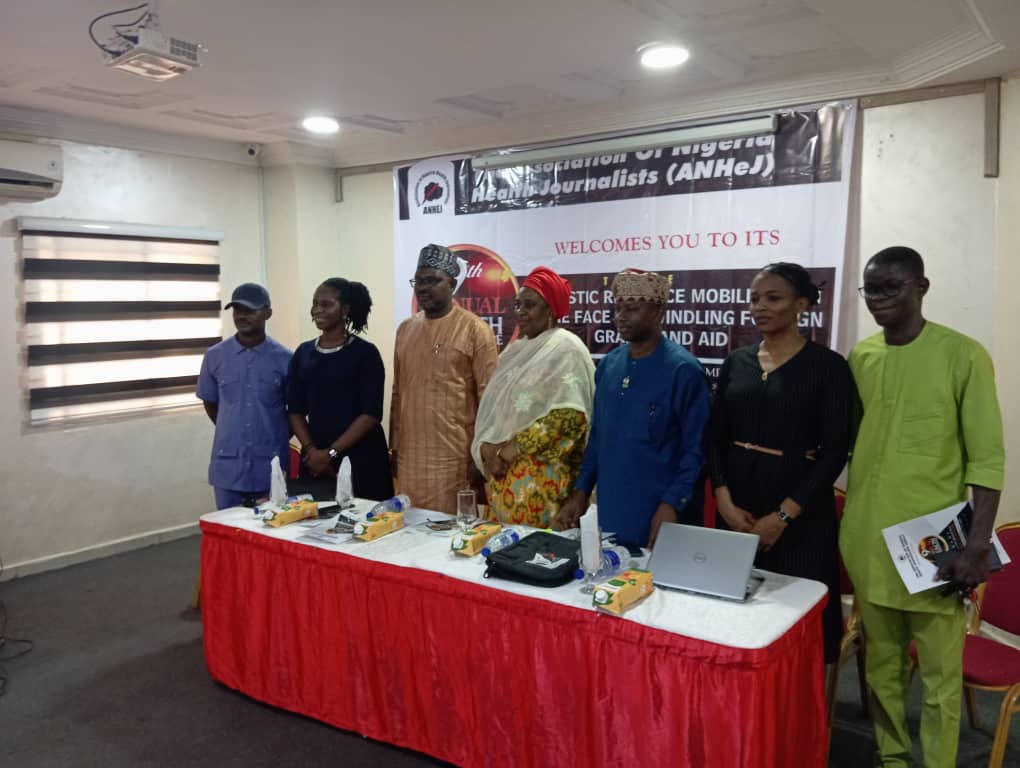
Experts in the health sector, at the weekend agreed that even though foreign grants and aid remain highly valuable, it is imperative for the three tiers of government to increase domestic funding in Nigeria.
They agreed that it is only through the above the nation can build a resilient, domestically financed health system.
This was agreed at the 9th annual health conference organized by the Association of Nigeria Health Journalists (ANHeJ) in Abuja.
The theme of this year conference is ‘Domestic Resource Mobilization in the Face of Dwindling Foreign Grants and Aids’ .
Among those who spoke at the occasion, include, Special Adviser to President on Health, Dr. Salma Ibrahim Anas, .Minister of State for Health and Social Welfare, Dr. Kunle Salako, representative from National Agency for Food and Drug Administration and Control, (NAFDAC), Dr. Matins Illuyomade,
Salako who was represented by his Special Adviser, Dr. Babatunde Akinyemi, said Nigeria has benefited from substantial foreign health assistance, including over $6 billion from PEPFAR, $2.5 billion from the Global Fund, $1.5 billion from the World Bank, $1.2 billion from Gavi, and $1.6 billion from the Bill & Melinda Gates Foundation.
He stressed, that government initiatives under the Renewed Hope Agenda and the Nigeria Health Sector Renewal Investment Initiative (NHSRII), including the Basic Health Care Provision Fund (BHCPF), which has disbursed over N260 billion to states and the Federal Capital Territory since 2018, and the National Health Insurance Authority (NHIA) Act, mandating health insurance for all Nigerians.
He said, “The United States government, through PEPFAR, has invested over $6 billion in Nigeria’s HIV/AIDS response since 2004, with annual allocations averaging $400-450 million in recent years. In fiscal year 2023 alone, USAID (Now DoS) allocated approximately $535 million for health programs in Nigeria, covering HIV/AIDS, malaria, tuberculosis, and maternal and child health initiatives.
“The Global Fund to Fight AIDS, Tuberculosis, and Malaria has disbursed over $2.5 billion to Nigeria since 2003, making us one of the largest recipients globally. The World Bank currently supports our health sector with approximately $1.5 billion through various projects, including the $500 million Nigeria COVID-19 Action Recovery and Economic Stimulus Program and the $820 million International Development Association credit for primary healthcare strengthening. Similarly, Gavi, the Vaccine Alliance, has committed over $1.2 billion to Nigeria since 2001 for immunization programs, while the Bill and Melinda Gates Foundation has invested approximately $1.6 billion across various health interventions in Nigeria over the past two decades.
“The United Kingdom’s Foreign, Commonwealth and Development Office (FCDO), though reducing its overall aid budget, continues to invest significantly in Nigeria’s health system, particularly through the £210 million Health Systems Strengthening program. The European Union and its member states collectively provide approximately €100 million annually for health-related interventions, while the Government of Japan, through JICA, supports our health infrastructure development with grants averaging $30 million annually.
.Multilateral development banks and financial instruments have also remained vital partners; the World Bank in 2024 approved substantial concessional financing, including a major credit and complementary grant financing package that supports health outcomes and health system resilience across states and communities. Such financing is targeted not only at service delivery but at strengthening our ability to prevent, detect, and respond to emergencies”.
Salako noted, “Foreign grants and aid remain highly valuable and will continue to finance critical interventions for some time. But the future we must build is one where domestic resource mobilization, fiscal discipline, efficient spending, and innovative financing are the engines that sustain our national health priorities. The Government of Nigeria is already advancing legal and budgetary instruments, leaning on proven programme data, and working with partners to protect gains while we scale domestic financing.
“Our commitment is to ensure that no Nigerian is left behind during this transition, and that we convert a period of funding volatility into a long-term opportunity to build a resilient, domestically financed health system”.
The Minister of state also enumerated the innovative domestic financing efforts at the state and private sector levels.
“Lagos State allocates over 12% of its budget to health, Kaduna State’s contributory health scheme has enrolled 1.6 million residents, and Abia State has launched a diaspora health investment fund.
“The Private Sector Health Alliance of Nigeria and the Nigeria Sovereign Investment Authority contributed over N50 billion and $200 million, respectively, to health initiatives,” he said.
Dr. Salma, in her presentation, said, donor fatigue is real, and the inevitable graduation of Nigeria from various aid programs is approaching.
In his welcome address, ANHeJ President, Joseph Kadiri, said the conference theme, “Domestic Resource Mobilisation in the Face of Dwindling Foreign Grants and Aid,” underscores the urgent need to strengthen domestic financing, partnerships, and resilient health institutions.
Kadiri called on journalists to track government commitments, highlight gaps, and amplify the realities faced by Nigerian families.
Nigeria imported motor vehicles and automotive parts worth $602m from the United States between January and May 2026, marking a 41.3 per cent increase from the $426m recorded in the corresponding period of 2025, the latest data from the U.S. Census Bureau and the U.
S. Bureau of Economic Analysis have shown.The figures showed that passenger cars accounted for the largest share of exports to Nigeria during the five-month period.
A breakdown of the data showed that U.S. exports of passenger cars to Nigeria rose to $454m in the first five months of 2026 from $312m in the corresponding period of 2025, representing an increase of 45.5 per cent.Exports of automotive parts also increased to $122m from $86m, indicating a 41.9 per cent year-on-year rise. However, exports of trucks, buses and special-purpose vehicles declined by 10.3 per cent to $26m from $29m recorded in the same period last year.
On a monthly basis, Nigeria imported $124m worth of motor vehicles and parts from the U.S. in May 2026, slightly lower than the $131m recorded in April.
Passenger car imports declined to $93m in May from $98m in April, while imports of trucks, buses and special-purpose vehicles fell marginally to $6m from $7m. Automotive parts imports remained unchanged at $26m in both months.
Compared with May 2025, however, total imports rose by 30.5 per cent from $95m to $124m. Passenger car imports increased by 32.9 per cent from $70m in May 2025 to $93m in May 2026, while automotive parts imports rose by 36.8 per cent from $19m to $26m. Imports of trucks, buses and special-purpose vehicles declined slightly from $7m to $6m over the same period.
The report also showed that total U.S. exports of motor vehicles and parts to all countries stood at $66.08bn in the first five months of 2026, compared with $69.32bn in the corresponding period of 2025, representing a 4.7 per cent decline.
Passenger car exports fell to $19.52bn from $22.04bn year-on-year, while exports of trucks, buses and special-purpose vehicles edged up marginally to $10.99bn from $10.94bn.
Automotive parts remained the largest export segment, although shipments declined to $35.56bn from $36.33bn in the same period of 2025.
Canada remained the largest destination for U.S. automotive exports during the period, receiving $24.70bn worth of vehicles and parts, followed by Mexico with $16.83bn and Germany with $3.72bn.
Among African countries listed in the report, Nigeria recorded the highest value of U.S. automotive imports at $602m, ahead of South Africa, which imported $313m worth of vehicles and parts during the first five months of 2026.
The Nigerian Ports Authority stated that the total number of vehicles handled in Nigeria during the first quarter of 2026 rose to 58,870 units from 35,262 units recorded in the corresponding period of 2025, representing a 67 per cent increase.
The NPA disclosed this in its Q1 2026 Operational Performance Review. “Vehicle traffic also emerged as a major growth area, with total vehicle units handled rising sharply by 67 per cent to 58,870 units during the quarter, compared to 35,262 units in the same period last year,” the NPA said.
Analysts say the figures reflect renewed confidence among importers as exchange rate volatility eased and access to foreign exchange improved, even though vehicle prices remain high.
The Nigerian Association of Chambers of Commerce, Industry, Mines and Agriculture has opened applications for a $150m offshore expansion facility designed to provide Nigerian businesses with long-term, single-digit interest financing for expansion and modernisation.
The association disclosed this in a statement issued on Sunday, saying eligible companies can now submit applications through a dedicated digital portal unveiled during the Infrastructure Conference 2026 held at the Afrexim Tower in Abuja.
According to the statement, the financing initiative was developed in partnership with Germany-based commercial banking group ODDO BHF SE to improve access to foreign capital for Nigerian businesses and strengthen the country’s organised private sector.
The statement read, “The Nigerian Association of Chambers of Commerce, Industry, Mines and Agriculture, under the leadership of Jani Ibrahim, has officially commenced applications for its $150m Offshore Expansion Facility, a financing initiative developed in collaboration with Germany’s ODDO BHF SE to support the growth and modernisation of Nigerian businesses.”
It said the platform represents a major step in digitising the origination of foreign direct investment for Nigerian enterprises.
The operational framework and application portal were jointly unveiled by the Chairman of the Joint NACCIMA-ODDO BHF Working Group Committee and former Managing Director of the Bank of Industry, Waheed Olagunju, and NACCIMA’s Digital Economy Coordinator and Chairman of the Digital Economy Trade Group, Segun Olugbile.
The statement said the facility would provide qualified Nigerian companies with access to patient, long-term expansion capital at single-digit interest rates.
It added that funding would prioritise manufacturing, excluding defence-related businesses, agro-allied processing, energy, logistics, mineral beneficiation and transportation, while 20 per cent of the total facility had been reserved for the digital economy and information and communication technology sector.
Speaking at the unveiling, Olagunju said the initiative was aimed at creating a transparent investment pipeline capable of attracting international investors while supporting the expansion of viable Nigerian companies.
“What we are launching today is a transparent, globally aligned investment origination pipeline as a demonstration of investors’ confidence in Nigeria’s economy,” he said.
Olagunju explained that the Joint NACCIMA-ODDO Committee had developed a framework to enable viable and environmentally compliant Nigerian businesses to obtain financing beginning from `$10m.
“The Joint NACCIMA-ODDO Committee has developed a rigorous framework that enables viable, ESG-compliant Nigerian enterprises to access capital, starting at a minimum of $`10 million, to acquire the European machinery, equipment, and technology needed to scale their operations,” he said.
The statement added that the digital application platform was built with bank-grade encryption and incorporated automated Know-Your-Customer verification processes to protect applicants’ financial information.
“To attract world-class European investment, our digital infrastructure must inspire absolute confidence and trust. This secure e-Portal has been developed with bank-grade encryption and complies with existing regulations. It automates Know-Your-Customer verification and integrates a secure framework to ensure that the proprietary financial information of applicants remains fully protected throughout the transaction process,” Olagunju added.
According to the statement, each successful applicant can access a minimum financing package of `$10m with a repayment tenure of at least seven and a half years.
It noted that beneficiaries would be required to commit between 35 and 50 per cent of the financing to procuring eligible machinery, equipment, goods and services from Europe, while the remaining funds could be deployed within Nigeria or other approved markets.
The association said only financially viable businesses with proven repayment capacity would qualify for the facility.
Applicants are required to submit at least three years of audited financial statements, demonstrate compliance with environmental, social and governance standards, and be verified financial members of recognised organised private sector associations, including NACCIMA, the Manufacturers Association of Nigeria, the Nigerian Association of Small and Medium Enterprises or the Nigerian Association of Small Scale Industrialists.
The statement described the initiative as part of NACCIMA’s broader efforts to establish credible international financing channels for Nigerian businesses.
“This initiative underlines NACCIMA’s commitment to building credible international financing pathways for Nigerian industries. By securing long-term capital through strategic global partnerships, we aim to enhance private sector competitiveness and drive sustainable industrial transformation across the nation,” the association stated.
NACCIMA said the financing programme is expected to support industrial expansion, technology acquisition, productivity improvement and increased competitiveness among Nigerian businesses seeking to scale operations through access to long-term foreign capital.

Vice President Kashim Shettima, World Trade Organization Director-General Ngozi Okonjo-Iweala and Kenyan scholar Prof. Patrick Lumumba have arrived in Asaba ahead of the Delta State Economic and Investment Summit scheduled for Monday.
The summit is expected to serve as a platform for driving economic transformation, boosting investor confidence, fostering strategic partnerships and attracting local and foreign direct investment into Delta State.
Shettima, who arrived on Sunday, was received at the Asaba International Airport by Delta State Governor Sheriff Oborevwori, alongside top government officials and political leaders.
The Vice President is expected to speak at the summit on how President Bola Tinubu’s Renewed Hope Agenda reforms have created opportunities for investment and business growth in Delta State.
Confirming the Vice President’s arrival in a Facebook post on Sunday, the Senior Special Assistant on Media to the Delta State Governor, Ossai Success, wrote: “Vice President Shettima Arrives Asaba Ahead of Delta State Economic And Investment Summit held tomorrow in Asaba.”
He added that “The Delta State Governor Rt Hon Sheriff Oborevwori led a delegation to receive the Vice President at the Asaba International Airport.”
Okonjo-Iweala also arrived in Asaba on Sunday ahead of the summit.
Announcing her arrival, Ossai wrote, “Touchdown Asaba is Dr. Ngozi Okonjo-Iweala Ahead of the Delta State Economic and Investment Summit 2026 Holding Tomorrow In Asaba. Come and Invest In Delta State.”
Also on Sunday, keynote speaker Prof. PLO Lumumba arrived in the Delta State capital.
According to Ossai, “Prof. Patrick Lumumba just arrived in Asaba ahead of the Delta State Economic and Investment Summit held tomorrow in Asaba.”
He added that “The Commissioner for Higher Education, Prof. Nyerhovwo Tonukari received the keynote Speaker, Prof. PLO Lumumba, ahead of the Delta State Economic and Investment Summit held tomorrow in Asaba.”
The Delta State Economic and Investment Summit is expected to bring together government officials, business leaders, investors and development partners to explore investment opportunities across key sectors of the state’s economy.


Nigerians Import $602m US Vehicles in Five Months
ShareNigeria imported motor vehicles and automotive parts worth $602m from the United States between January and May 2026, marking a...
NACCIMA Offers Firms $150m Low-interest Expansion Loan
ShareThe Nigerian Association of Chambers of Commerce, Industry, Mines and Agriculture has opened applications for a $150m offshore expansion facility...
Shettima, Okonjo-Iweala, Lumumba in Asaba for Delta Economic Summit
ShareVice President Kashim Shettima, World Trade Organization Director-General Ngozi Okonjo-Iweala and Kenyan scholar Prof. Patrick Lumumba have arrived in Asaba...


Mbah, Musa, Others Extol Ogalla’s Service as Enugu Honours Ex-Naval Chief
Share From Sylvia Udegbunam, Enugu Former Chief of the Naval Staff, Vice Admiral Emmanuel Ogalla (rtd), has been described as a...


Shettima, Jonathan, Mutfwang, Yilwatda Celebrate Jonah Jang at 80, Unveil Autobiography
ShareFrom Jude Dangwam, Jos The Vice President of Nigeria, Senator Kashim Shettima, former President Goodluck Ebele Jonathan, Plateau State Governor...
NESG Appoints Adeleye Falade as Board Member
ShareBy Tony Obiechina, Abuja The Nigerian Economic Summit Group (NESG) has approved the appointment of Engr. Adeleye Falade, FNSE, as...


Attackers Kill Soldier, Police Officer as Troops Rescue Nine in Zamfara
ShareFrom Ifeanyichukwu Nwannah, Gusau and Sylvia Udegbunam, Enugu Nigeria’s security challenges deepened at the weekend as separate attacks in Zamfara and...


Presidency, Atiku in Fresh War of Words over Reforms, Economy
ShareBy David Torough, Abuja A fresh political confrontation erupted on Sunday between the Presidency and former Vice President Atiku Abubakar...

NCS Wins Commonwealth Gold Award for Customs Cares Initiative
ShareBy Tambaya Julius, Abuja The Nigeria Customs Service (NCS) has earned international recognition after its flagship Corporate Social Responsibility (CSR)...


Lawyers Ask Sanwo-Olu To Suspend Onise Of Ise Appointment Over Pending Court Cases
ShareBy David Torough, Abuja A Lagos-based law firm, Law Pharm LP, has petitioned Lagos State Governor, Mr. Babajide Sanwo-Olu, urging...