
Oil & Gas
Sylva, NCDMB Host First African Content Roundtable in Bayelsa

From Tayese Mike, Yenagoa
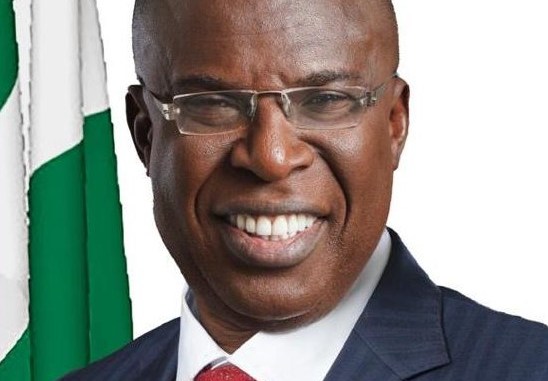
The Minister of State for Petroleum, Chief Timipre Sylva and the Nigerian Content Development Monitoring Board, last Thursday hosted the Ist African Local content Roundtable(ALCR) discussion in Yenagoa, the Bayelsa state capital.
Declaring the ceremony open, the Minister said holding the maiden edition of the African Roundtable discussion in a state where oil and gas was first recorded in commercial quantity in Africa and indeed Nigeria shows that the country was a leading example in content development.
He commended the NCDMB for initiating the Roundtable discussion, saying by this effort, it has set the pace as the premier Local Content regulator in Africa and a worthy example to sister nations that seek guidance to institutionalize Local Content practices in their jurisdictions.
According to him, the partnership with APPO is also commendable as it will provide a sustainable structure for driving regional collaboration on local content matters.
“The objective of this pan-African Roundtable is to institutionalize peer review mechanism among Oil-producing countries on local content as a key development imperative for domestication and sustainable growth of Africa’s hydrocarbon resources”.
“Any country that aspires to achieve rapid and sustainable economic growth must put in place an economic model that enables its human capital to harness its natural resources to create wealth and economic prosperity”.
“Nigeria embraced this model by adopting local content as an economic development model for the oil and gas sector, in view of its abundant hydrocarbon resources estimated at 37 Billion barrels of crude oil and 202 TCF of gas reserves.
We define local content as value added to or created in the Nigerian economy by a systematic development of capacity and capabilities, through deliberate utilization of Nigerian services, human and material resources in the Nigerian oil and gas industry.
Through implementation of local content we have achieved significant growth in-country value addition from less than 5% in 2010 to 35% in 2021 and we have set an ambitious target to achieve 70% local content in the oil and gas sector by 2027.
“Our success story in the oil and gas industry has led to bold step to extend local content to other sectors of the Nigerian economy. As a caring African country, we have also considered it necessary to amplify the benefits of local content to our fellow African countries and that is the essence of the African Local Content Roundtable”.
He said, everyone knows that decades of hydrocarbon production in Africa have not translated to the desired economic growth in our Continent.
According to Sylva, while over 15 African nations are producing and exporting crude oil, the sad reality is that our people have not benefitted maximally from this natural resource, either because we have not managed the proceeds optimally or we failed to domesticate the core operations of the industry.
“We must therefore use the opportunity of this RoundTable to initiate conversations around Local Content, share success stories, challenges and come up with policies that would deepen local participation and domiciliation in our respective countries.
One of the pathways for this desired collaboration and cross-country development is the African Continental Free Trade Area (AfCFTA) and I am pleased that we have a representative of AfCFTA in this forum.
Indeed, AfCFTA provides an opportunity to create a single market through the facilitation of free movement of goods, services and investment within the 54 member states of the Continent, creating access to 1.2 billion customers, with a cumulative Gross Domestic Product (GDP) of over US$3.4 trillion.
It is imperative that African oil-producing countries and their companies cooperate closely in developing and sharing capacities and capabilities to optimize the hydrocarbon deposits and achieve economic growth and development”.
“For example, we established the biggest FPSO integration yard in Lagos, Nigeria and so many other facilities that can be used by other African countries.
It makes better business sense to partner with an Umbilicals producing plant in Angola, or a bolt manufacturing company in Niger Republic instead of going all the way to United States and Norway for the same products.
We must take firm decisions and develop policies and projects that would position our industry competitively and sustain our economy under the emerging energy transition.
The Federal Government of Nigeria took firm steps in this regard very recently, funding two strategic energy projects in Nigeria. A 10,000 tons per day methanol plant and 500 million standard cubic feet per day gas processing plant in Brass, Bayelsa State and the Ammonia and Fertilizer plant in Akwa Ibom State.
“It is my expectation that the ALCR will become a signature event, leveraging on the wonderful foundations already built by APPO and rotating among all the African oil producing countries”.
In his speech, the co-host, Engr Simbi Wabote, who is the Executive Secretary of Nigerian Content Development Monitoring Board (NCDMB) said Africa needed to start discussion on how the continent can use its Hydrocarbon resources to migrate into a renewable energy.
According to Wabote, NCDMB as the leading in the development of local content in the Oil and Gas sector decided to bring all African oil producers together for them to start the discussion. Saying sustainability and continue growth to tackle poverty situation in the continent to bring about energy sustainability for the people is key to African leaders.
” I think its time for African to begin to come together on how to use their resources to migrate into a renewable one. The discussion is about climate change which we believe is somehow renewable and that has become topic all over the world”, he said.
He said with the threat of the climate change, what it portend for Africa is that very soon the natural resources that the continent has not even tapped will not be useful anymore. “Therefore we need to start the discussion on how we can use our hydrocarbons resources to migrate into a renewable energy. That is very important to us”.
Engr Wabote said why the local content roundtable is symbolic is because in Africa continent and the World, everybody knows that Nigeria is leading in local content when it comes to oil and gas sector.
“We have so many African countries that have come to jaw-jaw with us to learn the strategy on how to develop local content in the hydrocarbon sector. For us we feel we are the leader in that sector, we need to bring other African countries together in other to develop the local content since for them they are just discovering hydrocarbon resources and the discussion is how to migrate into energy”.
Wabote, who highlighted the achievements made by Nigeria in the last few years in the implementation of the local content policy, said the per centage of local content participation have been moved from 35 per cent to 70 per cent under his watch,” the local content policy in Nigeria has created indigenous contractors that are capable and strong, we have local participation in the vessels ownership”



TotalEnergies EP Nigeria Limited has commenced drilling of the Akpo Far East B exploration well, days after its Country Chair and Managing Director, Matthieu Bouyer, announced at the 2026 Nigerian Association of Petroleum Explorationists (NAPE) annual conference and exhibition that the company was launching a new deep offshore drilling campaign in Nigeria.
The well, being drilled with the Noble BlackRhino rig, is the first deep offshore exploration well to be drilled in Nigeria in 10 years.
It is expected to be followed by exploration and appraisal wells at Egina South and on the PPL 2000 and PPL 2001 licences.Speaking during an executive panel at the 44th NAPE Annual International Conference and Exhibition in Lagos, Bouyer said the drilling campaign was evidence of improving investor confidence in Nigeria’s energy sector.
The conference, held from 8 to 12 November, focused on unlocking reserves growth through exploration, local capabilities and adaptive technology.“The attractiveness of Nigeria has returned in our portfolio,” Matthieu Bouyer told the conference.
He said Nigeria’s challenge was not the availability of resources and called for faster conversion of discovered resources into projects and production.
“We need to think fast,” he said, calling for supply-chain constraints and other barriers to investment decisions to be addressed more quickly.
The Akpo Far East B well forms part of a broader exploration programme that will extend to Egina South and PPL 2000 and PPL 2001. TotalEnergies and its partner, SAPETRO, signed a Production Sharing Contract for the two licences in September 2025 after they were awarded through Nigeria’s 2024 Exploration Round. TotalEnergies holds an 80% operating interest, while SAPETRO holds 20%.
TotalEnergies emerged as the successful bidder for PPL 2000 and PPL 2001 in December 2024. The company’s planned drilling on the acreage, less than two years after the award, highlights the pace at which it is progressing the new exploration opportunity.
At the NAPE session, Bouyer said improved transparency in Nigeria’s licensing process had enabled TotalEnergies to secure new acreage through a competitive bid round for the first time in more than a decade.
He also pointed to recent Federal Government reforms, including Executive Orders designed to improve the competitiveness of deepwater and non-associated gas projects, as factors supporting renewed investment.
“The Executive Orders are working,” he said, citing recent investment decisions on the Ima and Ubeta gas developments as evidence of progress.
Commenting on the drilling programme, Mr Bouyer said the Akpo Far East B well and the planned activity at Egina South and PPL 2000 and PPL 2001 demonstrated TotalEnergies’ confidence in Nigeria’s resource potential.
“This momentum goes hand in hand with the efforts of the Nigerian authorities to strengthen transparency and attract investment into the country,” he said.
He acknowledged the teams responsible for the fast-track mobilisation of the Noble BlackRhino and thanked the company’s partners, NNPC Limited, Meren, CNOOC International and SAPETRO, for their support.
The NAPE executive session also featured Aliko Dangote, President and Chief Executive of Dangote Group, and Austin Avuru, NAPE Fellow and Co-founder of Seplat Energy, among others. Discussions centred on the reforms, fiscal stability and government-industry collaboration required to accelerate investment and increase Nigeria’s oil and gas production.
From Dan Amasingha, Minna.
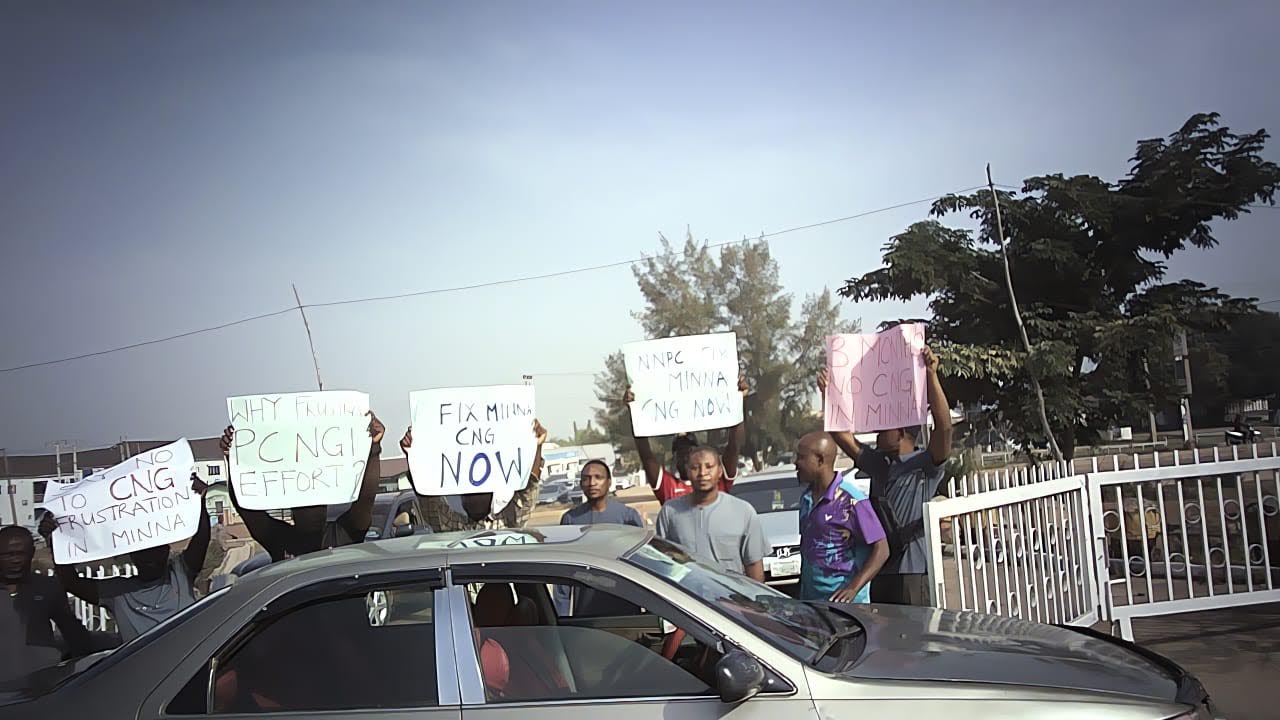
Angry vehicle owners on Sunday staged a peaceful protest at the NNPC Mega Station along the Western Bypass in Minna, Niger State, over the alleged three-month shutdown of the facility’s Compressed Natural Gas (CNG) dispensing service.
The protesters, who accused the station’s management of failing to address the persistent shortage, said the development had frustrated the Federal Government’s initiative to promote CNG as a cheaper alternative to Premium Motor Spirit (PMS), popularly known as petrol.
They lamented that despite investing hundreds of thousands of naira and, in some cases, over ₦1 million to convert their vehicles to run on CNG, they had been unable to access the product in the state capital for months.
Findings indicated that a component of the station’s CNG dispensing equipment had reportedly developed a fault but had allegedly remained unrepaired, leaving motorists who rely on the alternative fuel with little choice but to return to the more expensive petrol.
The persistent outage, the protesters said, had not only undermined the economic benefits of converting their vehicles but had also imposed additional financial burdens on vehicle owners already grappling with rising transportation and fuel costs.
Speaking during the protest, one of the motorists, Engr. Israel Ogbonnaya, described the situation as discouraging, alleging that repeated visits to the station to obtain explanations from the management had yielded no meaningful response.
“It is so discouraging that for three months now, the CNG station at NNPC Minna has not functioned. Imagine that since January, some people did conversion and have not recovered their money,” he said.
Ogbonnaya expressed disappointment that motorists had allegedly received no satisfactory explanation regarding the prolonged breakdown.
“The CNG broke down, nobody has spoken to us. We have come here several times demanding answers from the management, and nobody is talking.
“So, for now, we want to bring the attention of Nigerians and those in authority to the situation in Minna.
CNG is the heartbeat of the President. He commissioned a committee to look into this scheme, and these people are taking us for granted,” he added.
Another protester, Mohammed Doko Saidu, questioned the rationale behind encouraging motorists to convert their vehicles to CNG without ensuring the availability of adequate dispensing facilities to meet demand.
Saidu disclosed that he had spent more than ₦1 million converting his vehicle, only to discover that the product was unavailable in Minna.
“The frustrating aspect of all is that I just installed CNG, spending over a million naira, without a single gas in Minna; hoping that it is going to be fixed today, it is going to be fixed tomorrow, and up till this moment, there is nothing.
“Nobody is saying anything. The station is just lying fallow. In short, I had to disconnect some of the cylinders installed in my car because there is no gas.
What kind of government are we in? It is frustrating,” he said.
The protesters called on the NNPC Mega Station’s management and other relevant stakeholders to urgently repair the faulty equipment and restore CNG supply to Minna.
They warned that failure to resolve the problem could trigger another protest involving a larger number of aggrieved motorists, including commercial tricycle operators who also depend on CNG to reduce their operating costs.
The motorists maintained that the prolonged unavailability of the product had defeated the purpose of the conversion programme, forcing them to bear the cost of installing CNG systems while continuing to spend more on petrol.
The development raises concerns among affected motorists over the reliability of CNG supply infrastructure and the need for prompt maintenance of facilities established to support the Federal Government’s alternative-fuel initiative.
Efforts to obtain comments from the manager of the NNPC Mega Station were unsuccessful as of press time, while attendants on duty declined to speak on behalf of the management.
From Sylvia Udegbunam Enugu
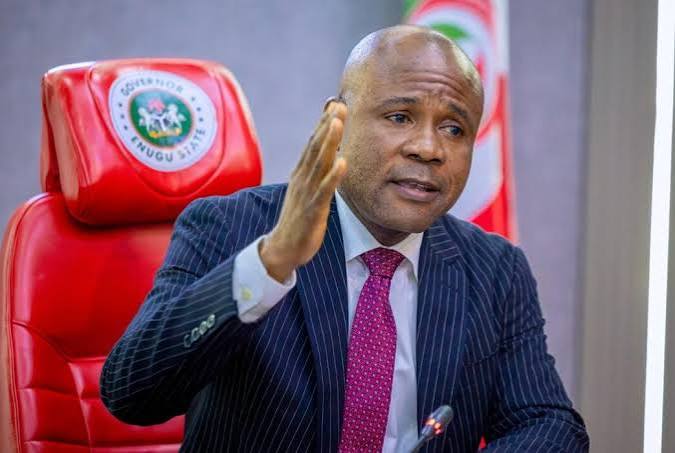
Governor of Enug State, Dr. Peter Mbah, has doubled down in his support for the removal of fuel subsidy by President Bola Tinubu’s administration, saying it was undebatable and inconceivable for anyone to imagine a return to the old order.
Mbah spoke at the “Meet the Candidates” town hall meeting organised by Afia TV in Enugu on Wednesday, where he also said that his administration had delivered good governance to the people of the state across all sectors.
He described it as a pathetic misconception of the country’s situation and the direction it was headed for anyone to talk about the reintroduction of fuel subsidy.
“If you reintroduce fuel subsidy today, we will lose ten times whatever we are currently trying to gain in terms of the removal of subsidy. The poverty rate that you are going to experience will be very high because the naira would be automatically devalued.
“We cannot go back to subsidy. And I do not think it is in the interest of the country for us to even debate that.
“Again, we should not even debate it because we do not want to send a signal to prospective investors that we are contemplating it. That would take us back. It is going to create panic in the system. It is going to get investors to pull back.
“Those that are coming in today to invest in that sector will become jittery. So, it is not even a subject to debate. It is something that we have moved on from, and we should be thinking about how to ensure that the natural benefits cascade to the households, create jobs and generate wealth for our people,” he said.
He said the nation should focus on how to further encourage private capital to flow, noting the growth the nation had experienced in the stock exchange space.
He added that Tinubu’s policies had stabilised the macro indicators, thus encouraging foreign direct investment.
“You can see quite a lot of funds coming into our country, not just portfolio investments, but also direct investments. It is also going to strengthen because the macro indicators are right,” he stated.
Mbah maintained that whereas fuel subsidy removal enables the government to target the less privileged, fuel subsidy as earlier practised benefited the rich more.
“By the way, I do not think the subsidy we practised before the President removed it was even the right one for the country because even the people we were looking at benefiting from it were only insignificantly benefiting from it. It was largely beneficial to our wealthy folks.
“But now, you can almost notice that the government is doing that in targeting the poor, using proceeds from subsidy removal. The government is aggressive on cash transfers. There is also the programme where the government is targeting 1,000 persons per ward across the entire country to be able to provide seed capital for them to become productive,” he added.
Meanwhile, on his stewardship so far, Mbah said his administration had kept faith with the people of Enugu State, delivering good governance across all sectors in line with his campaign manifesto.
He said the people of the state only needed to imagine where the state was before his inauguration as governor and where it is currently headed.
“Let us imagine the Enugu we knew four years ago. Let us just imagine an Enugu without Hotel Presidential. Let us imagine an Enugu without the International Conference Centre. Let us imagine an Enugu without Enugu Air. Let us imagine Enugu without the transport terminals, the 268 Smart Green Schools, 260 Type 2 Primary Healthcare Centres.
“You do not want them to imagine an Enugu without the International Hospital. You do not want them to imagine an Enugu without the CNG buses, the Nigergas. I think the list is endless.
“But I even think that we can stretch that imagination further because the work ahead will be more profound. Just imagine an Enugu where our children are receiving education that prepares them for the world because they have been imbued with evolving 21st-century skills. Imagine again an Enugu where you do not have any part of the city with an unpaved road.
“Also, imagine an Enugu in four years’ time that generates 660 megawatts of electricity; where we are able to provide 24-hour power supply; where you cannot come into your house and have the light off; and where people can run their businesses for a whole week without worrying about the cost of diesel. Just imagine an Enugu where you generate electricity and the people of Enugu are buying that at 120 naira because they own the coal that feeds the power plant.
“Imagine an Enugu where you now have to ride, not just on our CNG buses, but you have the monorail that can take you from point A to point B. Imagine an Enugu where you can fly from here to the United Kingdom, to the United States and other parts of the world,” he charged the electorate.
He urged the people to keep faith with the journey of greatness, growth and development, defending the gains of his first term and guaranteeing the promises of his second term by working for his re-election.
“If these imaginations capture our fancy, then we have a duty to fight for it. We do have a duty to continue to make sure that the bar does not come down and that the standard we have set in Enugu is sustained,” he concluded.



Benue IDPs Praise UNICEF over Provision of Facilities
ShareFrom Attah Ede, Makurdi Internally Displaced Persons (IDPs) in Benue State have poured praises on the United Nations Children’s Fund...

CBN Appoints Acting MD/CEO ofKeystone Bank
ShareBy Tony Obiechina, Abuja The Central Bank of Nigeria (CBN), in exercise of powers conferred on it by theBanks and...

3,526 Primary Healthcare Centres Revitalised – FG……… Tasks Health Journalists on Accountability
ShareBy Laide Akinboade Abuja The Federal Government (FG), on Thursday, disclosed that 3,526 primary healthcare centres had been revitalised, while...

Court Nullifies Omo-Agege’s NDC Senatorial Candidacy
ShareFrom Francis Sadhere, Delta The Federal High Court sitting in Warri, Delta State, has nullified the nomination of former Deputy...


APC Mourns 15 Supporters Killed In Zamfara Road Accident
ShareBy Orjime Moses, Abuja The All Progressives Congress (APC) has mourned 15 of its members and supporters reportedly killed in...
Ortom ‘Ranched’ Benue People in IDP Camps Instead of Cattle – Tondo
ShareFrom Attah Ede, Makurdi Former Benue State Commissioner for Lands and Survey, John Tondo, has criticised former Governor Samuel Ortom...


2027: INEC Chairman Seeks Stronger Security Cooperation Ahead Of Elections
ShareBy Orjime Moses, Abuja The Chairman of the Independent National Electoral Commission (INEC), Prof. Joash Ojo Amupitan, SAN, has called...


CBN Retains Interest Rate at 23 Per Cent
ShareBy Tony Obiechina, Abuja The Monetary Policy Committee (MPC) of the Central Bank of Nigeria (CBN) has retained the benchmark...


2027: Emovworho Warns Delta Politicians Against Exploiting Youths
ShareBy Orjime Moses, Abuja A concerned son of the Urhobo Nation, Austin Obule Emovworho, has warned political leaders in Delta...

Katsina Suspends Daura Emir, Orders Probe into Sexual Assault Allegation
ShareBy David Torough, Abuja The Katsina State Government has suspended all official engagements and travels of the Emir of Daura,...