
Metro
Universities: TETFund to Partner Rural Electrification Agency on Uninterrupted Power Supply

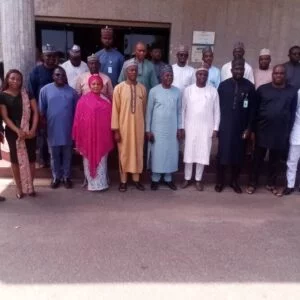
The Tertiary Education Trust Fund (TETFund) has expressed its partnership with the Rural Electrification Agency (REA) to ensure uninterrupted power supply in Universities and other tertiary institutions in the country.
The Executive Secretary of TETFund, Sonny Echono, disclosed this when the Managing Director of REA, Salihijo Ahmad, paid a courtesy visit in his office in Abuja on Tuesday.
While commending the Energising Education Programme (EEP) being implemented by REA in selected universities and teaching hospitals across the country, Echono said the importance of steady power supply in tertiary institutions cannot be over-emphasised.
“There is sheer acceptance that this is important for us as we move to improve not just the physical infrastructure but also ICT infrastructure and research infrastructure in our institutions.
“A lot of these require constant supply of power. There are certain samples you must put at certain temperature for a prolonged period. There are certain operations you do in medical laboratory that you cannot afford power to cease even for a second.
“And, if we really want to guarantee a learning environment that can compete with others across the globe, one of the primary things we can do is to guarantee power in our campuses,” Echono said.
He called on the agency to revamp the project in some of the beneficiary institutions that had encountered challenges with the EEP.
Echono also said that TETFund would explore the possibility of getting longer term financing from African Development Bank (AfDB) for subsequent editions of the scheme .
“You can get long term finance at affordable interest rate and it will enable us do more. With the instrument we have, we will have subsequent liquidity to defray the cost,” he said.
He further said that getting long term finance package for the project would be cost effective as only short term (one year cycle) funds were currently available to the agency.
Earlier, the Managing Director of REA, Salihijo Ahmad, said the EEP was aimed at providing sustainable and clean power supply to 37 federal Universities and seven University teaching hospitals across the country.
Ahmad noted that the programme had already commenced in 24 Universities and selected teaching hospitals, while calling for the cooperation of TETFund to ensure the total success of the scheme.
According to him, infrastructure is not just about classrooms and lecture theatres, with the current situation in the country, it is becoming more apparent that we have a decentralised power systems.
” They are very important for our institutions like universities and getting additional resources for the EEP from TETFund will go a long way to scale up the programme in the nation’s universities,” he said. (NAN)

By Tambaya Julius, Abuja
The Nigeria Customs Service (NCS) has commenced a two-week Technical Assistance Mission on Post Clearance Audit (PCA) in collaboration with the World Bank Group under the Accelerated Revenue Mobilisation Reform (ARMOR) Programme, aimed at strengthening compliance management, revenue assurance, and trade facilitation through modern audit practices.
The workshop, which runs from June 1 to June 12, 2026, is taking place at the Service’s Headquarters in Maitama, Abuja.
Delivering the opening remarks on behalf of the Comptroller-General of Customs, Adewale Adeniyi, Assistant Comptroller-General Babatunde Olomu described the mission as a significant step in advancing the Service’s modernisation agenda and strengthening its capacity as a technology-driven, intelligence-led, and globally competitive customs administration.
He noted that modern customs administrations increasingly rely on intelligence-led, risk-based, and post-clearance interventions that promote voluntary compliance while supporting legitimate trade and economic growth.
According to him, the mission offers an opportunity to assess existing processes, identify operational gaps, adopt international best practices, and develop practical solutions to strengthen the Post Clearance Audit framework.
Olomu identified risk-based targeting, case management, registry management, quality assurance, standardisation, and integrated audit systems as key areas of focus.
He emphasised that effective Post Clearance Audit enables Customs to move beyond transaction-based controls to a strategic compliance management approach that enhances revenue assurance, facilitates legitimate trade, strengthens transparency, and boosts public confidence.
The ACG commended the Comptroller-General for his commitment to modernisation and capacity building and also appreciated the World Bank and other development partners for their sustained support for Customs reforms.
He urged participants to actively engage throughout the programme and ensure that lessons learned are translated into measurable improvements in daily operations.
World Bank Task Team Lead, Moses Kajubi, said the mission is designed to strengthen the capacity of Post Clearance Audit officers through modern customs practices, practical audit tools, and internationally recognised methodologies.
He explained that participants would be exposed to global best practices, case management techniques, and compliance management strategies that can be adapted to Nigeria’s operational environment.
Kajubi stressed the importance of leveraging technology, structured case management systems, and data-driven decision-making to improve audit quality, compliance monitoring, and trade facilitation outcomes.
He expressed confidence that the engagement would strengthen institutional capacity and contribute significantly to the Nigeria Customs Service’s modernisation objectives.
Lead Consultant for the ARMOR-P, Colonel Aloke Dutt, said the mission seeks to enhance trade facilitation, optimise revenue, and improve compliance management through a more structured and unified approach to Post Clearance Audit.
He emphasised the need for standardised audit methodologies, effective monitoring mechanisms, and the integration of data analytics into audit processes to improve accountability and operational efficiency.
Dutt also highlighted the importance of leveraging technology-driven solutions such as the B’Odogwu platform and developing Standard Operating Procedures (SOPs) to support a competency-based audit system across the Service.
During a technical session, Assistant Comptroller of Customs, Muhammad Jubril, demonstrated the Post Clearance Audit process on the B’Odogwu platform, explaining how officers can initiate audit reviews using Harmonised Commodity codes and other risk indicators.
In his closing remarks, Comptroller Muhammad Shattima encouraged participants to maximise the opportunities provided by the workshop and apply the knowledge gained to achieve the strategic objectives of the NCS.
More than 100 houses were destroyed and scores of families displaced after a devastating rainstorm ravaged Tom Gangare community in Sopp Ward of Riyom Local Government Area of Plateau State.
The incident, which occurred on Sunday following a heavy downpour accompanied by strong winds, also destroyed health facilities, places of worship and other critical infrastructure, leaving residents counting their losses.
A member of the community Bot Felix said property worth millions of naira was damaged during the incident, while many affected residents have been rendered homeless.
He said violent windstorms uprooted several trees, many of which fell on residential buildings, worsening the destruction across the community.
Also speaking on the development, a stakeholder in the community, Hon. Dung Danboyi, described the incident as tragic and appealed for urgent intervention from government and humanitarian agencies.
According to him, although no life was lost, the destruction has left many households without shelter and exposed victims to severe hardship.
“The level of destruction is overwhelming. Many families have lost their homes and means of livelihood. We are appealing to government agencies, humanitarian organisations and well-meaning individuals to come to the aid of our people during this difficult time,” he said.
Danboyi called on the Plateau State Government, the Plateau State Emergency Management Agency (SEMA), the National Emergency Management Agency (NEMA), the Federal Ministry of Humanitarian Affairs and Poverty Reduction, development partners and other stakeholders to provide immediate relief materials and support for affected residents.
Also speaking, the Councillor representing Sopp Ward, Hon. Gwong Ibrahim, urged relevant authorities to urgently intervene to cushion the impact of the disaster on victims.
He stressed the need for emergency relief assistance, noting that many affected families were struggling to secure temporary shelter and basic necessities.
Meanwhile, the Chairman of Riyom Local Government Council, Hon. Sati Bature Shuwa, visited the community to assess the extent of the damage and sympathise with victims.
Addressing residents, Shuwa assured them that efforts would be made to facilitate assistance and support for those affected by the disaster.
He disclosed that a comprehensive assessment would be conducted to determine the extent of the losses and enable appropriate intervention by government and emergency management agencies.
Two people were killed, and about 10 houses were burnt in Ilesha Baruba, Baruten Local Government Area of Kwara State, on Saturday, after a violent clash involving an Islamic scholar triggered mob attacks in the community.
The Kwara State Police Command confirmed the incident in a statement on Sunday by its spokesperson, Adetoun Ejire-Adeyemi, describing it as mob violence, arson and extrajudicial killings.
According to the police, the crisis began after an altercation between an Islamic scholar, Alhaji Mohammed Ilyasu, and an unidentified Fulani man, during which both sustained machete injuries.
Both men were taken to hospital, where they were later confirmed dead.
“Investigations revealed that a violent altercation occurred between an unidentified Fulani man and an Islamic scholar, Alh Mohammed Ilyasu, during which both parties sustained severe machete injuries,” she said.
“They were immediately rushed to the hospital for medical attention. Sadly, Mohammed Ilyasu was confirmed dead on arrival, while the assailant also succumbed to his injuries while receiving treatment.”
The police said the deaths triggered reprisals by some youths, who stormed the hospital, took the corpse of the deceased assailant and set it ablaze.
“Rather than allowing the law to take its course, some irate youths reportedly stormed the hospital, seized the corpse of the deceased assailant, and set it ablaze,” the spokesperson said.
She added that another passerby was attacked and set on fire during the violence.
“In a further display of lawlessness, the mob allegedly attacked another man passing through the area and set him on fire,” she said.
About 10 houses belonging to members of the Fulani community, including the residence of the Ardo Fulani, Alhaji Hassan, were also burnt.
Security operatives, including police and military personnel, were deployed to restore order, the command said.
Commissioner of Police, Ojo Adekimi, condemned the incident, describing the attacks as criminal and barbaric.
“The acts are criminal, barbaric, and a direct affront to the rule of law,” he said.
He added that investigations had begun and warned that those involved would be arrested and prosecuted.


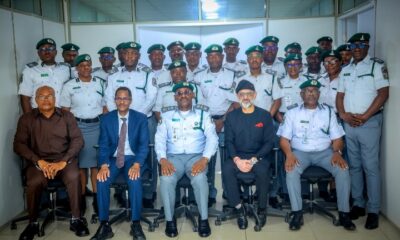

Nigeria Customs, World Bank Launch Two-Week Post Clearance Audit to Boost Revenue, Trade Compliance
ShareBy Tambaya Julius, Abuja The Nigeria Customs Service (NCS), in partnership with the World Bank Group, has commenced a two-week...


Court Suit halted Planned Demolition in Abuja
ShareBy Laide Akinboade, Abuja Residents of Kampala Street, Wuse II, Abuja, have formally notified the Abuja Metropolitan Management Council (AMMC)...

Tinubu’s Government has Made Poverty a Tool of Control’ — SDP Presidential Candidate
ShareBy Mike Odiakose, Abuja The presidential candidate of the Social Democratic Party (SDP), in the coming 2027 general elections, Prince...


Julius Berger Completes Bodo-Bonny Road
ShareBy Mike Odiakose, Abuja The 37.9-kilometre Bodo-Bonny Road project in Rivers state awarded to leading engineering construction company, Julius Berger...
Security Guard Allegedly Abducts Employer’s Children in Minna
ShareFrom Dan Amasingha, Minna A businessman, Alhaji Danjuma, resident in the Brighter Area of Minna, Niger State, has appealed for prayers and...


Ndidi Leads Eagles for Poland Friendly
ShareSuper Eagles captain Wilfred Ndidi has joined the rest of the squad in Warsaw ahead of Wednesday’s international friendly against Poland. Ndidi and other stars such as Moses...


DR Congo Reopens Bunia Airport after 10-Day Closure amid Ebola Outbreak
ShareAuthorities in the Democratic Republic of Congo (DRC) have reopened the main airport in Ituri Province, the epicentre of the country’s ongoing Ebola outbreak, after a...
Customs, World Bank Group Strengthen Post Clearance Audit Capacity
ShareBy Tambaya Julius, Abuja The Nigeria Customs Service (NCS) has commenced a two-week Technical Assistance Mission on Post Clearance Audit (PCA) in collaboration with the World Bank Group under the...
Civilian Protection Now Central to Air Operations – CAS
ShareChief of the Air Staff (CAS), Air Marshal Sunday Aneke, said civilian protection has become a central consideration in the planning and execution of Nigerian Air Force (NAF) operations. Aneke stated...

Cardoso Re-assigns Deputy Govs, Ikeazor Takes over Policy Directorate
Share Governor of the Central Bank of Nigeria (CBN), Olayemi Cardoso, has re-assigned all four deputy governors of the institution....