
Uncategorized
Al Jazeera Files ICC Case over Journalist’s Killing


The Al Jazeera network has submitted a case against Israeli forces at the International Criminal Court (ICC) over the killing of Shireen Abu Aqla.
The Palestinian-American journalist was shot in the head during an Israeli army raid in the occupied West Bank in May.
The Israeli military concluded that one of its soldiers probably killed her, but called her death unintentional.
Al Jazeera said that was completely unfounded and that its evidence showed it was a “deliberate killing”.
Outgoing Israeli Prime Minister Yair Lapid said: “No-one will investigate [Israel Defense Forces] soldiers and no-one will preach to us about morals in warfare, certainly not Al Jazeera.
”Israel does not recognise the ICC’s authority and has refused to co-operate with an investigation by the Hague-based court’s prosecutor into possible war crimes in the occupied territories.
Shireen Abu Aqla, who was 51, went to the Jenin refugee camp on 11 May to report for Al Jazeera’s Arabic TV channel on an Israeli raid which had seen gun battles break out between soldiers and Palestinian militants.
She was wearing a helmet and blue flak jacket marked with the word “press” when she was killed while walking along a road with other journalists, one of whom was also shot and wounded.
Journalists, bystanders and Palestinian officials said the gunfire came from Israeli troops stationed about 200m (656ft) away – allegations which was later backed by investigations by the UN and multiple media organisations.
The Israel Defense Forces (IDF) initially said that it was not possible to know who killed Abu Aqla. But in September a senior official told journalists that there was a high probability that she was shot “by mistake by an IDF soldier, and of course he didn’t identify her as a journalist”.
Al Jazeera, which is based in Doha and funded by the Qatari state, said in a statement on Tuesday that its legal team had conducted a detailed investigation into the killing and “unearthed new evidence”, including eyewitness accounts and multiple videos.
“Al Jazeera has highlighted in its submission to the ICC Prosecutor that the new witness evidence and video footage clearly show that Shireen and her colleagues were directly fired at by the Israeli Occupation Forces (IOF),” it said.
“The claim by the Israeli authorities that Shireen was killed by mistake in an exchange of fire is completely unfounded.
“The evidence presented to the Office of the Prosecutor (OTP) confirms, without any doubt, that there was no firing in the area where Shireen was, other than the IOF [Israeli Occupation Forces] shooting directly at her. The journalists were in full view of the IOF as they walked as a group slowly down the road with their distinctive media vests, and there were no other persons in the road.”
From Jude Dangwam, Jos
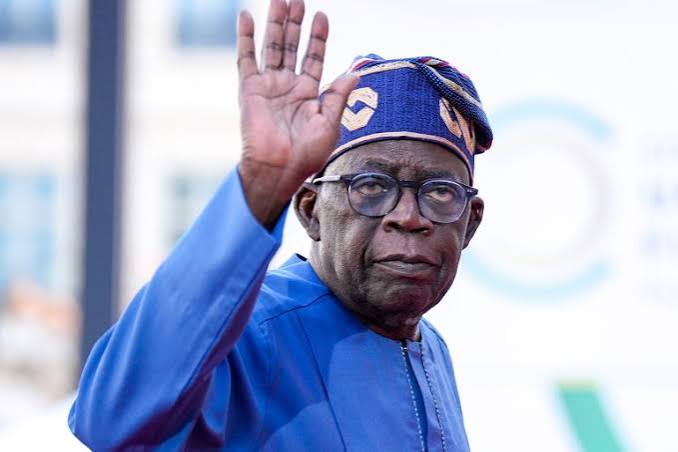
President Bola Tinubu has assured Nigerians of peaceful elections in 2027, promising to strengthen security operations, restore displaced communities and consolidate peace and stability in Plateau State.
Tinubu gave the assurance at the weekend during the flag-off of the North-Central Presidential Campaign Rally at the Jos Stadium, along Zaria Road, Jos, where he commended Plateau State Governor, Caleb Manasseh Mutfwang, for what he described as significant progress in restoring peace and stability to the state.
The President recalled the security challenges that characterised his previous visit to Plateau, said no government could achieve meaningful development without peace, stressing that the people must embrace unity, coexistence and collective responsibility to rebuild the state.
“When last I came here, it was a disaster. It was crisis after crisis. I must commend the governor for the peace and stability that is spreading. No government can prosper without peace,” he said.
Tinubu assured communities displaced by insecurity that his administration would work with relevant leaders to rebuild their homes and facilitate their return, emphasising that the government was committed to lifting Nigerians from poverty to prosperity rather than allowing further loss of lives and destruction of property.
He disclosed that 1,000 forest guards were currently undergoing training as part of efforts to strengthen security across vulnerable communities, adding that surveillance cameras had also been procured to improve early detection, warning systems and security response.
He said security agencies had been directed to take decisive action to sustain peace on the Plateau and expressed satisfaction for the successes made so far and charged them to sustain the tempo.
The President further appealed to residents to put aside their differences and work together for the development of the state, while urging eligible voters to exercise their democratic rights in the 2027 general elections.
He assured them that the elections would be peaceful and called on them to vote for APC candidates across all levels. Tinubu also promised to work with Governor Mutfwang to transform the state’s airport into a cargo airport to facilitate the export of agricultural produce, particularly vegetables and potatoes, and stimulate economic growth.
The Senate President, Senator Godswill Akpabio, declared that the political reconciliation among Plateau leaders would strengthen unity in the state, expressing confidence that the APC-led administration would address insecurity, end the plight of internally displaced persons and promote agricultural development. He also reiterated the need for state police to strengthen grassroots security.
The National Chairman of the APC, Prof. Nentawe Yilwatda, commended President Tinubu for fulfilling several promises to Plateau State, including the provision of security infrastructure, surveillance cameras, military presence and forest guards. He expressed confidence that the people of the state would reciprocate the gesture by supporting the President in 2027.
The rally equally witnessed the presentation of APC flags to all Governorship flag bearers in the North Central geopolitical zone of the country.

From Mike Tayese, Yenagoa
The Nigerian Content Development and Monitoring Board (NCDMB) and the Nigeria LNG Limited (NLNG) have launched a US$9 million professorial chair endowment programme across six Nigerian universities to develop commercially viable solutions to industry challenges, strengthen local research capacity and advance technological innovation.
Under the Nigerian Content Research and Development (NC-R&D) Professorial Chair Endowment Programme, each university is to receive US$1.
5 million to establish a specialised professorial chair focused on agreed industry research priorities. The initiative is being implemented in partnership with the NCDMB, under the supervision of its Planning, Research and Statistics Directorate.The schools include the University of Ibadan, Oyo State, Rivers State University, Modibbo Adama University, Yola, Adamawa State, Aliko Dangote University of Science and Technology, Kano State, University of Nigeria, Nsukka, Enugu State, and Yakubu Gowon University, formerly the University of Abuja.
Speaking at the kick-off ceremony, NLNG’s Managing Director and Chief Executive Officer, Adeleye Falade, described the programme as an investment in Nigeria’s capacity to translate academic knowledge into practical solutions. His keynote address, titled “Reshaping Nigeria’s Future Through Innovation, Research and Capacity Development,” emphasised the importance of sustained collaboration between government, industry and academia.
He noted that the programme would support research into challenges central to the energy industry’s future, including improving operational efficiency, managing emissions, strengthening safety, maintaining critical infrastructure and making industrial processes more sustainable.
Beyond the research endowments, Falade outlined opportunities for a “triple helix” approach that brings government, industry and academia together through specialised programmes, sabbaticals, exchange opportunities, practical testing of research assumptions and the joint development of postgraduate curricula.
The six beneficiary universities will undertake research in distinct areas and the NLNG Research and Innovation Centre for Computer and Electrical Engineering (RICCEE) at Rivers State University is envisaged as the coordinating point for these collaborations among the universities. Falade said discussions were already under way with the university on implementation arrangements and commended its Vice-Chancellor, Professor Isaac Zeb-Obipi, for his role in advancing the proposed collaboration. We have already gotten indications of other partners like Google, Cisco and MTN who are showing interest to support this initiative, he said.
Falade also highlighted the opportunities for younger researchers to deepen their expertise, investigate industry problems and learn from experienced academics and practitioners. He urged the beneficiary institutions to build on the endowments by strengthening research partnerships, attracting additional funding and pursuing the commercialisation of intellectual property.
Acknowledging NCDMB’s role in bringing the initiative to fruition, Falade called for sustained commitment to technology transfer and the development of home-grown solutions without compromising quality assurance or safety. He emphasised that the programme’s lasting value would lie in stronger institutions, research outcomes deployed in the field and the development of the next generation of Nigerian researchers and industry professionals.
In his remarks, the Executive Secretary of the NCDMB, Engr. Felix Omatsola Ogbe said the US$9 million endowment programme represents a strategic investment in the future of Nigeria’s research and innovation ecosystem.
The initiative, he said, complements the Board’s ongoing investments in research infrastructure, including the establishment of specialized R&D Centres of Excellence across six universities in the country.
Represented by the Senior Technical Adviser, Austin Uzoka, the Executive Secretary underscored that by supporting specialized professorial chairs in critical areas of the industry operations, NLNG and NCDMB is creating opportunities to bridge the longstanding gap between academic research and industrial application.
Details of the endowment indicates that the University of Ibadan will focus on natural gas processing, pollution control and environmental management, while Rivers State University will concentrate on digital engineering, intelligent energy systems, automation and asset integrity.
Modibbo Adama University will undertake research in energy transition and the environment. Aliko Dangote University of Science and Technology will focus on sustainable energy innovation and climate-resilient food systems.
The University of Nigeria, Nsukka, will specialise in green energy production and geoenvironmental engineering, while Yakubu Gowon University, formerly the University of Abuja, will focus on geoscience and satellite intelligence for resilient gas infrastructure.
Each university will work towards agreed research targets and commercialisation pathways, providing a framework for measuring progress and translating findings into practical applications. The institutions will also jointly host an information management hub to support knowledge sharing and exchange programmes.
The funding includes provision for minor civil works and infrastructure upgrades to transform identified spaces into fit-for-purpose research centres.
Proposed arrangements would enable industry professionals to contribute practical expertise in technical and non-technical disciplines while pursuing master’s and doctoral degrees. This would give students greater exposure to industry experience while strengthening the connection between postgraduate study and practical problem-solving.
The programme reinforces NLNG’s commitment to developing Nigerian capability and creating opportunities for local expertise to address industry needs, guided by its recently approved ‘NextGen Nigerian Content Strategy’ where NLNG plans to Sustain the gains through focused delivery of previous commitments in alignment with NCDMB; Enable its business by facilitating deeper adoption Nigerian Content Development as a business principle and Accelerate growth by showing up and support the Nigerian Content transformation for posterity, in line with its vision of inspiring a sustainable future.
By Tochukwu Jimo Obi
Sixty six years after independence, Nigeria should be asking itself a question that can no longer be postponed: what exactly has become of the great promise of our nation? A country blessed with enormous human and natural resources should not, at this stage of its journey, still be struggling with problems that ought to have become distant memories.
As we mark 66 years of independence, this should be more than another occasion for colourful ceremonies, patriotic speeches and celebrations. It is a time for sober reflection as a people, to examine where we are, where we ought to be and, most importantly, how best to move Nigeria forward.Undoubtedly, Nigeria is not where it used to be. There have been significant developments in different sectors of the economy and society, and successive administrations have introduced policies and programmes aimed at addressing the country’s challenges. However, we must also acknowledge that we are certainly not where we ought to be, considering the enormous human and natural resources available to us. A nation blessed with abundant natural resources, a large youthful population and considerable human capital should be able to provide a higher standard of living for its citizens.
At 66, Nigeria should have no reason to still be battling with inadequate power supply, dilapidated roads, massive unemployment and widespread hunger. These are challenges that have persisted for decades, despite the huge resources committed to addressing them. While some of our past and present leaders may have done, or may still be doing, their best, the reality remains that their efforts alone have not been enough to solve the numerous problems bedevilling the nation. What Nigeria requires is sustained commitment, effective institutions, accountability and policies that go beyond individual administrations.
Corruption and insecurity also continue to pose serious challenges to national development. Resources that should be channelled towards infrastructure, education, healthcare, job creation and other essential services can be undermined by corruption and poor accountability. Similarly, insecurity discourages investment, disrupts economic activities and threatens the lives and livelihoods of citizens. We cannot continue like this as a nation. There must be a collective determination to strengthen institutions, uphold the rule of law and confront the factors that continue to undermine national development.
Unfortunately, the people themselves appear to have become accustomed to many of these perennial problems. This has contributed to a situation where some citizens fail to demand accountability from leaders or make effective use of their democratic power during elections. Democracy gives citizens the opportunity to choose their representatives and to replace those whose performance does not meet their expectations. Elections should therefore be about competence, integrity, policies and the ability to serve the public interest, rather than personal loyalty or temporary benefits.
Sycophancy has also become increasingly visible in our political space. Some people praise leaders excessively for personal gain, defend actions they would ordinarily condemn and, in some cases, sell their votes during elections, only to complain about bad leadership afterwards. Citizens must understand that leadership and followership are interconnected. When voters trade their electoral power for immediate personal benefits, they may be contributing to a system that makes it more difficult to demand responsible governance later. The ballot should be treated as an important instrument for shaping the future of the country.
As Nigeria marks this 66th anniversary, our leaders at all levels must put the interest of the nation at the centre of their decisions and actions. Religious, political and ethnic considerations should not be allowed to take precedence over the collective interest of Nigeria. Diversity should be a source of strength rather than a reason for division. Those entrusted with public office must remember that political positions are temporary, while the consequences of decisions taken in office can affect generations yet unborn.
The people also have an important role to play in moving Nigeria forward. Citizens must obey the law, reject corruption, participate responsibly in elections, demand accountability and contribute positively to their communities. Professionals must give their best in their respective fields, young people must be encouraged to pursue productive opportunities, and the private sector must continue to contribute to economic development. Nation building cannot be left entirely to government. Every Nigerian has a responsibility to contribute to the Nigeria we desire.
At 66, the question, therefore, is not simply which way Nigeria, but what kind of Nigeria do we want to leave for the next generation? The answer lies in our collective willingness to change the things that have held us back, strengthen the institutions that sustain democracy and development, and place national interest above personal, political, religious and ethnic considerations. Nigeria has the resources, talent and potential to achieve greatness. What is required is the collective will to translate that potential into reality. As we celebrate 66 years of independence, let us renew our commitment to building a peaceful, prosperous and united nation. Nigeria shall be great again.
Tochukwu Jimo Obi, Obosi Anambra state.



Kohol tasks NUBESS Leaders on Service, Accountability, Legacy
ShareBy David Torough, Abuja The founder of Menroi Rural Priority Organisation, Professor Kohol Iornem has challenged leaders of the National...

Stakeholders Celebrate Zikism at 7th Nnamdi Azikiwe Annual Award Lecture in Abuja.
ShareBy Raphael Atuu, Abuja As Barrister Henry Okeke Says The gathering provided another opportunity for Nigerians to reflect on the...
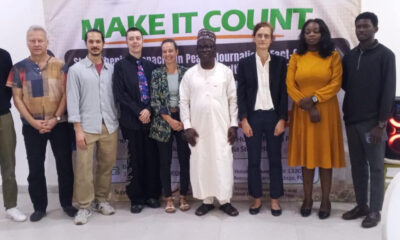

2027 Elections: CHRICED Trains 36 Journalists To Combat Fake News, Promote Peaceful Polls
ShareBy Orjime Moses Abuja As Nigeria prepares for the 2027 general elections, the Resource Centre for Human Rights and Civic...

Livestock Ministry Defends Abuja Headquarters Acquisition, Insists Due Process Was Followed
ShareBy Raphael Atuu, Abuja The Federal Ministry of Livestock Development has defended the acquisition of its headquarters building located along...
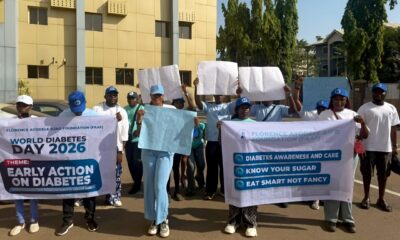

World Diabetes Day: FAAF Advocates Early Detection, Affordable Care
ShareBy David Torough, Abuja The Florence Ayodele Ajao Foundation (FAAF) has called for increased awareness and early detection of diabetes...


WHO Recommends Multiple Daily Insulin Injections to Manage Type 1 Diabetes
ShareThe World Health Organisation has recommended that people with type 1 diabetes receive insulin injections several times per day, with...
Benue Begs Newly Inducted Doctors to Return Home, Tackle Shortage of Medical Personnel
ShareFrom Attah Ede, Makurdi The Benue State Government has told the newly inducted medical doctors of Benue origin to return...
World Diabetes Day: Nigeria Must Fix Food Environment to Curb Diabetes Burden, Says CAPPA
ShareFrom Mike Tayese, Yenagoa As the world marks World Diabetes Day 2026 on November 14, under the theme “Early Action...

Pope Says Inca Heartland ‘Suffering’ as Villages Empty
SharePope Leo XIV warned Saturday that the heartland of the ancient Inca Empire was “suffering,” as the remote, poverty-stricken communities...
Pope Says Inca Heartland ‘Suffering’ as Villages Empty
SharePope Leo XIV warned Saturday that the heartland of the ancient Inca Empire was “suffering,” as the remote, poverty-stricken communities...