
OPINION
Bezos Wedding: When Will We Stop Applauding Power and Start Questioning It?


By Ebuka Ukoh
“We are nobodies. We have no money. Nothing. We’re just citizens who started organising—and we managed to move one of the most powerful people in the world out of the city.” —Tommaso Cacciari, No Space for Bezos.
It took me a lot to pick up my laptop and type. But it is easy to scroll through the news, get angry, and do absolutely nothing. But I know better now. Doing something—even a small thing—matters. For some, it will be to plant the seed.For others, it will be to water. The point is this: ordinary people still have power. They just need to know it and own it .
Last week, the streets of Venice reminded the world what people power looks like.
Protesters from groups like No Space for Bezos and Greenpeace Italy rallied against the lavish, hyper-exclusive wedding celebration of Jeff Bezos and Lauren Sanchez. The world’s third richest man planned to rent out historical landmarks, sail in on private yachts, and jam up Venice with celebrity guests and former U.S. Marines.The city was to become a backdrop for billionaire decadence. But the people said no.
From hanging protest banners across Venice’s canals to plastering the city with fake Bezos dollar bills, citizens organized, their message was clear: Venice is not for sale. And they won. The event was moved from the city center to a more remote location. The world’s elite retreated.
Compare this to Nigeria. If someone like Bezos were visiting Lagos or Abuja, we might declare a public holiday to welcome him. We just saw that happen. President Tinubu visited Benue State, where people were still reeling from a massacre, and the state declared a holiday, not to mourn the victims but to welcome a powerful man. This is what sycophancy looks like when it replaces sense.
We are quick to roll out red carpets for those with power, yet slow to resist those who abuse it. We silence our pain in favor of performance.
But what if, like the people of Venice, we pushed back?
In Nigeria, we are dealing with insecurity in Benue, oil spills in the Niger Delta, gentrification in Lagos, and crippling hardship from fuel subsidy removals. These aren’t random misfortunes. They are structural betrayals. Yet, we often act like we are powerless.
We are not .Organizing doesn’t always mean marching. It can mean: Forming community safety patrols when the state fails to protect.
Creating coalitions to monitor oil spill cleanup promises. Mobilizing digitally to resist land grabs.Voting as a bloc to unseat non-performing leaders.
The End SARS movement proved this. So did Bring Back Our Girls. Otoge in Kwara shifted political dynamics. The fuel subsidy protests, from Occupy Nigeria in 2012 to the current resistance against hardship, all show that organized voices can challenge the status quo.
But protest doesn’t need to trend on Twitter to be effective. It just needs to persist. As Tommaso Cacciari put it: “We are nobodies.” But they organized.
And they moved Bezos. The billionaires of this world may have yachts and security. But they are still afraid of one thing: the organized will of the people. Let’s be clear: protests should never be violent. In Nigeria, it seems the police are more equipped to suppress unarmed protesters than to fight armed robbers or bandits.
Still, we must not let the evil engineering of the system silence us. Whether it is digital advocacy, town hall meetings, school debates, or just one conversation that shifts someone’s thinking, do something.
Because the moment we stop trying, the system wins. In a world where the rich turn cities into playgrounds, organizing is how we take them back. It is how we remind ourselves that we are not furniture to be moved around for optics.
We are citizens. We are the city. An Igbo proverb says, Agbata obi eze adịghị mma, e kwu na ya bụ ihe mere eji agba egbe n’ogige eze. (The discomfort in the king’s neighbourhood is the reason the palace is never truly at peace.)A Yoruba saying reminds us: Pẹlẹbẹ ni ejò ńrin, àmọ̀ ìgbà tí ó fi ńrin mọ́kànjúà, ló ṣì jẹ́ kó di ẹ̀rù fún ara rẹ̀. (That snakes move alone is their undoing.)Let that be our moral guide.When we organise, we dignify ourselves. When we speak, we reclaim our future.
When we resist—with wisdom, unity, and courage—we change even billionaires’ plans.
Let Nigeria learn this. Let every citizen remember it. Because power still belongs to the people. If only we would use it. Mr Ukoh, an alumnus of the American University of Nigeria, Yola, and PhD student at Columbia University, writes from New York.
By Uji Wilfred
Right from the foundations of the Independence struggle that led to self-rule, political party formations in Nigeria were crafted majorly for the capture of political power through periodic elections.
Political Parties never had ideological foundations that defined the boundaries of political recruitment and participation.
Political parties in their formation, leadership structure and ownership, belonged more to the ruling oligarchs than the people or the masses.In the First Republic, political parties had little ideological bent, framed along regional and ethnic sentiments, but little of rallying the entire nation along in a unified polity.
In the general elections of 1954 – 1956, each of the ruling political party, the Northern People’s Congress, the Action Group and the National Council of Nigerian Citizens emerged as regional parties in terms of the demographic voting pattern as well as the control of political seats.The First Republic suffered from a contradiction of centripetal and centrifugal forces within the framework of the tripartite system which eventually led to the collapse of that republic.
Political parties as well as the leadership recruitment reflected a regional and ethnic bias more than the need for the national integration of Nigeria.
Decamping across political lines, irrespective of ideological leanings, were the basic norms of the First Republic with political parties splitting out from the major political party. Formation of new political parties to fragment the dominant hold of ruling political parties were common political vices of the political class at that time. For example, Chief Akintola, despite the ideological soundness of the Action Group, splitted up the party with the formation of a new political party.
Chief Akintola’s desire was fired more by ambition than the issues of ideology and national interest.
In Northern Nigeria, the ruling Northern People’s Congress waged a war of suppression and dominance against other minority political parties with strong ideological bent that inspired minority ethnic nationalism.
The NPC through its slogan of One North, One Destiny, suppressed minority political parties such as the United Middle Belt Congress led by Joseph Tarkaa.
The point is that Nigeria from her foundations inherited a political culture where political parties have weak ideological roots as well as party and leadership recruitment.
Since 1999, Nigeria has witnessed the recycling of bourgeoisie Political Party Formation and leadership recruitment through a process of metamorphosis that defiles ideological lines and national interest.
Political participation and leadership recruitment has been centered on the urgent need to capture power at the center using political parties owned by a few powerful oligarchs.
The People’s Democratic Party in its formation and foundation was a fraternity of past and serving military generals and their civilian equivalent.
The PDP since its inception has been led by past military officers like David Mark and Atiku Abubakar, the civilian equivalent of the military.
The dream of the PDP led by these retired military generals under the leadership of former President Olusegun Obasanjo was the enthronement of Africa’s biggest political party that was to last for a century.
As good as the dream of the party was, the PDP, like the experience of the First and Second Republics lacked deep ideological roots that defined the boundaries of political recruitment and participation.
The triumph of the People’s Democratic Party forced the rival All People’s Party and the Action Congress of Nigeria into a state of collapse and submission leading up to the bourgeoisie metamorphosis that resulted to the formation of the All Progressive Congress on the eve of 2015 with the sole objective to unseat President Good luck Jonathan.
The APC was a metamorphosis and amalgamation of opposition parties including some dissenting faction of the PDP to reclaim the so called birth right of the far right North in Nigeria to produce the President of Nigeria.
Political recruitment and leadership struggle in Nigeria has never been defined by ideological needs to salvage or emancipate Nigeria as a nation. Political struggle has always been a recycling of that section of the bourgeoisie, through a process of metamorphosis, whose objective is to capture political power at the center.
The present protest and political struggle by the African Democratic Congress, the faction led by David Mark and Atiku Abubakar, is a recycling of bourgeoisie metamorphosis not too different from the experience of 2015.
At best, the David Mark and Atiku Abubakar led protest represents that desperate struggle entrenched in the thinking of the Far Right of Far Northern Nigeria, that political leadership resides in the ancestral birth right of the aristocratic ruling political class of the North.
David Mark and Atiku Abubakar perhaps are suffering from a dementia that has made them forget that they were the agents that destroyed the foundations of democracy in Nigeria through the sacking of former President Good luck Jonathan of the People’s Democratic Party.
These men formed the All Progressive Congress and wrestled power from a democratic government exploiting the dynamics of national security and developmental challenges.
In 2015, Nigerians believed their opinions and through the ballot removed Good luck Jonathan.
However, since then, has Nigeria fared better under the APC that was enthroned by oligarchs leading in the present protest under the auspices of the ADC.
Perhaps, David Mark and Atiku Abubakar may assume that Nigeria suffers from a collective dementia that has forgotten the past so soon.
There is an adage that says, he who comes to justice and equity must come with clean hands. The same forces that enthroned bad governance in Nigeria factored in the APC, through a metamorphosis, want to rebirth another Nigeria through the ADC.
In ideological terms, this does not make sense, the ADC Protest is the same old thing of old wine in a new wine bottle.
If Nigeria must experience a change, let it come through some revolutionary medium that will not exploit the people’s trust and betray them once in power.
Over the past decades, the betrayal of public trust, exploiting the innocence of the people, perhaps the naivety of the people, is what we have seen and experienced through the circles of bourgeoisie metamorphosis and political leadership recruitment.
By Raphael Atuu
Benue State, fondly referred to as the “Food Basket of the Nation,” was created on February 3, 1976, by the military administration, carved out of the old Plateau State. From its inception, the state was administered by a succession of military administrators, followed by civilian governors in Nigeria’s evolving political landscape.
Over the decades, leadership passed through several hands each leaving varying degrees of impact on the state’s trajectory.
In its early years, Benue was widely regarded as a peaceful and united society. Communities coexisted in harmony, bound by shared values, cultural pride, and a strong sense of collective identity.
The economy was largely driven by agriculture, with fertile lands producing yams, rice, cassava, and other staple crops. Institutions like the Benue Cement Company also contributed to economic activity and employment.In those days, the government was distant from the daily struggle of the average citizen. Few people concerned themselves with the affairs of Government House. Wealth and dignity were derived from hard work, farming, trading, and craftsmanship not political patronage.
The people spoke with one voice, celebrated their traditions with pride, and upheld communal respect as a guiding principle.
However, the return of democracy in 1999 marked a significant turning point, one that would reshape the state’s social and political fabric in ways few anticipated.
With democratic governance came new opportunities, but also new challenges. Politics gradually became the most attractive path to wealth and influence.
For many, Government House transformed from a symbol of public service into a gateway to personal enrichment.
The perception of politics shifted from service to self-interest.
As political competition intensified, unity began to erode. Divisions along ethnic, local government, and party lines deepened. The once cohesive voice of the Benue people became fragmented, often drowned in partisan conflicts and power struggles.
Perhaps more troubling was the subtle transformation in societal values.
The Benue man, once admired for courage, resilience, and industry, began though not universally to exhibit tendencies toward dependency and political loyalty over merit.
Sycophancy started to replace integrity, and the dignity of labor was gradually overshadowed by the allure of quick gains through political connections.
Elected officials rose to positions of authority and influence, becoming key decision-makers in society.
Yet, for many citizens, the dividends of democracy remained elusive. Infrastructure development lagged, agricultural potential remained underutilized, and poverty persisted despite abundant natural resources.
The irony is striking: a state so richly endowed, yet struggling to translate its potential into tangible progress.
Beyond economics, insecurity and communal clashes in recent years have further strained the social fabric.
The peace that once defined Benue has been challenged, forcing many communities to confront displacement and uncertainty.
While these issues are complex and multifaceted, the role of political leadership in addressing or failing to address them cannot be ignored.
So, where did the politicians get it wrong?
They lost sight of the essence of leadership service to the people. Governance became more about control than development, more about personal gain than collective good.
Long term planning gave way to short term political calculations. Investments in agriculture, which should have remained the backbone of the state’s economy, were neglected in favor of less sustainable ventures.
Moreover, the failure to foster unity and inclusive governance widened the gap between leaders and the led. Politics became a tool for division rather than a platform for progress.
Yet, all hope is not lost.
Benue still possesses immense potential, fertile land, vibrant culture, and resilient people, what is needed is a return to the values that once defined the state: hard work, unity, integrity, and community driven development.
Leadership must be reimagined, not as an avenue for wealth, but as a responsibility to uplift the people.
The story of Benue State is not just one of decline it is also one of possibility.
With the right vision, commitment, and collective will, the state can reclaim its place as a model of peace, productivity, and progress.
The question remains: will its leaders and its people rise to the occasion?
If you want, I can.

By Tanimu Yakubu
Nigeria is not collapsing; it is confronting long-avoided economic realities. The current hardship, though undeniable, reflects a deliberate process of correcting structural imbalances that have persisted for years. Distress is evident, but it must not be mistaken for systemic failure.
Countries in true economic collapse do not unify exchange rates, rebuild external reserves, regain access to international capital markets, or improve fiscal performance.
Nigeria, despite significant pressures, is making measurable progress across these indicators.Ending a Distorted Economic Order
For years, Nigeria operated under an economic framework that projected stability while masking deep inefficiencies.
Artificially suppressed fuel prices, multiple exchange rate windows, and expansionary fiscal practices incentivized arbitrage over productivity.These distortions disproportionately benefited a narrow segment of the population while imposing hidden costs on the broader economy.
Their removal has revealed the true cost structure of the system. While this transition has triggered inflationary pressures, it has also restored policy transparency and enhanced the credibility of economic management.
Strengthening the Fiscal Base
Recent fiscal data indicates a strengthening foundation. Distributable revenues to the Federation Account have risen by over 40 percent following subsidy removal, reflecting improved remittance discipline and reduced leakages.
Nigeria’s public debt remains below 30 percent of GDP, a relatively moderate level compared to peer emerging markets, according to the International Monetary Fund. Meanwhile, external reserves have surpassed $40 billion, based on figures from the Central Bank of Nigeria.
At the subnational level, increased fiscal inflows are enabling more consistent salary payments, with some states introducing inflation adjustments, an indication of gradually expanding fiscal space.
Inflation: A Transitional Challenge
Inflation remains the most immediate and visible consequence of ongoing reforms. It is being driven by exchange rate adjustments, energy price corrections, and longstanding supply-side constraints.
Global experience suggests that such inflationary spikes are often temporary when reforms are sustained. The greater risk lies not in reform itself, but in policy inconsistency or reversal.
Interpreting the Present Moment
Public frustration is both expected and understandable. Nigerians are justified in demanding tangible improvements in living standards. However, it is important to distinguish between short-term hardship and systemic collapse.
Nigeria’s institutional framework remains intact, fiscal capacity is improving, and macroeconomic reforms are actively progressing. This phase represents adjustment, not disintegration.
From Stabilisation to Impact
The next phase of reform must translate macroeconomic gains into measurable improvements in citizens’ welfare.
Strategic investments in healthcare, education, and targeted social protection will be essential to sustaining public confidence.
Ultimately, the credibility of these reforms will be judged not by policy intent, but by their impact on everyday life.
Conclusion: The Imperative of Consistency
Nigeria has long recognised its economic challenges; what has often been lacking is sustained policy execution. The greatest threat at this juncture is not reform fatigue, but reform reversal.
Abandoning the current course would erode credibility, deter investment, and reintroduce the very distortions that hindered growth.
This moment demands patience, discipline, and resolve. Nigeria is not collapsing, it is undertaking a necessary correction and laying the foundation for a more resilient economic future.
Tanimu Yakubu is DG, Budget Office of the Federation.

FG begins Nationwide Review of Outdated Agric Curricula
ShareThe Federal Government has commenced a comprehensive review of agricultural curricula in polytechnics and colleges of education to address widening skills gaps and revive...
NCS First Female Pilot Gets U.S. Commercial Licence
ShareThe first female pilot of the Nigeria Customs Service (NCS), Nafisat Balogun, has secured a commercial multi-engine pilot licence in the United States of...


FirstBank Backs GTR West Africa 2026 Conference in Lagos
Share FirstBank has confirmed its sponsorship of the Global Trade Review (GTR) West Africa 2026 conference scheduled for Wednesday and...

Forensic Audit Dismisses Social Media Claims on INEC Chair
ShareBy David Torough, Abuja The Independent National Electoral Commission has confirmed it will pursue the arrest of individuals behind the...

Tinubu Expands Police Academy, Approves N15bn Take-Off Grant
ShareBy David Torough, Abuja President Bola Tinubu has approved a sweeping expansion and restructuring of the Nigeria Police Academy, signalling...


FCT Primary School Teachers Commence Indefinite Strike Today
ShareBy Laide Akinboade, Abuja The Nigeria Union of Teachers (NUT) FCT Wing, at the weekend said it has concluded an arrangement to commence indefinite strike over...
U-17 WWCQ: Guinea Thrash Niger to Set up Clash with Flamingos
ShareGuinea will face Nigeria’s Flamingos in the final qualifying round for the 2026 FIFA U-17 Women’s World Cup. The Guineans defeated...
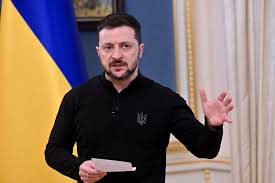

Zelensky Condemns US Extension of Russian Sanctions Waiver
ShareUkraine’s President Volodymyr Zelensky has condemned a US decision to extend the period during which Russia is allowed to sell oil despite Western sanctions. The move means countries can...


Delta Unveils Plan to Tackle Hunger, Boost Food Security by 2030
ShareFrom Francis Sadhere, Delta The Delta State Government has reaffirmed its commitment to boosting food security through the development of a clear and practical implementation work plan aimed...

FG Debunks False Allegation on Hidden Agenda, Federal Revenue Diversion
ShareBy Tony Obiechina, Abuja The federal government has refuted media reports to the effect that a significant portion of federation earnings is...