
Agriculture
Buhari Renames UniAgric Makurdi After Joseph Sarwuan Tarka

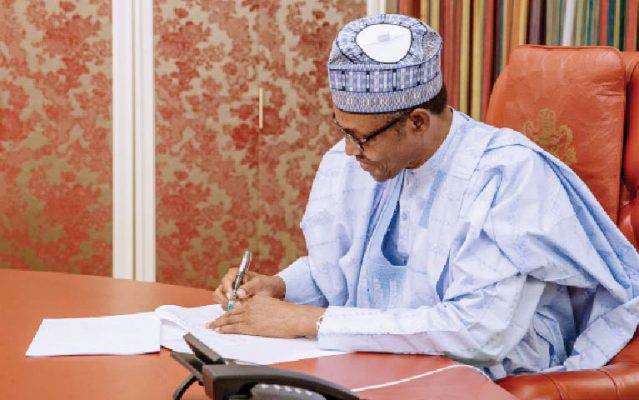
- Nigerian Prisons sertvice Now Correctional Service
By Mathew Dadiya, Abuja
President Muhammadu Buhari has signed into law a bill that changes the name of Nigeria Prison Service to Nigerian Correctional Service (NCS), which is viewed as part of his administration’s effort at reforming the prison system in the country.
The signing of the law came two months after the expiration of the 9th National Assembly, thereby raising concerns as to the legality of the law and if the clerk of the national assembly has such right to withhold bills and transmit them to the president months after the end of an assembly.
Senior Special Assistant to the President on National Assembly (Senate Matter), Senator Ita Enang said this on Wednesday, while speaking to State House Correspondents at the Aso Rock Villa, Abuja.
According to him, this Act repeals the Prisons Acts and changes the name from Nigeria Prisons Service to Nigerian Correctional Service, otherwise known as “the Correctional Service.”
There Correctional Service is made up of two main faculties: Custodial Service and Non-custodial Service.
He explained that the Custodial Service is to take custody and control of persons legally interned in safe, secure and humane conditions; conveying remand persons to and from courts in motorized formations; identifying the existence and causes of anti-social behaviours of inmates; conducting risk and needs assessment aimed at developing appropriate correctional treatment methods for reformation, rehabilitation and reintegration.
Others include: Implementing reformation and rehabilitation programmes to enhance the reintegration of inmates back into society; initiating behavior modification in inmates through the provision of medical, psychological, spiritual and counseling services for all offenders including violent extremists; empowering inmates through the deployment of educational and vocational skills training programmes, and facilitating incentives and income generation through Custodial Centres, farms and industries; administering borstal and related institutions; Providing support to facilitate the speedy disposal of cases of persons awaiting trial, and It further provides in Section 12 (2) (c).
“that where an inmate sentenced to death has exhausted all legal procedures for appeal and a period of 10 years has elapsed without execution of the sentence, the Chief Judge may commute the sentence of death to life imprisonment. And Section 12 (8) empowers the state Controller of the Service to reject more intakes of inmates where it is apparent that the correctional centre in question is filled to capacity.
He further explained that ”the non-custodial faculty of the Correctional Service is responsible for the administration of non-custodial measures, namely: Community Service, probation, parole, restorative justice measures and such other measures as a court of competent jurisdiction may order. ”Restorative Justice measure approved in the Act include victim-offender mediation, family group conferencing, community mediation and other conciliatory measures as may be deemed necessary pre-trial, trial during imprisonment or even post- imprisonment stages.”
Also, the President signed into law Federal Universities of Agriculture (Amendment No.2) Act, 2019, changing the name of the Federal University of Agriculture Makurdi in Benue State to Joseph Sarwuan Tarka University, Makurdi.
The House of Representatives had in 2016 passed a bill seeking the renaming of the university to J.S Tarka.
Joseph Sarwuan Tarka (1932-1980) was a Nigerian politician from Benue State and a former Minister for Transport and later Communications under the administration of Yakubu Gowon.
He was one of the founding members of the United Middle Belt Congress, a political organization dedicated to advocating autonomy for the country’s Middle Belt.
Tarka was a battle scared politician who underwent several political battles and was jailed on many occasions for his political actvisim as the main opposition leader in the Northern Region.
A colourful and skilled politician with a rare gift of oration, he was reputed for the energetic political campaigns he conducted. He was sometimes called the ‘smiling snake’ for the big smiles he had while speaking.
He was a founding figure of the defunct National Party of Nigeria(NPN) and was a presidential aspirant of the party but lost the ticket to Alhaji Shehu Aliyu Usman Shagari, who eventually got elected President in 1979.
He was then elected Senator in the second republic and became Chairman of the Senate Committee on Public Accounts until he died in 1980, while serving in the National Assembly.







Some residents in Lagos State have expressed concern over the recent surge in the price of tomatoes, forcing many households to adopt alternatives.
The residents made their views known in separate interviews on Wednesday in Lagos.
A market survey showed that a 50kg basket of tomatoes now sells between N115,000 and N125,000, compared to between N35,000 and N40,000 recorded last month.
Olachi Igwe, a resident of Ago Palace, said the scarcity and high cost of tomatoes had disrupted her household’s meal plans.
“I contacted my usual vendor, but she said tomatoes were scarce and difficult to source.
“A small bowl we used to buy for between N3,500 and N4,000 now sells for as high as N6,000 to N7,000, when available.
“For now, my family will resort to palm nut stew (ofe akwu) until prices stabilise,” she said.
Another resident, Mercy Okeleye of FESTAC, said although her family prefers fresh tomatoes, rising prices have forced her to consider cheaper options.
“I cannot do without fresh tomatoes because of the taste, but I may have to buy broken ones, popularly called ‘esha’, which are relatively cheaper.
“I do not consider tomato paste a suitable substitute because it is not purely made from tomatoes,” she said.
Also speaking, Tope Babalola from Dopemu, said she might adjust her cooking methods if prices remain high.
“I have not bought tomatoes in over a month, but if the price is still high, I will use more onions and peppers.
“I will not resort to artificial additives; I prefer natural ingredients for my meals,” she said.
Joan Ogugua, another resident, said she had already switched to tomato paste to cope with the situation.
“I asked my son to buy tomato paste for our meals. I cannot justify spending excessively on fresh tomatoes when other basic needs must be met,” she said.
Also, Oge Ugwu, a civil servant at Lekki, said she would resort to cucumber stew with the recent price hike.
The Tomatoes Growers and Processors Association of Nigeria (TOPAN) has predicted a steady increase in the price of the produce between May and June 2026.
The Kaduna State Chairman TOPAN, Rabiu Zuntu, disclosed this in an interview recently in Lagos.
Zuntu noted that although there is no particular time for tomatoes planting season up north, seasonal weather variations can affect the production of the produce.
“Although we can plant tomatoes all-year-round, we cannot assure quality harvest all-year-round.
“Some farmers are harvesting now, while others are transplanting, and others are harvesting.
“Tomatoes are still available for sale but the price of the produce is gradually on the increase.
“Come May/June, the prices of tomatoes will be very expensive, so now is a good time to stock up the produce. There’s always a scarcity within that period.
“This is because of the nature of the weather in the north around that period, the weather is usually very hot and tomatoes cannot resist such hot temperature,” he said.
Zuntu said the price of tomatoes have started rising up in the north.
“A 50kg rafia basket of tomatoes sells from N20,000 as against N7,000 to N10,000 that was sold earlier in the year.
“While a crate of tomatoes up north is sold between N10,000 and N15,000 as against N5,000 to N6,500 sold earlier in the year.
“In most part of Kano State, where there is bumper harvest, they are rounding off their harvest. So, tomato is not that available there and most buyers have turned to where they can find it now, mostly within Kaduna State and some parts of Plateau State.
“So, that’s why the supply has decreased and the tomato supply and cost is determined by the law of demand and supply,” he said.
A 50kg basket of tomatoes in Lagos, at the moment, sells between N40,000 and N60,000 depending on the size and quality.

The Smallholder Women Farmers Organisation in Nigeria (SWOFON), Oyo State chapter, has said that the lack of irrigation facilities had become a major obstacle to dry season farming in the state.
The Chairperson of SWOFON in Oyo State, Atinuke Akinbade, said this in an interview in Ibadan on Monday.
Akinbade, who shared the experiences of women farmers in the state during the 2025 dry season, said that inadequate access to water for irrigation significantly affected the performance of many farmers during the period.
“It hindered many older farmers from participating in dry season farming and also prevented younger farmers from doing as much as they could in cultivating large acres of land,” she said.
Akinbade explained that farmers who managed to plant during the season struggled to access sufficient water to irrigate their farms, a situation worsened by the effects of climate change.
“Many farmers who depended on streams and wells to water their crops suffered major setbacks because those sources could not provide enough water for irrigation.
“Some farmers had to resort to buying water from commercial water tankers, which increased the cost of production, while at times it was even difficult to get water from the tankers,” she said.
The SWOFON chairperson warned that failure to address the problem could worsen food insecurity in the coming months.
“Even now, rainy season farming has not fully commenced because of the irregular rainfall pattern.
“This is a double burden, and if nothing is done, it may lead to serious hunger later,” she said.
Akinbade, however, acknowledged that the government had organised training for members of the association on home gardening.
She, however, said that little support was provided to address the challenges of dry season farming.
The chairman said that the home garden support package given to members consisted mainly of seedlings and one sprayer.
“They gave us two packs each of maize and pepper seeds, with six seeds in each pack, as well as one sprayer, so that we can grow food for household consumption,” she said.
Earlier, Oluwatoyin Oyedeji, SWOFON Coordinator in Oyo East, explained the severe hardship members of the organisation experienced in sourcing water for irrigation.
“Many farmers are already counting their losses because water was not available to irrigate their farms.
“Those who depended on streams and brooks were badly affected because many of them dried up, while the few that still had water had so little that farmers had to dig deeper into the ground in search of more,” Oyedeji said.
In the same vein, the Women Leader for farmers in Saki East, Musiliu Ashiru, said the absence of irrigation facilities also hampered dry season farming in her area.
According to her, many farmers still engaged in dry season farming have had to pay for water to keep their crops alive.
“Many of them buy water from the dam here to irrigate their crops. It has not been easy for them this year,” Ashiru said.




Former Delta Governor Uduaghan Dies at 70
ShareFrom Francis Sadhere, Delta Former Governor of Delta State, Dr. Emmanuel Eweta Uduaghan, has died. Uduaghan, who governed the state...


Customs Opens Review for Disqualified Recruits, Flags 397 Applicants
ShareBy Tambaya Julius, Abuja The Nigeria Customs Service (NCS) has opened a review process for applicants disqualified during its recent...


World Bank Tasks FG, States on Sustainable Cash Transfers
ShareBy Tambaya Julius, Abuja The World Bank has urged the Federal Government and state governments to establish a sustainable social...


NDLEA Nabs 85-year-old Woman, Seizes 407kg Cannabis
ShareThe National Drug Law Enforcement Agency (NDLEA) has arrested an 85-year-old grandmother and five other suspected drug traffickers during coordinated...


Economy would’ve Collapsed without Tinubu’s Reforms, Says Shettima
ShareVice President Kashim Shettima has said Nigeria’s economy would have collapsed had President Bola Tinubu not taken what he called...


House of Reps Seeks 90-Day Fuel Reserve for Nigeria by 2027
ShareFrom Rabiu Sanusi, Kano The House of Representatives has backed plans to increase Nigeria’s strategic petroleum reserve from 20 days...

56,000 Candidates Register for 2026 Private WASSCE
ShareThe West African Examinations Council (WAEC) said no fewer than 56,000 candidates registered for the 2026 West African Senior School...


JAMB Warns Varsities Against Issuing Admission Letters
ShareThe Joint Admissions and Matriculation Board (JAMB) has warned universities against issuing admission letters to candidates, insisting that only admissions...
Beyond Survival: Building A Healthier Nigeria For A Longer Life
ShareBy Yussuf Mubaraq Damilare What does it mean to live a long life if access to basic medical care remains...


Jigawa to Increase Corps Members Allowance – Namadi
ShareThe Jigawa government has announced plans to increase monthly allowance for the National Youth Service Scheme (NYSC) members posted to...