
Economy
Buhari Signs N17.127 Trillion 2022 Budget into Law

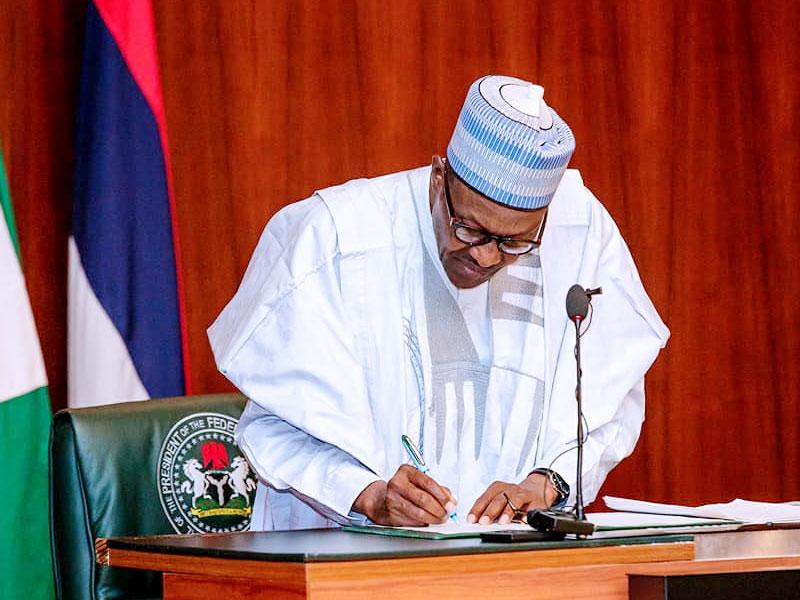
In keeping with the tradition of restoring a predictable January to December fiscal year, as provided for in the Constitution of the Federal Republic of Nigeria, President Muhammadu Buhari Friday in Abuja signed into law the 2022 Appropriation Bill and the 2021 Finance Bill.
The President signed the documents in the Presidential Villa in the presence of Senate President Ahmed Lawan, Speaker of the House of Representatives, Femi Gbajabiamila, and other members of the Federal Executive Council.
Speaking at the event, the President said the 2022 Budget, just signed into law, provides for aggregate expenditures of N17.127 trillion, an increase of N735.85 billion over the initial Executive Proposal for a total expenditure of N16.
391 trillion.The President explained that N186.53 billion of the increase however came from additional critical expenditures that he had authorised the Minister of Finance, Budget and National Planning to forward to the National Assembly.
‘‘The Minister will provide the public with the details of the budget as passed by the National Assembly, and signed into law by me,’’ he said.
The President announced that as the 2023 Budget is going to be a transition budget, work will start in earnest to ensure early submission of the 2023-2025 Medium-Term Expenditure Framework and Fiscal Strategy Paper as well as the 2023 Appropriation Bill to the National Assembly.
He, therefore, directed Heads of Ministries, Departments and Agencies (MDAs) to cooperate with the Ministry of Finance, Budget and National Planning, more specifically with the Budget Office of the Federation, to realise this very important objective.
President Buhari also expressed strong reservations on the ‘‘worrisome changes’’ made by the National Assembly to the 2022 Executive Budget proposal.
He announced that he would revert to the National Assembly with a request for amendment as soon as the Assembly resumes to ensure that critical ongoing projects cardinal to this administration do not suffer a setback due to reduced funding.
The President recounted that during the presentation of the 2022 Appropriation Bill, he had stated that the fiscal year 2022 would be very crucial in his administration’s efforts to complete and put to use critical agenda projects, as well as improve the general living conditions of our people.
‘‘It is in this regard that I must express my reservations about many of the changes that the National Assembly has made to the 2022 Executive Budget proposal.
‘‘Some of the worrisome changes are as follows:
‘‘Increase in projected FGN Independent Revenue by N400 billion, the justification for which is yet to be provided to the Executive;
‘‘Reduction in the provision for Sinking Fund to Retire Maturing Bonds by N22 billion without any explanation;
‘‘Reduction of the provisions for the Non-Regular Allowances of the Nigerian Police Force and the Nigerian Navy by N15 billion and N5 billion respectively.
‘‘This is particularly worrisome because personnel cost provisions are based on agencies’ nominal roll and approved salaries/allowances;
‘‘Furthermore, an increase of N21.72 billion in the Overhead budgets of some MDAs, while the sum of N1.96 billion was cut from the provision for some MDAs without apparent justification;
‘‘Increase in the provision for Capital spending (excluding Capital share in Statutory Transfer) by a net amount of N575.63 billion, from N4.89 trillion to N5.47 trillion.’’
President Buhari also expressed concern in the reductions in provisions for some critical projects, including N12.6 billion in the Ministry of Transport’s budget for the ongoing Rail Modernisation projects; N25.8 billion from Power Sector Reform Programme under the Ministry of Finance, Budget and National Planning; N14.5 billion from several projects of the Ministry of Agriculture, and introducing over 1,500 new projects into the budgets of this Ministry and its agencies.
Further, the President also expressed his reservations on the following:
‘‘Inclusion of new provisions totaling N36.59 billion for National Assembly’s projects in the Service Wide Vote which negates the principles of separation of Powers and financial autonomy of the Legislative arm of government.
‘‘The changes to the original Executive proposal are in the form of new insertions, outright removals, reductions and/or increases in the amounts allocated to projects.
‘‘Provisions made for as many as 10,733 projects were reduced while 6,576 new projects were introduced into the budget by the National Assembly.
‘‘Reduction in the provisions for many strategic capital projects to introduce ‘Empowerment’ projects.
‘‘The cuts in the provisions for several of these projects by the National Assembly may render the projects unimplementable or set back their completion, especially some of this Administration’s strategic capital projects.
‘‘Most of the projects inserted relate to matters that are basically the responsibilities of State and Local Governments, and do not appear to have been properly conceptualised, designed and costed.
‘‘Many more projects have been added to the budgets of some MDAs with no consideration for the institutional capacity to execute the additional projects and/or for the incremental recurrent expenditure that may be required.’’
President Buhari declared that it was surprising that despite the National Assembly increasing projected revenue by N609.27 billion, the additional Executive request of N186.53 billion for critical expenditure items could not be accommodated without increasing the deficit, while the sum of N550.59 billion from the projected incremental revenues was allocated at the discretion of National Assembly.
‘‘I signed the 2022 Appropriation Bill into law to enable its implementation to commence on 1st January 2022.
‘‘However, I will revert to the National Assembly with a request for amendment and/or virement as soon as the Assembly resumes to ensure that critical ongoing projects that are cardinal to this administration, and those nearing completion, do not suffer a setback due to reduced funding.’’
On COVID-19 and budget implementation, the President said despite the lingering adverse effects of the pandemic, he was happy with the success recorded in the implementation of the 2021 Budget.
‘‘The sum of N3.94 trillion that was provided for the implementation of capital projects by MDAs during the fiscal year has been released fully.
‘‘To enable MDAs to complete the implementation of their 2021 capital projects and optimise the impact of the capital budget on the economy, they have been allowed to continue to expend the funds released for their 2021 capital budgets till 31st March, 2022,’’ he said.
The President commended the understanding and speedy action of the National Assembly on this matter.
‘‘As the 2022 Budget will be the last full year budget to be implemented by our Administration, its effective implementation is very critical for delivering our legacy projects, promoting social inclusion and strengthening the resilience of the economy.
‘‘The Ministry of Finance, Budget and National Planning will implement all measures required to ensure timely and targeted release of capital votes.
‘‘All MDAs are to effect early commencement of project implementation, while ensuring productive use of funds provided for achievement of the objectives set for their sectors.
‘‘Considering the incidence of new COVID-19 variants globally, we will ensure timely implementation of measures provided for in the 2022 Budget to contain the spread of the virus and protect our people.
‘‘We continue to count on the collaboration of the State governments in our effort to protect the lives and livelihood of our people.’’
To achieve the laudable objectives of the 2022 Budget, President Buhari pledged that the Federal Government would further intensify revenue mobilisation efforts.
He expressed optimism in the ability of the Government to finance the budget considering the positive global oil market outlook and the continuing improvement in non-oil revenues.
‘‘To achieve our revenue targets, revenue generating agencies, and indeed all MDAs must ensure prompt and full remittance of collected revenues.
‘‘Relevant Agencies must also ensure the realisation of our crude oil production and export targets.
‘‘I also appeal to our fellow citizens and the business community at large to fulfil their tax obligations promptly.
‘‘However, being a deficit budget, the specific Borrowing Plan will be forwarded to the National Assembly shortly.
‘‘I count on the cooperation of the National Assembly for a quick consideration and approval of the Plan when submitted.
‘‘All borrowings will be judiciously utilised and invested in our future growth and prosperity.’’
The President also directed MDAs to liaise with the Bureau of Public Enterprises and/or the Infrastructure Concession and Regulatory Commission to explore available opportunities for public-private partnerships, concessions as well as climate finance arrangements to fast-track the pace of infrastructural development.
He thanked the Ministers of Finance, Budget and National Planning, the Budget Office of the Federation, and all who worked tirelessly and sacrificed so much towards producing the 2022 Appropriation Act.
‘‘Let me conclude by commending the understanding, sacrifice and resilience of our people during these challenging times.
‘‘As a Government, we remain committed to improving the general living conditions of our people.
‘‘We will continue to implement measures aimed at moderating the unintended negative effects of policies on the citizenry,’’ he said.



The Nigerian Export Promotion Council (NEPC) says exporters in Imo generated a total of 1,244,095 dollars as proceeds from export trade in 2025.
The Imo Coordinator of the council, Mr Anthony Ajuruchi, disclosed this during a follow-up engagement with cocoa farmers in the state on Thursday in Owerri.
50 cocoa farmers and exporters in Imo received 30 cocoa seedlings each in 2025 as part of interventions to boost production for export.
Ajuruchi said the amount was derived from proceeds of both formal and informal export transactions carried out by the farmers within the 2025 fiscal year.
He commended the Executive Director of NEPC, Mrs Nonye Ayeni, and the management team for their support and commitment to the growth of the export market in Imo and across the country.
According to him, the council recorded notable achievements in 2025, including the organisation of capacity-building programmes on non-oil export, product packaging and labelling.
“In addition to our interventions for cashew farmers, we conducted trainings on product development and adaptation, export contracts, market penetration, product certification and export documentation procedures.
“We also trained about 600 exporters and small and medium-scale enterprises,” he said.
Ajuruchi said the engagement with the cocoa farmers was aimed at obtaining feedback and brainstorming on strategies to increase production and export volume in 2026.
One of the beneficiaries, Mrs Sophia Orji, said the cocoa seedlings she received were doing well and had started fruiting after 17 months.
Another farmer, Mrs Mary Okeke, said her cocoa plants were thriving and appealed to NEPC to extend similar support to farmers during the rainy season.
Also speaking, Mr Canice Nze, Director of Produce in the Imo Ministry of Trade, Commerce and Investment, urged the farmers to register with the ministry to enable them benefit from cooperative structures and access possible government grants. (NAN)
By David Torough, Abuja
In line with the consumer-focused objectives of the Nigerian Communications Commission (NCC) and the Central Bank of Nigeria (CBN), the two regulators have drawn up a framework to address consumer complaints arising from unsuccessful airtime and data transactions during network downtimes, system glitches, or human input errors.
The framework is the outcome of several months of engagements involving the NCC, the CBN, Mobile Network Operators (MNOs), Value Added Service (VAS) providers, Deposit Money Banks (DMBs), and other relevant stakeholders.
According to the NCC, these engagements were prompted by a rising incidence of failed airtime and data purchases, where subscribers were debited without receiving value and experienced delays in resolution.
“The Framework represents a unified position by both the telecommunications and financial sectors on addressing such complaints. It identifies and tackles the root causes of failed airtime and data transactions, including instances where bank accounts are debited without successful delivery of services. It also prescribes an enforceable Service Level Agreement (SLA) for MNOs and DMBs, clearly outlining the roles and responsibilities of each stakeholder in the transaction and resolution process,” a statement by Head of Public Affairs of NCC, Nnen Ukoha said.
Under the new framework, where a purchaser is debited but fails to receive value for airtime or data—whether the failure occurs at the bank level or with an NCC licensee—the purchaser is entitled to a refund within 30 seconds, except in circumstances where the transaction remains pending, of which the refund can take up to 24 hours.
The framework further mandates operators to notify consumers via SMS of the success or failure of every transaction. It also addresses erroneous recharges to ported lines, incorrect airtime or data purchases, and instances where transactions are made to the wrong phone number.
Director of Consumer Affairs at the NCC, Mrs. Freda Bruce-Bennett in a comment on the development said the framework also establishes a Central Monitoring Dashboard to be jointly hosted by the NCC and the CBN. According to her, the dashboard will enable both regulators to monitor failures, the responsible party, refunds, and track SLA breaches in real time.
“Failed top-ups rank among the top three consumer complaints, and in line with our commitment to addressing these priority issues, we were determined to resolve it within the shortest possible time,” she said.
“We are grateful to all stakeholders—particularly the Central Bank of Nigeria and its leadership—for their tireless commitment to resolving this issue and arriving at this framework, and for ensuring that consumers of telecommunications services receive full value for their purchases.
“So far, pending the approval of management of both regulators on the framework, MNOs and banks have collectively made refunds of over N10 billion to customers for failed transactions” she explained .
Mrs. Bruce-Bennett further noted that implementation of the framework is expected to commence on March 1, 2026, once the two regulators have made final approvals, and technical integration by all MNOs, VAS providers and DMBs is concluded.

By Tony Obiechina, Abuja
The Budget Office of the Federation has reaffirmed the integrity of Nigeria’s newly enacted Tax Reform Acts, cautioning against what it described as governance by speculation and unverified claims following allegations of post-passage alterations.
In a statement on Wednesday, the Budget Office said it had taken note of concerns raised by the Minority Caucus of the House of Representatives, stressing that the sanctity of the law is central to constitutional democracy and not a mere procedural formality.
According to the Office, any suggestion that a law could be altered after debate, passage, authentication, and presidential assent without due process would strike at the core of the Republic and undermine citizens’ right to be governed by transparent and stable laws.
However, it warned that democratic integrity is also endangered by the careless amplification of unverified claims. “A nation cannot be governed by insinuation or sustained on circulating documents of uncertain origin,” the statement noted, adding that public confidence, once shaken by speculation, is often difficult to restore.
The Budget Office emphasized that both government and citizens share a common interest in truth, clarity, and due process, noting that public finance depends heavily on trust in the legality and clarity of fiscal laws. It welcomed the decision of the National Assembly to investigate the allegations, describing institutional inquiry, not conjecture as the appropriate response to claims of illegality.
On public access to the law, the Office agreed that Nigerians and the business community are entitled to clear and authoritative texts of all laws they are required to obey. It clarified, however, that the authenticity of legislation is determined by certified legislative records and official publication processes, not by informal or viral reproductions.
The statement also underscored the importance of separation of powers, warning that claims suggesting Nigeria is being governed by “fake laws,” if not backed by established facts, risk eroding confidence in democratic institutions.
At the same time, it stressed that legislative scrutiny should not be dismissed by the executive, noting that oversight is a constitutional duty, not an act of hostility.
From a fiscal perspective, the Budget Office said legal certainty is essential for revenue projections, macroeconomic stability, budget credibility, and investor confidence. While it is not the custodian of legislative records, it maintained that uncertainty around operative tax provisions directly affects economic planning.
To restore confidence, the Office proposed a set of measures, including the publication of verified reference texts in a single public repository, orderly access to Certified True Copies for stakeholders, clear public explanations where discrepancies are alleged, and strict alignment of all implementing regulations with authenticated legal texts.
Addressing calls for suspension of the tax reforms, the Budget Office cautioned against allowing prudence to slide into paralysis. It argued that properly implemented tax reform is necessary to reduce dependence on borrowing and inflationary financing, while easing indirect burdens on vulnerable citizens.
“Where clarification is required, it must be provided; where correction is required, it must be effected; where investigation is required, it must proceed,” the statement said, adding that governance and reform should not be stalled by unresolved conjecture.
The Office concluded by describing taxation as a democratic covenant that binds citizens and the state, insisting that compliance depends on transparency and trust. It called on political actors to protect institutions as much as positions, urging citizens and businesses to rely on verified sources and resist the spread of unauthenticated information.
The statement was signed by Tanimu Yakubu, Director-General of the Budget Office of the Federation, who reaffirmed the agency’s commitment to fiscal transparency, institutional integrity, and reforms that advance national prosperity while safeguarding citizens’ rights.


AFN Reports Major Gains against Terrorists, Rescues Over 800 Victims in Q1 2026
ShareBy David Torough, Abuja The Armed Forces of Nigeria (AFN) has announced significant operational successes across multiple conflict zones in...


Palm Sunday Killings in Jos: Nigeria Cannot Keep Bleeding Like This, CAN, insist
ShareBy Laide Akinboade, Abuja The Christian Association of Nigeria (CAN),condemned, in the strongest possible terms, the horrific attack that took...

Nasarawa Accountant General Resigns Declares for 2027 Governorship
ShareFrom Abel Zwanke, Lafia The Nasarawa state Accountant General Rt. Hon. Musa Ahmed Mohammed, has resigned his position and declared his intention to contest the 2027 governorship election....

CAF Considers Africa Cup of Nations Expansion to 28 Teams
ShareConfederation of African Football (CAF) President Patrice Motsepe has said that the Africa Cup of Nations could be expanded from 24 to 28 teams. Motsepe made the...


Russian Oil Tanker Reaches Cuba after Trump Appears to Loosen Blockade
ShareA Russian tanker carrying oil to Cuba has entered the waters off the Communist-run Island, Russia’s Interfax. The oil shipment – the first to reach Cuba since January – comes hours after US...


Drivers Protest Fuel Price Hike, Block road in Edo
ShareCommercial drivers operating along Upper Sakponba Road in Benin, Edo State, on Monday blocked sections of the busy road in protest against the recent increase in petrol prices. The protesting drivers also...

WAEC Releases 2026 WASSCE Timetable
ShareThe West African Examinations Council has released the official timetable for the 2026 West African Senior School Certificate Examination for...
NPA Targets N1.489tn Revenue for 2026
Share The Nigerian Ports Authority (NPA) has set N1.489 trillion as its Internally Generated Revenue (IGR) target for the 2026...

Northern Govs Approve N500m Each for Secretariat Project
ShareBy David Torough, Abuja The Chairman of the Northern States Governors’ Forum (NSGF) and Governor of Hombe State, Muhammadu Inuwa...

Plateau Attack: Mutfwang Orders Crackdown on Suspects, Imposes Curfew in Jos
ShareFrom Jude Dangwam, Jos and Laide Akinboade, Abuja Nigeria’s fragile security landscape came under renewed strain on Sunday and Monday...