
Uncategorized
Cross River Pledges Collaboration with Judiciary as New Legal Year Begins


From Patrick Abang, Calabar
The Cross River State government has said it was determined to collaborate with the Judiciary in the state.
The new legal year 2023/2024 began on Monday, with thanksgiving service, which held at St Bernard Catholic Church, Marian Hill, Calabar, and immediately followed by inspection of guard of honour and court session to officially mark the commencement of activities in the court.
In his remarks, the governor of Cross River State, Prince Bassey Otu, who was represented by his Deputy, Rt. Hon. Peter Odey, admonished the legal practitioners to be guided by the principle of integrity, professionalism and compassion.
“This occasion serves as a reminder of the pivotal role that our legal system plays in upholding justice, safeguarding our rights and ensuring the rule of law in our society.
“The legal year is time where we reflect on accomplishment of the past and look forward to the challenges and opportunities that lies ahead. It is a moment of commitment towards the pursuit of justice.
“The legal year also afford us an opportunity to reflect on the state of access of justice in our society. We must make sure that Justice is only available to those who can afford it but to all members of our community.
He added that, “the government is ready to collaborate with the judiciary to ensure that our Judges are equipped with all that is necessary to ensure they discharge their duties responsibly.
“We must strive for legal system that is not only equitable and fair but also for one that is inclusive and responsive to all individual regardless of their status.
“I want to assure you that this administration will meet with the judiciary and put an end to all the complaints existing in the judiciary, he said.
On her part, the Chief Judge of Cross River State, Hon Justice Akon Ikpeme noted that it is traditional to begin the legal year in church because there’ll come a day where everyone will stand before the greatest judge to give account of their lives.
“I have not seen this number of Senior Advocates of Nigeria (SANs) before in an opening of a legal year. I want to specifically thank you all.
“I pray in this new legal year we will judge with our consciences in place.
“We really need a multi purpose hall, and I know with this administration it will materialize, she appealed.
In a chat with newsmen on the sidelines of the event, the Special Adviser to the Governor on General Duty, Ekpenyong Akiba, a Lawyer, commended the cooperation between the three arms of government in the State and prayed that it was sustained.
“I expect that in line with the admonition today that what is due for the judiciary will not just be given but we’ll ensure that it is given in its due course”, he said.









By Tambaya Julius, Abuja
The Nigeria Customs Service (NCS) has concluded the final phase of its 2025 recruitment exercise, with nearly 3,000 shortlisted candidates undergoing screening in an exercise the Service said recorded improved coordination and efficiency.
The two-week exercise, held at the Training and Doctrine Command (TRADOC), Gwagwalada, Abuja, commenced on September 7 and ended on September 19, 2026.
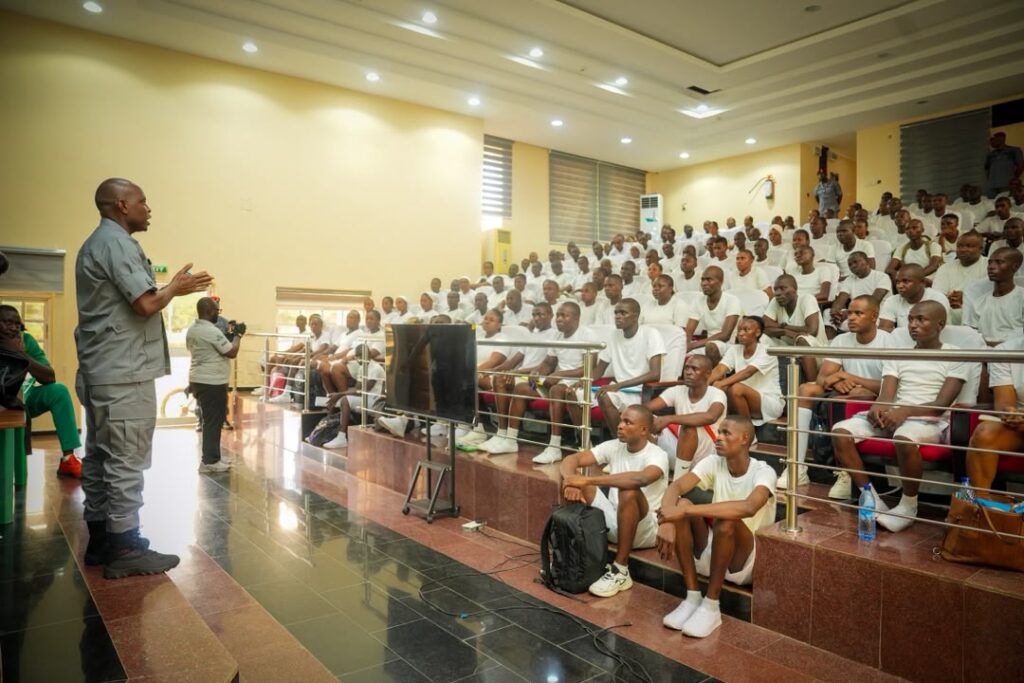
Candidates shortlisted for the Assistant Superintendent of Customs II (ASCII), Inspectorate and Customs Assistant cadres underwent documentation, physical fitness assessments and medical screening as part of the final stages of the recruitment process.
The exercise was conducted in batches, a measure introduced by the Service to reduce congestion and ensure smoother movement of candidates through the various screening points.
Speaking on the exercise, the Assistant Comptroller-General of Customs in charge of Human Resource Development, Frank Onyeka, said the Service had addressed challenges identified during the earlier phase of the recruitment process.
According to him, measures were introduced to improve coordination and reduce congestion at the screening centres.
“We have put measures in place to reduce congestion and ensure a smoother process this week. The gaps identified last week have been addressed, and we do not expect them to recur this week,” Onyeka said.
He urged candidates to remain disciplined and comply with the procedures established for the exercise.
The Service also introduced personalised screening forms as part of efforts to strengthen verification and minimise discrepancies in candidates’ records.
The Deputy Comptroller of Customs and member of the recruitment coordinating team, Adamu Musa, said each shortlisted candidate was provided with a form containing personal information and details required for the various stages of the screening.
He said the approach represented a departure from the previous system in which candidates received forms at the screening venue.
“Any candidate that has been shortlisted has a form designed especially for him, unlike in the past where you come, they issue you a form, and then some people along the way go and even change some of the records,” Musa explained.
According to him, the forms contained candidates’ names and other details covering sports, medical assessment, documentation and related requirements.
“So, once the candidate comes, you just verify what you already have from the system,” he added.
Musa said the new arrangement had made it easier for officials to authenticate candidates’ information while reducing opportunities for alterations and discrepancies.
The recruitment team also assessed candidates against established requirements, including age, physical fitness and drug screening.
Musa disclosed that candidates who test positive for hard drugs, exceed the stipulated age requirement or are found to have physical conditions that could affect their ability to perform their duties may be disqualified, subject to the final decision of the Service’s management.
He also stressed the importance of continuous recruitment and manpower development, noting that the expanding responsibilities of the Customs Service require personnel capable of responding to emerging challenges.
According to him, a well-trained workforce remains important to the Service’s responsibilities in national security, border protection, revenue collection and trade facilitation.
The Service also warned candidates and members of the public against relying on unverified information about the recruitment exercise.
Musa urged applicants to obtain recruitment updates only through the official communication channels of the Nigeria Customs Service, including its official website and verified social media platforms.
He warned that fraudsters could exploit the recruitment process by circulating fake announcements, misleading applicants or making unauthorised demands.
The warning comes as the Service moves towards the next stages of the recruitment process following the completion of the final screening exercise.
With the introduction of personalised forms, batch screening and tighter verification procedures, the NCS said it had strengthened the process to improve efficiency, reduce congestion and protect the integrity of the recruitment exercise.

Post Recapitulation: NAICOM Holds First Quarterly Staff Meeting
By Tony Obiechina, Abuja
The Commissioner for Insurance, Olusegun Ayo Omosehin, at the weekend presided over the Quarterly Staff General Meeting of the National Insurance Commission (NAICOM), the first such gathering since the successful conclusion of the insurance industry’s recapitalization exercise.
The meeting brought together management and staff to review the achievements recorded during the recapitalization programme and to align on the Commission’s strategic direction for the period ahead.
Participants also used the occasion to discuss issues bordering on staff welfare, institutional effectiveness, and the overall growth of the organization.
In their deliberations, the Commission reaffirmed its commitment to stronger regulation and supervision of the insurance sector, continuous capacity building for staff, and sustained operational excellence.
NAICOM said in a statement on Saturday that the resolutions reached at the meeting would help drive the emergence of a more resilient, competitive, and trusted insurance industry in the country.
By Prince Charles Dickson
Two of my dogs fought with a bitterness I had never seen. The older one carried himself as though the title deed to the yard was hidden beneath his paws. He knew every corner and had always enjoyed the younger dog’s deference.
Then a female dog entered the equation, and instinct overruled history.This was no ceremonial barking for the neighbours.
Teeth found flesh; dust rose. Each separation merely postponed the next assault. By the fourth day, the older dog was badly injured and close to death. The younger stood over him like a claimant who had discovered that age was not invincibility, then walked away as though succession had been settled.Then came the detail that changed the story: the younger dog was the older dog’s son. Once, he would not have imagined confronting his father, much less doing so with such confidence.
Nigeria is now standing inside that compound.
The female dog in this metaphor is not womanhood; she is politics and governance; the Nigerian state: desired, possessed, fought over, but rarely nurtured. The older dog represents a political breed that mistakes long residence for permanent ownership. The younger dog is the coming generation: impatient, digitally armed and unconvinced that fatherhood confers an eternal right to the yard. This is a warning, not a prescription; but when an old order refuses an orderly handover, succession often arrives with teeth.
My friend, Professor Chris Kwaja, recently put his finger on this future. Nigeria’s Gen Z—usually defined as those born between 1997 and 2012—is not a demographic footnote but a nation within the nation. Estimates vary by dataset, but we are speaking of tens of millions in a country whose 2025 population the United Nations Population Fund placed at 237.5 million. The arithmetic is patient but merciless.
The minimum constitutional age for the presidency is 35. The cohort’s oldest members are 29 in 2026; by 2035, they will be 38 and eligible. A Gen Z Nigerian may not become President that year, but one will eventually sit in Aso Rock. The question is: what kind of President will Nigeria produce?
This generation carries Nigeria in its pocket. It learns across borders, earns across currencies, compares governments in real time and records brutality before authority can issue a denial. It has far more in its locker than caricature admits—intellect, guts, innovation and creative audacity—and does not wait for the emir, bishop, party chairman or television editor to grant permission to speak.
The 2020 #EndSARS uprising showed the possibilities. Young Nigerians mobilised crowds, raised funds, coordinated welfare and legal aid, and seized narrative power from old gatekeepers. Yet assessments of its successes and limitations suggest that leaderlessness was both armour and ceiling: it resisted co-option but complicated negotiation and continuity. A hashtag can open a gate; it cannot write a budget. Virality is not organisation, followers are not delegates, and power does not resign because a meme embarrassed it.
This is where the current argument about an “Olodo uprising” requires more light than heat. Olodo, in popular Yoruba usage, is the dunce. The phrase captures anxiety that digital Nigeria rewards noise above knowledge, spectacle above substance and confidence above competence. The anxiety is not foolish. When a teacher cannot pay rent while profitable nonsense buys another SUV, society has published a curriculum without calling it one. If ignorance attracts money and fame while learning attracts unemployment, why feign surprise at the lesson being learnt?
But using the most visible absurdities online to define a generation is a false dawn of analysis. A ring light is not a census instrument. The algorithm magnifies whatever arrests attention; it does not mirror a generation’s mind. Five viral jesters can obscure thousands of young Nigerians writing code, building payment systems, creating films, conducting research, farming with data and solving problems the state has abandoned.
The “Olodo uprising” is not an age group; it is an incentive system with grey-haired patrons, corporate sponsors, educated audiences and institutions that have spent decades humiliating learning. Before TikTok, public officers commissioned uncompleted projects with brass bands and long grammar. The young did not invent anti-intellectualism; they merely gave some of it better lighting and faster internet.
The Yoruba say, Àgbà kì í wà lọ́jà, kí orí ọmọ tuntun wọ́—an elder cannot be in the marketplace while a newborn’s head remains crooked. If society’s head is bent, elders cannot shout “Olodo!” like innocent passers-by. Another warning says, Ọmọ tí a kò kọ́ ni yóò gbé ilé tí a kọ́ tà—the child we fail to build will sell the house we built. Nigeria erected monuments while neglecting schools, values, civic capacity and hope. Now it fears the auctioneer it raised.
Still, Gen Z must not mistake demographic power for moral superiority. Youth is not an ideology. A young thief remains a thief, even in livestreamed 4K. Nigeria can replace grey hair without replacing grey habits. Ethnic merchants will open TikTok shops; godfathers will recruit digital godsons. A Gen Z President could be innovative and accountable—or an old politician in sneakers, fluent in emojis and authoritarianism.
To reset Nigeria, this generation must convert attention into organisation, outrage into policy, and population into electoral power. It must enter wards, parties, councils, unions and communities; it must learn budgets, federalism, security, history and compromise. The Igbo say, Nwata kwọcha aka, ọ soro ndị okenye rie nri—when a child washes his hands, he may eat with the elders. Yet the elders must stop moving the table behind nomination fees, rigged primaries and patronage.
Nor are young Nigerians as post-ethnic or post-religious as romantic commentary suggests. They are less deferential, but algorithms manufacture digital tribes efficiently. The phone that exposes corruption can distribute a lie; the platform that mobilises justice can organise a mob. Digital nativity is power, not wisdom. Innovation without ethics can merely optimise corruption.
The Hausa offer an audacious proverb, Kowa ya raina tsayuwar wata, ya hau ya gyara—whoever dislikes the moon’s position should climb and straighten it. Gen Z has long mocked Nigeria’s crooked moon. Soon, it must climb. Then it will discover that the presidency is not a content house, the budget is not a caption and insecurity cannot be defeated with a clapback. Its President must govern X Spaces and village squares, data dashboards and dusty farm paths, including millions the algorithm never sees.
Meanwhile, the remaining Mohicans of the old political order are transitioning, one after another, from centre stage into memoir, memory and history. Their wisest choice is to build bridges, not barricades; to mentor without annexing; to surrender space without demanding that the future first kneel. As the Igbo say, Egbe bere, ugo bere—let the kite perch and let the eagle perch. Generational renewal need not be warfare, but coexistence becomes impossible when one bird claims the whole tree.
The older dog in my compound survived, but survival humbled him. The younger dog also learnt that victory can leave blood on everybody. The object of their contest simply moved on, indifferent to their wounds. Nigeria must not become that bleeding compound.
A Gen Z will soon be President of Nigeria. That is not prophecy; it is arithmetic. Whether that presidency becomes renewal or merely youthful packaging for an ancient failure depends on what we teach, reward and build now. The younger Turks are already inside the compound. The old breed should hear their footsteps—not with panic, but with the wisdom to prepare a handover before succession again arrives with teeth.
May Nigeria win.




Police Detain Woman for Alleged Killing of Co-wife in Bauchi
ShareThe police command in Bauchi State, said it has apprehended a housewife over alleged killing of her co-wife following a...

FRSC Deploys 170 Ambulances Nationwide for Emergency Rescue
ShareThe Federal Road Safety Corps (FRSC) has deployed more than 170 ambulances across the country as part of efforts to...


NBA Decries Rising Insecurity in Plateau, Urges Urgent Action
ShareThe Nigerian Bar Association (NBA) has decried the spate of security challenges currently confronting Plateau and other parts of Nigeria....

Benue Begins Compilation of Out-of-school Children
ShareThe Benue Government has begun compilation of out-of-school children as part of efforts to improve child protection and access to...

NAPTIP Uncovers Suspected Baby Trafficking Ring in C’River
ShareThe National Agency for the Prohibition of Trafficking in Persons (NAPTIP) has uncovered an alleged child trafficking operation involving newborn...


Kaduna Pensioners Applaud Uba Sani over N3.65bn Gratuity, Death Benefits
ShareThe Kaduna State Chapter of the Nigeria Union of Pensioners (NUP) has commended Gov. Uba Sani for approving N3.65 billion...

FG Calls for Urgent Action to Protect Nigeria’s Rivers
ShareThe Federal Government has called for integrated management of Nigeria’s rivers, forests, wetlands and watersheds to safeguard water resources, public...
FCCPC Calls for Improved Capacity Building on Competition Reporting, Matters
ShareThe Federal Competition and Consumer Protection Commission (FCCPC) says there is a need for sustained capacity building in competition reporting...

Fire Guts Customs Western Marine Command Office in Lagos
ShareFire gutted the Nigeria Customs Service (NCS) Western Marine Command office in Apapa, Lagos, on Monday, destroying property worth millions...


Fuel Price Hike Reduces Sales, Increases Cost of Doing Business — Traders
ShareSome traders in the Federal Capital Territory (FCT) have expressed concern over the impact of the recent fuel price increase...