
NEWS
Enugu Transport Ministry Bans Traffic Task Force Operations on Federal Highways

From Sylvia Udegbunam, Enugu
The Enugu State Ministry of Transport has banned all traffic task force operations on federal highways across the Enugu metropolis with immediate effect as part of efforts to curb the activities of fake enforcement officials accused of extorting motorists.
The directive was contained in a statement issued on Monday by the Commander of the Enugu State Traffic Management Authority (ESTMA), Kenneth Aniebonam Ugwu.
According to the statement, the ministry took the decision following reports that impostors posing as officials of the Ministry of Transport had been operating on federal highways, harassing and extorting motorists, thereby tarnishing the image of the ministry.
To address the situation, the ministry said it has constituted a special team to identify and apprehend those behind the illegal operations.
The statement disclosed that some suspected fake task force operatives were recently arrested while allegedly extorting motorists in different parts of the Enugu metropolis. It added that the suspects are currently undergoing interrogation and would be prosecuted in accordance with the law.
The ministry urged members of the public and motorists to promptly report any genuine complaint or encounter with suspected fake task force officials to the Office of the ESTMA Commander through 08102382688 for immediate intervention.
It warned that anyone found harassing or extorting motorists under the guise of traffic enforcement would be arrested and made to face the full weight of the law.

By Chinedu Moghalu
Elon Musk has a gift for reducing significant anxiety to a sentence. “Nigeria alone had 4 million more births than the entire EU last year!” he recently wrote on X.
The statistic admits two readings.
In an ageing Europe, it sounds like a warning. In an Africa commonly described through poverty and scarcity, it can be received as evidence of future power. Neither reading goes far enough.For much of the modern development debate, African population growth has been viewed through a Malthusian lens: more people competing for limited food, employment and public services.
Musk begins from the opposite fear, as he has consistently canvassed, that falling fertility will leave societies without enough people to renew themselves. Nigeria’s birth figures bring both anxieties into the same argument.Eurostat recorded 3.55 million births in the European Union in 2024, when fertility fell to 1.34 children per woman, the lowest in the present series. The EU’s median age had reached 44.9 years by the beginning of 2025. Nigeria’s population structure is markedly younger.
By 2050, Africa is expected to have about 2.5 billion people, close to one-quarter of humanity. Under the medium projection in the United Nations’ World Population Prospects 2024, Nigeria will approach 360 million. The infants represented in Musk’s post will then be young adults. Their health, education and prospects will already have been largely determined.
Musk’s argument therefore reaches beyond fertility. If human numbers matter to civilisation, Africa’s children cannot sensibly be regarded mainly as future customers, data producers or migrant labour. The companies and governments expecting to benefit from Africa’s demographic scale have a direct interest in the health, education, research capacity and productive systems that will shape it.
Potential Is Not A Dividend
A high birth rate alone does not amount to a demographic dividend. Rapid growth can increase the dependent population faster than schools, clinics, housing, sanitation and employment can expand. A dividend becomes possible when children survive, families become smaller by informed and voluntary choice, women gain greater agency, and the working-age share of the population rises. Employment and productivity must grow with it.
In a published essay, Muhammad Ali Pate, Nigeria’s Coordinating Minister of Health and Social Welfare, makes the essential distinction: a large population creates possibilities, not prosperity. He calls the health, nutrition, learning and skills built over a lifetime “grey matter infrastructure.” Human capability determines how well a society uses every other form of capital.
A child born today is not yet an engineer, farmer, physician, teacher or entrepreneur. Between infancy and adult life lie years of exposure to nutrition, disease, insecurity, family income, teaching quality and public institutions. Childhood stunting can impair cognitive development. Weak foundational learning makes later education harder. Certification without competence narrows the range of useful work.
Nigeria’s human capital deficit gives the argument urgency. In the World Bank’s 2025 Human Capital Index Plus, the country scores 64 on education, compared with a median of 88 among lower middle-income countries. Nigeria also faces maternal and child mortality, malnutrition, exclusion from school, and learning poverty. National averages conceal wide regional, rural-urban and income differences. Unequal welfare today becomes unequal productive capacity tomorrow.
Women cannot be treated as instruments in a contest over fertility. A sound demographic transition depends upon girls remaining in school, women surviving childbirth, access to reproductive healthcare, and families having the freedom to decide their size. African governments should resist Western alarm that presents African births as a threat, and African boasting that neglects the women who bear and raise the children.
Human Capital and Mobility
Population acquires economic weight when capability meets opportunity. Health and education cannot carry the burden alone. Power, transport, finance, industry and trade must support firms able to employ skilled people. Otherwise, Africa may educate workers for richer economies, while remaining short of the professionals it trained.
Europe’s ageing creates an awkward dependence. Its health services, care systems, engineering firms and technology companies need workers, while migration has become one of its most divisive political questions. Africa, for its part, may spend scarce public and family resources training professionals who leave because the economies that educated them cannot offer work equal to their abilities. The issue concerns where skills are formed, where productive opportunity is located, and which societies receive the return on investment in human capability.
Workers must remain free to leave. Mobility should be organised more fairly. Nigeria’s National Policy on Health Workforce Migration and World Health Organization guidance point towards ethical recruitment, circular pathways and co-investment by destination countries in the systems from which they recruit.
Where a richer country repeatedly draws from a fragile health service, it should help to enlarge the training pipeline. That is the defensible meaning of a human capital royalty: the worker remains free, while the systems that produce scarce capability share the cost more fairly. Joint training institutions, faculty support, better laboratories and recognised qualifications can strengthen source and destination systems alike.
Human capital is also a matter of sovereignty. A continent that exports raw materials, data and trained labour, while importing the most valuable products of knowledge will remain dependent, however large its population becomes.
A Continental Bargain
The African Union’s demographic dividend roadmap joins four areas too often separated in national policy: employment and entrepreneurship; education and skills; health and wellbeing; and rights, governance and youth empowerment. Skills have little value without work; growth remains fragile where health and rights are weak.
At the African Development Bank, President Sidi Ould Tah’s Four Cardinal Points place demography within a wider economic programme: Unlock Africa’s Capital; Rebuild Africa’s Financial Sovereignty; Turn Demographics into Dividends; and Build Resilient Infrastructure and Competitive Value Chains. African savings and institutional funds must finance productive investment. Infrastructure must support industry, and industry must create work on a scale equal to the continent’s growing labour force.
The African Continental Free Trade Area belongs in the same argument. Fragmented national markets limit the scale of firms and weaken bargaining power. A connected market approaching 2.5 billion people could support regional value chains, larger investments, and more specialised production.
Global technology companies already see Africa as a major market for connectivity, artificial intelligence, finance and energy. African governments should negotiate from the same fact. Foreign capital and technology remain necessary, but their terms should leave more knowledge, production and ownership within Africa. Market access and public procurement can support local suppliers, research, technical training, data infrastructure and domestic manufacturing.
The Test of Delivery
Continental plans cannot teach a child to read, keep a mother alive in childbirth or provide electricity to a small manufacturer. Delivery remains national and local. In Nigeria, primary healthcare, basic education, nutrition, water, sanitation, and economic opportunity depend as much upon states and local governments, as upon Abuja.
Institutions should be judged by results: mothers who survive, children who are nourished and learning, young people with useful skills, and firms able to employ them. Budgets are demographic documents. They reveal what governments are prepared to invest in citizens who cannot yet vote and whose adult lives will begin after many present office-holders have left public service.
Musk’s comparison does not settle a contest of fertility. Europe is wealthier, more productive and better equipped to turn individual ability into economic value. Nigeria and Africa have time, youth and scale. Whether these become power will depend on decisions now being made in homes, clinics, classrooms, workplaces and public institutions.
The figure that should concern Nigeria is how many of its children will reach adulthood healthy, educated, skilled and able to find dignified work.
By 2050, numbers will have altered the world’s demographic balance. Power will depend on what societies have made of those numbers.
Elon Musk has counted Nigeria’s births. History will count what Nigeria did with them.
Chinedu Moghalu is a lawyer, strategic communications expert, and public policy adviser with over two decades of leadership across government, international organisations, and development institutions. Currently, senior special adviser to Nigeria’s coordinating minister of health and social welfare.
By Chidi Amuta
Nelson Mandela must be churning in his resting place. An exemplary life lived and a myth created on a dream and a vision is now literally reduced to ashes. The rainbow nation with prosperity for all races as a vision has been badly damaged.
Its previously thriving post-apartheid economy is now literally in coma with frequent power outages, labour unrest and the return of racial divide and violence. Irate mobsare back on the prowl.Donald Trump, America’s rascally President has frequently cited the return of racial violence to South Africa to buttress his mostly unfounded charges of discrimination against whites in South Africa.
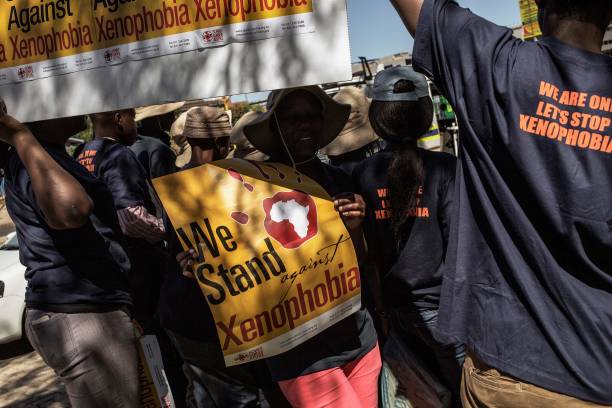
More directly relevant, South Africa has in recent months witnessed a wave of xenophobic mob protests and attacks against other Africans who have since come to settle and regard South Africa as home. Hundreds of thousands of these Africans have been chased out of South Africa by angry mobs of black
South Africans were. Ostensibly, these mob attacks are motivated by immigration concerns. It is a strange state that resorts to mob violence to enforce immigration restrictions.
Of specific relevance to us is the series of violence and crude treatment that has been meted out against Nigerians as a select group. Hundreds of thousands of Nigerians settled in South Africa for decades have been hounded from their homes and businesses. Property acquired over the years have been dispossessed. Businesses that have for long been thriving and providing employment and livelihood to South Africans have been torched and sacked suddenly. Admittedly, efforts by Nigerian authorities to evacuate these unfortunate Nigerians has been less than impressive if not outrightly incompetent.
This dastardly treatment of fellow Africans by South African mobs with the tacit and obvious collusion of the government in Pretoria is, in every way, a subversion of the history of the country. Africa sacrificed to end Apartheid in South Africa. For decades, how to end apartheid was the cardinal foreign policy thrust of most African countries. Countries with the resources even located far away like Nigeria were branded “front line states” in the battle against the last vestiges of apartheid.
It is in this spirit of continental solidarity that many Africans migrated to the newly independent and democratic South Africa. The rainbow nation welcomed all and sundry as it freed its economy from the stranglehold of apartheid and white domination of the economy. The sacrifice of fellow Africans was never lost on successive regimes in South Africa. Mandela upheld it. Mbeki kept faith. So did Motlanthe and Jacob Zuma before the present unravelling under Cyril Ramaphosa.
Nigerians in SA- traders, property owners, small to medium
For Nigeria, the recent treatment of Nigerian citizens in South Africa does not show sufficient appreciation of the country’s contribution to South Africa’s democracy and freedom.
Nigerian owned businesses have been shut down and looted by irate mobs, people who have for decades made South Africa their home have been forcefully evicted from their homes, assaulted, visited with violence and rendered homeless and hopeless. And to observe the cavalier attitude of the South African government over these months is even more disheartening. Calls for more compassionate treatment and minimal compensation have fallen on deaf ears.
The jobs lost, the businesses closed, the opportunities shut and the services lost will invariably lead to a hemorrhage of the South African economy. There is hardly any evidence that the local South African black population understand the long term damage they have done to their economy. It is doubtful that they have the entrepreneurial capacity and energy of the Nigerians and other Africans they have rudely hounded out. In the months and years ahead, the South African economy is likely to tank and shrink, further worsening the plight of the national economy.
The recent xenophobic assault on Nigerians in South Africa has led to calls for retaliatory measures by Nigerian authorities. Such calls may not fully understand the differential nature of the presence of Nigerians in South Africa or vice versa. Nigerians were mostly in ‘’South Africa as small to medium scale business operators- car dealers, restaurant owners, shop owners and general traders. An anti-immigrant assault on them was bound to root them out in huge numbers without huge consequences for the Nigerian economy.
On the contrary, South Africa is present in Nigeria mostly in the form of huge corporations like telecommunications, banks, entertainment networks and supermarket chains, often employing hundreds of thousands of Nigerians and rendering very strategic services across the Nigerian stretch. More importantly, the South African multinationals operating in Nigeria make very huge tax payments to the Nigerian government, making their presence crucial to the Nigerian economy which is still in dire need of foreign direct investment. Prominent South African players in the Nigerian market include Shoprite, MTN, Stanbic/IBTC, DSTV etc.
Nigeria cannot afford to hound out and expel these huge South African companies from Nigeria without dire consequences for our economy and people. Many jobs will be lost. Tax revenue will be lost. Strategic entertainment and financial services will be disrupted.
However, the command and control of South African businesses in Nigeria can be partially decapitated. Nigeria can limit the number of senior South African managers that these companies send to manage their affairs in Nigeria. This may not amount to outright nationalization but a considerable loss of control by South Africa.
Towards a resolution of the relationship hiatus between the two countries, diplomacy could play a role. But one- sided adversity does not help diplomatic exchange. The South African economy is now creaky and troubled. Nigeria is also in bad form as well. Economic adversity has led to popular disquiet and political uncertainty.
But we are in a new world ruled by the selfishness of nations fueled by migration pressures and anti -immigration violence.
The pull of African brotherhood is strained by the pressure of national survival. Isolationism. Has suddenly become an attractive option for nations under the pressure of migrant invasion. Mob rule has overwhelmed rational governance and the muscle of parties in power. Under these forces, the strength of governments has withered considerably.
The apparent face -off between Nigeria and South Africa calls for a different type of diplomacy. The imperative is for retributive economic diplomacy, diplomacy guided by the national economic interest and the welfare of our citizens wherever they may be on earth. The protection of our citizens as carriers of our economic interests has become paramount. Our over $25 billion annual home remittances from the Nigerian diaspora boils down to our people working and doing business around the world and sending money home for welfare and development.
It does not look like the current Nigerian has thought deeply about the options open to Nigeria in relation with South Africa in the aftermath of this xenophobia outrage.
By Akin Fadeyi
A man got tired of his wife’s alleged belligerent behaviour. She was never “available” and whenever she chose to be, she was always passive. Her love was dramatised for optics and her joy was influenced by incentives.
The man got tired and after a while took another wife, and handed some of his income management to the new lady. After about a year, they thought of moving from their four-bed bungalow to a more spacious terrace apartment. They moved. Three years later, the man discovered that he had been paying yearly rent on the terrace apartment to a caretaker who always handed the rent back to his new wife. Right under Maigida’s nose, his wife stole his money, built a house, rented it to him and was collecting rent on it. What do we call this? Domestic heist!Imagine waking up one morning to discover that for years, someone had allegedly been operating a government agency that never existed. Not a tiny neighbourhood association. Not a fictitious NGO. Not a WhatsApp investment platform. A “government agency.” He allegedly had a title, an office, documents, correspondence, and held meetings. He was recognised. He operated 34 bank accounts. Then, one day, the illusion collapsed. A “whistleblower” blew the cover, and the mask came off. And almost instantly, social media delivered its own verdict. “The government must have known. They’re all in on it together.” “Oh, this is Nigeria, anything can happen!”
Within hours, the incident had become less about the alleged fraud and more about a political blame game. Make no mistake, that reaction is understandable and very realistic. This is how our citizens and their overall appraisal of stewardship has been polarised for a while. As we keep placing premium attention on political alignments as our central identity, this defines our focus, ignites our outrage and makes governance-driven civil discourse almost impossible. Whenever public institutions appear vulnerable to abuse, accusations and counter accusations will fill the air. But there is another question we seldom ask. A far more uncomfortable one. What if this story is not just about the government? What if it is also about us? Because before we conclude that an institution must have been complicit simply because it was deceived, history invites us to pause.
Some of the world’s most sophisticated frauds unfolded not in fragile democracies but in countries renowned for strong institutions. On 11 December, 2008, the world woke up to a shocking revelation: that for years in the United States, a man named Bernard Madoff operated what became one of the largest investment frauds in history, orchestrating an estimated $65 billion Ponzi scheme scheme that cost investors tens of billions of dollars over two decades. Prince Adeniyi’s alleged heist is the “Presidential Advisory Council”. Bernard Madoff operated the “Investment Advisory Business,” which lured thousands of investors, fabricating account statements, inflating returns and fooling investors with a deceptive high-yield trading strategy.
Madoff’s closest government ties were in the Security and Exchange Commission. He was said to have “cultivated a close, personal relationship with regulators who were responsible for overseeing and regulating his firm.” Banks interacted with him. Professionals dealt with him. Regulators received warnings. Many intelligent people believed him. When everything collapsed, the public outrage was immediate: “Where was the regulator?” “How could nobody know this Madoff was a fraud?!”
On 10 November, 2021, the same questions echoed across the United Kingdom after the Arena Television financing fraud, in which lenders reportedly advanced about £280 million against television equipment that investigators later alleged either did not exist or had been pledged multiple times. In December 2019, an investment firm named Muddy Waters published a report accusing NMC Health of inflating its cash balances and understating its debt. This signalled the collapse of NMC Health, once listed on the London Stock Exchange. Billions of dollars in undisclosed debt and financial irregularities stunned investors and regulators alike. Different countries. Different governments. Different political parties. The same uncomfortable questions.
The lesson is not that oversight failures should be excused. Far from it. It is that sophisticated fraud is not uniquely Nigerian. When systems fail, institutions deserve scrutiny. But scrutiny should not automatically become a conspiracy. There is a difference. The reported allegations surrounding the so-called Presidential Foreign Intervention Promotion Council expose weaknesses that deserve critical interrogation. If someone could allegedly present himself as the Director-General of an entity that was not lawfully constituted, then our verification processes, inter-agency coordination, documentation culture and internal controls clearly require strengthening. Those are legitimate concerns. But who builds institutions? Every institution is ultimately a collection of human beings. The accountant who approves. The administrative officer who files. The procurement officer who signs. The banker who sees but covers unusual transactions. The consultant who looks away. The civil servant who decides that “it is not my business.” Systems do not collapse by themselves. They weaken, one compromise at a time.
Corruption is a scourge planted, cultivated and harvested by the human mind. Government, therefore, merely reflects society. Our national weaknesses did not begin inside public buildings. They began wherever integrity surrendered to convenience. Which brings me to another uncomfortable truth. Some professionals have unfortunately helped create escape routes for financial criminals. This is particularly troubling where legal expertise is used not to defend constitutional rights, but to create elaborate structures that conceal beneficial ownership, frustrate accountability, delay justice, or sanitise the proceeds of wrongdoing.
To be clear, the overwhelming majority of our lawyers serve society honourably and our legal profession remains indispensable to democracy and the rule of law. But where a minority knowingly enables financial crime, the line between professional representation and profiteering becomes dangerously blurred, and when patriotism loses to profit, the nation pays the price. The same can be said of accountants who manipulate records. Governors who divert federal allocations; contractors who are channels of fraudulent deals; and citizens who celebrate ill-gotten wealth, while mocking honest labour. That is why strengthening accountability must involve more than changing laws. It requires changing culture.
Encouragingly, Nigeria has been investing in digital reforms intended to strengthen identity verification, public administration and service delivery. Initiatives around the National Identity Management system and broader digital integration hold real promise for reducing impersonation, improving authentication, and making certain categories of fraud more difficult to execute. Technology, however, is not a magic wand. Till date, London has not eliminated fraud. New York has not eliminated scheming, and Singapore still prosecutes financial crime. Digital systems, therefore, may stifle pilfering tempting opportunities. They do not eliminate human greed.
This is precisely why continued investment in technology should be encouraged, refined and improved — not dismissed because crime still exists. Progress should never become the enemy of perfection. If technology can close even some of our leakages, protect public records, improve verification, and strengthen transparency, then it deserves support, while we continue demanding accountability from those entrusted with public office.
There is another habit we must abandon as citizens: Before investigations mature, before facts emerge, before institutions complete their work, many of us instinctively ask only one question: “How can this damage my political opponent?“ That instinct is costing us dearly. Every major scandal should not become immediate political ammunition, because crime has no political colour and fraud does not have a party loyalty. Criminality is born in the human mind.
When we reduce every wrongdoing to partisan warfare, we stop searching for solutions and start searching only for opportunities to score political points. That serves nobody. Patriotism demands something better. We should condemn wrongdoing — firmly and without hesitation. But we should resist the temptation to weaponise every crime against political opponents before the facts are known. A nation cannot heal if every scandal becomes a campaign poster. Neither should we pretend that the people committing these crimes fell from another planet. Those arrested for internet fraud; those involved in property scams; those selling one plot of land to multiple buyers; those prosecuted for banking fraud; those forging documents; those laundering the proceeds of crime; those manipulating procurements; landlords and House Agents extorting tenants. They are not strangers. They are products of the same society we all helped to shape.
Perhaps the most patriotic response is neither blind defence nor relentless condemnation. It should be honest introspection. It is insisting on stronger institutions, while also raising stronger citizens. It is applauding integrity wherever it appears. It is refusing to celebrate fraudsters because they are wealthy. It is refusing to amplify every damaging story about Nigeria with a sense of triumph, as though the nation’s embarrassment validates our personal opinions. Sadism is not victory and a mature nation confronts its failures without becoming addicted to them.
If this latest episode teaches us anything, it should be this: Oversight matters. Professional ethics matter. Institutional reform matters. But above all, when we cannot have conversations that strengthen democracy, critical matters of national importance get drowned by partisan noise. Ultimately, the real contest is not between government supporters and opposition supporters. It is between institutional strength and institutional weakness.
Governments will come and go. Political parties will rise and fall. Public officials will retire. But the institutions we build today will determine whether future generations inherit a nation in which public trust is earned through competence, accountability and integrity — or one in which every scandal becomes another chapter in an endless cycle of blame. It is one conviction per person that builds a nation. This is why our character matters, because it takes a strong, constructive, and intentional characteristic to look at the indulgences that tempt us and still muster the morality to look away. The fight against corruption should begin long before a courtroom. It begins from the man you see when you hold up the mirror!
Akin Fadeyi, a citizens engagement and behavioural change expert, is the founder and executive director of the Akin Fadeyi Foundation.




Why Nigeria’s Births should not Worry Elon Musk
ShareBy Chinedu Moghalu Elon Musk has a gift for reducing significant anxiety to a sentence. “Nigeria alone had 4 million...

Neutralizing South Africa’s Xenophobic Excesses
ShareBy Chidi Amuta Nelson Mandela must be churning in his resting place. An exemplary life lived and a myth created...
Enugu Joint Security Operatives Rescue Abduction Victim
ShareFrom Sylvia Udegbunam, Enugu A joint security team comprising Police operatives, Forest Guards, and members of the Neighbourhood Watch Group...


Police Uncovers Two Illegal Arms Factories in Benue
ShareFrom Attah Ede, Makurdi Police in Benue State uncovered and destroyed two illegal firearm manufacturing factories, recovered three AK-47 rifles...


Troops Foil Bandits’ Attack, Rescue Nine Kidnap Victims in Zamfara
ShareFrom Ifeanyichukwu Nwannah, Gusau Troops of Sector 2, Operation FANSAN YAMMA, deployed at the Forward Operating Base (FOB) in Kasuwan...
The Fake DG Saga Holds a Mirror to All of Us
ShareBy Akin Fadeyi A man got tired of his wife’s alleged belligerent behaviour. She was never “available” and whenever she...


OPay is Okay: Trust Is Not Claimed – It Is Earned
ShareFor tens of millions of people across Nigeria, digital finance has changed everyday life. Paying bills, sending money, saving, and...


Wike Directs Immediate Demolition of Suspected Criminal Hideout in Abuja
ShareBy Laide Akinboade Abuja Minister of the Federal Capital Territory (FCT), Nyesom Wike has directed the immediate demolition of an...
Osun Guber Poll: Group Nominates Ex-Reps, Cletus Obun, 12 Others for Solidarity, APC Victory
ShareFrom Mike Tayese, Yenagoa A pro-APC group known as G.37 has nominated a former member of the Federal House of...
Nigerians Import $602m US Vehicles in Five Months
ShareNigeria imported motor vehicles and automotive parts worth $602m from the United States between January and May 2026, marking a...