
Science & Tech
Environmental preservation: Expert advocates adoption of RBCs for car production

Dr Abubakar Kazeem, Head, Department of Science Policy and Innovation Studies, National Centre for Technology Management (NACETEM),has advocated adoption of recycling beverage cans(RBCs) in car production for environmental preservation and sustainability.
Kazeem gave the advice in an interview with the News Agency of Nigeria (NAN) in Abuja on Tuesday.
He noted that in today’s global economy, sustainability was a major concern for industries and that Nigeria’s automobile companies should seek ways to contribute to environmental preservation and reduction in air pollution.
Kazeem, also NACETEM’s Assistant Director of Research and Adjunct lecturer at the Department of Mechanical Engineering, University of Abuja, insisted that adoption of RBCs for car production was the way to go.
According to him, this can be done by exploring the use of RBCs for manufacturing critical components like inlet manifolds.
“Recycling aluminum cans not only help conserve natural resources but also saves manufacturing energy, making it an eco-friendly choice.
“Therefore, by embracing aluminum can recycling, Nigeria’s automobile industry can play a vital role in sustainable practices and contribute to a greener future,’’ he said.
He said global perspectives on car manufacturing showed a growing trend towards sustainability, which Nigeria’s automobile companies should captitalise on.
“This shift towards recycled materials can enhance financial stability, as research indicates that it is cost-effective compared to traditional raw materials
“Moreover, recycling aluminum cans offers significant environmental benefits, reduces harmful impacts and lower carbon emissions, this proactive step aligns with global efforts to combat climate change, ” he said.
The director also noted that in order to align with global climate ambitions and foster sustainable practices, “our automobile industry should be encouraged to take proactive steps towards a greener future.”
He also tasked the industry to focus on exploring various avenues that would reduce environmental impact while contributing to the nation’s energy transition plan.
“The good news is that strategic partnerships between the public and private sectors is being forged to secure funding for the energy transition, ensuring a smooth and efficient shift towards greener alternatives.
“With Nigeria’s firm focus on sustainability and decarbonisation, the automobile industry’s efforts are poised to shape the country’s long-term economic outlook and making a positive impact on global drive towards a more sustainable future.
“The fabrication of relevant components like the inlet manifold, water pumps, wheels and fan belt adjusters of a car are option to explore by the Nigerian automobile industry,’’ Kazeem said.
He expressed optimism that amidst vibrant progress, a visionary spark that ignites Nigeria’s auto industry was key to weaving an enchanting transformation with recycled materials.
Kazeem said, “In this symphony of hope, is how Nigeria’s auto industry will find its voice, singing an ode to sustainability, renewal, and innovation’s resolute spirit.”
“The cadence of progress entwines with recycled materials, the automotive landscape transformed into a tapestry of conscious choices and harmonious strides,’’ Kazeem said. (NAN)













From Mike Tayese, Yenagoa
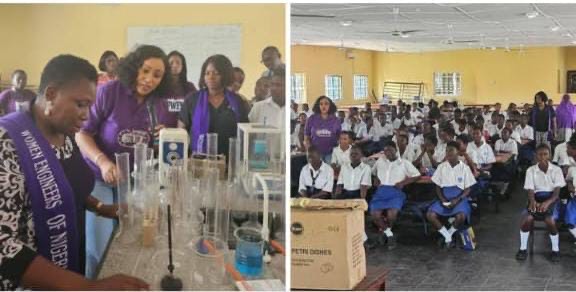
The Association of Professional Women Engineers of Nigeria (APWEN) Bayelsa Chapter led by their Chairman, Engr. Dr. Amalate Ann-Jonathan Obuebite FNSE, visited St. Judes Girls Secondary School, Yenagoa in commemoration of the 2026 International Day of Women and Girls in Science, donates laboratory equipment.
The donation, which includes pH meters, weighing scales, measuring cylinders, viscometers, volumetric and conical flasks, beakers, and pipettes is meant to support and encourage the study of Science, Technology, Engineering, and Mathematics (STEM) courses.
Presenting the items to the principal, Mrs. Josephine Imbiakpa, Dr. Obuebite emphasized APWEN’s commitment to promoting STEM education among girls.
Mrs. Imbiakpa expressed immense gratitude to APWEN BAYELSA for the donation, stating that it would motivate students to pursue STEM careers.
The event aimed to inspire girls to explore STEM fields and bridge the gender gap in these areas in line with the theme for this year.

NRS chair, Adedej
The Executive Chairman of the Nigerian Revenue Service (NRS), Zacch Adedeji, has described technology as a crucial factor in the implementation of the new tax laws in the country.
Adedeji stated this on Wednesday while delivering the maiden convocation lecture of the Federal Polytechnic, Ayede, Ogo-Oluwa Local Government Area of Oyo State.
In a statement by his Technical Assistant on Print Media, Sikiru Akinola, Adedeji listed some of the most fundamental challenges confronting taxation to include infrastructure, skills, trust and resistance.
In the lecture entitled ‘The Role of Technology in Implementing Nigeria’s New Tax Laws: Challenges, Prospects, and Implications for National Development,’ the NRS chairman said each of these challenges would be addressed with the imminent upgrading of the country’s tax system for a digital environment.
“Nigeria has recently enacted a new set of tax laws, representing the most significant restructuring of our nation’s fiscal legislation in 50 years. While public conversation often frames these changes as legal reforms, and that is true, it is also an incomplete picture.
“These laws are not merely changing rates, definitions, or administrative powers. They are quietly redefining how authority operates within the tax system. This is a complete structural overhaul, signaling the end of tax collection as a manual task and the beginning of tax intelligence.
“If you read the new laws carefully, you will notice a subtle but profound assumption woven throughout their fabric. They presuppose the existence of reliable taxpayer identification, integrated data across institutions, traceable transactions, automated processes, and scalable enforcement.
“In other words, these laws are built for a digital environment. They cannot function properly in a manual, fragmented, paper-based system. The implication is clear: without technology, the laws remain aspirational. With technology, they become operational.
“This transition is central to the mandate of the Nigeria Revenue Service as we implement this new legal framework. Historically, tax administration relied heavily on human discretion over who is registered, who is assessed, who is audited, and who is penalized.
“While discretion is not inherently evil, excessive discretion creates inconsistency, which in turn breeds mistrust and drives non-compliance,” Adedeji said.
Speaking further, he noted that when infrastructure improves, capacity grows, trust is protected, and resistance is managed just as technology begins to do what policy alone cannot.
“One of the most important prospects of a technology-driven tax administration is the ability to expand the tax base without increasing tax rates. This matters deeply in a society where citizens already feel overburdened.
“By improving visibility and bringing previously unseen economic activity into view, technology levels the playing field. When compliance broadens, the pressure on the existing base reduces,
fairness improves, and legitimacy grows. This is how modern tax systems grow revenue sustainably,’ he added.
In his remark, the Speaker of the House of Representatives, Tajudeen Abass, encouraged the graduating students to be good ambassadors of the institution.
Represented by AbdulFatai Buhari, senator representing Oyo North, Abass charged them not to relent in their bid to acquire more knowledge.
He also commended the tax boss for leading the change in tax administration in the country.
The institution’s governing council chair, Yakubu Datti commended Adedeji for leading the re-engineering of Nigeria’s tax architecture.
The Rector of the institution, Dr. Taofeek Adekunle Abdul-Hameed, charged the graduating students to emulate Adedeji who, he said, began his journey from a polytechnic.

The Ministry of Communications, Innovation and Digital Economy has partnered with Meta to launch the Llama Impact Accelerator, promoting impactful AI development in Nigeria.
The Minister, Dr Bosun Tijani, confirmed this in a statement released on Tuesday by Ms Sade Dada, Head of Public Policy for Anglophone West Africa at Meta.
Tijani described the partnership as a significant step in Nigeria’s mission to nurture a thriving AI ecosystem and drive national development through innovation.
He said the government views AI as a key tool for addressing national challenges.
The programme will equip innovators with vital tools and expert guidance.“This initiative forms part of Meta’s broader effort to democratise responsible AI and foster local innovation across Nigeria’s growing technology landscape,” the minister noted.
Tijani added that collaboration with government, academia and civil society will help cultivate a more inclusive, forward-looking AI community in the country.
Dada stated that Meta also partnered with the National Centre for Artificial Intelligence and Robotics (NCAIR) and the National Information Technology Development Agency (NITDA).
She explained that the eight-month programme targets early-stage startups using open-source Llama models to tackle national and regional challenges in four key areas.
The priority sectors include agriculture, security and safety, healthcare, and a ‘wild card’ category for high-impact innovations in any other field.
“The wild card category encourages bold and creative AI applications that could bring substantial impact to underserved sectors,” Dada said.
She added that the programme starts with a six-week incubation phase, offering technical training and mentorship from industry leaders and AI professionals.
This is followed by six months of extended support, including access to further technical resources and relevant opportunities for growth and scaling.
Dada said Meta was thrilled to collaborate with FMCIDE on this initiative, recognising Nigeria’s strong innovation ecosystem and growing pool of AI talent.
She added that Meta aims to empower communities through open-source AI, tailored to address Nigeria’s unique development challenges.
“The accelerator offers local talent the infrastructure, tools and mentorship needed to build responsible solutions using open-source models like Meta’s Llama,” she said. (NAN)




RMAFC Chairman Tasks Directors, Others on Accountability, Productivity
ShareBy Tony Obiechina, Abuja The Chairman of the Revenue Mobilisation, Allocation and Fiscal Commission (RMAFC), Dr. Mohammed Bello Shehu has...


NDLEA Secures 18 Convictions, Arrests 130 Suspects in Kaduna
ShareThe National Drug Law Enforcement Agency (NDLEA), Kaduna State Command, said it secured 18 convictions and arrested 130 suspects for...
Gen Z No Longer Think for Themselves, Ayra Starr’s Mother Blames Social Media
ShareNene Aderibigbe, mother of Nigerian singer Ayra Starr, has criticised the influence of social media on Gen Z, claiming that...


Davido, Chioma Arrive in Style for Zlatan, Davita’s Wedding in Morocco
ShareNigerian music star, Davido, and his wife, Chioma Adeleke, have arrived in style in Marrakesh, Morocco, for the wedding celebration...


Lessons from the 2023 Presidential Elections: Obi Vs Wike
ShareBy Sunday Adelaja My goal in this article is to go beyond promoting a particular candidate like I did in...
Certificates Without Jobs: The Uncomfortable Reality of Nigeria’s Education System
ShareBy Idris Rufai Welcome to Nigeria, where young people are highly educated, professionally qualified and, unfortunately, increasingly experienced in the...

FG Generates N33tn Revenue in 10 Months – Oyedele
ShareBy Tony Obiechina, Abuja The Federal Government generated N33tn in revenue between January and October 2026, while about 90 per...


Terrorists Flee Strongholds, Military Block New Bases – DHQ
ShareBy David Torough, Abuja The Defence Headquarters (DHQ) has dismissed reports and suggestions of a ceasefire with Boko Haram terrorists,...


Court Nullifies Mark-led ADC Leadership, Atiku’s 2027 Candidacy
ShareBy David Torough, Abuja The Federal High Court in Abuja has nullified the leadership of the African Democratic Congress (ADC)...

WAHO Advances Regional Health Integration Through Standardised Procedure Manuals
ShareBy David Torough, Abuja The West African Health Organization (WAHO) has commenced a regional workshop in Abuja to finalize procedural...