
Foreign News
French Court Sentences Ex-DR Congo Rebel, Politician to 30 Years in Jail

A French court has sentenced a former rebel leader and politician from the Democratic Republic of Congo to 30 years in jail after finding him guilty of complicity in crimes against humanity more than two decades ago.
Roger Lumbala headed a rebel movement backed by neighbouring Uganda accused of committing atrocities during a period known as the Second Congo War.
The judge said the 67-year-old was found guilty of ordering or aiding and abetting torture and inhumane crimes, summary executions, rape constituting torture, sexual slavery, forced labour and theft.
Lumbala, who was living in France when he was arrested nearly five years ago, has refused to accept the legitimacy of the court in Paris.
He did not attend the trial, which began last month, though he was in the dock to hear the verdict on Monday.
Lumbala also served as a minister in DR Congo’s transitional government from 2003 to 2005 and later as a member of parliament.
Several years later the Congolese government issued an arrest warrant for him over his alleged support for the M23, a rebel group currently active in the eastern DR Congo, prompting him to flee to France.
The Second Congo War, which raged from 1998-2003, involved nine countries, numerous rebel groups and led to the estimated deaths of between two and five million people.
At the time Lumbala led the Rally of Congolese Democrats and Nationalists (RCD-N), which allegedly carried out atrocities during a campaign between 2002 and 2003 called “Erase the Slate”.
The operation targeted members of the Nande and Bambuti ethnic groups in the north-eastern provinces of Ituri and North Kivu who were accused of supporting a rival militia.
A UN team that investigated in its aftermath said it was characterised by “premeditated operations using looting, rape and summary execution as tools of warfare”.
Lumbala’s case was prosecuted under the principle of “universal jurisdiction”, which allows French courts to seek justice related to crimes against humanity committed abroad.
Five non-governmental organisations, including Trial International and the Clooney Foundation for Justice, pooled their expertise to participate in the trial, helping support survivors to testify and requesting expert analyses.
Trial International, a Geneva-based justice campaign group, said 65 survivors, witnesses and experts testified before the court about the Erase the Slate operation.
After the verdict, it issued a statement from two of the survivors – David Karamay Kasereka and Pisco Sirikivuya Paluku.
“We were scared but came all the way here because the truth matters. For years, no one heard us,” they said
“We would have preferred to face Roger Lumbala, to look him in the eyes. But this verdict marks a first step toward reclaiming pieces of ourselves that were taken from us.”
During the trial Mr Kasereka, 41, described how his father and neighbours were tortured and killed by Lumbala’s men.
Paluku, who is a now 50-year-old nurse, told of how the rebels robbed and injured him, killed his uncle and raped his friend’s wife.
“We hope that this will serve as a lesson to those who continue to bring grief to the people of Congo, and particularly to Ituri,” he told the Reuters news agency.
Lumbala’s legal team, which has 10 days to file an appeal, called the sentence excessive. Prosecutors had sought a life sentence.
Eastern DR Congo, which is rich in minerals, has been wracked by conflict for more than 30 years, since the 1994 Rwandan genocide. Several peace deals going back to the 1990s have collapsed.
Over the years a number of other militia leaders, including Thomas Lubanga, Germain Katanga and Bosco Ntaganda, have been put on trial and convicted by the International Criminal Court (ICC) for abuses committed in the east of DR Congo.
Human rights groups welcomed Monday’s verdict as a milestone for further accountability in the long-running conflict there.
“This verdict is historic. For the first time, a national court has dared to confront the atrocities of the Second Congo War and show that justice can break through even after decades of impunity,” Trial International’s Daniele Perissi said in a statement.
Israel has intensified its attacks on Lebanon this week, hitting areas outside of Hezbollah’s control on Tuesday.
Strikes without warning hit a vehicle north of Beirut and the Jnah neighbourhood in the heart of the capital.
Attacks also continued in the city’s southern suburbs and the country’s south, both where Hezbollah has a strong presence.
A building was destroyed on the road to Beirut’s airport after an evacuation order, and in the south, a strike hit a health facility, killing a paramedic, according to Lebanon’s health ministry.
Israel’s military said it had hit Hezbollah infrastructure in Beirut and killed a senior commander and another senior figure from the Iran-backed armed group.
Hezbollah joined the ongoing regional war on 2 March, sending missiles towards Israel, after the US and Israel attacked the armed group’s ally Iran on 28 February.
Israeli attacks have kept bombarding Lebanon as its troops have moved into the country’s south.
On Tuesday, a vehicle was targeted in the Mansourieh area, a predominantly Christian residential neighbourhood north of Beirut.
Meanwhile, the Jnah neighbourhood in the heart of the capital was attacked after midnight. The Lebanese health ministry said the Al-Zahraa Hospital had received and treated “a number of those injured in the air strike”.
Hassan Jalwan, who lives near Jnah, said he heard several “big explosions” overnight.
“Nobody knows what’s happening,” he said, adding that “displaced people have been sleeping in the open” in the area.
The Dahieh neighbourhood to the south of Beirut, where Hezbollah has a strong presence, continues to be a target. A building was destroyed on Tuesday in Ghobeiry on the road to the airport following an evacuation order.
Also on Tuesday, Lebanon’s health ministry said at least seven people had been killed by Israeli strikes in the country’s south, including the paramedic.
The number of health workers who have been killed since the start of the war has now reached 53.
Earlier, the Lebanese army cleared its last positions in the south, pulling out from Ain Ibel and Rmeish villages a day after an army checkpoint was hit and a soldier was killed by an Israeli air strike, according to the Lebanese Armed Forces. The Israeli military has not appeared to have commented yet on the reported death.
However, some residents of the villages refuse to leave.
In the predominantly Christian village of Rmeish, Father Najib Al Amil appeared in a video on social media, where he said: “There is grass and soil. We rely on God and will stay in our village. We either all die together and lose our land or live and our villages will live with us.”
Israel has announced its decision to control large swathes of land in southern Lebanon – up to the Litani River, about 30km from the border with Israel to create a buffer security zone.
Israeli Defence Minister Israel Katz said Israel would keep security control over the territory even after the end of the current war against Hezbollah. The plan has drawn criticism from the UN.
Hundreds of thousands of people have been forced to leave the south, but there are still tens of thousands who have refused to go.
Supply lines to the south have been cut by Israel targeting bridges and infrastructure, making villages in the south uninhabitable.
Katz said more than 600,000 displaced Lebanese residents would be “completely prohibited” from returning to that area until the safety of residents of northern Israel was guaranteed.
The Israeli defence minister also said all houses in villages near the border in Lebanon will be destroyed “according to the model of Rafah and Beit Hanoun in Gaza”.
In total, 1,268 people in Lebanon have been killed since the beginning of the attacks, the country’s health ministry said on Tuesday.
More than one million people have been displaced, the UN reported.
This is a critical time for Lebanon and the residents of the south. Many see Israel’s strategy in the south mimicking that of Gaza destruction, depopulation and occupation.
The government said earlier that this constitutes a violation of the country’s sovereignty.
South Lebanon previously lived under Israeli occupation for nearly 18 years, between 1982 and 2000.
Some Lebanese have lived through the displacement and loss of land generation after generation.
Many in Lebanon believe that Israel is more powerful than Hezbollah and capable of destroying the south with its advanced missiles and drones. At the same time, if Israel is to stay in the south, Hezbollah is more powerful on the ground and can engage in a guerrilla war to wear out the Israelis and prevent them from staying put.
In short, for the hundreds of thousands who have been forced out of their homes, this war is not ending anytime soon.
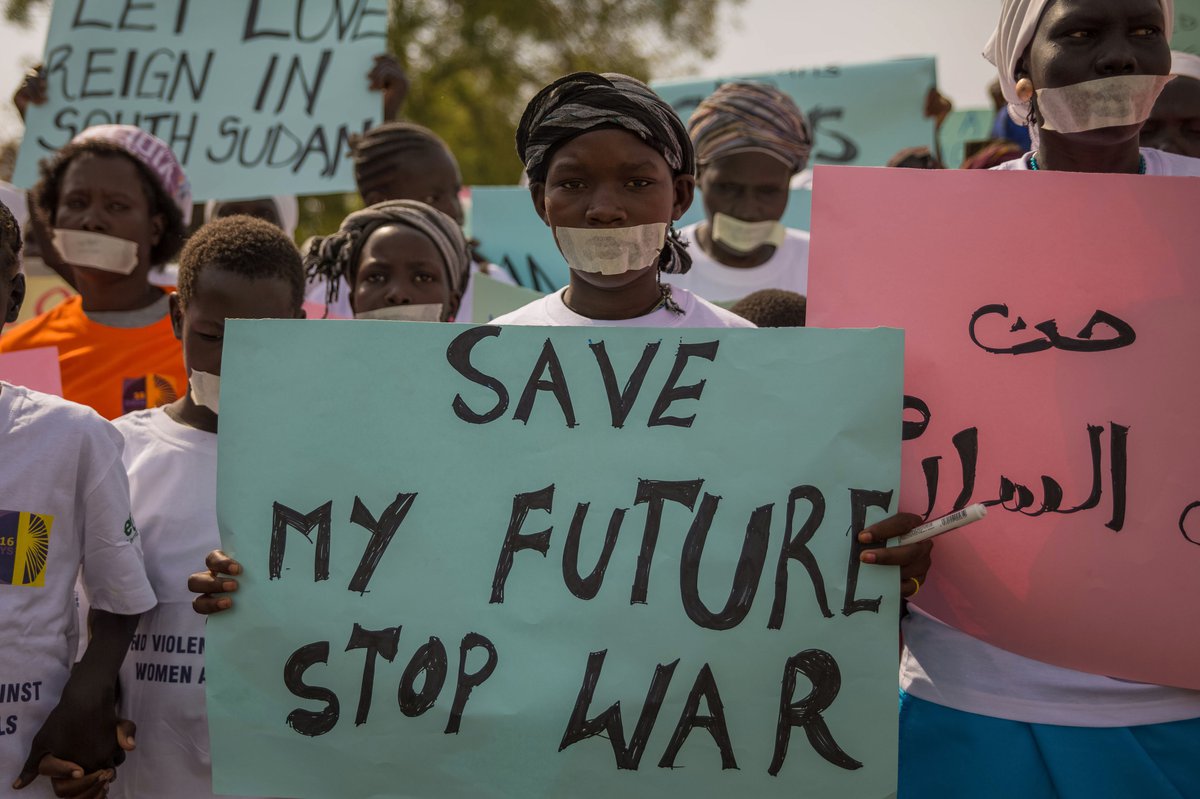
Armed assailants killed 73 people at a gold mine in South Sudan, government officials said on Monday, in violence linked to a dispute over gold extraction.
The attacks occurred on Saturday near Jebel Iraq in Central Equatoria state in the south of the country, Vice President James Wani Igga said.
At least 25 others were injured and some fled the scene.
Authorities warned that the death toll could rise as the search for missing people continues.
It remained unclear which group was responsible for the attack.
The vice president said an official investigation would be launched and security measures at mining sites and commercial centres would be strengthened.
Charles Madut, the governor of Northern Bahr el Ghazal state in the country’s north-west, condemned the attack, describing the violence against innocent civilians as unacceptable and said that the perpetrators must be brought to justice.
A Russian tanker carrying oil to Cuba has entered the waters off the Communist-run Island, Russia’s Interfax.
The oil shipment – the first to reach Cuba since January – comes hours after US President Donald Trump said that he had no problem with countries, including Russia, sending supplies to the island.
Trump’s remark appeared to signal a loosening of a de facto oil blockade his administration had imposed on Cuba since January.
Cuba has been experiencing a series of nation-wide blackouts as the blockade exacerbated existing shortages.
According to Interfax, the Russian tanker Anatoly Kolodkin is carrying a “humanitarian shipment” of 100,000 tonnes of crude oil.
Last week, the World Health Organization (WHO) had warned that severe fuel shortages meant that Cuban hospitals were struggling to maintain emergency and intensive care services.
Cuba’s situation has deteriorated rapidly since 3 January, when US forces seized Venezuelan leader Nicolás Maduro – a staunch ally of the Cuban government – who had been providing the island with oil under highly preferential terms.
Trump also threatened to impose tariffs on any nation sending oil to Cuba.
Russian Minister of Energy Sergei Tsivilev said on Wednesday that Cuba “had found itself in a difficult situation as a result of sanctions pressure”.
“That is why we are currently sending humanitarian supplies to Cuba,” he added.
Just over a week ago, the US Treasury department added Cuba to a list of countries barred from receiving oil deliveries from Russia.
But in an apparent reversal of his strategy, Trump told journalists on board of Air Force One on Sunday that he had “no problem” with Russia delivering oil to Cuba.
“We have a tanker out there. We don’t mind having somebody get a boatload because they need (…) they have to survive,” he said.
It was not clear from Trump’s comment if this represented a reversal of the fuel blockade policy or just a temporary softening.
The Russian tanker is expected to offload the oil in Matanzas terminal in the coming hours.
The oil it carries is expected to provide Cuba with a short-term lifeline.
Its Communist government, led by President Miguel Díaz Canel, has been in talks with the Trump administration to find a route out of the crisis.
But both sides have publicly set out a number of political and economic red lines which make it hard to see where they could find common ground.
President Trump recently said he could “take” Cuba while the island’s leadership has said it refuses to accept any enforced changes to the personnel or political direction of its government.
Cuba was already facing its worst economic and energy crisis since the end of the Cold War, because of a combination of a fall in tourism after the coronavirus pandemic and government economic mismanagement.
This crisis has been further worsened by the de facto fuel blockade.

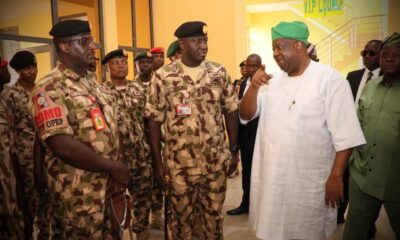

COAS Storms Plateau with Top Security Chiefs, Vows Lasting Peace
ShareBy David Torough, Abuja The Chief of Army Staff, Lieutenant General Waidi Shaibu, has led a high-powered delegation of security...

Kano Gov Observes Defection of Eight Reps Members to APC
ShareBy Mike Odiakose, Abuja Kano State Governor, Abba Kabir Yusuf, on Tuesday attended plenary at the National Assembly in Abuja,...

Kogi Awards Contract for 9km Dualisation of Airport Road
ShareFrom Joseph Amedu, Lokoja The Kogi State Government has approved the award of a contract for the dualisation of the road leading to the proposed Kogi Airport. The project, which...
FIFA Rankings: Super Eagles Rank Third in Africa, 26th Globally
ShareNigeria’s Super Eagles have maintained their position at 26th in the world in FIFA’s latest rankings, following a busy March international window. In a post obtained...
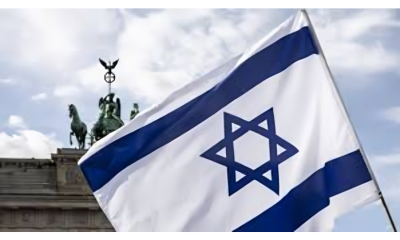

Israel Intensifies Lebanon Attacks, Hits Areas Not in Hezbollah’s Control
ShareIsrael has intensified its attacks on Lebanon this week, hitting areas outside of Hezbollah’s control on Tuesday. Strikes without warning hit a vehicle north of Beirut and the Jnah...
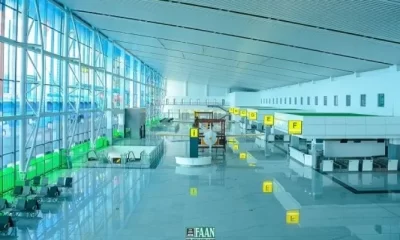

Electric Spark Disrupts Operations at Lagos Airport
ShareOperations were briefly disrupted at the Murtala Muhammed International Airport, Lagos, on Tuesday following an electrical spark that triggered smoke within one of the airport’s operational...


Sanwo-Olu Frees 43 Inmates to Decongest Lagos Prisons
ShareLagos governor, Babajide Sanwo-Olu, has released 43 inmates from correctional centres to decongest facilities and advance justice sector reforms. The development was contained in a statement on...


Banking Operators Raise N4.65trn As CBN Concludes Sector Recapitalisation
Share By Tony Obiechina, Abuja The Central Bank of Nigeria (CBN) has announced the successful conclusion of the banking sector...

INEC Freezes ADC Activities amid Court Order
ShareBy Mike Odiakose, Abuja The Independent National Electoral Commission (INEC) has removed the names of the National Working Committee (NWC)...


Fresh Violence Rocks Jos over Angwan Rukuba Massacre
ShareBy David Torough, Abuja Tension gripped Jos, the Plateau State capital, on Wednesday as fresh violence erupted in the wake...