
DEFENCE
FRSC Disengages 43 Personnel for Desertion, Scandalous Behaviour, Patrol Misconduct


The Federal Road Safety Corps (FRSC) has taken decisive and uncompromising disciplinary action by disengaging 43 personnel from its service over acts bordering on desertion, scandalous conduct, and patrol misconduct.
FRSC Corps Marshal, Malam Shehu Mohammed said this in a statement by the corps Public Education Officer (CPEO) Olusegun Ogungbemide yesterday in Abuja.
Mohammed said that the affected officers comprise 31, dismissed for desertion, five for scandalous behaviour, and seven for patrol related misconduct.
He said that the action just like others of its kind sends an unequivocal message because; the FRSC badge is a symbol of honour and responsibility.
“Any officer who chooses to violate the standards of this noble institution will face the full weight of the corps’ disciplinary machinery,” he said.
The corps marshal described the action as a bold reaffirmation of the corps’ zero tolerance stance against indiscipline and ethical violations.
He stressed that the corps remained a professional paramilitary organisation guided by strict operational standards, adding that it would not condone any behaviour capable of undermining public trust, institutional integrity, or its set objectives.
He explained that desertion represented a grave breach of service oath and operational responsibility, particularly in a safety critical organisation entrusted with protecting the lives of millions of road users daily.
”Scandalous behaviour and patrol misconduct directly erode public confidence and contradict the core values of discipline, transparency, and service excellence which the corps upholds.
“To this end, the corps wishes to reassure Nigerians that it will continue to intensify internal monitoring, strengthen supervisory frameworks, and promote ethical reorientation across all commands nationwide.
“The Management remains resolute in building a professional workforce driven by integrity, discipline, and operational excellence.
“The corps therefore calls on the motoring public to sustain their confidence in FRSC and continue to support its mandate of creating safer roads for all,” he said.

The Headquarters, 1 Division Nigerian Army, says it will conduct its First Bi-Annual Range Classification Exercise for 2026 from March 23 to 27, at the Nigerian Air Force (NAF) Base Shooting Range, Mando, Kaduna.
This is contained in a statement by the Acting Deputy Director, Army Public Relations, 1 Division, and Lt.
-Col. Ajemusu Jingina, issued yesterday in Kaduna.“The exercise aims to enhance the marksmanship skills of officers and soldiers, as well as assess the serviceability of their weapons.
“Therefore, 1 Div. urges residents of NAF Base, Mando, and neighbouring communities not to panic at the sound of gunshots or movement of troops and equipment during the period,” it said.
The statement also advised members of the public to stay away from the range area throughout the duration of the exercise for safety reasons.
It added that the division expressed appreciation for the continued cooperation and understanding of the public.
DEFENCE
Military Repels Attacks, Neutralizes Terrorists, Rescues Kidnap Victims in Nationwide Operations
By David Torough, Abuja
The Armed Forces of Nigeria have recorded multiple operational successes across the country between March 7 and March 12, 2026, repelling terrorist attacks, rescuing kidnapped victims and dismantling criminal networks as part of ongoing efforts to safeguard national security.
During a press briefing on Friday in Abuja, the Director of Defence Media Operations, Michael Onoja, said troops conducted coordinated intelligence-driven missions across all theatres of operation, targeting terrorist enclaves, kidnapping syndicates, illegal oil operations and other threats to national stability.
In the North-East, troops of Operation HADIN KAI sustained pressure on insurgents linked to Boko Haram and the Islamic State West Africa Province.
Several attacks were repelled while key operatives, including logistics suppliers and tax collectors, were arrested in parts of Yobe and Borno states.On March 11, troops supported by air power repelled a coordinated night attack by ISWAP fighters in Goniri, Yobe State, killing more than 20 terrorists, including a senior commander identified as Abu Yusu. Weapons, improvised explosive devices and ammunition were recovered during the operation.
Authorities also confirmed that 14 insurgents surrendered within the period, bringing the total number of former fighters who have surrendered under the government’s deradicalization programme, Operation SAFE CORRIDOR, to over 122,800 since 2015.
In the North-West, soldiers under Operation FANSAN YAMMA carried out raids and patrols across Kaduna, Katsina, Sokoto, Kebbi and Zamfara states. Troops intercepted weapons hidden in commercial vehicles, dismantled terrorist hideouts and rescued kidnapped victims along the Abuja–Kaduna road after engaging gunmen in a forest near the border between the Federal Capital Territory and Kaduna State.
Security forces also destroyed a terrorist enclave linked to the Lakurawa group in Sokoto State, arrested suspected terrorists in Kano State and apprehended 15 suspected logistics suppliers distributing fuel to criminal groups in Sabon Birni, Sokoto State.
Operations in the North-Central zone also yielded results. Troops under Operation SAVANNAH SHIELD rescued kidnapped victims and neutralized terrorists during engagements in Edu and Pategi local government areas of Kwara State. In one incident, soldiers responding to a distress call freed a kidnapping victim after engaging gunmen in a forested area.
Similarly, troops of Operation ENDURING PEACE operating in Plateau, Bauchi and Kaduna states rescued multiple victims and arrested suspects. Security personnel also intercepted a trailer carrying 802 bags of ammonium sulphate in Bauchi State, a substance authorities say could potentially be used in the manufacture of explosives.
In the North-Central theatre covered by Operation WHIRL STROKE, soldiers neutralized two suspected terrorists in Katsina-Ala Local Government Area of Benue State and recovered weapons, SIM cards and ATM cards believed to be linked to wider criminal networks.
Meanwhile in the South-South region, troops conducting operations under Operation DELTA SAFE arrested suspected criminals in Delta State and neutralized three suspected kidnappers during a joint operation with local hunters in a forest in Edo State.
In the South-East, soldiers of Operation UDO KA continued operations against criminal elements linked to the proscribed Indigenous People of Biafra and its armed wing, the Eastern Security Network. Troops cleared improvised explosive devices along a road in Orsu Local Government Area of Imo State that had been abandoned for three years due to militant activity.
Security forces also dismantled illegal refining sites in Imo State, destroying equipment and storage tanks used in illicit oil operations.
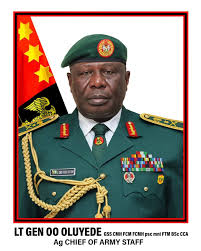
The Chief of Defence Staff, Olufemi Olatubosun Oluyede, commended troops for their resilience and praised the public for providing intelligence that aided the operations. He reaffirmed the military’s commitment to intensifying operations across the country to dismantle remaining terrorist and criminal groups.
According to the military, collaboration with local communities, vigilante groups and other security agencies will continue as part of efforts to restore lasting peace and stability across Nigeria.

Nigeria has inaugurated a national baseline assessment to boost its counter-terrorism efforts against Improvised Explosive Devices (IEDs).
The initiative, led by the National Counter Terrorism Centre, was unveiled on Wednesday in Abuja during the Counter-Improvised Explosive Devices Baseline Self-Assessment Workshop.
The workshop was organised in collaboration with the United Nations Mine Action Service and the British High Commission.
Speaking on behalf of the National Security Adviser, Nuhu Ribadu, the National Coordinator of the centre, Maj.-Gen. Adamu Laka, said the exercise was designed to critically examine Nigeria’s existing counter-IED capabilities and identify operational gaps across security institutions.
Laka described the initiative as a strategic follow-up to the Counter-IED Symposium held in March 2025 and a key step toward developing a comprehensive National Counter-IED Strategy.
He said IEDs remained one of the most dangerous weapons used by terrorist groups, particularly in the North-East, posing serious threats to military personnel, civilians and national infrastructure.
He noted that beyond the loss of lives and injuries, IEDs attacks had severely disrupted farming and economic activities, restricted humanitarian operations, displaced communities and weakened investor confidence in affected areas.
“These impacts go far beyond the battlefield and continue to affect the stability and recovery of communities across the country,” he said.
Laka explained that the assessment would utilise the Counter-IED Self-Assessment Framework developed by the United Nations Institute for Disarmament Research to generate empirical data and strengthen coordination among security agencies.
In her remarks, First Secretary at the British High Commission, Annup Vyas, said the United Kingdom was proud to support Nigeria in confronting the persistent threat posed by IEDs.
Vyas noted that the workshop marked an important milestone in the UK-Nigeria security and defence partnership aimed at strengthening national and regional stability.
“The threat from improvised explosive devices is ongoing and deeply damaging to lives, communities and regional stability.
“IEDs do not distinguish between soldiers, civilians or infrastructure. Their impact cuts across everything Nigeria is working to protect,” he added.
He emphasised that effective responses to the threat required not only resources and commitment but also a clear understanding of strengths, gaps and areas requiring improvement within Nigeria’s counter-IED architecture.
According to him, the assessment framework provides a structured methodology to evaluate national capabilities across prevention, detection, mitigation, investigation and consequence management.
The Commander of the Nigerian Army Corps of Engineers, Shamsideen Shafaru, said IEDs remain one of the most adaptive weapons used by hostile groups across several operational theatres.
Shafaru stressed that defeating the threat required a unified, intelligence-driven and capability-focused approach involving military, security, intelligence and civilian stakeholders.
He said the workshop would examine existing procedures, training frameworks, equipment and coordination mechanisms to identify capability gaps and strengthen operational synergy.
Shafaru reaffirmed the commitment of the Nigerian Army Corps of Engineers to supporting national counter-IED efforts through combat engineering expertise, technical innovation and force protection initiatives.
Edwin Faigmane, UNMAS Country Representative, said the workshop was part of a broader initiative to strengthen national capabilities in IED threat mitigation, protect civilians, and ensure the safety of security personnel.
Faigmane said the work of UNMAS focuses on mitigating threats from IEDs to personnel, civilians, and critical infrastructure.
He noted that the workshop uses a C-IED capability maturity self-assessment tool, developed by the United Nations Institute for Disarmament Research, which allows participating security agencies to evaluate and prioritize national C-IED capacities.
Participants at the workshop include representatives of the armed forces, security and intelligence agencies, ministries, departments and agencies, as well as international partners supporting Nigeria’s counter-terrorism efforts.




Julius Berger Delivers Landmark CSR Activities in Rivers State
ShareBy Mike Odiakose, Abuja Julius Berger Nigeria PLC, the nation’s premier engineering construction powerhouse, is not only building bridges and...


Adebayo: Age Not the Issue, Nigeria Needs Leaders Who Truly Love the Country — Archbishop Kanu
ShareBy Mike Odiakose, Abuja Former Prelate Emeritus of the Methodist Church of Nigeria, Archbishop Uche Kanu, has said that Nigeria’s...


Cleric, Followers Observe Eid despite Sultan’s Directive
ShareA Sokoto-based Islamic scholar, Sheikh Musa Lukuwa, yesterday led his followers in observing Eid al-Fitr prayers in defiance of a directive issued...

CAF Executive Member Calls for Rejection of Abject Afcon Decision
ShareThe decision to strip Senegal of the 2025 Africa Cup of Nations title is “abject” and “we have to denounce...


Oil Crosses $110 a Barrel after Gas Field Strike
ShareOil prices rose above $110 (£82.78) a barrel after Iranian media reported an airstrike hitting a facility on the world’s largest natural gas field. The...


Army Conducts Shooting Exercise, Kaduna Residents Told Not to Panic
ShareThe Headquarters, 1 Division Nigerian Army, says it will conduct its First Bi-Annual Range Classification Exercise for 2026 from March 23 to 27, at the Nigerian Air...


How God Changed My Story after 16 Years in Music, Says Spyro
ShareAfrobeats singer Spyro has revealed that 16 years of perseverance and struggle in the music industry finally paid off three...


Asake Reaffirms Loyalty to Olamide, Downplays Split Rumours
ShareAfrobeats star Asake has reiterated his unwavering loyalty to his former label boss and mentor, Olamide, amid speculation of a...
Chef Drives Push to Rebrand Nigerian Cuisine Globally
ShareNigerian chef Gbolabo Adebakin, known as Chef Gibbs, has urged deliberate global rebranding of Nigerian cuisine to challenge misconceptions and...


ShareNigeria’s Balance of Payment Falls 38% to $4.23bn in 2025 Nigeria’s external sector faced significant headwinds in 2025, as the...