
Foreign News
Guterres Opens UN General Assembly


United Nations Secretary General Antonio Guterres is set to open the 74th session of the UN General Assembly in New York on Tuesday.
The UN chief will welcome the incoming General Assembly president Tijjani Muhammad-Bande of Nigeria to his new role as head of the 193-member body.
As is tradition, the new session begins one week before the assembly’s high-level debate kicks off on September 24 with the participation of world leaders.
In a fast-changing world where humanity’s issues are “increasingly interlinked,” the General Assembly is “our universal platform to build consensus for the common good,” Guterres said at the closing of the 73rd session on Monday.
“From the climate crisis to migration flows and rising inequality, from waves of intolerance to harnessing technology for good, one thing is certain: global issues require global solutions,” the UN chief said.
The 74th session will be presided over by Muhammad-Bande, who will hold the mainly ceremonial position for one year.
Muhammad-Bande takes over from Maria Fernanda Espinosa of Ecuador, who was the fourth woman to lead the UN’s parliament-style body.
The General Assembly is the main representative body of the UN, and all 193 member states have equal voting rights in its chamber.
It adopts treaties and passes resolutions, but they are not legally binding. (dpa/NAN)











“Late and clumsy” intervention by the government in trying to overturn the banning of Israeli Maccabi Tel Aviv fans from a match against Aston Villa only served to “inflame tensions”, a committee of MPs has found.
The move was “ineffective” and reflected “unfavourably on the culture of the Home Office”, the Home Affairs Committee report concluded.
The report into events surrounding the November Europa League match also found the decision by Birmingham’s Safety Advisory Group (SAG) may have been “unduly influenced by political pressure”.
A Home Office spokesperson said it was only informed a ban was “one possible option” before the decision was taken.
After reviewing evidence presented by West Midlands Police (WMP) the SAG ruled supporters of the Israeli club should not be permitted to attend the fixture over safety concerns. The force has since admitted it “overstated the evidence” used to make the decision.
Following the ban announcement, the government said it would do everything in its power to have the ban overturned.
Government intervention was “clumsy and came too late,” said Karen Bradley, chair of the Home Affairs Committee.
Police use of AI in drawing up its evidence led to “inaccurate and unverified information” which “reinforced false narratives”, said the report.
The “extraordinary measure” to ban fans seemed to have been taken to “make policing the match much easier”, added the Conservative committee chair.
“To justify this step, information that showed the Maccabi fans to be a high risk was trusted without proper scrutiny. Shockingly, this included unverified information generated by AI,” she said.
The former chief constable of the force, Craig Guildford announced his retirement on 16 January in the wake of damning criticism surrounding the issue.
It was “right” the chief constable had retired so the force could rebuild trust, the MPs’ report said.
Guildford’s retirement came after he admitted inaccuracies in evidence to the committee, including a denial the force had used AI to research evidence, including a non-existent match between the Israeli club and West Ham.
Senior officers did not intentionally mislead the committee over AI generated intelligence, but demonstrated a “remarkable lack of professional curiosity”, said the report.
The committee said it had considered the presence of Birmingham city councillors on the SAG, including one who had been campaigning against the fixture taking place.
Councillor for Aston ward, Mumtaz Hussain, had failed to declare an interest when attending a SAG meeting on 7 October, and “later characterised some Maccabi Tel Aviv fans as ‘thugs'”, the report states.
She recused herself from a later meeting on 24 October.
Councillor Waseem Zaffar, who has since passed away, did declare an interest as a campaigner against the match at the first SAG meeting.
It recommended that changes be made to ensure elected politicians can no longer sit on such groups.
Following a first appearance giving evidence to the committee, the force wrote to members of the Jewish community, apologising for giving the impression they had been consulted on the decision.
The report said it was “surprising and disappointing” Assistant Chief Constable Mike O’Hara was not more precise in his remarks about whether Jewish representatives had supported the ban.
The report concluded the government should give serious consideration to the proposal to introduce a new category for football matches of national significance.
The Home Office said it had sought to find ways by which fans could safely attend the game.
Following the incident, the home secretary withdrew confidence in the chief constable and said she planned to restore the power of government to sack police chiefs.
The report also criticised the West Midlands Police and Crime Commissioner (PCC) who “appeared to prioritise defending the chief constable above holding him to account”.
In a statement, the PCC Simon Foster said he would be giving the report “careful consideration” but that he continued to hold the force to account.
WMP said it was “fully committed” to learning from the events surrounding the ban and was seeking to restore the public’s trust and confidence in the force.
Birmingham City Council leader John Cotton said that police evidence was the key driver of the SAG’s decision, “but there are also clear actions for the council, which we will undertake”.

Pakistan has carried out multiple overnight air strikes on Afghanistan, which the Taliban has said killed at least 18 people, including women and children.
Islamabad said the attacks targeted seven alleged militant camps and hideouts near the Pakistan-Afghanistan border and that they had been launched after recent suicide bombings in Pakistan.
Afghanistan condemned the attacks, saying they targeted multiple civilian homes and a religious school.
The fresh strikes come after the two countries agreed to a fragile ceasefire in October following deadly cross-border clashes, though subsequent fighting has taken place.
The Taliban’s defence ministry said the strikes targeted civilian areas of Nangarhar and Paktika provinces and had killed dozens of people.
In Girdi Kas village, in the Bihsud district of Nangarhar, a man named Shahabuddin told reporters while pointing at his destroyed house that of 23 members of his family, only five had survived the attack.
Local Taliban spokesman Sayed Taib Hamd said that 18 members of the family had been killed.
No deaths have been reported so far in the other areas hit. A guesthouse and a religious school were targeted in the Bermal and Urgun districts of Pakitka province, but they were empty at the time of the attacks, local officials and locals said.
Pakistan’s Ministry of Information and Broadcasting said it had carried out “intelligence based selective targeting of seven terrorist camps and hideouts”.
In a statement on X, it said the targets included members of the banned Tehreek-i-Taliban Pakistan, which the government refers to as “Fitna al Khawarij,” along with their affiliates and the Islamic State-Khorasan Province.
The ministry described the strikes as “a retributive response” to recent suicide bombings in Pakistan by terror groups it said were sheltered by Kabul.
The recent attacks in Pakistan included one on a Shia mosque in the capital Islamabad earlier this month, as well as others that took place since the holy month of Ramadan began this week in the north-western Khyber Pakhtunkhwa province.
Pakistan accused the Afghan Taliban of failing to take action against the militants, adding that it had “conclusive evidence” that the attacks were carried out by militants on the instructions of their leadership in Afghanistan.
The Taliban’s defence ministry later posted on X condemning the attacks as a “blatant violation of Afghanistan’s territorial integrity”, adding that they were a “clear breach of international law”.
It warned that “an appropriate and measured response will be taken at a suitable time”, adding that “attacks on civilian targets and religious institutions indicate the failure of Pakistan’s army in intelligence and security.”
The strikes come days after Saudi Arabia mediated the release of three Pakistani soldiers earlier this week, who were captured in Kabul during border clashes last October.
Those clashes ended with a tentative ceasefire that same month after the worst fighting since the Taliban returned to power in 2021.
Pakistan and Afghanistan share a 1,600-mile (2,574 km) mountainous border.

A total of 1,557 Venezuelan political prisoners have applied for amnesty under a new law introduced on Thursday, the country’s National Assembly President has said.
Jorge Rodríguez, brother of Venezuelan interim President Delcy Rodríguez and an ally of former President Nicolás Maduro, also said “hundreds” of prisoners had already been released.
Among them is politician Juan Pablo Guanipa, one of several opposition voices to have criticised the law for excluding certain prisoners.
The US has urged Venezuela to speed up its release of political prisoners since US forces seized Maduro in a raid on 3 January. Venezuela’s socialist government has always denied holding political prisoners.
At a news conference on Saturday Jorge Rodríguez said 1,557 release requests were being addressed “immediately” and ultimately the legislation would extend to 11,000 prisoners.
The government first announced days after Maduro’s capture, on 8 January, that “a significant number” of prisoners would be freed as a goodwill gesture.
Opposition and human rights groups have said the government under Maduro used detentions of political prisoners to stamp out dissent and silence critics for years.
These groups have also criticised the new law. One frequently cited criticism is that it would not extend amnesty to those who called for foreign armed intervention in Venezuela, BBC Latin America specialist Luis Fajardo says.
He noted that law professor Juan Carlos Apitz, of the Central University of Venezuela, said that part of the amnesty law “has a name and surname”. “That paragraph is the Maria Corina Machado paragraph.”
It is not clear if the amnesty would actually cover Machado, who won last year’s Nobel Peace Prize, Fajardo said.
He added that other controversial aspects of the law include the apparent exclusion from amnesty benefits of dozens of military officers involved in rebellions against the Maduro administration over the years.
On Saturday, Rodríguez said it is “releases from Zona Seven of El Helicoide that they’re handling first”.
Those jailed at the infamous prison in Caracas would be released “over the next few hours”, he added.
Activists say some family members of those imprisoned in the facility have gone on hunger strike to demand the release of their relatives.
US President Donald Trump said that El Helicoide would be closed after Maduro’s capture.
Maduro is awaiting trial in custody in the US alongside his wife Cilia Flores and has pleaded not guilty to drugs and weapons charges, saying that he is a “prisoner of war”.




Nigeria Records N5trn Post-harvest Losses in 2025
ShareThe Organization for Technology Advancement of Cold Chain in West Africa (OTACCWA) has disclosed that Nigeria recorded between N3.5 trillion...


Tinubu Applauds Leo Stan Ekeh’s Achievements at 70
SharePresident Bola Tinubu has congratulated Leo Stan Ekeh on his 70th birthday, describing him as a pioneering innovator in Nigeria’s...


Zamfara Tackles Illegal Hawking, Sales of Drugs
ShareFrom Ifeanyichukwu Nwannah, Gusau Zamfara State Ministry of Health has convened a high level stakeholders’ meeting aimed at curbing the...


STEAP Transforms 50 Benue Schools into Anti-Trafficking Prevention Hubs
ShareBy David Torough, Abuja The School-Based Trafficking Education and Prevention (STEAP) Project has recorded significant progress in Benue State, with...
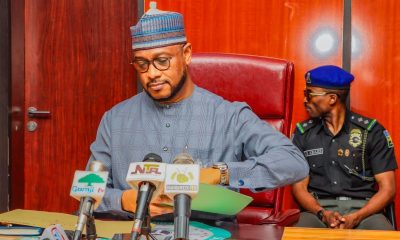

Zamfara Seeks Collaboration with International Partners, Others to Curb Out of School Children
ShareFrom Ifeanyichukwu Nwannah, Gusau The Zamfara State Government has appealed for collaborative actions from International partners and stakeholders to address...


FG Plans to Establish Armed Forces College of Medicine and Health Sciences
ShareBy Tony Obiechina, Abuja The Federal Government has advanced plans for the establishment of the Armed Forces College of Medicine...


Christian Council of Nigeria Backs CAN, Rejects Niger Hisbah Bill
ShareFrom Dan Amasingha, Minna The Christian Council of Nigeria (CCN), Niger State Chapter, has declared its full support for the...
Katsina Bureau of Statistics Deploys Enumerators for 2024/2025 SGDP Survey
ShareFrom Bala ldris, Katsina The Katsina State Bureau of Statistics (KTSBS) has commenced field operations for the 2024/2025 State Gross...
Young Innovators Win Big at Maiden Enugu Campus Hackathon
ShareFrom Sylvia Udegbunam, Enugu Youth innovators at the weekend won big at the maiden edition of the state backed Enugu...


UNEC Nursing Students Celebrate annual Health Day with Medical Outreach in Enugu Community
ShareFrom Sylvia Udegbunam, Enugu The students of department of nursing sciences, University of Nigeria Enugu Campus (UNEC) posted to Ugwu...