
Metro
Irregular Migration: Foundation Calls on FG, Others to Create Productive Skills for Youths

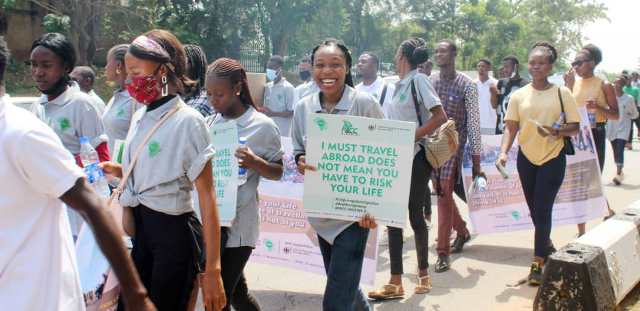
An NGO, Africa Youth Growth Foundation (AYGF), has underscored the need for government at all levels to create productive engagement skills for youths to guard against irregular migration.
The Executive Director, AYGF, Dr Arome Salifu, made the call at a Townhall meeting of its Migration Information Communication Campaign (MICC), Nigeria – Part two project on Thursday in Abuja.
The theme of MICC is: “Migration is not a crime, just do it the right way for your own safety and dignity’’.
Salifu said that the three tiers of governments should be able to reduce poverty of the people, create employment for them to make them productive in the country.
“So we are calling on the Nigerian government at the local, states and federal levels to put in place the enabling environment for Nigerians to stay back at home.
“They should be able to reduce poverty of the people, create employment for the people; create enabling skills that can facilitate productive engagement of these massive young people we have on the street.
“These are some of the sustainable measures government must put in place to see that irregular migration is addressed and human trafficking is confronted across the nation.
“This is a clarion call; it is indeed time to declare state of emergency in terms of economic support for young people, who are currently having hopelessness in their chances of surviving the hardship that we are currently experiencing as a people.’’
He further advised the youths to look at the possibility of taking their time to get sufficient resources to go through the regular pathway.
He said “this is because a lot is happening within the ecosystem of migration.
“organs are being harvested; excess exploitation is taking place on daily basis; labour exploitation, sex slavery and many others,’’ he said.
Gov. Ifeanyi Okowa of Delta noted that the concern for humanity and the understanding that all humans were equal before God lent sufficient justification to the campaign for regular migration.
Okowa, who was represented by his Senior Special Assistant on Internal Affairs, Dr Genevieve Mordi, said that regular migration was a major component in the fight against human trafficking.
“Indeed, Migration is as old as history itself but it must be done following the laid down protocols of the country one has an interest in migrating to.
“The goal is to realise and promote a global society that upholds human dignity and sanctity of human life: a society which means actualisation is built on a foundation of equal respect for all mankind.”
He, therefore, commended the leadership of AYGF for raising awareness on regular migration.
“As well as enlighten the uninformed of the pitfalls of irregular migration such as conditions faced by victims of human trafficking and ills associated thereto world over.
“Events of this nature will help to sensitise the populace, and push for protection of the rights of victims and therefore, deserve our
collective support.
“As at the last count, indigenes of Delta constituted 667 out of the thousands of victims of human trafficking that were kindly evacuated in a Federal Government sponsored programme from Libya.
“The fallout of irregular migration cannot be over-emphasised.’’
According to him, the 2018 Global Slavery Index (GS) contains shocking figures that should awaken the empathy and
consciences of people of goodwill around the world.
“The index indicates an estimated 40.3 million men, women and children are victims of modern day slavery on any given day in 2016.
“Of these 24.9 million people were in forced labour and 15.4 million were forced marriages.
“Sadly, women and girls make up 71 per cent of these victims. These figures as grim as they are do not include victims who are trafficked for black market organ harvesting.
“The GSI estimates 126, 670 solid organ transplants were performed in 2015 and the World Health Organisation estimates that illegal organ trade comprise approximately 10 per cent of the global transplant activity.
“This brings to fore the importance of traveling legally,’’ the governor added.
Ms. Elizabeth Poage, the National Project Officer, Labour Migration and Diaspora, International Organisation for Migration said that people were trafficked for exploitative purposes including labour and sexual exploitation.
Poage said that sexual exploitation remained the most common motive for trafficking but the share of those trafficked for forced labour had grown from 18 per cent to 38 per cent among detected cases.
Speaking on AYGF pilot project, she applauded AYGF for the successful implementation of the pilot project.
Poage noted that the outcome of the project would contribute to improving the overall labour migration governance in Nigeria.
“And will also inform the Federal Ministry of Labour and Employment of some of challenges of labour migration management in Nigeria and how to mitigate them.”
The Africa Youth Growth Foundation (AYGF) marked its 15 anniversary and the launch of the project “Extension of Labour Inspection Activity and Labour Law Enforcement to Sectors and Workplaces where Migrant Workers may be Present”.(NAN)








By Orjime Moses, Abuja
The Independent National Electoral Commission (INEC) has urged youths in the South-South to shun electoral violence, hate speech, misinformation and political manipulation ahead of the 2027 general elections.
The commission made the call in a post on its official Facebook page, saying it had intensified engagement with youth organisations across the six geopolitical zones to promote peaceful participation, electoral integrity and credible elections.
The South-South zonal engagement, which followed an earlier meeting in the South-West, brought together representatives of youth organisations and other stakeholders to discuss strategies for promoting peaceful participation and credible elections.
In his address, the Resident Electoral Commissioner (REC) in Akwa Ibom State, Prof. Anugbum Onuacha, urged young people and other stakeholders to take ownership of the electoral process by participating actively in election planning and implementation.
He stressed the need for professionalism, transparency and stakeholder inclusion, noting that public confidence in elections could be strengthened when critical stakeholders were carried along.
Onuacha reaffirmed the commission’s neutrality, declaring that INEC had no political party or candidates. He also said the commission remained committed to improving its electoral processes, adding that lessons from previous elections would guide subsequent exercises.
In his goodwill message, the Akwa Ibom State Director of the National Orientation Agency (NOA), Mkpoutom Noa, commended INEC for organising the engagement, describing it as an important platform for addressing youth involvement in electoral violence.
He urged participants to understand the consequences of electoral offences and avoid being used as instruments of political violence.
Similarly, the National Youth Service Corps (NYSC), through its Akwa Ibom State Coordinator, conveyed a goodwill message from its Director-General, Brigadier-General U. O. Ahmed, urging young Nigerians to embrace peace, demonstrate political maturity and take collective responsibility for protecting democracy.
The message cautioned youths against allowing political differences, personal interests and financial inducements to turn them into agents of intimidation and electoral violence.
It also encouraged young people to use social media responsibly, promote voter education and participate peacefully in the democratic process.
Speaking, the Deputy Director, Inclusivity, INEC Headquarters, Abuja, Mrs Habiba A. Jatto, said the engagement was designed to strengthen collaboration between the commission and youth organisations ahead of the 2027 general elections.
She described young people as a critical national resource whose energy, creativity, resilience and digital capabilities could contribute significantly to democratic development.
Jatto, however, expressed concern that despite constituting more than 60 per cent of Nigeria’s population, young people were often exploited by political actors for negative electoral activities.
She said the engagement was aimed at repositioning youths as responsible stakeholders and partners in promoting peaceful elections rather than tools for advancing anti-democratic interests.
According to her, the objectives included strengthening partnerships between INEC and youth groups, promoting civic responsibility and democratic values, sensitising young people on electoral integrity and political tolerance, and encouraging issue-based political engagement.
The engagement featured presentations by INEC officials on the commission’s preparations for the 2027 general elections, electoral offences and penalties, the Bimodal Voter Accreditation System (BVAS) and the use of technology in elections.
The Head of Department, Voter Education and Publicity, INEC Akwa Ibom State, Geraldine Ekelemu, spoke on the commission’s state of preparedness for the 2027 elections, highlighting the importance of voter education and public awareness.
Also, the Head of Department, Legal Services, INEC Akwa Ibom State, Emeka Owabie, addressed electoral offences and penalties, while Tope Fakiyesi, who represented the Head of Department, Information and Communication Technology, Edidong Ekam, spoke on BVAS and new technology in elections.
The Assistant Director, Youth, INEC Headquarters, Bukar Maikwada, urged young people to use their digital skills to promote accurate information, counter misinformation and strengthen democratic participation.

The National Identity Management Commission (NIMC) has reiterated its commitment to strengthening Nigerians’ digital identity, cybersecurity and privacy safeguards under the 2026 NIMC Act.
The commission also pledged to expand access to essential services across Nigeria through an improved digital identity system.
NIMC Director of Operations, NIMC, Uche Chigbo, said this on Thursday in Abuja on the sidelines of the Digital Nigeria Conference organised by the National Information Technology Development Agency (NITDA).
Recall that President Bola Tinubu signed the NIMC Act (2026) into law on June 26, 2026.
Chigbo explained that the repealed NIMC Act No. 23 of 2007 had become obsolete over the past 19 years before its replacement by the new law.
She said the new legislation would reposition NIMC and strengthen its role in Nigeria’s digital identity ecosystem.
According to her, the commission had shifted its focus beyond enrolment figures to maximising the value of digital identity.
She said that NIMC was working towards achieving universal identity coverage while ensuring that the National Identification Number (NIN) unlocked economic and social opportunities.
Chigbo said the new Act would expand the commission’s mandate to strengthen its technology architecture, particularly cybersecurity, and position it as the certification authority for public key infrastructure.
She added that the legislation would empower NIMC to play a leading role in developing Nigeria’s Digital Public Infrastructure.
She said that the Act introduced stricter sanctions for identity-related violations, particularly through collaboration with the Nigerian Data Protection Commission (NDPC).
The director said that the commission was developing identity-proofing mechanisms for people without conventional identity documents.
According to her, community chiefs or relatives could identify such individuals to facilitate their identity registration.
Chigbo added that the Act would also address challenges faced by Nigerians without permanent residential addresses to prevent their exclusion from identity registration.
Head of Legal, Enforcement and Regulations at the NDPC, Babatunde Bamigboye, said that it was imperative to protect personal information under the new Act.
Bamigboye said NIMC’s expanded mandate did not override individuals’ privacy rights, stressing that the law recognised the need to protect personal data.
He said possession of citizens’ identity and personal data did not give NIMC or any government agency unrestricted access to the database without a lawful basis.
According to him, access to personal information must be supported by lawful grounds, including consent, public interest and other provisions recognised under the Nigeria Data Protection Act.
He added that individuals had the right to access their personal data, correct inaccurate information and object to unauthorised access.
Bamigboye also stressed the need to protect individuals from decisions made solely through automated systems, particularly as artificial intelligence becomes increasingly integrated into public services.
He urged digital stakeholders to adopt proactive measures to ensure compliance with privacy, accountability and data protection standards.
“We want to see that such an operation is proactive. We don’t have to wait until things happen before we react,” he said. (NAN)

Nollywood actress and filmmaker, Bimbo Ademoye, has rejected an apology from a man who filed a copyright claim against her YouTube movie, My 30th Wedding, insisting that she remains angry over the incident.
The actress had earlier offered a ₦1m reward for information about the individual, identified as Mazi Enemuo, after a copyright claim temporarily affected the monetisation of the movie, which has reportedly garnered about 29 million views.
The film was released on October 1, 2026, on her YouTube channel.
On Monday, Ademoye took to Instagram to express her frustration, alleging that Enemuo had uploaded a song from the movie and used it to claim earnings from the project.
She said the soundtrack, titled “We Can Take It (My 30th Wedding)”, was specially produced for the film by musician Progress and that she owned the rights to it.
Ademoye also urged her followers to report the individual across social media platforms and called on YouTube and YouTube Africa to intervene.
She later announced that monetisation on the movie had been restored, thanking her team for their intervention.
However, she maintained that her ₦1m bounty on Enemuo remained in place.
Enemuo subsequently apologised, saying he had uploaded the song to help promote the movie’s soundtrack and reach a wider audience, rather than infringe on Ademoye’s rights.
In a public apology, he said, “Unfortunately, the distribution platform has laid a YouTube Content ID claim on the content. I take full responsibility for the situation and have since taken down the song from all streaming platforms.”
He added that the song would be removed from all platforms within 24 to 48 hours and that he would contact the distributor to ensure that no residual claim remained.
But responding to the apology on Instagram on Tuesday, Ademoye described it as insincere and questioned his explanation that he had intended to help her reach a wider audience.
“Mr Enemuo, while I see your apology, I call it complete bullshit! I took multiple breaths and I’ve counted 1-10 multiple times to ensure I calm down and not say anything out of pocket but guess what, I’m still very angry!
“You claimed you wanted to help me reach a wider audience, I’m not sure you thought that statement through, you wanted to use your 250 subscribes to help me reach a wider audience with my almost 2 million subscribers?” she asked.
Questioning why Enemuo uploaded the particular soundtrack rather than another song from the movie, she said, “You specifically took the song I didn’t properly copyright of all the songs in the movie. Why didn’t you take hammerboi’s song? If anything, that’s the viral one I’d have loved to go even more viral song.”
She also questioned why he attempted to claim earnings from the movie after allegedly uploading the song to promote it.
“After you ‘helped me reach a wider audience’ why did you try to claim my earnings? Why did you monetise it and have me demonitised?” she asked.
The actress further warned that she would pursue the matter, writing, “But I’d make an example out of you. Don’t ever take my silence for weakness, believe me when I tell you I AM NOT THAT NICE AT ALL! ESPECIALLY WHEN IT COMES TO MY WORK.”
In a postscript to her response, Ademoye also dismissed suggestions that she was using the controversy for publicity or had failed to protect her work through copyright registration.
She shared screenshots of messages from people who, according to her, had contacted her after their channels were taken down following copyright enforcement on her projects.




Nigerian Military Rescues 47 Kidnap Victims, Arrests Suspects in Nationwide Operations
ShareBy David Torough, Abuja The Armed Forces of Nigeria (AFN) have rescued 47 kidnapped persons, including 29 children, neutralised several...


Nigerian Army Inducts 6,419 New Soldiers as Force Expands to 12 Divisions
ShareBy David Torough, Abuja The Chief of Army Staff (COAS), Lieutenant General Waidi Shaibu, has inducted 6,419 newly trained soldiers...


Troops Rescue 14 Kidnap Victims in Kaduna, Hunt for Others
ShareBy David Torough, Abuja Troops of the Nigerian Army have rescued 14 passengers abducted by kidnappers at Kurmin Goro in...


A Year Never to be Forgotten in My Lineage — Pastor Komaiya
ShareBy David Torough, Abuja The Senior Pastor of Masters Place International Church, Pastor Korede Komaiya, has described 2026 as an...


PAP Phase Two Chairman Hails Otuaro over Aberdeen University Engagement
ShareFrom Seyi Tayese, Yenagoa The National Chairman of the Presidential Amnesty Programme (PAP) Phase Two, Ibena Rufus Salvation, has commended...

Henry Okeke Welcomes Tinubu to Enugu, Hails Mbah’s Development Efforts
ShareBy Raphael Atuu The Convener of New Enugu Group Barrister Henry Okeke, has welcomed President Bola Ahmed Tinubu to Enugu...


COAS Sharpens Combat Edge of Expanding Nigerian Army, Graduates 91 RRI CTCOIN Recruits
ShareBy David Torough, Abuja The Chief of Army Staff (COAS), Lieutenant General Waidi Shaibu, has highlighted the importance of specialised...


FOOG Women Support Group for Tinubu Commends Babangida, Abdulsalami Over Tinubu’s 2027 Endorsement
ShareBy Francis Sadhere, Delta The FOOG Women Support Group for Tinumbu has commended former Nigerian military Heads of State, Generals...


COAS Strengthens Troops Welfare, Commissions Training Infrastructure atDepot Nigerian Army Zaria
ShareBy David Torough, Abuja The Chief of Army Staff (COAS), Lieutenant General Waidi Shaibu, has strengthened the Nigerian Army’s drive...

Benue IDPs Praise UNICEF over Provision of Facilities
ShareFrom Attah Ede, Makurdi Internally Displaced Persons (IDPs) in Benue State have poured praises on the United Nations Children’s Fund...