
NEWS
Julius Berger Commits to Renewed Hope Climate Change Awareness Tour


By Mike Odiakose, Abuja
Leading engineering construction company, Julius Berger Nigeria PLC has joined forces with the Renewed Hope Climate Change Awareness Tour, a national initiative aimed at promoting climate resilience and sustainable development across Nigeria to further the goals of the project.
The initiative was inaugurated inside the State House Conference Centre, Abuja Tuesday.
Speaking at the event, President Bola Tinubu who was represented by the Minister of Environment, Balarabe Abbas Lawal, urged governors, Organised Private Sector actors and fellow stakeholders to lead Nigeria’s climate transition, transforming awareness into practical action at all levels while calling on governors, private sector leaders, and stakeholders to accelerate Nigeria’s transition to a resilient, low-carbon economy.
Tinubu said climate change was not only a risk but also an opportunity for innovation, growth, and national development.
“Today we inaugurate a movement, the Renewed Hope Climate Change Awareness Tour. It is a national call to action, a call to innovation, opportunity, and sustainable development for all Nigerians,” Tinubu said.
Stressing that Nigeria stood at a defining moment as the global transition to low-carbon development accelerated, the President said, “Capital is shifting, markets are evolving, and technology is transforming industries. Nigeria intends to lead tomorrow.”
He explained that the tour would take climate awareness beyond conference halls into communities, engaging governors, traditional rulers, students, innovators, entrepreneurs, farmers, and financial institutions nationwide.
By doing so, he added that bankable projects will be identified, local solutions unlocked, climate finance capacity strengthened, and partnerships between the public and private sectors mobilised.
To the stakeholders, the President said that nationally determined contributions were commitments to reduce emissions, enhance resilience, and safeguard communities, saying, “Commitments must be matched with action, supported by investment, and this tour bridges that gap.”
He further tasked young Nigerians to take ownership of the climate transition, stressing that their ideas, technology, and entrepreneurship would shape the nation’s future while aligning with the Renewed Hope Agenda.
Said he, “climate resilience is national security. Leadership is not a budget; it is a result we must accept with confidence. Nigeria chooses leadership over hesitation,”
Also, the Director of Forestry in the ministry, Halima Bawa, stressed the urgency of confronting climate change, noting its effects, including desert encroachment, flooding, coastal erosion, and erratic rainfall affecting farmers.
Lawal lauded the Climate Change Act 2021 for establishing a legal framework for coordinated climate governance, carbon budgeting, and a pathway to net-zero emissions by 2060, institutionalising climate action across sectors.
Special Assistant to the President on Climate Change Matters, Yussuf Kelani, said the tour represented a national movement grounded in leadership, collaboration, and commitment to Nigeria’s environmental and economic security.
Kelani, Chairman of the REHCCAT Committee, said the initiative sought to democratise climate knowledge, align federal and state-level action with Nigeria’s NDCs, and mobilise partnerships, green jobs, and climate finance.
Guest Speaker, Prof. Babajide Alo, emphasised that climate resilience required locally led adaptation, community empowerment, and capacity-building to actively manage climate risks and implement sustainable solutions.
“Securing Nigeria’s climate future requires revisiting priorities and lifestyles, embracing responsible consumption, reducing carbon footprints, and embedding sustainable development in every sector,” Alo said, calling for action at all levels.
For Julius Berger Nigeria PLC, the Chief Risk Officer, Shakira Mustapha said the target of well-wishers of Nigeria is a net zero emission.

Justin Bieber made a nostalgia-fuelled return to the major stage as Coachella’s much-anticipated headline act.
The 32-year-old spent much of Saturday night’s gig sitting in front of a laptop and singing to YouTube music videos of his older hits, such as Baby and Never say Never – delighting the crowd in an apparent tribute to the platform on which he was discovered.
He also played some of the home videos that had brought him to the industry’s attention aged 12, pulling them up on the big screen, and appeared to interact with the live comments on the YouTube stream of his set.
It marked the star’s biggest live show in four years, having cancelled his Justice World tour following health issues.
He opened the gig alone on an otherwise empty stage, performing tracks from his 2025 albums Swag and Swag II – before telling the crowd he wanted to take them “on a journey” and reaching back into his archive.
He repeatedly asked the audience: “How far back do you go?”
Bieber also played the clip for which he most recently went viral – and which prompted speculation about his mental state – in which he confronted a photographer and said: “It’s not clocking to you, I’m standing on business.”
Dressed in a hoodie and shorts on a stripped-back stage, Bieber was joined by musical guests including The Kid Laroi, Wizkid, Tems and Dijon.
The star’s wife Hailey Bieber was spotted in the crowd, alongside celebrity couple Timothée Chalamet and Kylie Jenner.
Bieber cancelled his world tour after revealing he was suffering from facial paralysis, after being diagnosed with Ramsay Hunt syndrome – a complication from contracting shingles – in 2022.
He released his surprise album Swag in July 2025, and in February performed live at the Grammy Awards.
His Coachella set marked a starker departure from the previous night’s headline act, Sabrina Carpenter, whose Hollywood-themed gig included costume changes, choreography and elaborate stage design.
Colombian pop star Karol G will be Sunday’s headliner at the festival, which takes place over two weekends in the California desert.
It draws more than 100,000 people daily, according to police from the city of Indio, and has been running at Indio’s Empire Polo Club since 2002.
By Tambaya Julius, Abuja
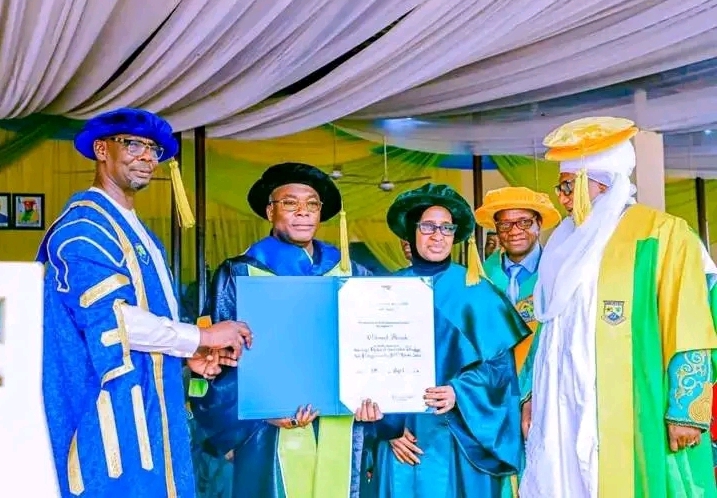
The Nasarawa State University, Keffi over the weekend celebrated its 25th silver jubilee anniversary and combined 8th convocation ceremony, where over 25,000 students were awarded with various academic degrees.
The grand event, held over the weekend at the school main Campus Keffi, was confirmed and honoured with Doctor of Philosophy (PhDs), Master’s degrees, First Degrees, and Postgraduate Diplomas on graduating students across different faculties.
The ceremony also confirmed honorary doctorate degrees on prominent personalities for their contributions to global leadership, business, and development.
Among the prominent personalities honoured were the President of Tanzania, Samia Suluhu Hassan; Abdul Samad Rabiu, Chairman of BUA Group; and Mahmood Ahmad.
The awards recognised their outstanding contributions to global leadership, development, and their roles in advancing socio-economic development both within Africa and globally.
During the ceremony, the Governor of Nasarawa State, Abdullahi Sule, awarded a cash prize of five hundred thousand Naira (N500,000) each to 82 first-class graduates, while the overall best graduating student was awarded N1 million.
The governor explained that the initiative was designed to promote excellence among students and aligns with the state government’s broader agenda of investing in education and human capital development. According to him, recognising academic achievement is essential in inspiring younger generations to pursue excellence.
Sule emphasised that rewarding hard work and dedication would encourage students across the state to strive for distinction in their academic pursuits. He noted that such incentives serve as a catalyst for improved performance and a stronger educational system.
As part of activities marking the institution’s 8th convocation and 25th anniversary celebrations, the governor commissioned several infrastructure projects at the University.
The newly inaugurated projects include the Alumni Secretariat, the Department of Accounting Postgraduate E-Library, as well as the university’s second gate and access road. He commended the university management for its commitment to infrastructural development and academic excellence.
The two-day celebration attracted a wide array of dignitaries from across Nigeria, including Governors, Ambassadors, Vice-chancellors, professors, traditional rulers, Business Men, and key stakeholders in the education sector.
In her address, the Vice-Chancellor of Nasarawa State University, Keffi, Prof. Sa’adatu Hassan Liman, warmly welcomed guests and expressed appreciation to the university’s leadership for their continued support.
She specifically acknowledged the Chancellor, HRH. Shehu Chindo Yamusa the Emir of Keffi, as well as the Pro-Chancellor, Prof. Atahiru Jiga, and members of the governing council for their impactful leadership.
Liman credited the institution’s progress to strong governance and visionary leadership, noting that both staff and students have benefitted from an enabling academic environment.
“I have acquired knowledge and experience in this institution due to impactful and good leadership,” she said.
She further urged students to prioritise their education and draw inspiration from the leadership and values upheld by the university. According to her, such commitment is essential for contributing meaningfully to Nigeria’s academic advancement and global competitiveness.
“Apply your knowledge positively, contributing to the advancement and educational success of Nigeria and the global community,” she appealed.

OPay, a leading financial institution in Nigeria, has been awarded The Most Trusted Quality Mobile Money and Digital Financial Services Company of the Year at the 2026 ISO World Corporate Brand of the Year Award. This recognition reaffirms OPay’s strong reputation and the trust tens of millions of Nigerians have in its services.
The award ceremony, held on Thursday, April 9, 2026, at the Providence Hotel, Ikeja, Lagos, brought together leading companies making a positive impact across different industries.The organisers, ISO World Consult, noted that the selection was based on an outstanding 4.6 from online referrer rating and also highlighted OPay’s strong track record and its role in improving financial services across Nigeria.
This recognition further shows that OPay continues to make financial services simple, secure and reliable for everyday
Nigerians. From sending money to paying bills and supporting businesses, OPay has become a trusted part of daily life.
Chukwudinma Okafor, Chief Compliance Officer, OPay, said: “This award is a strong validation of the trust our customers and partners place in us. We are committed to maintaining high standards in compliance, risk management, and service delivery. Our goal is to keep building a platform that supports growth, protects users, and contributes positively to the financial system.”
OPay remains focused on expanding access to financial services and helping more Nigerians take part in the digital economy.
About OPay
OPay was established in 2018 as a leading financial institution in Nigeria with the mission to make financial services more inclusive through technology. The company offers a wide range of payment services, including money transfer, bill payment, card service, airtime and data purchase, and merchant payments, among others. Renowned for its fast and reliable network and strong security features that protect customer’s funds, OPay is licensed by the CBN and insured by the NDIC with the same insurance coverage as commercial banks.


Justin Bieber Headlines Coachella with Nostalgia-fuelled Set
ShareJustin Bieber made a nostalgia-fuelled return to the major stage as Coachella’s much-anticipated headline act. The 32-year-old spent much of...

Sule Rewards First-Class Graduates, Honours Tanzania’s President at NSUK 8th Convocation
ShareBy Tambaya Julius, Abuja The Nasarawa State University, Keffi over the weekend celebrated its 25th silver jubilee anniversary and combined...

OPay Named Nigeria’s Most Trusted Digital Financial Company at 2026 ISO Awards
ShareOPay, a leading financial institution in Nigeria, has been awarded The Most Trusted Quality Mobile Money and Digital Financial Services...

Kogi Dismisses Claims of Ethnic Exclusion in Employment
ShareFrom Joseph Amedu, Lokoja The Kogi State Government has responded to a viral voice note allegedly recorded by a female civil servant,...
Prosperity Cup 2026: LGA Finals Get Dates
ShareFrom Mike Tayese, Yenagoa The Central Organizing Committee (COC) of Nigeria’s biggest grassroots football spectacle, the Bayelsa Governor’s Football Tournament,...


Trump Orders US Naval Blockade of Strait of Hormuz
SharePresident Donald Trump on Sunday ordered a US naval blockade of the Strait of Hormuz in response to Iran’s “unyielding” refusal to give up its nuclear ambitions during...
Psychiatrist Decries High Cost of Mental Illness Treatment, Seeks Interventions
ShareA Consultant Psychiatrist, Prof. Taiwo Obindo has decried the cost of care and drugs for individuals undergoing treatment for various mental health conditions, calling for interventions to reverse the...


ENSIEC Fixes 2026 Council Election Timetable Sept 26
Share From Sylvia Udegbunam, Enugu The Enugu State Independent Electoral Commission (ENSIEC) have released a revised timetable for the 2026 local...

Afreximbank Total Assets Grow to $48.5bn in 2025
ShareBy Tony Obiechina, Abuja The African Export-Import Bank (Afreximbank) said it has grown its total assets and contingencies to $48.5...

FG Tasks Dangote Sugar on 600,000MT Capacity Expansion
ShareBy Tony Obiechina, Abuja The Federal Government has urged the Dangote Group to expand the annual production capacity of its...