
NEWS
Kogi CP Seeks Intelligent Information, Prayers to Tackle Insecurity


From Joseph Amedu, Lokoja
The Kogi State Commissioner of Police, Millet Dantawaye has appealed to the people of the state not to relent in the supply of intelligent information and consistent prayers to curb criminal activities in the state.
He made the appeal at First Evangelical Church Winning All (ECWA) Lokoja during a Thanksgiving service of Salami Aderin Eunice, mother of Segun Salami of Channels TV correspondent in Kogi state, who celebrated her 75th year’s birthday on Sunday. Dantawaye noted that Kogi state is a difficult state because it is surrounded by nine states as some of the hoodlums will always like to enter the state and carry out their evil work, but thank God that they have been able to bring the situation under control.He appealed to the congregation to always pray for them and to state at large and also provide them useful information that can help them to curb criminal activities in the state.“I beg for any kind of intelligence report from you, any information that you get. It could be in your school, your children’s school; it could be even in the church here. It can be in your place of work.“Kogi is a very difficult terrain to oversee because of its bother to about 10 States including the Federal Capital Territory (FCT) Abuja“So, we need your prayers as individuals and as a church to us as the security agencies especially the police in policing the state. It is only by God’s divine backing and enablement.“I want to beg you to always give us reliable information at your disposal that will enable us to expose the criminal among us“We will continue to do the needful with the available resources and power to ensure that Kogi remains safe and secure,” Dantawaye said.He commended the Kogi state government in its effort to fight crime in the state adding that the government needs the cooperation of the society and individuals to fight crime in the state.Dantawaye congratulated Salami who clocked 75th years.In his sermon titled: “Gratitude to God”, Rev Paul Frank, stressed the need for everyone to be grateful to God for his kindness and benevolent towards us as a people.“For every benefit we receive, gratitude is demanded of us. Ingrates will never appreciate anything that describes an ingrate as a murderer, selfish.“Your miracle is attached to your worship and testimonies. We must deliberately thank God for aHis grace that has kept you safe in the midst of the rising insecurity in the country especially in Kogi,” Frank said.Frank urged the people never to take the grace of God for granted.Frank congratulated the Salami’s family for walking into the Sanctuary to give gratitude to God, the describing the gesture as a necessity to honour Jesus in the life of the celebrantIn his remarks, Segun Salami described his Mom as a wonderful mother and eulogised her kindness, support and for raising her children in the fear of God.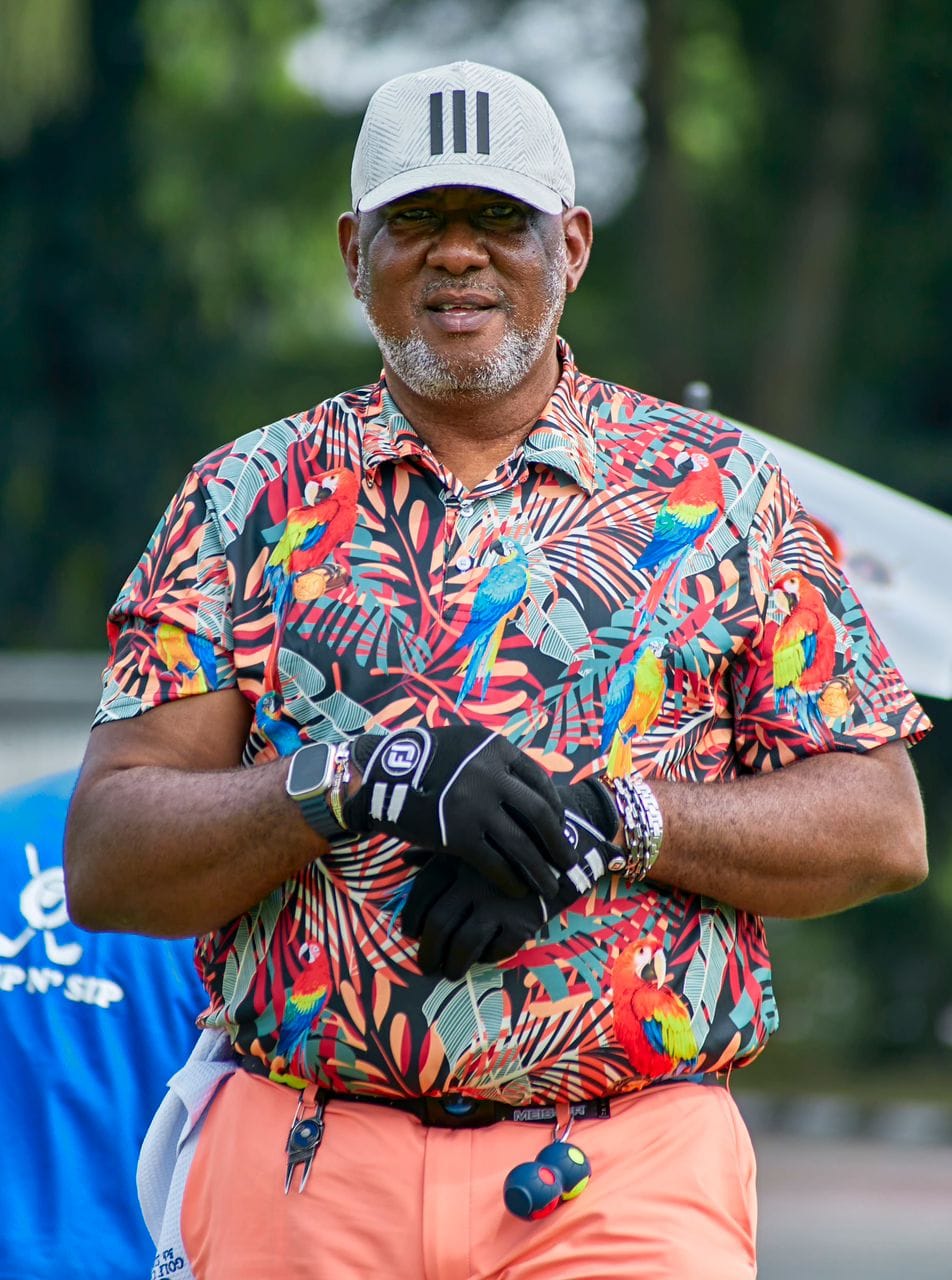
By Julius Tambaya, Abuja
Chief Leo Edochie, Nigeria’s number one celebrity golfer turned heads with a jaw-dropping appearance at The Shire Course, one of the iconic golf destinations in the United Kingdom.
It was all glitz and glamour as Edochie and a handful of his friends played an invitational at the prestigious course in the last weekend of July.
The Shire London is uniquely different in a number of ways. Unlike other conventional golf courses, it has six par threes, six par fours and six par fives. There are no two consecutive holes of the same par on this Course that prides itself as being “warm, unpretentious and friendly”.
As the only golf course in the United Kingdom designed by the legendary Seve Ballesteros, its signature feature is the Hole 18 with an S-shaped lake which is described as “one of the country’s most demanding closing holes”.
If the topic is golf, Chief Edochie will raise no eyebrows if you refer to him as an addict or fanatic. And that explains why his steadily-expanding, feel-good golf itinerary took him to The Shire London where he shone brightly, not necessarily by the number of birdies he returned but the significance of his message.
“It was a fantastic experience to play in such a high-profile course,” he says. “Though I had a solid round, it was not all about me. It’s about showing those kids in Port Harcourt, Enugu, Kaduna or Lagos that The Shire is not out of their reach.
“Yes, I am honoured to be adored as Nigeria’s celebrity golfer but my real goal is to inspire the next generation of golfers and enhance women’s participation in the sport in our country. If my round here in London makes one person to pick up golf, then I’m as excited as hitting an eagle on a difficult hole”.
But without a doubt, Leo brought swag and aura to the invitational at The Shire. His intimidating physique, bright apparels and trademark two-tone golf shoes were unmistakable on the fairways and left onlookers in awe. “Oh, that’s a lovely shot,” Edochie gleefully yelled after nicely scooping the ball from a greenside bunker.
The Celebrity golfer, who is also , a consummate professional and wealthy entrepreneur, playing golf is no more a hobby, it is an obsession spurred by a huge appetite to unlock the sport’s untapped potentials and provide the platform for nurturing future champions.
That explains why he continues to generate headlines for readily reaching his fat wallet to promote the game as well as offer substantial charitable contributions.
In no distant time, he will be hosting Celebrity Golfer Leo Edochie Charity Golf tournament which fits into his persona. True to his long-standing reputation for giving back to humanity, the proceeds from the event will be dedicated to charity.
The surge in celebrity participation in golf by Nigerians today reflects Leo’s impact, enhanced more by his leveraging the social media to share his experiences on and off the fairways as a way to promote the sport.
Yet, he has a new dream. He has expressed a burning desire to introduce Nigerians to the experience of watching golf tournaments live, replicating the spectator culture common in the developed countries and in the PGA events. Such fan engagement, according to Edochie, “will change the perception of golf, boost tourism and bring in more people into the game.”
As Chairman of Python Golf Club Open tournament, this former president of Port Harcourt Polo Club plans to use the next golf tournament in November to pilot the initiative of creating the spectator atmosphere.
According to Leo, “I’m deeply excited when I see other people following in my footsteps, not only by the way they dress but by also recording and airing their games.
“My next goal is to bring Nigerians to watch golf tournaments live, just like they watch football games. The merits are so much that we can’t afford to miss out on the foreseeable opportunities.”
However, the Shire experience did not obscure the primary reason of Chief Edochie’s London visit- proud father and mother were attending the graduation of their last son in the company of their other children and friends. All his 3 kids graduated from the same university of Reading in England.
Coming soon for the celebrity golfer is golf entrepreneurship and merchandising.
The golf community eagerly anticipates.
By Willie Adegbite
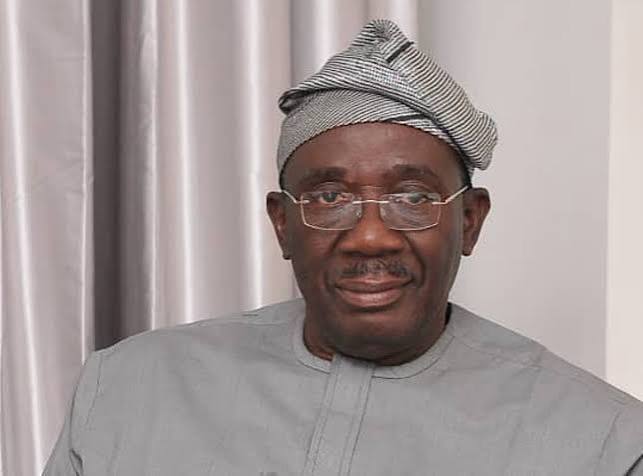
A video clip has placed Senator Francis Fadahunsi at the centre of a political firestorm. In it, he appears to use language that many have interpreted as a call to violence against members of the Accord Party.
The senator insists the footage was edited and that his words were metaphorical, but the controversy has already taken hold. His political opponents have demanded his arrest, while the National Human Rights Commission has called for his suspension, arrest and investigation.But in the rough-and-tumble of Nigerian politics, context matters. This controversy is about more than an incautious word.
It also raises questions about the political environment in which the remarks were made and the allegations of violence that Fadahunsi says prompted them.It is important to state clearly that Senator Fadahunsi’s remarks do not reflect the position of the All Progressives Congress or its governorship candidate in Osun State. The APC has never subscribed to do-or-die politics. Its candidate is not an advocate of violence or political thuggery. The party believes in competitive elections conducted within the boundaries of law and civility. That distinction matters because the temptation in partisan politics is to treat the words of one member as the doctrine of the entire party. That is not the case here.
Let us first deal with the offending word.
In the language of Nigerian political campaigning, “kill” can sometimes be used as visceral hyperbole for “overwhelm”, “defeat” or “send packing”. It is hardly elegant, but it is not invariably literal. In Yoruba political speech especially, vivid language is often used to describe electoral domination.
The danger is that such language can be heard differently when the political atmosphere is already tense.
Fadahunsi’s defence is that his words were taken out of context and that he was speaking metaphorically about defeating his opponents at the polls. That explanation deserves to be heard and tested against the full recording. But even if his intention was entirely political, the choice of words was reckless in an environment where allegations of violence are already circulating.
That is the uncomfortable middle ground in this controversy.
We should neither assume that the senator intended physical violence simply because a word was used, nor pretend that the word was harmless because it may have been metaphorical.
The more important question is what prompted the outburst.
Fadahunsi has alleged that as many as 30 APC members were killed in Osun within a month, while other reports have put his broader claim at more than 40 people killed in Osun East over the past year. These are serious allegations, not established facts, and they require verification.
But they should not be dismissed because they come from a politician currently facing scrutiny.
If even a fraction of these allegations is substantiated, Osun has a serious security problem that deserves the attention of the police and other relevant authorities. The families of anyone killed in political violence deserve investigation and justice, irrespective of party affiliation.
This is where the controversy risks becoming distorted. The attention devoted to Fadahunsi’s words should not prevent the authorities from examining the allegations of violence that he says formed their backdrop.
The two issues can be addressed at the same time.
The senator’s language can be investigated, while the alleged killings can also be investigated. One does not cancel out the other.
Indeed, this is precisely where responsible governance matters. When security agencies fail to provide timely and credible information about incidents of violence, suspicion grows and political narratives quickly fill the vacuum. Viral videos then become evidence, arguments become accusations and every incident is interpreted through partisan lenses.
Fadahunsi’s outburst is therefore not necessarily the cause of the tension in Osun. It may also be a symptom of a political environment in which fear and recrimination have become increasingly prominent.
That does not excuse his language.
Public office carries a responsibility to choose words carefully, particularly during an election. A politician who knows that his supporters are agitated should be cooling tempers rather than giving opponents reason to believe that violence has been sanctioned. The APC and its candidate have consistently demonstrated that they understand this responsibility. They reject the language of violence and have called for peaceful engagement.
Fadahunsi must therefore face the consequences of his words. The police investigation should run its course, and if it establishes that he genuinely incited violence, the law should take its course.
But fairness requires the authorities to follow the same principle in examining the allegations he has raised.
If people have been killed, their families deserve more than a political argument over a viral video. They deserve to know what happened and who was responsible.
This is also where Fadahunsi himself has an opportunity to help de-escalate the situation.
He should make it unequivocally clear that whatever metaphor he intended, he does not support physical violence against Accord members or anybody else. He should urge his supporters to settle the contest at the ballot box and cooperate fully with the authorities investigating both his remarks and the incidents he has cited.
That would be more than damage control.
It would be responsible leadership.
The same standard should apply across the political divide. Nobody should be allowed to use the language of violence as political mobilisation, just as nobody should be allowed to use allegations of violence selectively for partisan advantage. For the APC and its candidate, the path is clear. The party must continue to demonstrate through its conduct and messaging that it rejects violence and upholds the principles of democratic contestation.
Osun does not need competing narratives of victimhood. It needs credible facts.
The coming election is too important for the state to become trapped in a cycle in which every inflammatory statement produces another accusation, every accusation produces another counter-accusation and the underlying violence remains insufficiently investigated.
Fadahunsi may have chosen the wrong words. He should own that responsibility. But the controversy should not end there.
The real test is whether Osun’s political leaders and institutions can look beyond the viral clip and address the conditions that made such language possible in the first place.
An election should settle political disagreements with votes. It should not leave citizens wondering whether the people seeking their mandate are prepared to protect them from the consequences of their own rhetoric.
That is the responsibility Fadahunsi now carries.
And it is a responsibility that extends far beyond him.
Dr Adegbite contributed this piece from Abuja.
By Ehi Braimah
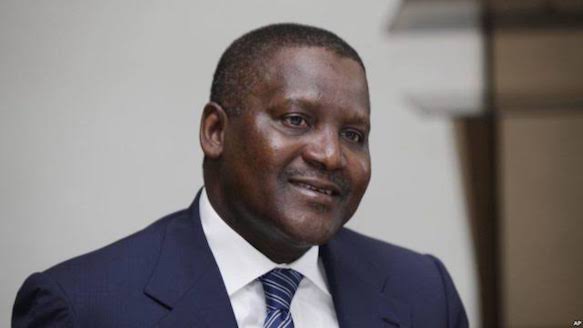
When conversations turn to investment in Africa, one name consistently dominates the discussion: Aliko Dangote. Over the past four decades, the Nigerian industrialist has become more than Africa’s richest businessman – he has emerged as one of the continent’s most influential advocates for industrialisation, value addition and economic self-reliance.
His investments tell a story that goes beyond profit; they reflect a philosophy that Africa can no longer afford to remain merely a supplier of raw materials while importing finished products at enormous cost.Dangote’s vision is rooted in a simple but transformative belief: Africa must produce what it consumes and trade more with itself.
This conviction aligns perfectly with the aspirations of the African Continental Free Trade Area (AfCFTA), which seeks to create a single African market and stimulate manufacturing, investment and intra-African trade.Unlike many investors who view Africa as a collection of disconnected national markets, Dangote has consistently viewed the continent as one vast economic space with immense potential. His strategy has therefore been to establish industries that solve critical supply gaps while creating jobs, developing local expertise and reducing dependence on imports.
His most visible success story is cement. Through the Dangote Cement Group, he transformed Nigeria from one of the world’s largest cement importers into a net exporter. Today, the company operates manufacturing plants in numerous African countries, including Ethiopia, Tanzania, Senegal, Zambia, Cameroon, Congo, South Africa and Ghana, among others. Collectively, these investments have created tens of thousands of direct and indirect jobs while supplying the materials needed for roads, bridges, schools, hospitals, housing and other infrastructure that underpin economic development.
Dangote has repeatedly argued that infrastructure is impossible without locally available cement. By manufacturing close to African markets, his company reduces transportation costs, conserves foreign exchange and builds domestic industrial capacity. The result is not merely commercial success but the strengthening of Africa’s productive economy.
Dangote’s US$45 billion capital expansion programme (2026–2030) across Africa clearly underscores his vision of prosperity for the continent. Dangote Cement alone has invested US$8.5 billion across Africa in 15 years. However, his commitment extends beyond cement into agriculture and food security. Through Dangote Sugar Refinery, he has invested heavily in integrated sugar production with the objective of reducing Africa’s dependence on imported sugar. The strategy combines cultivation, processing and refining, creating agricultural value chains that benefit farmers, transporters, processors and distributors.
Sugar, often overlooked in discussions of industrialisation, illustrates Dangote’s broader philosophy. Africa possesses fertile land, favourable climate and abundant labour. Yet, billions of dollars leave the continent annually to import products that could be produced locally. Dangote believes reversing this trend is essential for sustainable development.
The same philosophy explains his investment in fertiliser. The Dangote Fertiliser Plant in Nigeria is among the largest granulated urea fertiliser facilities in the world. Its significance extends well beyond Nigeria’s borders. Fertiliser is fundamental to improving agricultural productivity across Africa, where millions of smallholder farmers struggle with declining soil fertility and low crop yields.
By producing fertiliser locally, Africa reduces import dependence while making strategic input more accessible to farmers. In Ethiopia, Dangote has invested over US$4 billion in the country’s fertiliser plant to cut imports and reduce forex pressure. Higher agricultural productivity contributes directly to food security, export competitiveness and rural prosperity. For Dangote, industrialisation and agriculture are complementary pillars of economic transformation rather than competing priorities.
Perhaps no investment better illustrates his long-term vision than the Dangote Petroleum Refinery. For decades, Nigeria – despite being one of Africa’s largest crude oil producers – imported much of its refined petroleum products. This paradox imposed enormous costs on the economy and exposed the country to supply disruptions and foreign exchange pressures.
The refinery seeks to reverse this historical anomaly by refining crude oil domestically on an unprecedented scale. Beyond meeting Nigeria’s needs, it has the capacity to supply refined petroleum products to many African countries, reducing the continent’s dependence on imports from Europe, Asia and the Middle East. It also demonstrates that Africa can execute world-scale industrial projects despite enormous financial, technical and logistical challenges.
Dangote’s ambitions are increasingly continental. Reports of planned refinery investments and partnerships in Kenya reflect his broader vision of strengthening Africa’s energy security and industrial base beyond Nigeria. The proposed 700,000 bpd refinery in Kenya will cost about US$17 billion, and it is projected that it will take about three to five years to build. Whether through new investments, partnerships or strategic supply arrangements, the objective remains consistent: creating integrated African value chains capable of supporting economic growth across multiple countries.
The Dangote Petroleum Refinery in Ibeju Lekki, Lagos has significantly strengthened Nigeria’s energy security at a time of heightened geopolitical tensions in the Middle East, where conflicts have disrupted global oil supply chains and fuel markets. By refining crude oil locally, Nigeria has reduced its dependence on imported petroleum products, making the country less vulnerable to external supply shocks, freight disruptions and price volatility.
Had the refinery not come on stream, Nigeria would likely have faced acute petrol shortages, steeper pump prices and intensified pressure on scarce foreign exchange needed for fuel imports. Increased demand for U.S. dollars would have placed further strain on the naira, worsening exchange rate instability and fueling inflation across the economy. While Nigeria remains exposed to global crude oil price movements, the Dangote Refinery has provided a vital buffer, enhancing energy resilience, conserving foreign exchange and reinforcing the country’s economic stability during a period of global uncertainty.
Central to Dangote’s philosophy is his confidence in Africa’s future. He has frequently encouraged both African and international investors to stop seeing Africa through the narrow lens of political instability, poverty and risk. Instead, he points to the continent’s rapidly growing population, expanding middle class, abundant natural resources and entrepreneurial energy as compelling reasons to invest.
He often reminds audiences that every successful economy was built by investors willing to take calculated risks. In his view, Africa’s challenges should not discourage investment; rather, they represent opportunities to create solutions that generate both commercial returns and lasting social impact.
His message to African governments is equally consistent: sustainable development requires policies that encourage industrial investment, protect legitimate businesses, improve infrastructure and create predictable regulatory environments. Investors need confidence that long-term projects will receive stable policy support.
Dangote also believes that African capital should play a leading role in Africa’s development. While foreign direct investment remains valuable, local investors understand African markets more deeply and are often willing to commit for the long term. Their success, he argues, inspires confidence among international investors.
The emergence of the AfCFTA makes Dangote’s vision even more relevant. A continent-wide market of over 1.4 billion people offers manufacturers unprecedented opportunities to achieve economies of scale. Companies producing cement, fertiliser, sugar and refined petroleum products can increasingly serve multiple African markets under a more integrated trading framework. This is precisely the future Dangote has anticipated through decades of cross-border investment.
Ultimately, Aliko Dangote’s legacy will not be measured solely by his wealth but by the industries he has built and the confidence he has inspired in Africa’s economic potential. His investments demonstrate that African entrepreneurs can conceive, finance and execute projects of global significance. They show that industrialisation is not an abstract aspiration but a practical pathway to jobs, technology transfer, export growth and shared prosperity.
As global investors gather at Africa-focused business summits from Abuja to Nairobi, Accra, Kigali, Lome, Abidjan, Johannesburg, London, New York, Washington DC, Paris, Dubai, Beijing, Moscow, Singapore and beyond, Dangote’s journey offers an important lesson: investing in Africa is not an act of charity; it is a strategic economic decision grounded in the continent’s vast opportunities.
His life’s work is an enduring reminder that Africa’s greatest wealth lies not only beneath its soil but also in its capacity to manufacture, innovate and create value for its own people and for the world.
Ehi Braimah is a public relations specialist, marketing strategist and publisher/editor-in-chief of Naija Times and Lagos Post. He is a strong advocate for African prosperity and can be reached through: ehi.braimah@neomedia.com.ng.



Nigeria’s Celebrity Golfer, Leo Edochie Shines at London’s Shire
ShareBy Julius Tambaya, Abuja Chief Leo Edochie, Nigeria’s number one celebrity golfer turned heads with a jaw-dropping appearance at The...

Fadahunsi, Osun and the Price of Political Rhetoric
ShareBy Willie Adegbite A video clip has placed Senator Francis Fadahunsi at the centre of a political firestorm. In it,...
What Investing in Africa Means to Aliko Dangote
ShareBy Ehi Braimah When conversations turn to investment in Africa, one name consistently dominates the discussion: Aliko Dangote. Over the...

It’s not Tinubu’, Femi Kuti Reveals Nigeria’s Real Problem
ShareAfrobeat legend, Femi Kuti has claimed that President Bola Tinubu is not the major problem facing Nigeria. He argued that...


Brain Jotter Cries out after Harassment by Lagos Touts
ShareNigerian content creator, Brain Jotter, has cried out on social media after being harassed by Lagos touts, popularly known as...


Ayra Starr’s Mother Promotes ‘Starr Girl’ Album on Lagos Streets
ShareThe mother of Afrobeats star, Oyinkansola Aderibigbe, popularly known as Ayra Starr, Nene Aderibigbe, has promoted her daughter’s forthcoming ”Starr...

Int’l Youth Day: Alia Lauds Youths for Support, Pledges More Opportunities
ShareFrom Attah Ede, Makurdi Benue State Governor, Rev Fr Hyacinth Alia has commended youths of the State for their tremendous...


Finance Ministry Blames NNPCL for Failure to Answer $3b, $722m NEITI Queries
ShareBy Eze Okechukwu, Abuja The Federal Ministry of Finance has heaped blames on the Nigerian National Petroleum Company Limited (NNPCL)...


Nollywood: Villain Roles My God-given Niche, Says Patience Ozokwor
ShareVeteran Nollywood actress, Patience Ozokwor, popularly known as Mama G, says she believes God gave her a niche to effectively...


Ruger Fumes as TikToker Wishes Him Dead over Song Lyrics
ShareNigerian musician Ruger has reacted to a TikTok user who wished him dead. It all started when the female user...