
NEWS
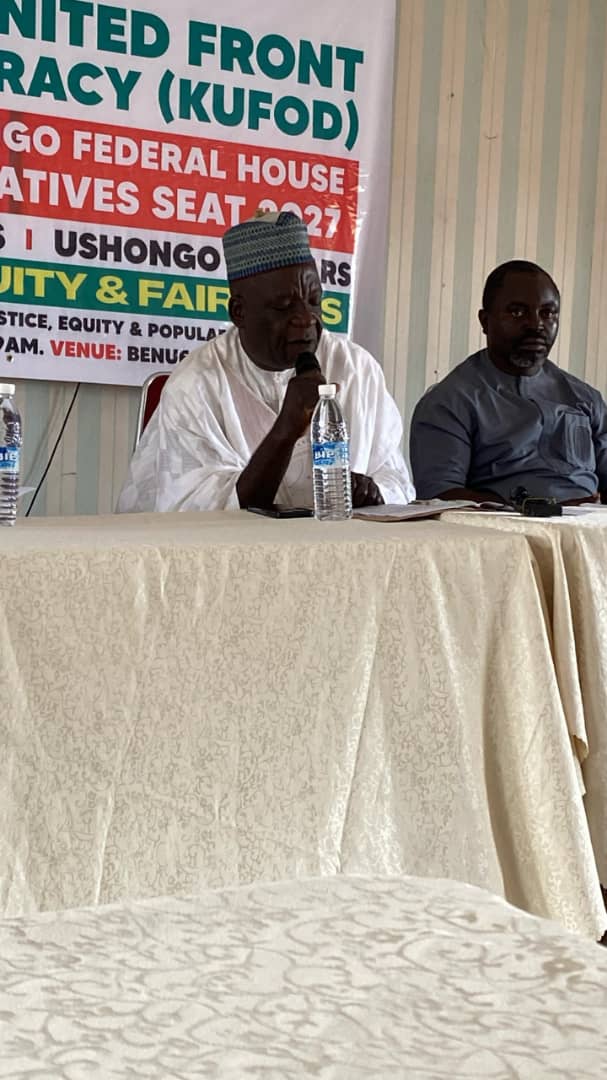
Kwande Elder Backs Ushongo for 2027 Reps Seat

By David Torough, Abuja
A respected elder statesman from Kwande Local Government Area of Benue State, Engr. Isaac Terlumun Iyorhen, has made a passionate call for the House of Representatives seat of the Kwande/Ushongo Federal Constituency to return to Ushongo LGA in the upcoming 2027 general elections, citing historical political equity and Tiv cultural principles.
Speaking at a well-attended press conference organized by the Kwande United Front for Democracy (KUFOD) with the theme “Kwande/Ushongo 2027 House of Representatives’ Seat: Time for Equity,” Engr.
Iyorhen emphasized that fairness demands Ushongo be allowed to produce the next representative after Kwande’s prolonged 12-year hold on the seat.Tracing the history of political power rotation in the constituency since 1999, Iyorhen noted that both LGAs had initially taken turns equitably. However, this balance was disrupted when Kwande retained the seat consecutively from 2015 to 2027, a deviation from the established unwritten agreement.
“It is time to correct that imbalance,” Iyorhen declared. “For equity and peaceful coexistence, Kwande must step aside and allow Ushongo its rightful turn in 2027.”
He drew on Tiv cultural traditions, particularly the ‘Ya na angbian’ principle (“Eat and give your brother his share”) and ‘Gba-Aondo’ (a culturally sanctioned way of fairness), to support his position, warning that continued political domination could strain fraternal ties between the two LGAs.
The elder also appealed to all Kwande politicians to refrain from contesting the seat in the next election, stating that any aspirant from Kwande would be seen as “only clapping for Ushongo’s victory.”
“We are not lacking in competent leaders from Ushongo. Their past representations were stellar. This time, we are confident Ushongo will present a candidate with character, competence, and integrity,” he added.
The press conference, held under a charged yet reflective atmosphere, has sparked fresh debate in the Kwande/Ushongo political landscape, with stakeholders now expected to weigh the call for justice and unity as the 2027 polls draw closer.
The Katsina State Government said it has vaccinated 67,670 eligible persons against diphtheria and secured 650,000 additional vaccine doses to contain an outbreak reported in 29 local government areas.
Executive Secretary of the Katsina State Primary Health Care Development Agency (KSPHCDA), Dr Shaimau Abba, disclosed this at a press briefing on Sunday in Katsina.
Abba said that as of Epidemiological Week 35, ending Aug.
28, suspected cases of the disease had been reported across 29 of the state’s 34 local government areas.She identified Funtua as the most affected local government area, followed by Kankia, Bakori, Katsina, Mashi and Daura.
According to her, the outbreak is a serious public health concern, however, the government has activated necessary measures to prevent further transmission and reduce severe illness and deaths.
She described diphtheria as a serious but preventable infectious disease that mainly affected the respiratory system and could spread from person to person, particularly in communities with low vaccination coverage.
She said that the response was being coordinated under the leadership of Gov. Dikko Radda, through the State Emergency Preparedness and Rapid Response Team and KSPHCDA.
The executive secretary said that the response involved the State Ministry of Health, National Primary Health Care Development Agency (NPHCDA), Nigeria Centre for Disease Control and Prevention (NCDC) and development partners.
She said that the emergency preparedness and response structure remained fully activated under the Incident Management System, with surveillance and response activities continuing across affected communities.
Abba said that the measures included intensified disease surveillance, contact tracing; line-listing of suspected cases; regular review of outbreak data, and provision of chemoprophylaxis to identified contacts.
According to her, a reactive vaccination campaign commenced on Aug. 25, targeting 15 high-risk wards across Bakori; Charanchi; Funtua; Mashi and Kankia Local Government Areas.
Abba described the response from residents as encouraging, attributing the turnout to intensive house-to-house mobilisation and the involvement of traditional leaders and other community stakeholders.
She added that close supervision by government health authorities and development partners had also contributed to the progress recorded.
The executive secretary said that the government had secured an additional 650,000 doses of diphtheria-containing vaccines to strengthen and expand the reactive immunisation campaign.
She said that the additional doses would enable health authorities to rapidly protect residents in communities experiencing the outbreak and those considered vulnerable.
Abba urged residents to cooperate with health workers and vaccination teams, stressing that community participation was crucial to stopping the spread of the disease.
She also called on parents and caregivers to ensure that eligible children received routine childhood vaccinations and urged residents to promptly report suspected cases to the nearest health facility.
Abba assured residents that surveillance, treatment and vaccination activities would continue until the outbreak was brought under control.
She said that the combined efforts of government, health workers, communities, traditional and religious leaders and development partners would be critical to protecting lives and preventing further transmission. (NAN)
From John Lamma, Jalingo
In an effort to promote lasting peace and peaceful coexistence in society, Bishop Ande Emmanuel of the United Methodist Church Nigeria (UMCN) has called for stronger collaboration among the Church, Muslim community and media.
Emmanuel made the call on Friday at the closing session of a five-day Roundtable Peace Talk and Media Interactive Session held at the Catholic Pastoral Centre, Mile Six, Jalingo, Taraba State.
The engagement, themed “Promoting Peace, Reconciliation, Unity and Sustainable Conflict Transformation,” brought together religious leaders, traditional rulers, media practitioners, women and youth leaders and other stakeholders to discuss ways of preventing conflict and strengthening peaceful coexistence.
The bishop said peace could not be achieved by Christians, Muslims, government or the media alone, stressing that it was a shared responsibility.
He urged Nigerians to move beyond discussing peace and take practical steps to make peaceful coexistence possible.
Emmanuel said the responsibility of church leaders extended beyond preaching the gospel, urging them to become active peace vanguards by promoting reconciliation, tolerance and unity in their communities.
He also called for stronger Christian-Muslim cooperation, saying religious differences should not become a basis for hatred or violence.
According to him, Christians and Muslims might have different theological beliefs, but they share communities, markets, schools, workplaces and a common country.
He urged both faith communities to protect those bonds and make Jalingo and Taraba examples of peaceful Christian-Muslim coexistence.
The bishop said the United Methodist Church in Nigeria had learned important lessons from its own experience of internal conflict and reconciliation.
He said the Church had experienced serious divisions over the years, resulting in leadership disputes, strained relationships, court cases, factions and divided communities.
He explained that conflict transformation should go beyond simply ending immediate disputes to addressing the underlying causes of conflict, including mistrust, injustice, inequality, exclusion, grievances and damaged relationships.
The bishop said the Church’s experience could serve as a message of hope to Nigeria, arguing that if a divided church could begin to rebuild trust and unity, divided communities could also overcome longstanding differences.
Emmanuel, however, stressed that unity did not mean uniformity, noting that Nigerians could belong to different ethnic groups, political parties and religious traditions while respecting one another.
The bishop particularly urged journalists and media managers to recognise their role in promoting peace, warning that irresponsible reporting and unverified information could worsen tensions and trigger crises.
He called on media practitioners to verify information before publishing it, investigate claims, provide context and avoid inflammatory language that could deepen religious, ethnic or political divisions.
Emmanuel warned against allowing social media to turn newsrooms into “forwarding centres,” urging journalists to cross-check information before amplifying it.
He encouraged journalists to report not only conflicts but also stories of reconciliation, cooperation, community rebuilding and peaceful relations between Christians and Muslims.
According to him, responsible journalism could help identify early warning signs of conflict, expose injustice before it escalated and give communities opportunities to be heard.
Emmanuel also urged religious leaders to ensure that churches and mosques did not become platforms for hatred.
He called for regular meetings between Christian and Muslim leaders and joint peacebuilding initiatives involving young people and women.
The bishop cautioned against collectively blaming Muslims for acts of violence committed by extremists, saying individual criminal acts should not be used to stigmatise entire religious communities.
Emmanuel stressed that sustainable peace must also be built on justice, accountability, good governance, development, education, employment and security.
The bishop also called for greater involvement of traditional rulers in early warning, mediation, dialogue and community reconciliation.
According to him, traditional rulers understand their communities, histories and grievances and can often identify rising tensions before they develop into major conflicts.
Speaking on behalf of traditional rulers, HRH Alh. Abubakar Mamoud Adamu, Kur Jibu Bali, called for collective efforts to promote peaceful coexistence and national unity.
Adamu urged religious leaders to consistently educate their followers on the importance of dialogue and peaceful resolution of disputes whenever misunderstandings arise.
Pastor Dr. Haniel Banti, Kpan Sanwi Chiefdom, Lau Local Government Area, called for an attitudinal change among church leaders, accusing some of contributing to crises within the Church.
Banti urged the Church to reclaim its position as a vanguard of peace by demonstrating tolerance, reconciliation and responsible leadership.
On youth development, Emmanuel said young people should not be viewed merely as a problem to be controlled, but as a generation that should be empowered through education, skills, employment and opportunities.
Rev. Dr. Christie Neal, Domain Facilitator from the United States, charged participants to put into practice the lessons acquired during the five-day Roundtable Peace Talk.
Neal commended Bishop Emmanuel for organising the programme, describing the initiative as timely and relevant to the promotion of peace in society.
The bishop also challenged the United Methodist Church to take the lessons from its reconciliation experience beyond the Church and contribute to peacebuilding efforts across Nigeria.
He urged members of the Church to protect the unity achieved through reconciliation and avoid returning to factionalism, sectionalism and personality-driven divisions.
Emmanuel said the Church’s experience should demonstrate to Nigerians that reconciliation was possible even after prolonged division.
He urged Nigerians to reject the use of religion, ethnicity and politics as weapons of division and instead choose dialogue, reconciliation, justice and unity.
Emmanuel proposed seven commitments for peacebuilding: speaking truth without spreading hatred, verifying information before amplifying it, choosing dialogue before escalation, protecting human dignity, building bridges across religious and social divides, pursuing justice without revenge, and making peacebuilding a way of life.
The bishop called on Nigerians to become “bridge-builders” and work towards a society where religious, ethnic and political differences would not destroy the country’s common humanity.
The event, which marked the conclusion of the five-day peace engagement, featured interactive question-and-answer sessions, while certificates of participation were presented to delegates at the conclusion of the programme.
From John Lamma, Jalingo
In an effort to promote lasting peace and peaceful coexistence in society, Bishop Ande Emmanuel of the United Methodist Church Nigeria (UMCN) has called for stronger collaboration among the Church, Muslim community and media.
Emmanuel made the call on Friday at the closing session of a five-day Roundtable Peace Talk and Media Interactive Session held at the Catholic Pastoral Centre, Mile Six, Jalingo, Taraba State.
The engagement, themed “Promoting Peace, Reconciliation, Unity and Sustainable Conflict Transformation,” brought together religious leaders, traditional rulers, media practitioners, women and youth leaders and other stakeholders to discuss ways of preventing conflict and strengthening peaceful coexistence.
The bishop said peace could not be achieved by Christians, Muslims, government or the media alone, stressing that it was a shared responsibility.
He urged Nigerians to move beyond discussing peace and take practical steps to make peaceful coexistence possible.
Emmanuel said the responsibility of church leaders extended beyond preaching the gospel, urging them to become active peace vanguards by promoting reconciliation, tolerance and unity in their communities.
He also called for stronger Christian-Muslim cooperation, saying religious differences should not become a basis for hatred or violence.
According to him, Christians and Muslims might have different theological beliefs, but they share communities, markets, schools, workplaces and a common country.
He urged both faith communities to protect those bonds and make Jalingo and Taraba examples of peaceful Christian-Muslim coexistence.
The bishop said the United Methodist Church in Nigeria had learned important lessons from its own experience of internal conflict and reconciliation.
He said the Church had experienced serious divisions over the years, resulting in leadership disputes, strained relationships, court cases, factions and divided communities.
He explained that conflict transformation should go beyond simply ending immediate disputes to addressing the underlying causes of conflict, including mistrust, injustice, inequality, exclusion, grievances and damaged relationships.
The bishop said the Church’s experience could serve as a message of hope to Nigeria, arguing that if a divided church could begin to rebuild trust and unity, divided communities could also overcome longstanding differences.
Emmanuel, however, stressed that unity did not mean uniformity, noting that Nigerians could belong to different ethnic groups, political parties and religious traditions while respecting one another.
The bishop particularly urged journalists and media managers to recognise their role in promoting peace, warning that irresponsible reporting and unverified information could worsen tensions and trigger crises.
He called on media practitioners to verify information before publishing it, investigate claims, provide context and avoid inflammatory language that could deepen religious, ethnic or political divisions.
Emmanuel warned against allowing social media to turn newsrooms into “forwarding centres,” urging journalists to cross-check information before amplifying it.
He encouraged journalists to report not only conflicts but also stories of reconciliation, cooperation, community rebuilding and peaceful relations between Christians and Muslims.
According to him, responsible journalism could help identify early warning signs of conflict, expose injustice before it escalated and give communities opportunities to be heard.
Emmanuel also urged religious leaders to ensure that churches and mosques did not become platforms for hatred.
He called for regular meetings between Christian and Muslim leaders and joint peacebuilding initiatives involving young people and women.
The bishop cautioned against collectively blaming Muslims for acts of violence committed by extremists, saying individual criminal acts should not be used to stigmatise entire religious communities.
Emmanuel stressed that sustainable peace must also be built on justice, accountability, good governance, development, education, employment and security.
The bishop also called for greater involvement of traditional rulers in early warning, mediation, dialogue and community reconciliation.
According to him, traditional rulers understand their communities, histories and grievances and can often identify rising tensions before they develop into major conflicts.
Speaking on behalf of traditional rulers, HRH Alh. Abubakar Mamoud Adamu, Kur Jibu Bali, called for collective efforts to promote peaceful coexistence and national unity.
Adamu urged religious leaders to consistently educate their followers on the importance of dialogue and peaceful resolution of disputes whenever misunderstandings arise.
Pastor Dr. Haniel Banti, Kpan Sanwi Chiefdom, Lau Local Government Area, called for an attitudinal change among church leaders, accusing some of contributing to crises within the Church.
Banti urged the Church to reclaim its position as a vanguard of peace by demonstrating tolerance, reconciliation and responsible leadership.
On youth development, Emmanuel said young people should not be viewed merely as a problem to be controlled, but as a generation that should be empowered through education, skills, employment and opportunities.
Rev. Dr. Christie Neal, Domain Facilitator from the United States, charged participants to put into practice the lessons acquired during the five-day Roundtable Peace Talk.
Neal commended Bishop Emmanuel for organising the programme, describing the initiative as timely and relevant to the promotion of peace in society.
The bishop also challenged the United Methodist Church to take the lessons from its reconciliation experience beyond the Church and contribute to peacebuilding efforts across Nigeria.
He urged members of the Church to protect the unity achieved through reconciliation and avoid returning to factionalism, sectionalism and personality-driven divisions.
Emmanuel said the Church’s experience should demonstrate to Nigerians that reconciliation was possible even after prolonged division.
He urged Nigerians to reject the use of religion, ethnicity and politics as weapons of division and instead choose dialogue, reconciliation, justice and unity.
Emmanuel proposed seven commitments for peacebuilding: speaking truth without spreading hatred, verifying information before amplifying it, choosing dialogue before escalation, protecting human dignity, building bridges across religious and social divides, pursuing justice without revenge, and making peacebuilding a way of life.
The bishop called on Nigerians to become “bridge-builders” and work towards a society where religious, ethnic and political differences would not destroy the country’s common humanity.
The event, which marked the conclusion of the five-day peace engagement, featured interactive question-and-answer sessions, while certificates of participation were presented to delegates at the conclusion of the programme.




Omarana Accuses Atiku of Backdoor Move to Substitute ADC Governorship Candidate
ShareFrom Yagana Ali, Yola The governorship candidate of the African Democratic Congress (ADC) in Adamawa State, Ambassador (Engr.) Omar Suleiman,...
Katsina Vaccinates 67,670 as Diphtheria Outbreak Hits 29 LGAs
ShareThe Katsina State Government said it has vaccinated 67,670 eligible persons against diphtheria and secured 650,000 additional vaccine doses to...
Bishop Ande Mobilises Church, Muslims, Media for Peace
ShareFrom John Lamma, Jalingo In an effort to promote lasting peace and peaceful coexistence in society, Bishop Ande Emmanuel of...
Bishop Ande Mobilises Church, Muslims, Media for Peace
ShareFrom John Lamma, Jalingo In an effort to promote lasting peace and peaceful coexistence in society, Bishop Ande Emmanuel of...


Sanwo-Olu Charges Youths on Nigeria’s Devt, Good Character
ShareLagos State Governor, Babajide Sanwo-Olu has charged youths to contribute to Nigeria’s development and imbibe good character to become responsible...
Varsity Student Recounts Hot Water Attack by Cousin in Benue
ShareFrom Attah Ede, Makurdi A 200-level Political Science student of Rev. Fr. Moses Orshio Adasu University (MOAUM), identified as Rose...

Maikalangu Mourns Former FCT NUJ Chairman, Osadebamwen
ShareBy Raphael Atuu, Abuja The Executive Chairman of Abuja Municipal Area Council (AMAC) and Chairman of the Association of Local...
Enugu Trains over 15,000 Civil Servants on E-Governance, Digitalization
ShareFrom Sylvia Udegbunam, Enugu The Enugu State Government has trained over 15,000 civil and public servants on e-governance and digitalisation...
FG Hands Over 188 Housing Units to Taraba
ShareBy Raphael Atuu, Abuja The Federal Government, officially handed over 188 housing units to the Taraba State Government in Jalingo,...


Mbah, NSC Unveil Coal City Games Mascot
ShareFrom Sylvia Udegbunam, Enugu Enugu State Governor, Dr. Peter Mbah, and the National Sports Commission (NSC), have unveiled the official...