
Foreign News
Mexican President Urges the U.S. to Help Fight Drug Trafficking

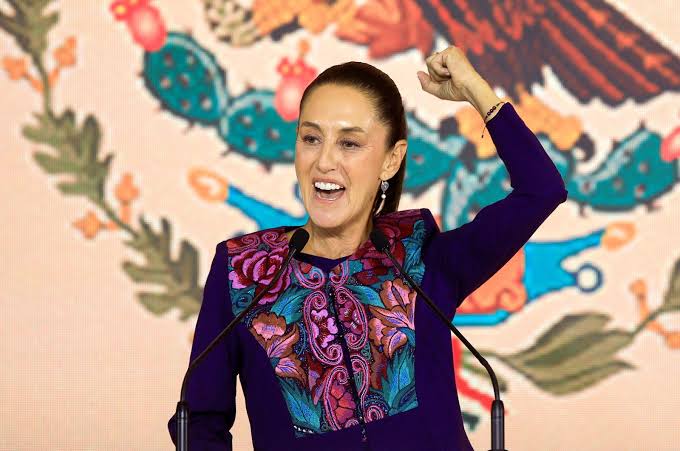
The United States must do its part in the fight against drug trafficking, Mexican President Claudia Sheinbaum said, following recent revelations of corruption at the U.S. Drug Enforcement Administration.
“We insist that they have a very important part to play over there and they shouldn’t just keep pointing the finger at Mexico,” Sheinbaum said at a press conference in the National Palace.
She said Mexico has succeeded in slashing the flow of fentanyl into the United States by more than 70 per cent, a figure acknowledged by U.
S. authorities.She added that the United States is also where the distribution of drugs and money laundering take place on a massive scale due to the high rate of drug consumption.
Sheinbaum also noted that Sara Carter, director of the U.S. Office of National Drug Control Policy, has acknowledged that drug abuse in the United States is a public health issue.
In May, Carter’s office released a document in which the U.S. federal government acknowledges the need for a national public health policy to address drug addiction.
Earlier this year, Carter visited Mexico and expressed interest in the Mexican government’s initiatives aiming to tackle the root causes of violence and prevent drug use.
Study says 12 per cent of Australian adolescents had used e-cigarettes in their lifetime and almost six per cent had used tobacco.
The study, published by the Australian and New Zealand Journal of Public Health also said that 3.
5 per cent had used nicotine pouches on Wednesday.According to the survey by the journal 1,848 students aged 14-18 across the Australian states of New South Wales, Queensland and Western Australia have put their health at risk using a range of different nicotine products.
More than two per cent of respondents had used all three products.
Among adolescents who had used nicotine pouches, a newly emerging nicotine product of concern, 82 per cent had also vaped and 71 per cent had smoked cigarettes, the survey showed.
Males reported higher use of nicotine pouches and cigarettes than females, it said, adding that nicotine pouch use was reported by 4.8 per cent of males, compared with 1.5 pe rcent of females.
Meanwhile, tobacco cigarette use was reported by 6.9 per cent of males and 4.1 per cent of females.
The study shows the need for targeted strategies to prevent teenage nicotine addiction and to support young people to quit, said lead author Lauren Gardner, a senior research fellow at the University of Sydney.
“Many teens who have used one nicotine product have also tried others,” Gardner said.
The researcher added that the findings showed the need for prevention strategies addressing “shared risk factors for nicotine use more broadly, rather than focusing on just vaping or smoking.”
Public health experts said the findings highlight the need for governments to protect young people from nicotine products, crack down on illegal sales and fund evidence-based prevention campaigns.
The Russian Federation has refuted accusation by Germany linking Moscow to an attempted Leipzig/Halle Airport drone attack which occurred on Aug. 4.
The Embassy of Russia Federation in Nigeria in a statement issued by its Chargé d’ Affaires, Igor Ivannikov, on Tuesday in Abuja, described the accusation as ‘unsubstantiated”.
He said Berlin had not provided technical or independent investigative evidence to validate that the reported drone originated from Russia.
“Berlin’s investigations and intelligence saying that Russia was involved in the incident as part of a broader pattern of Russian hybrid operations, are misleading.
“Russia’s Foreign Minister Sergey Lavrov reiterated that Germany cannot confirm the drone originated from Russia, yet assumed its configuration is similar to equipment used by Russia,” he said.
The chargé d’ affaires explained that similar drone equipment could be manufactured by several countries and that such are commercially available, while stressing the need for joint investigation between Germany and Moscow to ascertain the truth.
“Germany’s failure to pursue such an investigation demonstrates a biased approach and a lack of genuine interest in establishing the facts surrounding the incident,” Ivannikov said.
He said that measures taken by Berlin, in terms of the closure of the Russian Consulate in Bonn, the Russian House cultural centre, restriction of visa and sanctions, were not proportional to the unexamined case.
He also said that such unverified action suggested a pre-fabricated scenario aimed at deliberately seeking confrontation, using a false pretext to severely damage bilateral relations.
“Such actions violate international law and the foundations of diplomatic relations.
“It is also simultaneously increasing military support for Kyiv authorities, whose actions Russia has long documented as exhibiting radical nationalism, russophobia,” he said.
German Chancellor Friedrich Merz has clashed with AfD leader Alice Weidel in parliament, calling her party a “destructive force” with a migration policy that amounts to “ethnic cleansing” for skilled workers.
Merz was addressing the Bundestag in the aftermath of the anti-immigration party’s sweeping victory in the eastern state of Saxony-Anhalt where it won almost 44% of the vote, while the chancellor’s conservatives saw their vote halved.
Weidel told MPs that voters had shown that Merz’s coalition with the centre left was a total failure and his time was up.
Merz hit back saying the AfD had harmed German interests by backing Russia, and its “remigration” policy would affect millions.
It is not yet clear whether the party will be able to form a government or not in Saxony-Anhalt, having fallen three seats short of an outright majority. No far-right party has won power in any of Germany’s 16 states since World War Two, and Merz has admitted the “seismic” result has changed Germany.
The AfD’s success has been praised by US President Donald Trump, who said “the Populist Party in Germany just had a really big night”, linking the victory to “absolutely horrible immigration rules and regulations”.
The AfD in Saxony-Anhalt has been labelled as “right-wing extremist” by German domestic intelligence and the party has promised a “deportation and remigration” offensive targeting irregular migrants.
Trump had been due to speak by phone to the German chancellor on Wednesday to mark the 25th anniversary of the 9/11 attacks in the US, but the government spokesman in Berlin said the call had been postponed without saying why. No new date has been set.
Repeatedly heckled by AfD MPs, the chancellor told Weidel that one in six skilled workers had a migration background, and if her party had its way then its policy would amount to “nothing other than an ethnic cleansing in the skilled trades based on skin colour and origin”.
While the government understood some deportations were needed, he said it made a careful distinction between those who contributed to German prosperity and those without permanent residency.
Disruption by AfD MPs became so loud that at one point Bundestag President Julia Klöckner threatened to start expelling people from the chamber: “We are not on a football pitch.”
Weidel said mass migration had left Germans with daily knife violence and attacks on trains and in stations, but Merz warned that the AfD’s plans would mean that no single care home, hospital or restaurant could function.
As leader of the main opposition party in the Bundestag, Weidel opened the session by telling Merz his Christian Democrats had been “pulverised” in Saxony-Anhalt, after winning 17.2% of the vote, and she accused his government with the Social Democrats of driving Germany towards bankruptcy.
Merz said her party had not won an outright majority in Saxony-Anhalt and it would not achieve one in Germany.
“You are and will remain a destructive force,” he said, accusing the party of cheating the voters by saying before the election that their candidate for premier, Ulrich Siegmund, would only rule if he won a majority, but hours after the vote deciding to go and find one.
The AfD has opened the door to working with another party, perhaps the left-wing populist BSW, as long as it backs Siegmund to be state premier.
Siegmund’s number two in Saxony-Anhalt, has even suggested that Merz’s CDU could work with his party, if it abandons the so-called firewall (Brandmauer), under which no mainstream party will work with the far right.



Mexican President Urges the U.S. to Help Fight Drug Trafficking
ShareThe United States must do its part in the fight against drug trafficking, Mexican President Claudia Sheinbaum said, following recent...
Australian Teens Use Multiple Nicotine Products – Study
ShareStudy says 12 per cent of Australian adolescents had used e-cigarettes in their lifetime and almost six per cent had...
Russia Dismisses Accusation of Attempted Leipzig/Halle Airport Drone Attack
ShareThe Russian Federation has refuted accusation by Germany linking Moscow to an attempted Leipzig/Halle Airport drone attack which occurred on...
Germany’s Merz Attacks AfD in Stormy Debate after Far-right Election Win
ShareGerman Chancellor Friedrich Merz has clashed with AfD leader Alice Weidel in parliament, calling her party a “destructive force” with...
Namibia Calls for Green Financing to Drive Industrialisation, Job Creation
ShareNamibia on Wednesday called for innovative green financing to support industrialisation, job creation and expanded electricity access as the country...
France, Britain, Canada Affirm Commitment to Two-state Solution
ShareBritish, French, and Canadian leaders have affirmed their “commitment to protect the two-state solution” in the face of the “systematic...


UNESCO Warns of Continued Rise in Attacks on Schools Worldwide
ShareThe United Nations Educational, Scientific and Cultural Organisation (UNESCO) expressed its concern Wednesday over the continued rise in attacks on...
Kimi Raikkonen’s Son Robin, 11, Signs for Red Bull
ShareRobin Raikkonen, the 11-year-old son of former Formula 1 world champion Kimi Raikkonen, has signed for Red Bull. Nicknamed ‘Ace’,...


Messi Agrees to Buy Second Spanish Club
ShareSpanish second-division side Eldense said Argentina great Lionel Messi has reached a “preliminary agreement” to become the club’s majority shareholder....
2026 Python Open: Edochie’s C’ttee Sets Record as Members Splash N82m in Pre-tournament Fundraiser
ShareBy Eze Okechukwu, Abuja The Python Golf Club in Port Harcourt, Saturday, September 5, 2026, set a record for pre-tournament...