
NEWS
NAF Trainer Aircraft Crashes in Kaduna


Nigerian Air Force (NAF) yesterday said its Super Mushshak trainer aircraft was involved in a minor mishap in Kaduna.
This was contained in a statement made available to Defence Correspondents in Abuja by the Director of Public Relations and Information of NAF, Air Vice Marshal Edward Gabkwetv.
The statement said the accident which occurred at about 3.
5 nautical miles from Kaduna military airfield involved two pilots who were returning from a routine training flight.Both pilots came out of the crash unscathed.
The Chief of Air Staff, Air Marshal Hasan Abubakar ordered preliminary investigations into the incident.
By Tambaya Julius, Abuja
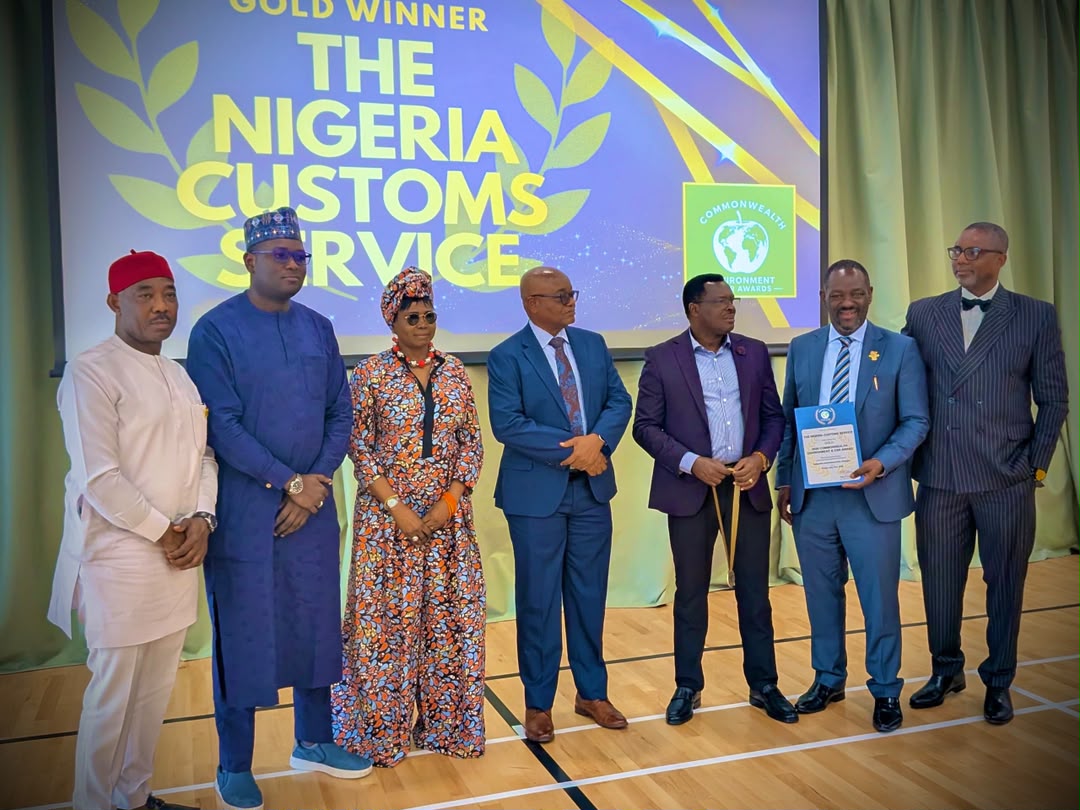
The Nigeria Customs Service (NCS) has earned international recognition after its flagship Corporate Social Responsibility (CSR) initiative, Customs Cares, won the Commonwealth Environment and CSR Gold Award in Glasgow, Scotland.
The prestigious award, presented on Friday, July 31, 2026, recognises organisations implementing measurable, sustainable and community-driven initiatives that contribute significantly to the achievement of the United Nations Sustainable Development Goals (SDGs).
Customs Cares received the top honour for its impactful interventions in education, healthcare, food security and environmental sustainability across communities in Nigeria.
Receiving the award on behalf of the Comptroller-General of Customs (CGC), Adewale Adeniyi, the Deputy Comptroller-General of Customs in charge of Enforcement, Investigation and Inspection, Timi Bomodi, described the recognition as a landmark achievement in the Service’s ongoing transformation.
“This award is both humbling and inspiring. It affirms our belief that public institutions create their greatest value not only by fulfilling their statutory mandates, but by improving lives and strengthening the communities they serve,” Bomodi said.
Adeniyi attributed the international recognition to the support of President Bola Ahmed Tinubu’s Renewed Hope Agenda, noting that the Customs Cares initiative has positively impacted more than 10 million Nigerians across 12 states and the Federal Capital Territory (FCT).
According to the CGC, the programme has delivered school renovation projects, healthcare interventions, clean water facilities, food support and the Green Borders Initiative aimed at promoting environmental sustainability.
“Beyond every classroom renovated, every borehole commissioned and every tree planted is something even more enduring; trust,” he said.
Also speaking at the event, the Governor of Tharaka Nithi County, Kenya, Muthomi Njuki, stressed the importance of global collaboration in addressing climate change.
He said no nation could tackle the climate crisis alone, emphasising that accountability, partnerships, innovation and shared responsibility remain essential to building a greener, safer and more prosperous world.
The Comptroller in charge of CSR at the Nigeria Customs Service, Mbwiduffu Ibrahim, said the global recognition would further motivate the Service to expand its community development efforts.
“For a long time, we worked believing that the impact in our communities was reward enough. Today, this international recognition tells us that those efforts have not gone unnoticed,” she said.
According to the organisers, the Nigeria Customs Service earned the award for its innovative Hub-and-Spoke Community Activation Model, which has strengthened community engagement and expanded the reach of its CSR interventions.
The organisers added that the award reinforces the NCS’s growing reputation as a modern customs administration committed to revenue generation, trade facilitation, border security and sustainable national development.

By David Torough, Abuja
A Lagos-based law firm, Law Pharm LP, has petitioned Lagos State Governor, Mr. Babajide Sanwo-Olu, urging him to immediately suspend the administrative process leading to the appointment and installation of Prince Ibrahim Adebowale Saliu as the Onise of Ise Kingdom, pointing out pending litigation before the Lagos State High Court.
In a petition dated August 3, 2026, and signed by Adekunle Biobaku Esq.
, the solicitors, acting for claimants in Suit No. EPD/15252GCMW/2026, between Alh Prince R O Ogunbajo Adegoroye, Prince Adefowope Adenupebi Adegoroye, Prince Adelaja Adeyinka Salisu Adegoroye and others vs Gov of Lagos state, Attorney General and Commissioner for justice , Lagos state and four others warned that allowing the process to continue before the court determines the dispute could undermine the rule of law and fuel tension in the community.The petition, also copied to the Commissioner for Local Government, Chieftaincy Affairs and Rural Development, Lagos State said the government should preserve the status quo until the courts pronounce on the legality of the competing claims.
“Our clients have directed us to respectfully bring to Your Excellency’s attention a development which, if not urgently addressed, is capable of undermining the administration of justice, eroding public confidence in the rule of law and creating avoidable tension in Ise Kingdom,” the petition read.
According to the lawyers, the dispute over the vacant Onise stool is already before the Lagos State High Court in two separate suits; Suit No. ID/107169CM/2026 between Prince Taibu Adewale Ogunbanjo and another against the Attorney-General and Commissioner for Justice, Lagos State and four others, as well as Suit No. EPD/15252GCMW/2026 filed by their clients.
The firm stated that its clients’ case first came up before the High Court sitting in Epe on June 29, 2026, but was adjourned to October 29 after the court did not sit.
It disclosed that it had earlier written to the Attorney-General and the Permanent Secretary, Ministry of Local Government, Chieftaincy Affairs and Rural Development on July 24, 2026, notifying them of the pending litigation and reminding the government of its obligation to maintain the status quo pending the determination of the case.
The petition further stated that the Lekki Local Council Development Area (LCDA), the authority responsible for the appointment process, had informed the state government that multiple nominations had emerged from the Okunoye Ruling House and that issues surrounding the nomination of Prince Ibrahim Adebowale Saliu and the applicable chieftaincy declaration were already before the court.
According to the solicitors, the council consequently indicated that it could not proceed with the appointment process until the pending suits were determined.
They also said the LCDA convened a stakeholders’ meeting involving the contending families and cautioned against taking any action capable of prejudicing the court proceedings.
However, the lawyers expressed disappointment that the Lagos State Ministry of Justice allegedly advised the Ministry of Local Government, Chieftaincy Affairs and Rural Development to continue with the administrative process for Prince Saliu’s approval and appointment.
“It is therefore with profound disappointment that our clients learnt that notwithstanding these developments, the Ministry of Justice issued legal advice directing the Ministry to proceed with the administrative process leading to the approval and appointment of Prince Ibrahim Adebowale Saliu as the Onise of Ise Kingdom,” the petition stated.
The petition reproduced portions of the Attorney-General’s legal advice, which reportedly concluded that Prince Saliu’s nomination complied with the Obas and Chiefs of Lagos State Law, 2015, and advised the ministry to continue the approval process.
However, the solicitors argued that the legal advice effectively determined issues that were already before competent courts.
“It is deducible from the above legal advice that the Honourable Attorney-General and Commissioner for Justice has unilaterally constituted itself as a party, the Bar and the Bench on the same issues that have been submitted for adjudication before Courts of competent jurisdiction,” the petition alleged.
The lawyers further argued that proceeding with the appointment would amount to presenting the court with a completed act before judgment.
“The Government has elected to determine administratively questions that are already awaiting judicial determination. Such a course would be inconsistent with the constitutional doctrine of separation of powers, diminish public confidence in the impartiality of Government and risk creating avoidable tension within Ise Kingdom,” the petition added.
To support their position, the solicitors cited the Supreme Court decisions in Governor of Lagos State v. Ojukwu (1986) and Kotoye v. Central Bank of Nigeria (1989), arguing that parties to a pending suit must preserve the subject matter of the litigation until the court reaches a final decision.
The petition also relied on Section 6(6)(a) and (b) of the 1999 Constitution (as amended), which vests judicial powers in the courts.
The lawyers appealed to Governor Sanwo-Olu to direct the immediate suspension of every administrative process relating to the approval, recognition or installation of any person as the Onise of Ise Kingdom awaiting the determination of the pending suits before the High Court.
They also urged the governor to direct the Ministries of Justice and Local Government, Chieftaincy Affairs and Rural Development to refrain from taking further steps capable of prejudicing the proceedings, maintain the existing status quo and ensure that all government agencies act in accordance with the rule of law.
“Our clients remain steadfast in their confidence that Your Excellency’s administration will take immediate steps to preserve the integrity of the judicial process and prevent any action capable of rendering the pending proceedings nugatory,” the petition stated.
As of press time, the Lagos State Government had not responded to the petition.
By Uche Uwaleke
Nigeria’s public debt has become one of the defining economic policy issues of our time. While debates often focus on the size of the debt, a more fundamental question deserves greater attention: what is the composition of Nigeria’s debt portfolio, and does it support long-term economic transformation? The answer to this question is far more consequential than the headline debt figure itself.
Countries have borrowed heavily and prospered because their borrowing financed productive assets that generated growth, employment, and future revenues.Others have accumulated debt without creating corresponding economic value, leaving future generations with liabilities but few productive assets.
Nigeria stands at this important crossroads.According to the Debt Management Office (DMO), Nigeria’s total public debt stood at N159.3 trillion (about US$111 billion) as of 31 December 2025.
Domestic debt accounted for 53.27 percent of the total, while external debt represented 46.73 percent. On the surface, this distribution appears balanced. However, a closer examination reveals structural weaknesses that should concern policymakers.
Within the domestic debt stock, Federal Government of Nigeria (FGN) Bonds accounted for more than 79 percent, while infrastructure-specific instruments such as Sukuk and Green Bonds represented less than two percent.
The external debt profile reveals a similar pattern. Eurobonds constituted about 36 per cent of external debt but accounted for more than half of external debt service obligations.
By contrast, concessional loans from multilateral institutions such as the World Bank Group and the African Development Bank made up roughly 46 per cent of external debt yet imposed significantly lower debt servicing costs.
These figures reveal that Nigeria’s debt challenge is not primarily one of quantity but of quality. The country increasingly relies on relatively expensive, discretionary commercial borrowing rather than project-linked financing tied directly to productive investments.
This financing model undermines both fiscal sustainability and economic development.
This trend partly explains why Nigeria continues to experience a debt service-to-revenue ratio exceeding 60 percent despite maintaining a relatively modest debt-to-GDP ratio by international standards.
It goes without saying that debt sustainability is ultimately determined not by debt relative to GDP alone but by government’s capacity to generate sufficient revenue to service its obligations without crowding out essential public expenditure.
When a large share of government revenue is devoted to debt servicing, fiscal space for education, healthcare, security, social protection, and infrastructure becomes severely constrained.
The current composition of Nigeria’s public debt also raises important questions regarding compliance with the spirit and letter of Section 41 of the Fiscal Responsibility Act, 2007.
The Act provides that governments at all levels should borrow only for capital expenditure and human development on concessional terms or on terms that are economically beneficial.
The legislative intent was unmistakable: borrowing should finance investments that expand the productive capacity of the economy rather than recurrent consumption or discretionary spending.
Yet the overwhelming dominance of conventional FGN Bonds and commercial Eurobonds creates significant room for discretion regarding the ultimate application of borrowed funds. Unlike Sukuk, Green Bonds, and other infrastructure-specific financing instruments, conventional bonds are generally not tied to clearly identifiable projects with measurable outputs.
Consequently, it becomes considerably more difficult to track whether borrowed resources are deployed toward productive capital formation or absorbed into recurrent expenditure and other non-productive uses.
The consequences are visible across Nigeria’s infrastructure landscape. The country’s infrastructure stock remains below 40 per cent of GDP which is among the lowest in Sub-Saharan Africa and substantially below the levels required to sustain rapid industrialization, enhance competitiveness, and stimulate broad-based economic growth.
The persistent deficits in transportation networks, electricity infrastructure, water supply, healthcare facilities, educational institutions, and digital connectivity continue to constrain private investment and limit productivity.
Infrastructure financing should therefore occupy the centrepiece of Nigeria’s debt management strategy rather than remain a peripheral consideration. Borrowing is not inherently detrimental.
Indeed, well-structured public borrowing has historically played a critical role in the economic transformation of many successful emerging economies. What distinguishes successful borrowers from unsuccessful ones is the discipline with which debt is linked to productive investment.
Malaysia offers an instructive example. Over several decades, the country successfully utilized infrastructure-oriented financing instruments, particularly Sukuk, to finance highways, airports, seaports, rail transportation, energy infrastructure, and urban development.
By directly linking financing to specific infrastructure projects, Malaysia enhanced transparency, strengthened investor confidence, improved project monitoring, and ensured that borrowed funds created tangible public assets capable of supporting long-term economic growth.
Indonesia has similarly expanded the use of sovereign Sukuk to finance roads, bridges, airports, rail networks, and other strategic infrastructure.
Because these instruments are tied to clearly defined projects, investors can identify the assets being financed, while government agencies remain accountable for project delivery. This approach has contributed significantly to Indonesia’s infrastructure expansion over the past decade.
Chile and Canada provide additional examples through their extensive use of infrastructure bonds to finance transportation systems, water infrastructure, renewable energy, and other public assets under robust governance frameworks.
These countries demonstrate that infrastructure-focused borrowing can attract long-term institutional investors while simultaneously strengthening fiscal credibility.
The common lesson from these experiences is straightforward. When borrowing is linked directly to identifiable infrastructure projects, governments are better positioned to establish clear Key Performance Indicators (KPIs), monitor implementation, evaluate outcomes, and minimize diversion of funds.
Infrastructure bonds naturally promote transparency because the proceeds are ring-fenced for specified investments rather than merged into general budgetary financing.
Nigeria should therefore fundamentally rethink the architecture of its public debt portfolio. The objective should not simply be to borrow less, but to borrow better.
First, government should significantly reduce reliance on discretionary borrowing instruments in favour of project-linked financing vehicles such as Sukuk, Green Bonds, Infrastructure Bonds, Diaspora Infrastructure Bonds, and other asset-backed instruments.
Every major borrowing programme should be associated with clearly identified projects capable of generating measurable economic and social returns.
Second, the Fiscal Responsibility Act should be amended to explicitly require that a substantially higher proportion of public borrowing be project-tied.
While Section 41 establishes an important principle, greater legislative clarity is required to eliminate ambiguity in implementation.
The amended law should require that loan requests submitted to the National Assembly identify the specific projects to be financed, expected economic returns, implementation timelines, performance indicators, and monitoring mechanisms.
Beyond this, the legislation should include meaningful enforcement provisions.
Where government persistently violates statutory borrowing conditions or diverts borrowed funds from approved projects, subsequent borrowing requests should not receive legislative approval until compliance has been restored.
Such a provision would strengthen fiscal discipline and reinforce the constitutional oversight role of the National Assembly.
Third, the Debt Management Office should incorporate a substantially larger allocation for infrastructure bonds within its Medium-Term Debt Management Strategy.
Debt management should evolve beyond merely securing financing at the lowest possible cost. It should explicitly support national development objectives by ensuring that debt accumulation translates into productive public capital capable of expanding the economy’s future revenue base.
Fourth, Nigeria should adopt explicit fiscal rules limiting excessive dependence on expensive commercial debt.
In particular, government should establish a prudent ceiling for the debt service-to-revenue ratio within its fiscal framework.
Such a benchmark would serve as an early warning mechanism against excessive exposure to high-cost commercial borrowing, particularly Eurobonds, whose servicing costs become increasingly burdensome during periods of rising global interest rates and exchange rate depreciation.
Finally, Nigeria should reconsider the current domestic-to-external debt composition. The existing ratio of approximately 53:47 exposes the country to considerable exchange rate and refinancing risks.
In an increasingly uncertain global financial environment characterized by volatile capital flows, elevated interest rates, geopolitical instability, and a strengthening United States dollar, excessive external commercial borrowing magnifies fiscal vulnerability.
A more prudent medium-term objective would be to adjust the debt portfolio toward a 70:30 domestic-to-external ratio.
A larger domestic debt component would reduce foreign exchange exposure, improve debt sustainability, deepen Nigeria’s domestic capital market, mobilize long-term domestic savings, and provide greater policy flexibility during periods of global financial stress.
External borrowing should increasingly prioritize concessional financing from multilateral and bilateral development partners while limiting reliance on expensive commercial Eurobonds except where economically compelling.
All said, the debate on Nigeria’s public debt should move beyond simplistic discussions about whether the country should borrow.
The more important question is whether every naira and every dollar borrowed creates productive assets that improve the welfare of citizens and strengthen the economy’s future capacity to generate income.
It is a no-brainer that borrowing that finances roads, railways, power infrastructure, irrigation systems, renewable energy, broadband connectivity, and industrial parks constitutes an investment in national prosperity.
Borrowing that merely finances consumption or recurrent expenditure leaves little more than future repayment obligations.
Nigeria possesses enormous economic potential. Unlocking that potential requires a debt strategy that places productive investment at its core.
The country must transition from discretionary borrowing to disciplined, infrastructure-driven financing anchored on transparency, accountability, measurable outcomes, and fiscal sustainability.
Such a shift would not only improve the quality of Nigeria’s public debt portfolio but also restore public confidence that borrowed resources are being invested where they matter most.
Changing the narrative in Nigeria’s public debt portfolio is therefore not simply a matter of financial engineering. It is an economic imperative.
The structure of public debt must become an instrument for building national wealth rather than merely financing government expenditure.
Until that transformation occurs, Nigeria will continue to accumulate liabilities faster than productive assets.
The time has come to align the nation’s borrowing strategy with its development aspirations, ensuring that every debt contracted today lays the foundation for greater prosperity tomorrow.
Prof Uche Uwaleke, a Financial Economist, is the Director of the Institute of Capital Market Studies at the Nasarawa State University Keffi and President of the Capital Market Academics of Nigeria



NCS Wins Commonwealth Gold Award for Customs Cares Initiative
ShareBy Tambaya Julius, Abuja The Nigeria Customs Service (NCS) has earned international recognition after its flagship Corporate Social Responsibility (CSR)...


Lawyers Ask Sanwo-Olu To Suspend Onise Of Ise Appointment Over Pending Court Cases
ShareBy David Torough, Abuja A Lagos-based law firm, Law Pharm LP, has petitioned Lagos State Governor, Mr. Babajide Sanwo-Olu, urging...

Borrowing to Build: Reforming Nigeria’s Public Debt Architecture
ShareBy Uche Uwaleke Nigeria’s public debt has become one of the defining economic policy issues of our time. While debates...


Emulate Komaiyas Kingdom First Leadership Style, Ashimolowo Urges Leaders
ShareBy David Torough, Abuja The Senior Pastor of, Kingsway International Christian Centre (KiCC), Pastor Mathew Ashimolow has called on leaders...


Troops Neutralise Over 102 Terrorists, Rescue 393 Kidnap Victims, Arrest 345 Suspects in July
ShareBy David Torough, Abuja The Armed Forces of Nigeria (AFN) neutralised more than 102 terrorists and other criminal elements, arrested...

Kanye West, Former Assistant Settle Sexual Harassment Case
Share‘Supergirl’ hits N164m, ‘Moana’ earns N86m in West Africa ‘Supergirl’ and ‘Moana’ have recorded impressive box office performances, highlighting the...


Phyno Releases ‘Na Afa Nna’ Freestyle, Hints at Forthcoming Album
ShareNigerian rapper and songwriter, Chibuzor Nelson Azubuike, popularly known as Phyno, has released a new freestyle titled “Na Afa Nna.”...


Peter Okoye Calls Out Rudeboy for Shading Him amid Public Criticism
SharePeter Okoye, one-half of the defunct Nigerian Afrobeats duo, P-Square, has accused his twin brother, Rudeboy of always joining popular...


Singers BNXN, Asake Release First Collaborative Single ‘Eja Meja’
ShareNigerian music stars Daniel Benson, popularly known as BNXN and Ahmed Ololade, aka Asake, have released their first collaborative single...


Abuja Millennium Tower Costs N400b, Says Wike
ShareBy Laide Akinboade, Abuja The Minister of Federal Capital Territory (FCT), Nyesom Wike on Thursday explained that the cost of...