
Science & Tech
NASRDA, NESREA, NiMET, others Decry Human Activities Causing Poor Air Quality


The National Space Research and Development Agency (NASRDA), government agencies and stakeholders have decried human activities that contribute to poor air quality across the country.
They condemned this act on Friday at the close of the international conference organised by Centre for Atmospheric Research, an activity centre of NASRDA, in collaboration with Osun State University and Penn State University, USA.
The conference which lasted from Monday to Friday focused on COVID-19, Air Quality and Environment, with the theme “Fighting Pollution: A Silent Threat to our Existence.’’
Prof.
Babatunde Rabiu, Director, Centre for Atmospheric Research, said the centre in the past few years had sited air quality sensors across different locations of the country.Rabiu said that the sensors were primarily to aid research on air quality which should improve a habitable environment for humans.
The director said that the centre has several air monitors across the country.
“We have nine clarity devices and 27 Purple Air sensors connected to us asides those connected to other individuals across the country,” he said.
Prof. Israel Oyewole, Provost, College of Science and Engineering, Osun State University, drew the attention of agencies and the government to air pollution, as well as the need to address issues on bush burning.
Oyewole called for improvement on the regulation of industry activities, as well as emissions into the environment.
“If we don’t control pollution, we are at a dangerous situation that will be affecting us,” he said.
Mr Chukwunweizu Maike, Osun Coordinator, National Environmental Standards and Regulations Enforcement Agency (NESREA) said that the agency has up to 34 regulations.
Maike said the regulations include regulation on Air pollution, vehicular emission, ozone layer, surface and ground water pollution, among others.
He further said that the agency in the state was ensuring compliance, monitoring of facilities, mining, base metal facilities and sanitation activities.
“We arrange mediation meetings to address community crisis and currently, we have an issue of mining that almost led to the cancellation of the annual Osun Osogbo festival in August.
“Mining in Osun was getting higher and we are currently investigating ground and surface water pollution, particularly where we have the mining companies in Ilesha and Ile-Ife axis.
“Once we are done with the investigation, some of these companies may be sealed or will be made to face the right penalty,’’ Maike said.
Mrs Olumide Olaniyan, a Deputy General Manager, Nigerian Meteorological Agency (NiMET), said the agency was proposing to establish more stations across the country to further monitor air quality.
Olaniyan said that continuous pollution of the environment causes climate change, while it affects the health of humans.
She recalled that, according to the World Meteorological Organisation, Nigeria was, ranked one of the worst polluted countries in Africa.
“Polluting the atmosphere causes global warming and this causes increase in temperature that will lead to evaporation, hence intense floods.
“Pollution is serious, we need to do something about it and the Sustainable Development Goals have given the mandate for zero emission by 2030 and I don’t think we are close to that,’’ Olaniyan said.
She urged that policy makers should be sterner in establishing policies that promote clean air.
Prof. Fuwape Ibiyinka, Vice-Chancellor, Michael and Cecilia Ibru University, said, ”as individuals, we need to cultivate better habits that promote clean air and environment.
”How can we reduce indoor, outdoor pollution, either as a nation or individuals, as agencies, institutions ?
“We need to start taking care of our environment, whatever we do to our environment, pollutes our lives collectively, whether soil, water or even air, it is a cycle.
“As individuals, we have the responsibility to ensure that we take care of our environment, because ,if we default, the environment will react.’’
According to her, rural people still use firewood, adding, ”there is need to develop renewable stoves, solar operated stoves, we should not just complain, but provide alternatives that are cheap.
“We also need to educate people on the dos and don’t, as well as the need to engage the Ministry of Health so they can carry it as a health issue for a collaborative effort towards better health.’’
Dr Gabriel Fawole, from School of the Environment, University of Portmouth, UK, recommended for wastes to be buried in place of burning them and recycling of wastes.
Fawole said that in the developed world, some human activities like travelling on air for short trips, driving some distance were regulated to avoid emissions that come from those means of transportation.
He also said, ”everyone needs to control his indoor pollution,” adding that 10 to 20 per cent of air pollution generated outdoor affect the indoors.
“If the environment is dusty, keep your windows shut, because when these pollutants come in, they don’t go out and when you generate pollution indoors, they don’t go out easily.’’
There were series of technical sessions that took place at the conference, all suggesting ways government, institutions and individuals can contribute towards a healthy and better environment. (NAN)


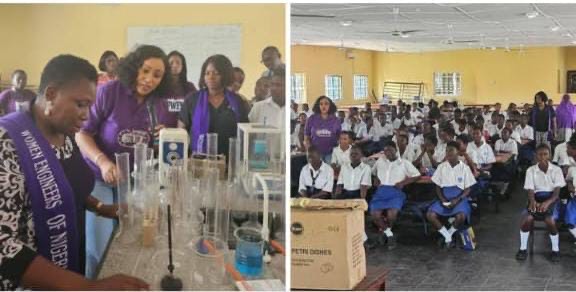
From Mike Tayese, Yenagoa
The Association of Professional Women Engineers of Nigeria (APWEN) Bayelsa Chapter led by their Chairman, Engr. Dr. Amalate Ann-Jonathan Obuebite FNSE, visited St. Judes Girls Secondary School, Yenagoa in commemoration of the 2026 International Day of Women and Girls in Science, donates laboratory equipment.
The donation, which includes pH meters, weighing scales, measuring cylinders, viscometers, volumetric and conical flasks, beakers, and pipettes is meant to support and encourage the study of Science, Technology, Engineering, and Mathematics (STEM) courses.
Presenting the items to the principal, Mrs. Josephine Imbiakpa, Dr. Obuebite emphasized APWEN’s commitment to promoting STEM education among girls.
Mrs. Imbiakpa expressed immense gratitude to APWEN BAYELSA for the donation, stating that it would motivate students to pursue STEM careers.
The event aimed to inspire girls to explore STEM fields and bridge the gender gap in these areas in line with the theme for this year.

NRS chair, Adedej
The Executive Chairman of the Nigerian Revenue Service (NRS), Zacch Adedeji, has described technology as a crucial factor in the implementation of the new tax laws in the country.
Adedeji stated this on Wednesday while delivering the maiden convocation lecture of the Federal Polytechnic, Ayede, Ogo-Oluwa Local Government Area of Oyo State.
In a statement by his Technical Assistant on Print Media, Sikiru Akinola, Adedeji listed some of the most fundamental challenges confronting taxation to include infrastructure, skills, trust and resistance.
In the lecture entitled ‘The Role of Technology in Implementing Nigeria’s New Tax Laws: Challenges, Prospects, and Implications for National Development,’ the NRS chairman said each of these challenges would be addressed with the imminent upgrading of the country’s tax system for a digital environment.
“Nigeria has recently enacted a new set of tax laws, representing the most significant restructuring of our nation’s fiscal legislation in 50 years. While public conversation often frames these changes as legal reforms, and that is true, it is also an incomplete picture.
“These laws are not merely changing rates, definitions, or administrative powers. They are quietly redefining how authority operates within the tax system. This is a complete structural overhaul, signaling the end of tax collection as a manual task and the beginning of tax intelligence.
“If you read the new laws carefully, you will notice a subtle but profound assumption woven throughout their fabric. They presuppose the existence of reliable taxpayer identification, integrated data across institutions, traceable transactions, automated processes, and scalable enforcement.
“In other words, these laws are built for a digital environment. They cannot function properly in a manual, fragmented, paper-based system. The implication is clear: without technology, the laws remain aspirational. With technology, they become operational.
“This transition is central to the mandate of the Nigeria Revenue Service as we implement this new legal framework. Historically, tax administration relied heavily on human discretion over who is registered, who is assessed, who is audited, and who is penalized.
“While discretion is not inherently evil, excessive discretion creates inconsistency, which in turn breeds mistrust and drives non-compliance,” Adedeji said.
Speaking further, he noted that when infrastructure improves, capacity grows, trust is protected, and resistance is managed just as technology begins to do what policy alone cannot.
“One of the most important prospects of a technology-driven tax administration is the ability to expand the tax base without increasing tax rates. This matters deeply in a society where citizens already feel overburdened.
“By improving visibility and bringing previously unseen economic activity into view, technology levels the playing field. When compliance broadens, the pressure on the existing base reduces,
fairness improves, and legitimacy grows. This is how modern tax systems grow revenue sustainably,’ he added.
In his remark, the Speaker of the House of Representatives, Tajudeen Abass, encouraged the graduating students to be good ambassadors of the institution.
Represented by AbdulFatai Buhari, senator representing Oyo North, Abass charged them not to relent in their bid to acquire more knowledge.
He also commended the tax boss for leading the change in tax administration in the country.
The institution’s governing council chair, Yakubu Datti commended Adedeji for leading the re-engineering of Nigeria’s tax architecture.
The Rector of the institution, Dr. Taofeek Adekunle Abdul-Hameed, charged the graduating students to emulate Adedeji who, he said, began his journey from a polytechnic.

The Ministry of Communications, Innovation and Digital Economy has partnered with Meta to launch the Llama Impact Accelerator, promoting impactful AI development in Nigeria.
The Minister, Dr Bosun Tijani, confirmed this in a statement released on Tuesday by Ms Sade Dada, Head of Public Policy for Anglophone West Africa at Meta.
Tijani described the partnership as a significant step in Nigeria’s mission to nurture a thriving AI ecosystem and drive national development through innovation.
He said the government views AI as a key tool for addressing national challenges.
The programme will equip innovators with vital tools and expert guidance.“This initiative forms part of Meta’s broader effort to democratise responsible AI and foster local innovation across Nigeria’s growing technology landscape,” the minister noted.
Tijani added that collaboration with government, academia and civil society will help cultivate a more inclusive, forward-looking AI community in the country.
Dada stated that Meta also partnered with the National Centre for Artificial Intelligence and Robotics (NCAIR) and the National Information Technology Development Agency (NITDA).
She explained that the eight-month programme targets early-stage startups using open-source Llama models to tackle national and regional challenges in four key areas.
The priority sectors include agriculture, security and safety, healthcare, and a ‘wild card’ category for high-impact innovations in any other field.
“The wild card category encourages bold and creative AI applications that could bring substantial impact to underserved sectors,” Dada said.
She added that the programme starts with a six-week incubation phase, offering technical training and mentorship from industry leaders and AI professionals.
This is followed by six months of extended support, including access to further technical resources and relevant opportunities for growth and scaling.
Dada said Meta was thrilled to collaborate with FMCIDE on this initiative, recognising Nigeria’s strong innovation ecosystem and growing pool of AI talent.
She added that Meta aims to empower communities through open-source AI, tailored to address Nigeria’s unique development challenges.
“The accelerator offers local talent the infrastructure, tools and mentorship needed to build responsible solutions using open-source models like Meta’s Llama,” she said. (NAN)



UN, EU Seek Trust, Technology to Strengthen Africa’s Counter-Terrorism Fight
ShareUN Deputy Secretary-General Amina Mohammed, has called for stronger intelligence sharing, public trust and responsible use of emerging technologies to...


University of Agriculture, Orerokpe Bill, Passes Third Reading in Senate
ShareThe University of Agriculture, Orerokpe Bill, sponsored by Senator Ede Dafinone, representing Delta Central Senatorial District, has passed through its...


Ishowo Urges Kwara to Convert KWASUED to Medical Varsity
ShareA Kwara based Public Affairs Analyst, Comrade Ishowo Olanrewaju, weekend called on the Kwara State government to urgently convert the...

NESG Chairman Urges Shift from Economic Reforms
ShareChairman, Nigerian Economic Summit Group (NESG), Olaniyi Yusuf has urged the Federal Government to translate economic reforms into tangible results,...


Yakubu Receives Fellowship Of Nigerian Institute Of Town Planners
ShareBy Raphael Atuu, Abuja TPL Chief Amb Hon. Stephen Shekwonce Yakubu, the District Head (Hakimi of Garki Shekwope), had his...


Much Ado About the PBAT Door-to-Door Movement
ShareBy Catherine Agbo In the unfolding drama of Nigerian political discourse, few things excite the commentary circuit quite like a...


WAHO, ECOWAS Countries Move to Tackle Health Worker Shortages, Brain Drain
ShareBy David Torough, Abuja The West African Health Organization (WAHO) has called for stronger regional collaboration and practical policy interventions...

Afreximbank’s Net Income Rises 24 Per Cent to $813.5 Million in Nine Months
ShareThe African Export-Import Bank (Afreximbank) and its subsidiaries have reported a 24 per cent increase in net income for the...


Wike-Led FCTA Committed to Quality Healthcare, Stronger Medical Institutions – Mahmoud
ShareBy Laide Akinboade, Abuja The Minister of State, Federal Capital Territory (FCT), Dr. Mariya Mahmoud, has reaffirmed the commitment of...


Enugu Police Arrest 28 Year Old Suspect for Robbing POS Operator
ShareFrom Sylvia Udegbunam, Enugu The Enugu State Police Command has arrested a 28-year-old male suspect, Michael Ayisa, for allegedly robbing...