
BUSINESS
NDIC Receives FG’s Platinum Award for Outstanding Corporate Governance, Service Delivery


From Anthony Nwachukwu, Lagos
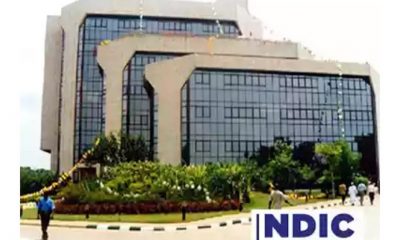
The Federal Government has presented the Level Five (Platinum Level) award to the Nigeria Deposit Insurance Corporation (NDIC) following its outstanding performance in corporate governance and accountability.
NDIC scored an outstanding 93 per cent in the Bureau of Public Service Reforms (BPSR) Self-Assessment Tool (SAT), which was deployed to Federal Ministries, Departments and Agencies (MDAs) to assess and enhance service delivery, a statement from the corporation’s Communication and Public Affairs Department disclosed.
Presenting the award, Secretary to the Government of the Federation (SGF), Mr.
Boss Mustapha, represented by the Special Adviser to the President on Policy and Coordination, Dr. Habiba Lawal, congratulated the board, management and staff of NDIC for their courage and commitment during the exercise.According to him, NDIC’s exceptional achievement serves as an impetus for other government agencies to take the opportunity of the BPSR SAT to assess their strengths and weaknesses, and employ the outcome of the self-evaluation to achieving government’s objective of effective service delivery to the citizenry.
Also, the Minister of Finance, Budget and National Planning, Dr. Zainab Ahmed, represented by the Director, Home Finance, Mr. Stephen Okon, assured of the ministry’s continued commitment and support to the corporation towards the implementation of the recommendations of the BPSR SAT report.
While presenting the SAT report, the Director-General of BPSR, Dr. Dasuki Arabi, disclosed that NDIC was the first and only agency under the Federal Ministry of Finance, Budget and National Planning to submit to the SAT assessment.
He explained that the corporation’s 93 per cent score, which represents “Far Exceeded Expectations” rating, is a direct result of the management’s commitment to high standards in corporate governance, as well as staff diligence and hard work.
Arabi noted that the assessment, which commenced in September 2021, focused on broad areas of strategic governance, including financial management, operational and service delivery process, human resource management and planning, procurement process and change management.
Excited at the achievement, the Chairman, NDIC Board of Directors, Mrs. Ronke Sokefun, and the Managing Director/Chief Executive Officer of NDIC, Mr. Bello Hassan, congratulated the NDIC Board, management team and staff for the feat.
Hassan disclosed that since the BPSR assessment, NDIC has continued to benchmark itself with international standards and best practices through a culture of continuous process improvement and service delivery to its various stakeholders.
And for Sokefun, NDIC will continue to strive for excellence in the delivery of its mandate while implementing the recommendations of the BPSR report.




The Nigerian National Petroleum Company Ltd. (NNPC Ltd.) recorded N7.2 trillion Profit After Tax (PAT) in 2025, a 33 per cent increase from N5.4 trillion.
Group Chief Executive Officer, Bayo Ojulari, disclosed this on Tuesday in Abuja at a media briefing after the company’s AGM and second Earnings Call.
Revenue declined to N34.
5 trillion from N45.1 trillion in 2024.Ojulari attributed the 24 per cent revenue decline to lower crude oil prices and reduced product volumes following market deregulation.
He said earnings per share rose to N35.
90 from N27.07, while return on equity improved by 200 basis points to 16 per cent.The company’s declared dividend increased by 35 per cent to N5.8 trillion, while taxes, royalties and other government remittances rose 39 per cent to N22.3 trillion.
“Stronger earnings in spite of this pressure demonstrate the resilience of NNPC Limited’s operations,” Ojulari said.
He said profit grew because NNPC had improved its operations and maintained discipline across its businesses.
Ojulari said crude oil and condensate production reached a five-year peak of 1.77 million barrels per day.
He added that gas supply reached a three-year high of 7.2 billion standard cubic feet per day.
“Stronger performance gives NNPC Limited more capacity to invest, contribute to public revenue and strengthen Nigeria’s energy security,” he said.
On infrastructure, Ojulari said the mainline of the Ajaokuta-Kaduna-Kano gas pipeline had been completed.
He said work was ongoing on tie-ins to delivery points, beginning with Abuja, followed by Ajaokuta and Kaduna.
According to him, the next milestone is to commence gas flow through the pipeline to industries and power plants.
Ojulari said the company completed the Obiafu-Obrikom-Oben (OB3) gas pipeline in 2026 after several years of challenges.
On the refineries, he said prospective partners under NNPC’s technical equity partnership model had conducted a three-month onsite review.
He said more than 34 engineers participated in the review, adding that NNPC was now concluding the report.
Ojulari said the company was targeting self-sustaining and profitable refineries, with a pathway expected to be defined soon.
He reaffirmed NNPC’s target of producing two million barrels of crude oil daily by 2027 and three million barrels by 2030.
He said gas production targets were 10 billion cubic feet per day by 2027 and 12 billion by 2030.
“NNPC plans to mobilise over 60 billion dollars of investment across the energy value chain,” he added.
Ojulari said more than 1,000 newly recruited professionals joined NNPC in 2025 under its Talent to Value programme.
He said the recruits completed a one-year internship and training programme before being deployed across the company. (NAN)
The Federal Competition and Consumer Protection Commission (FCCPC) says there is a need for sustained capacity building in competition reporting and issues.
The Executive Vice Chairman of FCCPC, Tunji Bello, said this in a statement made available to the News Agency of Nigeria (NAN) in Abuja on Sunday.
Bello described competition matters as a relatively new area in the country adding that it required specialised knowledge among journalists, regulators and other stakeholders.
He said that competition law and consumer protection regulations had made stakeholders’ education a priority for the commission.
Bello said that the FCCPC recently supported the training of judges through the National Judicial Institute (NJI) to deepen understanding of competition-related matters.
He noted that members of the judiciary also required exposure to the nuances of the emerging field.
“We recognised that because it is a new terrain, the judges themselves are not familiar with the nuances.
”So we brought in experts on competition,” he said.
Bello stressed that the media had a critical role in promoting public understanding of competition and consumer protection issues.
“If FCCPC is becoming more known to the public, it is as a result of the kind of publicity you have given us,” he said. (NAN)

Fire gutted the Nigeria Customs Service (NCS) Western Marine Command office in Apapa, Lagos, on Monday, destroying property worth millions of Naira.
The fire, which reportedly started at about 10:23 a.m. from an electrical surge in the conference room, spread to other sections of the building.
Officers on duty made frantic efforts to contain the fire before officials of the Lagos State Fire and Rescue Service arrived at about 10:45 a.
m.The Deputy Comptroller of Customs, Timothy Jonah, who just resumed at the Command, to take over the affairs from his predecessor, described the incident as unfortunate.
He said: “I just resumed duty to take over, only to witness this fire outbreak.
“Every challenge, though negative, is an opportunity to strengthen our operations.
“In the meantime, we will set up a committee to investigate the cause of the fire.”
He commended the swift response of the personnel on duty and their collaboration with the fire service, saying measures would be taken to strengthen safety protocols and prevent a recurrence. (NAN)




NAN Backs Insurance Sector’s Transformation Agenda, hails NAICOM
ShareBy Tony Obiechina, Abuja The National Association of Nigerian Students (NANS) National Secretariat, the umbrella body representing over 40.1 Million...


Don Calls for More Investment in Entrepreneurship/Innovation in Nigeria
ShareFrom Joseph Amedu, Lokoja A Professor of Entrepreneurship and Corporate Strategy at the Federal University, Lokoja, John Alabi has called...


Tinubu Submits NDDC 2026 Appropriation Bill
SharePresident Bola Tinubu has submitted the 2026 Statutory Budget Proposal of the Niger Delta Development Commission (NDDC) to the House...


Senate Passes Bill Extending 2025 Capital Budget Implementation to Dec 31
ShareThe Senate on Tuesday passed a bill extending the implementation of the capital component of the 2025 Appropriation Act from...
CANEX 2026 to Unlock Investment, Jobs in Nigeria’s Creative Economy — FG
ShareThe Federal Government said Nigeria’s hosting of the 2026 Creative Africa Nexus (CANEX) Weekend will attract investment, deepen market access...


NNPC Posts N7.2trn Profit amid Revenue Decline
ShareThe Nigerian National Petroleum Company Ltd. (NNPC Ltd.) recorded N7.2 trillion Profit After Tax (PAT) in 2025, a 33 per...


Wike Approves Contracts for Digitization of FCT High Courts
ShareThe Minister of the Federal Capital Territory (FCT), Nyesom Wike, has approved the award of contracts for the digitisation of...

OPay Names Top 10 Teams in N18m National Innovation Challenge
ShareIn a bid to empower young Nigerians with the skills, opportunities and support needed to build solutions for real-world challenges,...


CBN Sets Agenda for Post-Recapitalisation Banking
ShareBy Tony Obiechina, Abuja The Central Bank of Nigeria (CBN) said recent reforms in the foreign exchange market, monetary policy...

Gunmen Abduct 18 Women in Benue, 47 Niger Farmers
ShareFrom Attah Ede, Makurdi, and Dan Amasingha, Minna Fresh fears over the worsening insecurity across the country emerged on Tuesday...