
NEWS
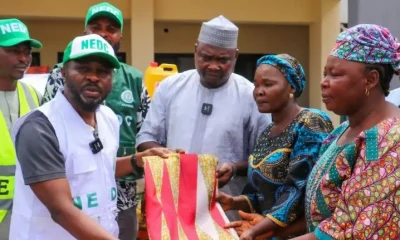
NEMA Distributes Relief Materials to Flood Victims in Enugu LG

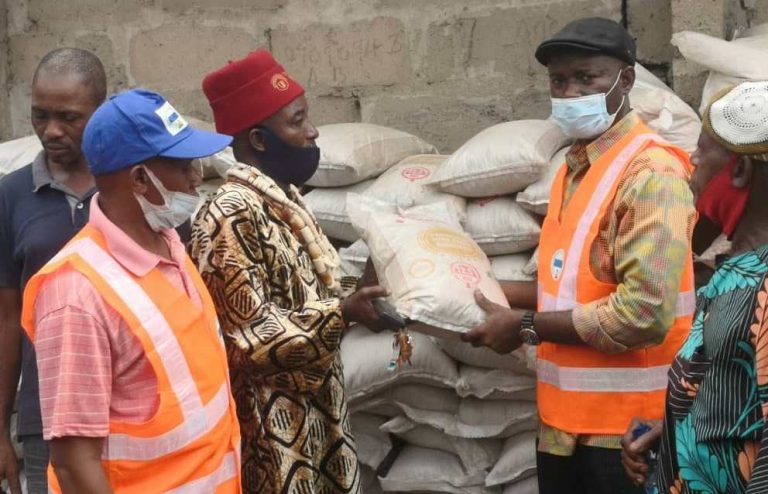
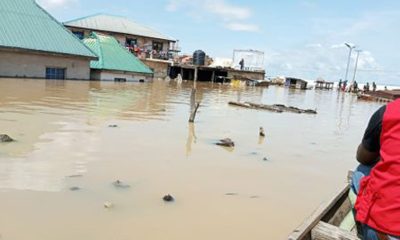
The National Emergency Management Agency (NEMA), on Sunday, distributed relief materials worth millions of naira to communities affected by the 2020 flood within Uzo Uwani Local Government Area of Enugu State.
The relief materials, which included food and non-food items, were distributed to three agrarian communities of Ojor, Ogurugu and Igga.
Speaking at Ojor Community, Zonal Coordinator of NEMA, Mr Fred Anusim, said that the flood incident that destroyed massive farmlands and buildings in the communities occurred on Oct.
3, 2020.Anusim said that the notice of the incident was brought to the attention of NEMA through the Enugu State Emergency Management Agency (SEMA), traditional rulers and other media reports.
According to him, NEMA carried out an assessment of the incident, which revealed that several buildings and farmlands were affected leading to displacement of residents and dislocation of means of livelihood.
“The responsiveness of the Federal Government to the plight of affected persons has been quite prompt and encouraging; hence we have since received an approval of relief items from the Director-General of NEMA, Retired AVM Muhammadu Muhammed.
“Please note that the relief materials brought to you today is not to replace what you lost during the flood disaster but to cushion the effect of the unfortunate incident.
“We suggest that the affected persons should look out for early warning signs at the on-set of rain in order to avert the loss of lives and property because flood in the area has become a perennial event.
“Furthermore, we urge the local government authorities at the beginning of every rainy season to alert SEMA and NEMA to embark on massive sensitisation of the affected areas in order to create awareness on the dangers of flood.
“The food items in the relief materials included: 456 bags of 12.5kg rice; 456 bags of 25kg beans; 456 bags of 12.5kg garri; 46 kegs of 20 litres palm oil; 79 cartons of seasoning; and 38 cartons of tin tomatoes.
“The non-food items are: 912 pieces of blankets; 912 pieces of foam mattresses; 59 cartons of bath soap; 456 pieces of wax print; 624 bags of cement; 624 bundles of roofing sheets; 69 bags of 3 inches nails; 208 packets of zinc nails; 624 pieces of ceiling boards and 700 pieces of children’s wear,’’ he said.
Responding, the Traditional Rule r of Ojor Community, Igwe Emmanuel Umunna, thanked the Federal Government for bringing succour to his subjects affected by the 2020 flood.
“We are grateful to the Federal Government and NEMA that took the pain; notwithstanding that we are at the extreme and boundary area of the state to remember and locate us with these relief materials,’’ Umunna said.
One of the victims of the flood, Mr Fidel Okiji, thanked the Federal Government for the relief materials as well as its timely delivery.
“I believe this will go a long way to ameliorate the hardship my family had been going through since the flood incident,’’ Okiji, who is a beneficiary of the relief materials, said.
Another victim and beneficiary of the relief materials, Mrs Angelina Ndibe, prayed to God to bless the Federal Government and NEMA officials for coming to her aid when she lost all her crops to flood.
At Ogurugu Community, the Traditional Ruler of the Community, Igwe Emmanuel Egwuaba, appreciated the Federal Government for the succour provided for members of his community affected by the 2020 flood.
One of the victims and beneficiary of the relief materials in Ogurugu Community, Mr Joseph Okonkwo, expressed appreciation to the Federal Government for the timely gesture of bringing down the relief materials. (NAN)







President Donald Trump has expanded a US travel ban, barring nationals of five additional countries and people travelling on Palestinian Authority-issued documents from entering the US.
The White House said the restrictions were intended “to protect the security of the United States” and will come into force on 1 January.
Full-entry restrictions will be imposed on people from Burkina Faso, Mali, Niger, South Sudan and Syria as well as Palestinian Authority passport holders.
The administration also moved Laos and Sierra Leone, which were previously subject to partial restrictions, to the full ban list and put partial restrictions on 15 other countries, including Nigeria, Tanzania and Zimbabwe.
Trump, who has tightened immigration controls since returning to the White House in January, said the expanded travel ban was necessary because of what his administration described as failures in screening and vetting systems overseas.
Officials cited high visa overstay rates, unreliable civil records, corruption, terrorist activity and a lack of cooperation in accepting deported nationals.
The announcement followed the arrest of an Afghan national suspected of shooting two National Guard troops over the Thanksgiving weekend, an incident the White House pointed to in highlighting its security concerns.
This is the third time Trump has imposed a travel ban.
During his first term, he introduced a similar order in 2017, which sparked protests and legal challenges at home and abroad. The policy was later upheld by the US Supreme Court.
The White House said the restrictions would remain in place until affected countries show “credible improvements” in identity management, information-sharing and cooperation with US immigration authorities.
A number of exceptions apply and the ban will not affect lawful permanent residents, many existing visa holders, diplomats, or athletes travelling for major sporting events. Officials said case-by-case waivers would also be available where travel is deemed to be in the national interest.
Countries with full restrictions:
Afghanistan, Burkina Faso, Burma, Chad, Equatorial Guinea, Eritrea, Haiti, Iran, Laos, Libya, Mali, Niger, Republic of the Congo, Sierra Leone, Somalia, South Sudan, Sudan, Syria, Yemen
Individuals travelling on Palestinian Authority issued or endorsed travel documents are also subject to a full suspension of entry
Partial restrictions:
Angola, Antigua and Barbuda, Benin, Burundi, Côte d’Ivoire, Cuba, Dominica, Gabon, Gambia, Malawi, Mauritania, Nigeria, Senegal, Tanzania, Togo, Tonga, Venezuela, Zambia, Zimbabwe
Special case:
Turkmenistan (restrictions remain for immigrants but have been lifted for non-immigrant visas).

By Eze Okechukwu, Abuja
President Bola Tinubu has nominated new chief executives for Nigeria’s two foremost petroleum regulatory agencies following the resignation of their heads, Engineers Farouk Ahmed and Gbenga Komolafe.
In separate letters to the Senate yesterday, the President requested the confirmation of Oritsemeyiwa Amanorisewo Eyesan as Chief Executive Officer of the Nigerian Upstream Petroleum Regulatory Commission (NUPRC) and Engineer Saidu Aliyu Mohammed as Chief Executive Officer of the Nigerian Midstream and Downstream Petroleum Regulatory Authority (NMDPRA).
The nominations followed the voluntary exit of Ahmed, who headed the NMDPRA, and Komolafe, the pioneer CEO of the NUPRC.
Both men were appointed in 2021 by former President Muhammadu Buhari after the enactment of the Petroleum Industry Act (PIA), which created the two regulatory bodies to oversee reforms in Nigeria’s oil and gas industry.According to a State House press release by the Special Adviser to the President on Information and Strategy, Bayo Onanuga, Tinubu urged the Senate to expedite the confirmation process to ensure continuity and stability in the regulation of the petroleum sector.
Eyesan, a seasoned industry professional, is an Economics graduate of the University of Benin and spent nearly 33 years with the Nigerian National Petroleum Company Limited (NNPC) and its subsidiaries. She retired as Executive Vice President, Upstream, in 2024, and previously served as Group General Manager, Corporate Planning and Strategy, from 2019 to 2023.
Engineer Saidu Aliyu Mohammed, born in 1957 in Gombe State, is a Chemical Engineering graduate of Ahmadu Bello University, Zaria. He has held several strategic positions in the oil and gas industry, including Managing Director of the Kaduna Refining and Petrochemical Company and the Nigerian Gas Company. He also served as Group Executive Director and Chief Operating Officer, Gas and Power Directorate at NNPC.
Mohammed has chaired the boards of the West African Gas Pipeline Company, Nigeria LNG subsidiaries and NNPC Retail, and played key roles in major national projects such as the Escravos–Lagos Pipeline Expansion, the Ajaokuta–Kaduna–Kano (AKK) Gas Pipeline and Nigeria LNG Train developments.
The President expressed confidence that the nominees’ experience and expertise would strengthen the implementation of the Petroleum Industry Act and advance reforms across Nigeria’s oil and gas value chain.
Labour Takes Nationwide Protest to Streets over Insecurity
The Nigeria Labour Congress (NLC) yesterday led a nationwide protest across major cities, including Abuja, Calabar and Osogbo, to draw attention to Nigeria’s worsening insecurity and economic hardship, insisting that governments at all levels must urgently reclaim communities, protect citizens and restore public confidence.
In Abuja, the NLC President, Joe Ajaero described the heavy deployment of security personnel around the protest as “normal,” arguing that whether security agencies were sent to protect or stop workers, it showed the impact of labour’s action.
However, he faulted the practice of deploying security chiefs to interface with labour during industrial disputes, stressing that labour matters were not security issues.“Industrial relations issues are the responsibility of the Ministry of Labour and the Office of the Secretary to the Government of the Federation, not heads of security institutions,” he said, warning against intimidation of workers under the guise of security.
Addressing workers after a brief procession, the NLC Deputy General Secretary, Comrade Ismail Bello, said the protest was not partisan but a struggle for the survival of all Nigerians. He lamented the devastation caused by insecurity, noting that communities had been destroyed, livelihoods lost and essential services disrupted.
“We have paid a heavy price. Healthcare workers, teachers, transport workers and many others have been affected. The damage is enormous and it has to stop,” Bello said, adding that the constitution guaranteed the right to peaceful protest and freedom of association.
He called for decisive action against kidnappers and criminal elements, arguing that failure to punish perpetrators had emboldened insecurity. “Children must return to school. Communities must return to normalcy. Government must deploy the full machinery of governance to recover all spaces taken over by criminals,” he added.
The NLC Head of International Department, Comrade Uche Ekwe, said the protest was meant to strengthen the government’s resolve to confront insecurity, insisting that those funding criminal activities must be arrested and prosecuted.
Labour disclosed grim statistics to underscore its concerns, revealing that since 2009, over 2,295 teachers had been killed by insurgents and bandits, more than 19,000 displaced in the North-East, and over 910 schools destroyed. In the health sector, about 35 per cent of facilities were destroyed by terrorism, while 50 per cent became inaccessible, worsening the shortage of medical personnel.
In Cross River State, organised labour staged a peaceful rally in Calabar, where the NLC Chairman, Comrade Greg Olayi, warned that Nigerians could no longer live or work in safety. He cited attacks on farmers, kidnappings of schoolchildren and insecurity on highways as evidence of a failure of governance.
Similarly, the Joint Negotiating Council Chairman, Comrade Raymond Afu, described the rally as a call to conscience for government at all levels, stressing that the essence of governance was the protection of life and property.
In Osun State, labour leaders and civil society voices also joined the protest, calling on the state government to strengthen local security networks, including Amotekun and other community-based outfits, rather than shutting them down. They warned that insecurity must not be allowed to take root in the state.
The Osun State Chairman of the Nigeria Union of Journalists (NUJ), Wasiu Ajadosu, said organised labour could no longer remain silent while citizens faced daily threats, emphasising that security was the foundation for development and social justice.


Nigeria Clinches Bronze in Judo at 4th African Youth Games
ShareTeam Nigeria clinched a bronze medal in judo at the ongoing 4th African Youth Games after winning the 63kg category bout against Zimbabwe. The...

NCDMB Set to Attain 100 Per Cent Local Content in Africa
ShareBy Eddy Ochigbo, Abuja The Nigerian Content Development Management Board (NCDMB) has reaffirmed its determination to increase the current from...


Trump Expands US Travel Ban to Five More Countries
SharePresident Donald Trump has expanded a US travel ban, barring nationals of five additional countries and people travelling on Palestinian Authority-issued documents from entering the US. The White...


Farouk Ahmed, Gbenga Komolafe Resign after Dangote Petition
ShareBy Eze Okechukwu, Abuja President Bola Tinubu has nominated new chief executives for Nigeria’s two foremost petroleum regulatory agencies following the resignation...

NLC Stages Nationwide Strike over Insecurity
ShareLabour Takes Nationwide Protest to Streets over Insecurity The Nigeria Labour Congress (NLC) yesterday led a nationwide protest across major...

Presidency Transmits N43.5trn 2026 Appropriation Bill to Reps
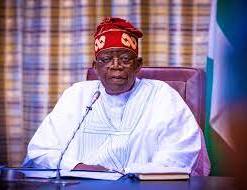
SharePresident Bola Tinubu yesterday, transmitted the appropriation (Repeal and Re-enactment Bill 2024/2025 bill to the House of Representatives for consideration and expected approval...

SMEDAN Unveils MSMEs New Policy in 2026, Targets Funding Expansion
ShareThe Small and Medium Enterprises Development Agency of Nigeria (SMEDAN) said it will deepen business formalisation, expand access to affordable financing and unveil a new national MSMEs policy in 2026....


NCDMB set to Attain 100% Local Content in Africa
ShareBy Eddy Ochigbo The Nigerian Content Development Management Board (NCDMB) has reaffirmed its determination to increase the current from 56%...

The Man Rotimi Makinde: A True Progressive by All Standards
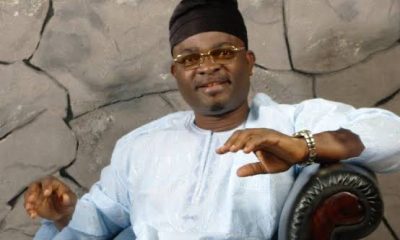
ShareBy Kolapo Ogundare It is impressive to note that many well-meaning Nigerians are now coming out, recounting several good deeds...
FG, NBS Launch Nationwide MICS7 Survey
ShareFrom Francis Sadhere, Delta The Federal Government of Nigeria, through the National Bureau of Statistics (NBS), has officially launched the...