
Uncategorized
Nigeria; a Gen Z Will Soon Be President

By Prince Charles Dickson
Two of my dogs fought with a bitterness I had never seen. The older one carried himself as though the title deed to the yard was hidden beneath his paws. He knew every corner and had always enjoyed the younger dog’s deference.
Then a female dog entered the equation, and instinct overruled history.This was no ceremonial barking for the neighbours.
Teeth found flesh; dust rose. Each separation merely postponed the next assault. By the fourth day, the older dog was badly injured and close to death. The younger stood over him like a claimant who had discovered that age was not invincibility, then walked away as though succession had been settled.Then came the detail that changed the story: the younger dog was the older dog’s son. Once, he would not have imagined confronting his father, much less doing so with such confidence.
Nigeria is now standing inside that compound.
The female dog in this metaphor is not womanhood; she is politics and governance; the Nigerian state: desired, possessed, fought over, but rarely nurtured. The older dog represents a political breed that mistakes long residence for permanent ownership. The younger dog is the coming generation: impatient, digitally armed and unconvinced that fatherhood confers an eternal right to the yard. This is a warning, not a prescription; but when an old order refuses an orderly handover, succession often arrives with teeth.
My friend, Professor Chris Kwaja, recently put his finger on this future. Nigeria’s Gen Z—usually defined as those born between 1997 and 2012—is not a demographic footnote but a nation within the nation. Estimates vary by dataset, but we are speaking of tens of millions in a country whose 2025 population the United Nations Population Fund placed at 237.5 million. The arithmetic is patient but merciless.
The minimum constitutional age for the presidency is 35. The cohort’s oldest members are 29 in 2026; by 2035, they will be 38 and eligible. A Gen Z Nigerian may not become President that year, but one will eventually sit in Aso Rock. The question is: what kind of President will Nigeria produce?
This generation carries Nigeria in its pocket. It learns across borders, earns across currencies, compares governments in real time and records brutality before authority can issue a denial. It has far more in its locker than caricature admits—intellect, guts, innovation and creative audacity—and does not wait for the emir, bishop, party chairman or television editor to grant permission to speak.
The 2020 #EndSARS uprising showed the possibilities. Young Nigerians mobilised crowds, raised funds, coordinated welfare and legal aid, and seized narrative power from old gatekeepers. Yet assessments of its successes and limitations suggest that leaderlessness was both armour and ceiling: it resisted co-option but complicated negotiation and continuity. A hashtag can open a gate; it cannot write a budget. Virality is not organisation, followers are not delegates, and power does not resign because a meme embarrassed it.
This is where the current argument about an “Olodo uprising” requires more light than heat. Olodo, in popular Yoruba usage, is the dunce. The phrase captures anxiety that digital Nigeria rewards noise above knowledge, spectacle above substance and confidence above competence. The anxiety is not foolish. When a teacher cannot pay rent while profitable nonsense buys another SUV, society has published a curriculum without calling it one. If ignorance attracts money and fame while learning attracts unemployment, why feign surprise at the lesson being learnt?
But using the most visible absurdities online to define a generation is a false dawn of analysis. A ring light is not a census instrument. The algorithm magnifies whatever arrests attention; it does not mirror a generation’s mind. Five viral jesters can obscure thousands of young Nigerians writing code, building payment systems, creating films, conducting research, farming with data and solving problems the state has abandoned.
The “Olodo uprising” is not an age group; it is an incentive system with grey-haired patrons, corporate sponsors, educated audiences and institutions that have spent decades humiliating learning. Before TikTok, public officers commissioned uncompleted projects with brass bands and long grammar. The young did not invent anti-intellectualism; they merely gave some of it better lighting and faster internet.
The Yoruba say, Àgbà kì í wà lọ́jà, kí orí ọmọ tuntun wọ́—an elder cannot be in the marketplace while a newborn’s head remains crooked. If society’s head is bent, elders cannot shout “Olodo!” like innocent passers-by. Another warning says, Ọmọ tí a kò kọ́ ni yóò gbé ilé tí a kọ́ tà—the child we fail to build will sell the house we built. Nigeria erected monuments while neglecting schools, values, civic capacity and hope. Now it fears the auctioneer it raised.
Still, Gen Z must not mistake demographic power for moral superiority. Youth is not an ideology. A young thief remains a thief, even in livestreamed 4K. Nigeria can replace grey hair without replacing grey habits. Ethnic merchants will open TikTok shops; godfathers will recruit digital godsons. A Gen Z President could be innovative and accountable—or an old politician in sneakers, fluent in emojis and authoritarianism.
To reset Nigeria, this generation must convert attention into organisation, outrage into policy, and population into electoral power. It must enter wards, parties, councils, unions and communities; it must learn budgets, federalism, security, history and compromise. The Igbo say, Nwata kwọcha aka, ọ soro ndị okenye rie nri—when a child washes his hands, he may eat with the elders. Yet the elders must stop moving the table behind nomination fees, rigged primaries and patronage.
Nor are young Nigerians as post-ethnic or post-religious as romantic commentary suggests. They are less deferential, but algorithms manufacture digital tribes efficiently. The phone that exposes corruption can distribute a lie; the platform that mobilises justice can organise a mob. Digital nativity is power, not wisdom. Innovation without ethics can merely optimise corruption.
The Hausa offer an audacious proverb, Kowa ya raina tsayuwar wata, ya hau ya gyara—whoever dislikes the moon’s position should climb and straighten it. Gen Z has long mocked Nigeria’s crooked moon. Soon, it must climb. Then it will discover that the presidency is not a content house, the budget is not a caption and insecurity cannot be defeated with a clapback. Its President must govern X Spaces and village squares, data dashboards and dusty farm paths, including millions the algorithm never sees.
Meanwhile, the remaining Mohicans of the old political order are transitioning, one after another, from centre stage into memoir, memory and history. Their wisest choice is to build bridges, not barricades; to mentor without annexing; to surrender space without demanding that the future first kneel. As the Igbo say, Egbe bere, ugo bere—let the kite perch and let the eagle perch. Generational renewal need not be warfare, but coexistence becomes impossible when one bird claims the whole tree.
The older dog in my compound survived, but survival humbled him. The younger dog also learnt that victory can leave blood on everybody. The object of their contest simply moved on, indifferent to their wounds. Nigeria must not become that bleeding compound.
A Gen Z will soon be President of Nigeria. That is not prophecy; it is arithmetic. Whether that presidency becomes renewal or merely youthful packaging for an ancient failure depends on what we teach, reward and build now. The younger Turks are already inside the compound. The old breed should hear their footsteps—not with panic, but with the wisdom to prepare a handover before succession again arrives with teeth.
May Nigeria win.
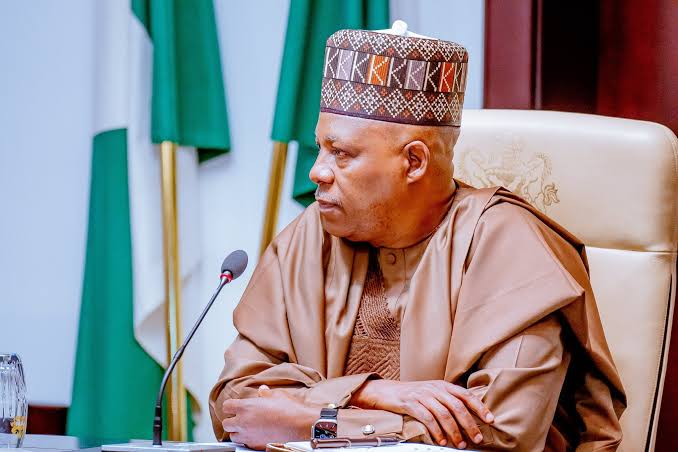
Vice President Kashim Shettima has said President Bola Tinubu demonstrated political maturity by forgiving northern governors who opposed his presidential bid in the 2023 election, urging politicians in Kwara State to similarly reconcile after their contests.
Shettima stated this on Wednesday in Ilorin while speaking at the turbaning of the Kwara State Governor, AbdulRahman AbdulRazaq, as the Sardauna of Ilorin Emirate by the Emir of Ilorin, Alhaji Ibrahim Sulu-Gambari.
The Vice President, who spoke against the backdrop of political activities ahead of the 2027 elections, urged politicians to regard political contests as temporary and avoid allowing disagreements arising from them to become permanent divisions.
He said, “I call on all of us to unite in this political season and play politics without bitterness. The truth that sets us free is also the truth that people don’t want to hear.”
Shettima recalled the opposition Tinubu faced during the 2023 presidential contest, saying the eventual winner had continued with his campaign despite limited support among governors in the northern region.
“You all know that we have 19 states in the North. Out of these, only six actually believed and supported Tinubu, but Tinubu refused to be deterred. He was able to cross the road,” he said.
According to the Vice President, the political atmosphere at the time was further complicated by the belief among some northern political actors that former President Muhammadu Buhari did not support Tinubu’s ambition.
He recalled the slogan, “Baba bayan sunshi,” which he explained was used to suggest that Buhari did not want Tinubu to succeed him as President.
Despite the opposition, Shettima said Tinubu remained focused on his ambition and subsequently won the presidential election, adding that the President later extended a hand of fellowship to those who had worked against him.
“After the 2023 election, President Tinubu hugged and forgave all other northern governors that did not support him. That is a mark of a good leader,” the VP said.
Shettima therefore urged politicians in Kwara, particularly those involved in the current contest for political offices, to learn from the President’s approach by putting their differences aside after the conclusion of their respective contests.
His appeal comes amid disagreements within the Kwara State chapter of the All Progressives Congress following the party’s governorship primary, with some aggrieved aspirants and their supporters forming a group known as the G-15.
The Vice President also reminded politicians that political power was temporary and should therefore be exercised with humility, responsibility and a sense of service.
“As public office holders, we spend more of our lives outside public offices than we do in public offices. Let us embrace each other, let us have the courage to serve with humility,” Shettima said.
He added that political office was not necessarily a reflection of superior pedigree, intellect or ability, but an opportunity entrusted to individuals by God and the electorate.
“We are in power not because of our pedigree, intellect, ability or physical build, but by destiny. What brings us together supersedes what separates us,” he stated.
Shettima also praised Tinubu’s handling of the economic challenges inherited by his administration, saying the President chose to confront the situation rather than spend his time blaming the previous government.
He said the administration inherited an economy facing severe challenges, but its economic team had continued working to stabilise the situation.
“The economic team forged ahead to turn the economy around; today, Nigeria is better for it,” the Vice President said.
Shettima described Tinubu as a decent leader who had confidence in those working with him, adding that he was pleased to serve as the President’s deputy.
The Vice President also commended the Emir of Ilorin for honouring AbdulRazaq with the Sardauna title, saying the governor’s father had left an enduring legacy in the Ilorin Emirate and beyond.
He said the conferment of the title would further strengthen the relationship between the governor’s family and the emirate while urging AbdulRazaq to continue contributing to the development of Kwara State.
Earlier, the Vice President inaugurated the state’s Revenue House on Ahmadu Bello Way, Ilorin, as well as the garment factory in the state capital.
The Transmission Company of Nigeria (TCN) has announced an annual preventive maintenance of its 330/132 Kilo Volt (kV) at Ajaokuta Transmission Substation.
It said that the maintenance was scheduled to take place on Tuesday from 9am to 4pm.
The management of the company announced this on its X handle in Abuja on Tuesday.
According to TCN, the exercise will enable its crew to carry out preventive maintenance on the 162 MegaVolt Ampree (MVA), 330/132kV power transformer, associated switchgear and ancillary equipment in the substation.
It said that the Abuja Electricity Distribution Company (AEDC) would be unable to off-take electricity to its customers in Ekirin, Omuo, Ibillo, Akoko, Ogala, Ikare, Magongo, Okene Town, Ayere, Kabba and environs during the period.
”Similarly, Benin Electricity Distribution Company (BEDC) will be unable to off-take electricity to its customers in Okpella Town, BUA Cement Company, West African Fertiliser Company, Dibeks Milling Company, and Edestein Company.
”Other areas to be affected include the Freedom Group Company, Ososo, Uluoke, Iyora, Apana, Okpekpe, Arigidi, Ikare Town, Lampese, Igara, Oka and environs,” it said.
The company said that power supply would be restored to the affected areas upon completion of the exercise.
It also apologised for the inconvenience the planned maintenance would cause affected electricity customers, and appreciated their understanding and cooperation.(NAN)
Nigeria has commenced local production of next-generation dual-active ingredient insecticide-treated mosquito nets to strengthen malaria prevention and domestic manufacturing.
The Ministry of Health and Social Welfare said this in a statement on its official X handle recently.
According to the statement, the facility, Health Textiles Nigeria FZE, wholly owned by Vestergaard Sàrl, is the first in Nigeria to manufacture dual-active ingredient insecticide-treated nets.
It said that the facility would produce PermaNet® Dual, a mosquito net designed to address the growing challenge of insecticide resistance and prequalified by the World Health Organization (WHO) in 2023.
At full scale, the facility is expected to produce about 10 million nets annually and create more than 600 jobs, the statement said.
It said about 80 employees had already been recruited and were undergoing training in manufacturing excellence, product quality, occupational health and safety and regulatory compliance.
The Coordinating Minister of Health and Social Welfare, Prof. Muhammad Pate, said the development aligned with the Nigeria Health Sector Renewal Investment Initiative (NHSRII).
Pate said the initiative focused on unlocking the healthcare value chain through investment, local production and stronger domestic capacity.
“This investment demonstrates what is possible when government policy, private-sector investment and technology transfer come together to unlock Nigeria’s healthcare value chain.
“The commencement of local production also strengthens our capacity to produce essential health products and supports a more resilient health system,” Pate added.
He commended Vestergaard for investing in local manufacturing, describing the commencement of production as an important step in malaria prevention.
The statement said that the establishment of Health Textiles Nigeria followed a 2024 Memorandum of Understanding between Vestergaard and the Presidential Initiative for Unlocking the Healthcare Value Chain (PVAC).
The agreement was aimed at strengthening local production capacity for essential health products, according to the statement.
The National Coordinator of PVAC, Dr Abdu Mukhtar, said the development demonstrated how investment, technology transfer and government policy could translate into productive capacity and skills development.
He said the training of Nigerian professionals and commencement of production represented the type of outcome the initiative sought to replicate across other healthcare value-chain segments.
Vestergaard Chief Executive Officer, Amar Ali, said the company was pleased to commence production in Nigeria and appreciated the Federal Government’s support.
He said the facility combined Vestergaard’s manufacturing expertise with Nigerian talent to produce dual-active insecticide-treated nets locally.
The development comes as Nigeria continues to bear a substantial share of the global malaria burden, the statement said.
According to the statement, WHO estimates that malaria caused 282 million cases and 610,000 deaths globally in 2024.
It said the African Region accounted for the overwhelming majority of malaria cases and deaths recorded globally during the period.
The statement said that Health Textiles Nigeria was expected to fulfil its first commercial orders in the coming months, expanding Nigeria’s capacity to produce the malaria prevention commodity locally.
Also, domestic production must be supported by strong quality assurance, regulatory oversight and safety standards.
It said the federal government would continue supporting strategic investments, technology transfer and skills development to strengthen Nigeria’s healthcare value chain.(NAN)


Nigeria; a Gen Z Will Soon Be President
ShareBy Prince Charles Dickson Two of my dogs fought with a bitterness I had never seen. The older one carried...

Wike, Performance and the Politics of Cross-Party Influence
ShareBy Raphael Atuu, Abuja Since assuming office as Minister of the Federal Capital Territory in August 2023, former Rivers State...
Niger 37 Tragedy: NSCDC Boss Must Go
ShareThe death of 37 detainees in the Nigeria Security and Civil Defence Corps (NSCDC) detention facility in Minna, Niger State,...

Shettima to Declare Editors’ Conference Open in Enugu Thursday
ShareVice President Kashim Shettima will on Thursday, September 24, 2026, declare open the 22nd All Nigeria Editors Conference (ANEC) of...


Police Raid FCT Crime Hotspots, Arrest 300 Suspects
ShareOperatives of the Federal Capital Territory Police Command have arrested approximately 300 persons, following a raid on identified crime flashpoints,...


Fidelity Bank Deepens Partnership with DAILY ASSET
ShareBy David Torough, Abuja Fidelity Bank Plc has reaffirmed its commitment to strengthening its partnership with DAILY ASSET Newspaper following...


DAILY ASSET Loses Deputy Editor-in-Chief, Danusa Ocholi
ShareBy David Torough, Abuja The Management of Asset Newspapers Limited, Publishers of DAILY ASSET, has announced the passage of the...


Fidelity Bank Deepens Partnership with DAILY ASSET
ShareBy David Torough, Abuja Fidelity Bank Plc has reaffirmed its commitment to strengthening its partnership with DAILY ASSET Newspaper following...


Niger 37: Bago Vows Full Probe as NSCDC Detains 24 Personnel
ShareFrom Dan Amasingha, Minna Niger State Governor, Umaru Bago, has vowed to uncover the circumstances surrounding the deaths of 37...


Cheaper Crude: APC-PCC Demands Answers from Atiku
ShareBy David Torough, Abuja The All Progressives Congress Presidential Campaign Council (APC-PCC) has challenged former Vice President and African Democratic...