
OPINION
Nigeria’s Tertiary Healthcare; The Waterbed, the Blackout and the Long Road

By Prince Charles Dickson
In February 2026, Ogonna Egwu took her gravely ill mother to the Accident and Emergency Ward of the University of Nigeria Teaching Hospital, Ituku-Ozalla. Doctors reportedly asked her to buy a waterbed the hospital could not provide.
Unable to leave her mother alone for the 25-kilometre trip into Enugu, she gave money to a staff member. The bed arrived the next day. Her mother died a day later.Then came a final indignity: the bed was allegedly withheld as “hospital policy” and sold to another patient. Egwu later recovered only part of her money.
The Guardian’s account reads like fiction, but it is the kind of reality that has become dangerously ordinary.This is not merely a story about a missing waterbed. It is an X-ray of a country where a patient’s relative becomes procurement officer, porter, blood scout and pharmacist; while grief waits at the cashier’s desk. When a hospital does not get wetin patient need, the family becomes an emergency ministry. The scandal is larger than one hospital and wider than one region.
A tertiary hospital should crown a functioning referral chain: the place for cancer therapy, neurosurgery, complex obstetrics, intensive care, specialist training and research. In Nigeria, that pyramid stands on its head. A 2026 country profile reports that 60 to 90 per cent of patients bypass primary care for secondary or tertiary facilities.
If the foundation bends, the penthouse does not fit stand straight.
From Enugu to Ibadan and Kano, the map changes, but the pathology remains: specialists spend precious hours managing illnesses that should have been prevented, detected or treated earlier.
In the South-East, The Guardian describes primary health centres below standard, general hospitals without basic diagnostics and tertiary facilities overwhelmed by the resulting traffic. Across facilities in Enugu, Nnewi, Owerri, Abakaliki and Umuahia, patients report buying medicines outside, conducting tests privately, waiting for theatre space and supplying water at the bedside. Federal Medical Centre Umuahia reportedly faced power-related costs approaching ₦70 million monthly.
Big gate no be big medicine.
Hospital infrastructure is not concrete alone. It has reliable electricity, clean water, oxygen, blood, laboratories, ambulances, functional equipment, secure information systems and human dignity.
There have been genuine improvements. UNTH has gained major solar-power capacity and a modern linear accelerator, while other facilities have received new buildings and equipment. But one functioning cancer machine serving a heavily populated region is both progress and a warning.
Machine wey no work na monument with plug.
Procurement must include maintenance, consumables, spare parts, trained operators and public reporting of equipment uptime. Commissioning photographs do not treat patients.
Travel west and the illusion of advantage appears. The South-West has major medical schools, more specialists and a dense private healthcare market. Yet University College Hospital, Ibadan, once a symbol of Nigerian medical excellence—suffered a grid disconnection in October 2024 and more than 100 days of blackout. Its power distress remained a public issue in 2026.
In an intensive care unit, electricity is not an overhead, it is medicine. Across Lagos, excellent private care may exist kilometres from overcrowded public wards, but proximity is not accessible.
Hospitals fit dey for your street; if the bill passes your pocket, e far like another country.
The generator has become an unofficial consultant, but diesel cannot be a national health policy.
The North carries the same disease with additional complications: vast distances, thinly distributed specialists, poverty, insecurity and disrupted transportation. A 2026 analysis of national survey data found inadequate antenatal-care use highest in the North-West at 35.5 per cent, followed by the North-East at 31.6 per cent and North-Central at 27.3 per cent, compared with about 10 per cent in the South-East and South-West.
By the time many patients reach Kano, Zaria, Maiduguri or Jos, a manageable condition has become an emergency. Aminu Kano Teaching Hospital has also experienced costly electricity disruptions.
Referral letter without ambulance, safe road and money na invitation wey person no fit attend.
New northern investments—including a 50-bed mental-health and drug-rehabilitation centre at the University of Maiduguri Teaching Hospital—deserve recognition. Yet an excellent tertiary island cannot compensate for a weak mainland of primary and secondary care. A woman with obstructed labour gains nothing from a sophisticated theatre she cannot reach. A trauma patient cannot use a CT scanner after losing the golden hour on a broken road.
All three regions meet at the Nigerian pocket. Out-of-pocket payments accounted for about 71 per cent of health expenditure in 2023, while roughly 91 per cent of Nigerians were uninsured in 2024. Here, sickness first attacks the body, then attacks the family economy. People buy medicines, tests, blood, gloves and consumables; they borrow, sell assets, postpone care or simply go home.
This is not a consumer choice. It is coercion by illness.
Sickness no dey ask tribe, but treatment dey recognise postcode and pocket.
Buildings do not diagnose, operate or comfort. Nigeria had about 38 doctors for every 100,000 people in 2023, with distribution skewed towards cities. Brain drain is not simply a morality tale about unpatriotic professionals; it is a verdict on the system. Health workers leave because remuneration, safety, equipment, career progression and working conditions fail them.
You no fit ask healer to stay where workplace dey wound am.
Those who remain become exhausted, patients wait longer, and young professionals learn to improvise around institutional failure. The cost is not only poorer treatment. Medical education, research and Nigeria’s capacity to confront future epidemics are also weakened.
Funding is not merely what appears in an appropriation law; it is release, execution and accountability. In February 2026, the health minister told lawmakers that only ₦36 million of the ministry’s ₦218 billion 2025 capital appropriation had been released.
Budget wey government no release na promise written with invisible ink.
The division of responsibility, federal tertiary care, state secondary care and local primary care—too often becomes an escape route for blame. But sickness does not carry a government organogram. The patient does not care which tier failed to provide oxygen.
Government reports that nearly 3,000 primary health centres have been revitalised under the IMPACT programme and that emergency obstetric sites and tertiary projects are coming online. That is welcome. The true test, however, is not how many buildings were inaugurated, but how many open every day, have skilled personnel, medicines, water and electricity, and can make a safe referral.
No be signboard dey save life; na di service behind am.
Nigeria needs a referral compact across all three levels of government. Primary centres must deliver prevention, maternal care, essential medicines and early diagnosis. General hospitals need blood banks, oxygen, imaging and round-the-clock emergency surgery. Tertiary hospitals must recover their specialist, teaching and research mandate.
Power and water should be treated as clinical infrastructure, protected through dedicated tariffs and redundant grid, solar, battery and generator systems. Equipment purchases must carry lifecycle budgets and biomedical-engineering support. Health workers need timely salaries, safe workplaces and incentives for underserved areas. The NHIA and state insurance schemes must protect vulnerable families, while public dashboards disclose budgets, releases, waiting times, equipment uptime and avoidable deaths.
Citizens are not the cause of this collapse, but they are not powerless. Communities can use ward health committees, enrol in available insurance, donate blood and demand evidence instead of applauding buildings. Professional bodies must defend workers and patients. Civil society and the media must follow public money beyond allocation to actual results. Leaders should be judged by what happens in a hospital ward at 2 a.m., not by ribbon-cutting at noon.
Return to Ogonna Egwu’s waterbed. Her mother did not need another policy launch. She needed a chain of care that worked—before the emergency, inside the hospital and after the prescription.
Country wey hospital dey wait for patient family to supply the hospital, na the country?
Nigeria must decide whether its tertiary hospitals will remain monuments to ambition or become instruments of survival. A nation cannot rise higher than the care it gives to the person who cannot pay, travel abroad or call anybody.
By Raphael Atuu
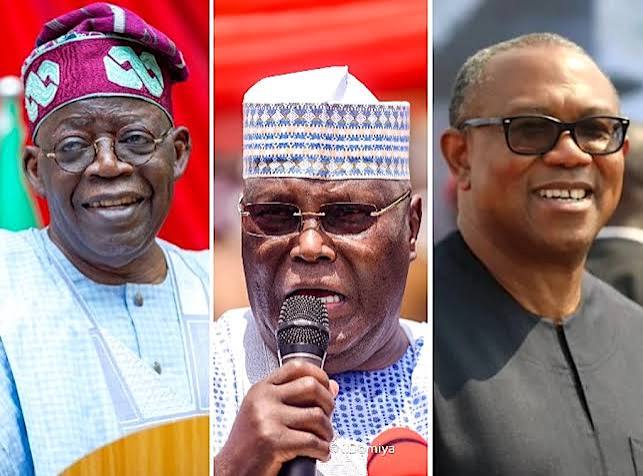
As the 2027 general elections draw closer, the political atmosphere in Nigeria is gradually heating up, with President Bola Ahmed Tinubu, former Vice President Alhaji Atiku Abubakar, and former Anambra State Governor Peter Obi emerging as the major figures shaping the race for the presidency with new strategies.
While President Tinubu is seeking a second term in office, Atiku and Obi are hoping to finally occupy the nation’s highest political seat after previous attempts.
The trio are already adjusting their strategies, building alliances, and strengthening their political structures as they prepare for what promises to be one of the most competitive elections in Nigeria’s democratic history.
President Tinubu, who came into office in 2023, is expected to campaign based on his administration’s reforms and long-term economic plans.
His supporters argue that his policies, including efforts to attract investment, improve infrastructure, and restructure the economy, will eventually deliver positive results.
However, critics believe that the removal of fuel subsidy, rising inflation, and the increasing cost of living have created serious hardship for many Nigerians.
Despite these challenges, Tinubu has continued to defend his administration, insisting that his reforms are necessary to build a stronger economy and that Nigerians will benefit from the sacrifices being made today.
His early move to unveil his campaign team suggests that the ruling party may already be preparing ahead of the opposition.
For Alhaji Atiku Abubakar, the 2027 election represents another opportunity to achieve a long-time ambition of leading Nigeria.
The former vice president has promised policies aimed at reviving businesses, improving economic opportunities, and reviewing some government decisions that have affected Nigerians.
His position on fuel subsidy and opening up more opportunities for private sector participation has attracted attention among some voters and business communities.
However, Atiku’s major challenge remains convincing Nigerians that he represents a fresh alternative after several previous presidential contests.
He will also need to unite his political supporters and build a stronger national coalition to compete effectively.
Peter Obi, who gained massive support during the 2023 election, remains a major force in the political landscape.
His supporters, popularly known as the “Obidient movement,” believe his message of good governance, accountability, and economic transformation can bring a new direction for the country.
Although Obi has not introduced a completely new political strategy ahead of 2027, he appears focused on consolidating the support and goodwill he gained from the last election.
His challenge will be expanding his support base beyond his existing followers and proving that his movement can translate into a nationwide electoral victory.
Beyond the personalities involved, the 2027 election is expected to be decided by key issues affecting ordinary Nigerians, including the economy, security, unemployment, education, healthcare, and the cost of living.
Many voters are likely to judge the candidates based on their ability to provide practical solutions rather than political promises.
Another major factor will be the strength of political alliances. Nigeria’s electoral history shows that no candidate can win the presidency without strong structures across the country.
The ability of Tinubu, Atiku, and Obi to build broad coalitions, attract influential political figures, and connect with young voters will play a significant role in determining the outcome.
For now, President Tinubu appears to have an early advantage in terms of incumbency and political machinery, while Atiku and Obi are working to create a strong challenge. But with many months before Nigerians return to the polls, the political landscape could still change.
In the end, only one candidate will emerge as Nigeria’s president after the 2027 election.
The battle ahead will not only be about personalities but also about who can convince Nigerians that they have the right solutions for the country’s future.
As Nigeria gradually enters the political season ahead of the 2027 general elections, there is a growing temptation among politicians to return to the familiar playbook: aggressive campaigns, endless promises, political propaganda, ethnic calculations, religious sentiments and the mobilisation of money and machinery.
But if the political class is paying attention, the recent Osun election should offer a sobering lesson.
Elections are no longer simply contests between political parties or exercises in political arithmetic. They are increasingly becoming referendums on performance, credibility, organisation and the relationship between politicians and the people.The Osun experience should therefore be more than another election victory or defeat to be celebrated by one camp and rationalised by another. It should be a warning to every politician preparing for 2027.
The first lesson is that the people are watching.
For too long, Nigerian politicians have behaved as though voters can be permanently manipulated with slogans, inducements and election-day theatrics. But voters are becoming more discerning. They may still respond to material incentives, but they also remember who governed well, who failed, who showed up and who disappeared after collecting their votes.
The second lesson is that political structures cannot replace public trust.
A party may possess powerful godfathers, influential leaders, vast resources and impressive campaign machinery, but these cannot indefinitely compensate for a credibility deficit. Political structures are important, but they work best when they are reinforced by genuine voter confidence.
The third lesson is that incumbency is not an automatic guarantee of victory.
Those who occupy political offices must understand that public office comes with a political bill that eventually falls due. Roads, schools, healthcare, jobs, security, salaries, infrastructure and the general welfare of citizens are not merely governance issues; they increasingly shape electoral decisions.
The politician who assumes that occupying government gives him an irreversible advantage may discover, rather painfully, that voters have the final word.
There is also a lesson for opposition parties. Winning elections requires more than criticising the government. Nigerians are increasingly interested in alternatives. Opposition parties must articulate credible programmes, build strong grassroots structures and demonstrate that they have the competence and discipline required to govern.
Perhaps the most important lesson is that 2027 cannot be approached as politics as usual.
Nigeria is facing an electorate that is younger, more digitally connected and increasingly vocal. Social media has changed political communication. Citizens can challenge official narratives in real time. Political mistakes can become national conversations within minutes. Candidates can no longer depend entirely on traditional campaign rallies and carefully managed media appearances.
The political class must also recognise that Nigerians are tired of being treated as statistics during elections and forgotten citizens afterwards.
The road to 2027 will undoubtedly produce the usual alliances, defections, endorsements and political realignments. There will be new coalitions and old rivalries. There will be attempts to weaponise identity, manipulate emotions and redefine political narratives.
But the real question is whether politicians will learn from Osun.
Will they understand that voters deserve respect? Will they realise that performance matters? Will political parties begin to prioritise competence over loyalty? Will candidates campaign on ideas rather than insults? Will politicians understand that democracy is not simply about winning elections but earning the legitimacy to govern?
These are the questions the Osun election should force the political class to confront.
The 2027 election is approaching. The campaign season may only be beginning, but the lessons have already arrived.
The politicians who choose to ignore them may do so at their own peril.
Nigeria’s voters are watching. And this time, they may be keeping a much longer memory.
Kokome, a communications strategist and public affairs analyst, writes from Lagos via kokomejohn@yahoo.com
By John Chibuzo Emmanuel
The realm of Nigerian politics today is a chessboard where our bones and dripping blood are recklessly tossed from one end to another. This is why one of the most quoted phrases in the history of our nation is “politics is a dirty game.
” Well, from the days of Azikiwe right to the days of Asiwaju, from Balewa to Buhari, from Gowon to Goodluck, from Obafemi to Obasanjo, corruption scandals have never ceased to dominate our headlines.Achebe summed it all up when he lamented: “The trouble with Nigeria is simply and squarely a failure of leadership.
There is nothing basically wrong with the Nigerian character. There is nothing wrong with the Nigerian land or climate or water or air or anything else. The Nigerian problem is the unwillingness or inability of its leaders to rise to the responsibility, to the challenge of personal example which are the hallmarks of true leadership” (Achebe 1).And in these trying times of ours, when the blood of our children flow in the thick green forest, when the cries of our raped mothers do nothing but chase away the watching birds that perch on the tall trees, when the screams of our brave soldiers that echo in the forests serve as their untimely and only goodbye; we must remember General Murtala Muhammad. In this era when inhumanity has replaced our sense of religion and empathy, we must not forget a man who truly loved, lived and died for Nigeria. We must not forget the bravest and most fearless leader to have walked the brown earth of this barren land endowed with the greatest mineral deposits. Do not laugh at this paralyzing but profound and truthful paradox.
It is indeed a national tragedy that the most distinguished and excellent individuals in our short history have either been relegated to the background of oblivion, persecuted by the majority, or slaughtered on the altar of envy. It is a national tragedy that our school children know nothing of their history or heroes. It is even a greater tragedy that they are being robbed of noticeable examples of distinguished leadership from our history. The painful consequence of this is that we have come to accept stupidity and ideological bankruptcy in politics as our national guiding principles.
Mothers in the marketplace, children in malpractice-ridden schools, students in dilapidated institutions, brave soldiers dying in the thick enclaves of Sambisa, intellectuals tired from years of doing battle with the federal and state governments, do not forget General Murtala Muhammad. Do not forget General Murtala for he is a reminder of all we can achieve if we eradicate the different manifestations of corruption unique to our lives.
General Murtala was born on November 8, 1938, and became one of the youngest generals throughout the history of Nigeria. At the age of thirty-six he took over the reins of government from General Yakubu Gowon on July 29, 1975, through a bloodless coup d’etat, and ruled the country for just two hundred days before he was assassinated by Lieutenant Colonel Bukar Suka Dimka on February 13, 1976.
However, in his two hundred days of power, he implemented some of the most impactful and iconoclastic social and economic reforms ever seen in the history of this country. In his two hundred days of power, he sacked more than ten thousand corrupt and incompetent civil servants. In his two hundred days of power, he conceived and began implementing a vision of a central capital city other than Lagos. This city is now known as the city of Abuja.
In his two hundred days in power, he championed African Liberation Movements throughout Africa as well as opposed apartheid and neo-colonialism virulently. In his two hundred days of power he did what even democratically elected leaders have always hesitated to attempt: decentralization of the national executive. He decentralized his executive powers into a military triumvirate consisting of himself, Olusegun Obasanjo and Theophilus Danjuma.
In his two hundred days in power, the University of Jos—my alma matter—became a degree awarding institution. In his two hundred days of power he set Nigeria on the path of democracy before his tragic and untimely end. In his two hundred days in power he taught Nigerians the definition of true leadership.
No wonder Achebe once popularly wrote: “On the morning after Murtala Muhammed seized power in July 1975, public servants in Lagos were found “on seat” at seven thirty in the morning. Even the “go-slow” traffic that had defeated every solution and defied every regime vanished overnight from the streets.” How can one man wield such a positive influence in our national culture?
General Murtala Muhammed never allowed his ideas to rot in the bureaucratic files of government “experts”. For this, his signature phrase “with immediate effect” has become one of the most used and sadly, abused phrases by Nigerian politicians.
Do you know that the expression “fellow Nigerians” which has been bastardized by Nigerian leaders today was a term he coined and used to address ordinary Nigerians on the street whom he truly cared for? Do you know that upon his ascension to power he cut down the heavy security and military convoys that have come to characterize modern Nigerian politics? Do you know that in his two hundred days of power corrupt military officers and even military governors faced the wrath of the law just like every other Nigerian citizen on the streets? Do you know that all this was achieved by a man of just thirty-seven years?
If we forget Murtala Muhammad, we forget the dream of the poor hawker on the street, the prayer of the sun bathed keke driver, the hope of the unemployed graduate on the verge of suicide, or the resilience of the Northern girl child in her quest for education. If we forget Murtala Muhammad, we forget the Nigerian dream. The dream of living a peaceful and happy life.
On this historic day, we must remember General Murtala Muhammed and all he stood for so that we can eternally realize and regret the depth of our profound ignorance if we make a mistake on the 2027 ballot box. We cannot afford to make a mistake in the ballot box unless we want to eternalize the pain and tragedy of our lives. Vote for the future; our future, next year. Thank you for listening.
John Chibuzo is a Nigerian writer, literary critic, educator and multi-instrumentalist based in Jos city. His poetry and essays have been published in The National Scholar, Lolwe, Beyond the Pages, Nestle on the Rock and the anthology: Letters to the Union We Hope to Become. He co-founded The Excellent Magazine in 2024 and served as it’s first editor-in-chief. He studied English and Literature at the University of Jos.




Omarana Accuses Atiku of Backdoor Move to Substitute ADC Governorship Candidate
ShareFrom Yagana Ali, Yola The governorship candidate of the African Democratic Congress (ADC) in Adamawa State, Ambassador (Engr.) Omar Suleiman,...
Katsina Vaccinates 67,670 as Diphtheria Outbreak Hits 29 LGAs
ShareThe Katsina State Government said it has vaccinated 67,670 eligible persons against diphtheria and secured 650,000 additional vaccine doses to...
Bishop Ande Mobilises Church, Muslims, Media for Peace
ShareFrom John Lamma, Jalingo In an effort to promote lasting peace and peaceful coexistence in society, Bishop Ande Emmanuel of...
Bishop Ande Mobilises Church, Muslims, Media for Peace
ShareFrom John Lamma, Jalingo In an effort to promote lasting peace and peaceful coexistence in society, Bishop Ande Emmanuel of...


Sanwo-Olu Charges Youths on Nigeria’s Devt, Good Character
ShareLagos State Governor, Babajide Sanwo-Olu has charged youths to contribute to Nigeria’s development and imbibe good character to become responsible...
Varsity Student Recounts Hot Water Attack by Cousin in Benue
ShareFrom Attah Ede, Makurdi A 200-level Political Science student of Rev. Fr. Moses Orshio Adasu University (MOAUM), identified as Rose...

Maikalangu Mourns Former FCT NUJ Chairman, Osadebamwen
ShareBy Raphael Atuu, Abuja The Executive Chairman of Abuja Municipal Area Council (AMAC) and Chairman of the Association of Local...
Enugu Trains over 15,000 Civil Servants on E-Governance, Digitalization
ShareFrom Sylvia Udegbunam, Enugu The Enugu State Government has trained over 15,000 civil and public servants on e-governance and digitalisation...
FG Hands Over 188 Housing Units to Taraba
ShareBy Raphael Atuu, Abuja The Federal Government, officially handed over 188 housing units to the Taraba State Government in Jalingo,...


Mbah, NSC Unveil Coal City Games Mascot
ShareFrom Sylvia Udegbunam, Enugu Enugu State Governor, Dr. Peter Mbah, and the National Sports Commission (NSC), have unveiled the official...