
NEWS
NYSC DG visits Hospitalized Corps Member

By Evelyn Terseer, Abuja
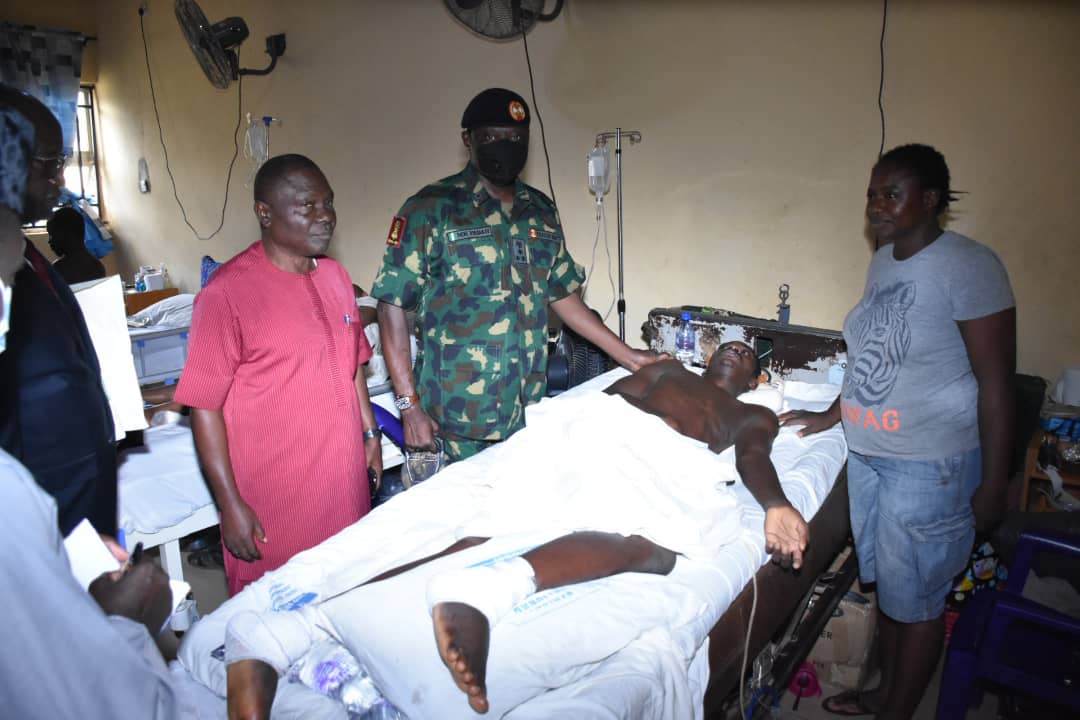
The Director General of National Youth Service Corps, Brigadier General Muhammad Kaku Fadah yesterday visited Corps Member Isreal Akinbinu AK/21C/2508 who had an accident and is on admission at the National Orthopaedic Hospital in Enugu.
General Fadah, who expressed his sympathy over the unfortunate incident assured the Corps Member of the Scheme’s full support until he recovers.
In the statement by the Director, Press and Public relations Eddy Megwa, he commended the Management of National Orthopaedic Hospital Enugu for giving maximum medicare to the hospitalized Corps Member who was on referral from Akwa Ibom State where he was intially deployed to before the accident.
While expressing her appreciation to the NYSC Director General for the visit, the mother of the Corps Member, Mrs Adetutu Akinbami who could not hide her feelings commended General Fadah for his favourable disposition to the security and welfare of Corps Members.
She prayed for divine protection for the Management, Staff and Corps Members.
General Fadah was accompanied during the visit by the Director, Special Duties, Alhaji Musa Abubakar, Director Press and Public Relations, Mr Eddy Megwa and NYSC Enugu State Coordinator, Mr Sam Ujogu.








From Joseph Amedu, Lokoja
The Kogi State Government has commiserated with the family of Adewumi Olamide Gift, a student of the Kogi State College of Nursing Sciences, Obangede, over her painful death.
Following the development, Governor Ahmed Ododo has directed the Commissioner for Health, Dr.
Abdulazeez Adams to immediately investigate the circumstances surrounding her death.“Already a team has been deployed to the College to conduct a thorough investigation”
Commissioner of Information and Communications, Kingsley Fanwo in a statement issued on Wednesday, assured the family, students and the general public that the investigation will be thorough and transparent.
“Government extends its heartfelt condolences to the bereaved family, the management, staff and students of the College. We pray that God grants the family the strength to bear this painful loss and repose to the soul of the deceased” the statement said.

By Laide Akinboade, Abuja
The World Health Organisation (WHO) on Wednesday raised alarm over Africa having the highest death rates associated with Antimicrobial Resistance (AMR).
The WHO Regional Director for Africa, Dr Mohamed Janabi, stated this in his message commemorating the 2026 World Antimicrobial Resistance Awareness Week, observed from November 18 to 24.
Janabi lamented that bacterial antimicrobial resistance was associated with an estimated 4.7 million deaths globally in 2021, with sub-Saharan Africa bearing the heaviest mortality burden.
Antimicrobial resistance occurs when bacteria, viruses, fungi and parasites develop the ability to withstand medicines designed to kill them or stop their spread, making infections increasingly difficult to treat
Janabi said, “From 18 to 24 November, we join the global community to mark World AMR Awareness Week under the theme “One Health, One Action: Prevent AMR now”. The theme recognizes that the health of people, animals, plants and the environment is closely connected. Preventing resistance demands action across all these sectors.
“The discovery of penicillin and other antibiotics transformed medicine infections that once proved fatal became treatable, and surgery, cancer treatment and organ transplantation became safer. Today, antimicrobial resistance threatens these gains. Medicines we have relied on for generations are losing their effectiveness, making infections harder to treat and putting lives at risk across our Region.
“Antimicrobial resistance, or AMR, occurs when bacteria, viruses, fungi and parasites no longer respond to medicines. Bacterial AMR was associated with an estimated 4.7 million deaths globally in 2021. Sub-Saharan Africa bears the highest rates of AMR-associated mortality, adding to the pressures on families and health services”.
The WHO boss noted that, “Inappropriate use of antimicrobials in people and animals accelerates resistance. Poor infection prevention, inadequate water and sanitation, and unsafe waste disposal help resistant organisms spread. Addressing these conditions must be central to our response.
“Countries across the WHO African Region are making progress. All 47 Member States now have national action plans on AMR, although implementation varies. All are also enrolled in WHO’s Global Antimicrobial Resistance and Use Surveillance System, and 44 can perform susceptibility testing for priority bacterial pathogens, helping identify which antibiotics are likely to work.
“Thirty-six countries have adopted WHO’s Access, Watch and Reserve classification of antibiotics. This supports appropriate prescribing and efforts towards the global target of ensuring that at least 70% of antibiotics used in human health come from the Access group by 2030.
“Coordination across sectors is also improving. The number of countries with functional One Health AMR governance mechanisms increased from 15 to 29 between 2023 and 2026. These arrangements clarify responsibilities and help sectors plan and act together”.
He therefore commended the Member States and regional Quadripartite partners (the Food and Agriculture Organization of the United Nations, the United Nations Environment Programme and the World Organisation for Animal Health) for their collaboration.
“We must now translate this progress into more consistent protection for communities. Preventing infections reduces the need for antimicrobials. Clean water, sanitation, good hygiene, vaccination and effective infection prevention in health facilities and farms are essential. Safe management of waste and wastewater also merits greater attention”.
Janabi urged all governments to turn national plans into funded action, with clear responsibilities and measurable results. Domestic investment must support laboratories, surveillance and the appropriate use of antimicrobials, while ensuring that people can access quality-assured treatment when they need it.
“I urge health professionals and those working in animal health and agriculture to prevent infections and use antimicrobials responsibly. Researchers, industry and development partners should support country priorities, expand equitable access to diagnostics and treatments, and strengthen the evidence needed to guide action.
“Communities, young people, educators and the media can help make AMR better understood. Practical advice includes keeping vaccinations up to date, practising good hand hygiene, using antibiotics only when prescribed by a qualified health professional, and never sharing leftover medicines”.
He also assured that, WHO will continue working alongside countries and partners to strengthen the One Health response and protect the medicines that make so much of modern health care possible.

From Ajiya Ayuba, Bauchi
The Bauchi State Government has committed to providing dedicated training land and sustained logistical support to the Nigerian Army as the military expands its force structure from eight to 12 divisions.
Bala Mohammed, governor of Bauchi State, gave the assurance at the Government House, Bauchi, while receiving Waidi Shaibu, a lieutenant general and Chief of Army Staff (COAS), alongside top commanders of the Nigerian Army High Command.
The visit coincided with the grand finale of Exercise Mugun Bugu 2026 in Alkaleri Local Government Area and the maiden Nigerian Army Armoured Corps (NAAC) Biennial Conference, Reunion, and Pulling-Out Ceremony.
Shaibu, who began his military career in the Armoured Corps in Bauchi, noted that the ongoing expansion of the Army under President Bola Tinubu has triggered a significant influx of officers and soldiers into the state for year-round specialised training.
He said that “Bauchi is the home to every Armoured officer because they normally start their careers here, from the young officers’ course until they attain the rank of colonel,” Shaibu said.
“With the expansion from eight to 12 divisions, some new units are being established in Bauchi, and a lot of officers and soldiers are coming to the Corps for consecutive training throughout the year.
The Commander of the Nigerian Army Armoured Corps will formally present a request for a dedicated parcel of land to support this training demand.”
The Army Chief also commended the state government for infrastructural upgrades around military facilities, noting that the reunion had brought together over 100 retired senior officers to deliberate on advancing the Armoured Corps.
In his remarks, Governor Bala Mohammed Abdulkadir congratulated Shaibu on his appointment and praised the swift operationalisation of two newly approved Nigerian Army battalions in Alkaleri and Tafawa-Balewa local government areas.
According to the governor, the rapid deployment of personnel and logistics to the new formations has bolstered investor confidence, agricultural output, and economic stability across the state, particularly along vulnerable forest and border corridors.
“The relative peace and stability we enjoy today, which has enabled us to execute massive infrastructure development, agricultural and economic reforms, would not have been possible without the unwavering vigilance and synergy of the 33 Artillery Brigade, the Armoured Corps, and sister security agencies,” Mohammed said.
While highlighting persistent security threats including banditry, kidnapping, and illegal mining around Alkaleri, Toro, Tafawa Balewa, Bogoro, and Katagum, the governor stated that the state government had already approved the Army’s request for additional training land.
“Security is a shared responsibility, even though we are in the opposition, we have no apology thanking President Bola Ahmed Tinubu and the Nigerian Army for decisive actions that have restored confidence and proved that criminal elements have no hiding place in Bauchi State or the North-East,” he added.
Governor Bala Mohammed Abdulkadir of Bauchi State further pledged that his administration would continue to prioritise troop welfare, intelligence sharing, and support for the families of fallen soldiers.



Ododo Orders Investigation over Death of Adewumi Olamide Gift
ShareFrom Joseph Amedu, Lokoja The Kogi State Government has commiserated with the family of Adewumi Olamide Gift, a student of...


AMR: Africa has Highest Number of Death Rate – WHO
ShareBy Laide Akinboade, Abuja The World Health Organisation (WHO) on Wednesday raised alarm over Africa having the highest death rates...

Bauchi Pledges Dedicated Training Land, Logistics as Nigerian Army Expands to 12 Divisions
ShareFrom Ajiya Ayuba, Bauchi The Bauchi State Government has committed to providing dedicated training land and sustained logistical support to...


Enugu PDP Inaugurates Ward, LG Campaign Coordinators
ShareFrom Sylvia Udegbunam, Enugu The Peoples Democratic Party (PDP), in Enugu State, has inaugurated Ward and Local Government Campaign Coordinators...


2027: Abba Urges Kano Residents to Obtain PVCs
ShareFrom Rabiu Sanusi, Kano Kano State Governor, Alhaji Abba Kabir Yusuf, has called on pensioners and residents across the state...


UNICEF Organises Two-day Media Dialogue on Humanitarian Action for Children in Benue
ShareFrom Attah Ede, Makurdi The United Nations Children’s Fund (UNICEF) with support from the Government of Sweden through the Swedish...


ASUU Declares Indefinite Strike at Zamfara State University
ShareThe Academic Staff Union of Universities (ASUU), Zamfara State University branch, has commenced an indefinite strike over the failure of...

CBN, NNPCL Sign MOU to Strengthen Macroeconomic Stability, Energy Financing
ShareBy Tony Obiechina, Abuja The Central Bank of Nigeria (CBN) and the Nigerian National Petroleum Company Limited (NNPCL) have signed...

Nigeria, Russia Sign Customs Agreement to Strengthen Trade, Border Security
ShareBy Tambaya Julius, Abuja The Nigeria Customs Service (NCS) and the Federal Customs Service of the Russian Federation have signed...


Troops Arrest Suspected Ammunition Supplier, Recover 300 Rounds Hidden in Sack of Beans
ShareBy David Torough, Abuja Troops of the Nigerian Army have arrested a suspected ammunition supplier and recovered 300 rounds of...