
NEWS
Oborevwori Orders Crackdown after DSS Arms Seizure in Asaba

From Francis Sadhere, Delta
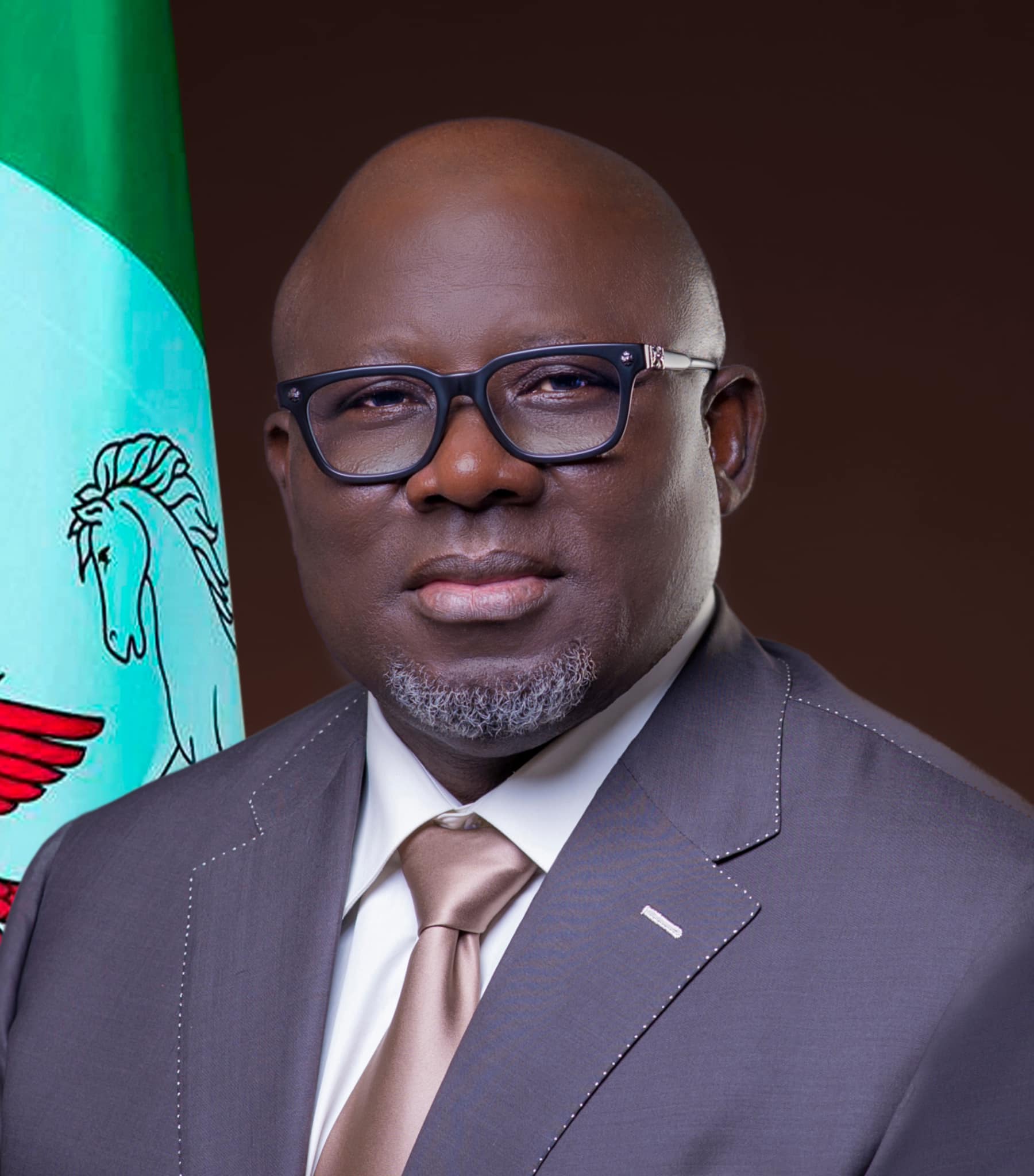
Delta State Governor, Rt. Hon. Sheriff Oborevwori, has directed security agencies in the state to launch a comprehensive crackdown on criminal networks following the interception of a large cache of sophisticated weapons by the Department of State Services (DSS) in Asaba.
Oborevwori gave the order on Monday during a visit to the Delta State Command of the DSS, describing the seizure as a “major breakthrough” in the state’s ongoing campaign against insecurity. “I am very delighted to be here today. I had to leave another important engagement to be here because the breakthrough recorded by our security agencies is highly commendable and significant to the peace and safety of our state,” he said.The governor commended the DSS for its intelligence-driven operation and lauded the synergy among security agencies in tracking criminal networks. He said the development underscored his administration’s unwavering commitment to peace, public safety, and investor confidence.Oborevwori, however, warned that his administration would not tolerate any act of lawlessness, particularly in Warri and its environs, stressing that peace was non-negotiable in his economic development agenda.“Those who are planning to cause crisis should have a rethink: we want peace, not trouble. We are working tirelessly to open up Warri for investors and economic growth, but where there is violence, investors will stay away,” he cautioned.He warned that anyone involved in killings, violence, or arms trafficking would be hunted down and prosecuted, declaring that bringing arms into the state amounted to a direct threat to peace and stability.“Bringing in heavy arms and ammunition of this nature is unacceptable and a direct threat to our collective peace. We will not allow it under any circumstance,” the governor said, urging residents to support security agencies in maintaining law and order.On the killing of Jerry Aduara, a two-time chairman of the Odion Urhobo Youth Council and member of the Warri South Local Government Peace Committee, Governor Oborevwori said he had ordered the immediate arrest of the culprit and all those connected to the incident.“I have directed security agencies to arrest the person who shot and killed somebody in Warri. They should look for that person and bring him to book, including those backing him. Nobody involved will go scot-free because this is Delta State, and we want peace,” he stated.The Deputy Director of Operations of the DSS, Delta State Command, Anthony Ifemeje, briefed the governor on the operation that led to the interception of the weapons and arrest of the suspects.He revealed that on October 12, 2025, operatives of the command arrested a notorious arms dealer, Stephen Sabo Atoshi, and his accomplice, a 40-year-old secondary school teacher from Taraba State, during an intelligence-led raid in Asaba metropolis.According to him, the suspects belonged to a transnational arms trafficking syndicate smuggling weapons from Sebha in southern Libya through Chad into Nigeria via an illegal border in Gidam, Yobe State.Items recovered from the suspects included seven GPMGs, several AK-47 rifles, five hand grenades, and other military-grade weapons, some of which were concealed in bags of beans transported from the North to the Oko Food Market along the Asaba–Onitsha Expressway.The operation also uncovered 497 cartons of fake drugs intended for distribution within the state.Ifemeje assured the governor that the DSS remained committed to dismantling criminal networks, cutting off arms supply routes, and sustaining intelligence-driven operations to ensure lasting peace in Delta.Oborevwori reiterated that security remained the cornerstone of his MORE Agenda, emphasizing that Delta State would remain peaceful, business-friendly, and intolerant of criminal activities.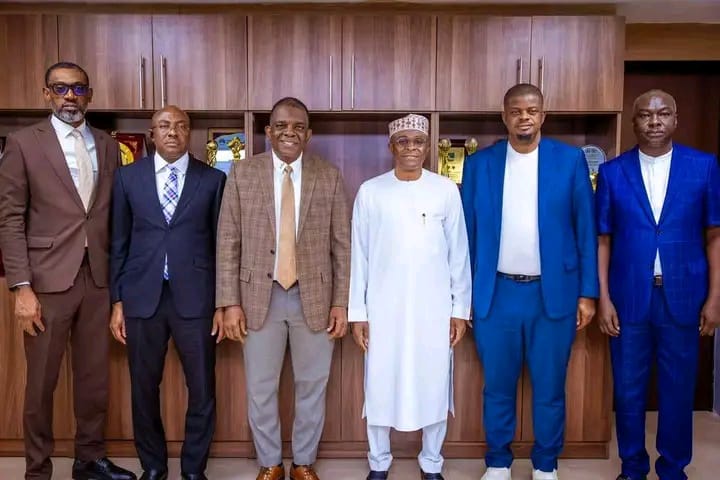
By David Torough, Abuja
The Nigerian Ports Economic Regulatory Agency (NPERA) and the Nigerian Ports Authority (NPA) have commenced discussions on the transfer of inland dry port-related functions as part of efforts to ensure a seamless implementation of the new regulatory framework and promote the growth of Nigeria’s marine and blue economy.
The meeting, held between the management of both agencies, focused on the technical aspects of the transition, including the need to clearly delineate responsibilities and prevent duplication of functions among relevant government agencies.
The Director-General/CEO of NPERA, Dr. Akutah Pius, said the directive of the Minister of Marine and Blue Economy, Dr. Adegboyega Oyetola, should be viewed as a directive aimed at advancing the growth and development of the nation’s marine and blue economy.
He stressed that the transition could not be successfully achieved by NPERA alone, noting that the cooperation of all relevant stakeholders was essential.
According to him, the Ministry of Marine and Blue Economy would remain at the centre of the transition process, while relevant mandates would be appropriately transferred to facilitate smooth integration.
He noted that the Minister’s intervention while the NPERA Bill was still before the National Assembly had helped resolve disagreements among agencies and create a foundation for greater inter-agency collaboration.
Akutah further emphasised the importance of unity and cooperation in achieving a successful transition, explaining that the purpose of the meeting was to commence the process of transferring the relevant inland dry port duties to NPERA, in line with the agency’s mandate as an economic regulator.
He said the provisions of the NPERA Act, including Section 51, needed to be effectively operationalised to facilitate a seamless transition and ensure that the various responsibilities of stakeholders were properly aligned.
The NPERA Boss proposed the establishment of a joint committee comprising NPERA, NPA, the National Inland Waterways Authority (NIWA), and the Federal Ministry of Marine and Blue Economy to coordinate the transition process.
He noted that inland dry ports are critical to extending the benefits of the maritime sector to Nigeria’s hinterland and strengthening the country’s trade and logistics network.
Responding, the Managing Director of NPA, Dr. Abubakar Dantsoho described the initiative as a welcome development and assured NPERA of the Authority’s operational and technical support throughout the transition process.
Dantsoho said the process had commenced with the right intention and purpose, adding that updated information on the current status of inland dry ports would be made available to support the deliberations.
He expressed optimism that further engagements would lead to the realisation of the objectives of the transition and strengthen the development of inland dry ports.
The Executive Director of the NPA, Lekan Badmus, commended NPERA for initiating the collaboration, describing the meeting as an important step towards achieving a smooth integration.
He said the agencies had now entered the technical phase of the transition, with particular attention being given to avoiding duplication of functions.
In his closing remarks, Dr. Akutah said that the proposed committee would reconvene with the Minister to obtain further clarification on the transition and agree on the necessary steps to ensure that the process is implemented smoothly and effectively.

The Joint Admissions and Matriculation Board (JAMB) has reviewed its policy on swapping candidates’ registered GSM numbers and changing registered email addresses, allowing candidates who have genuinely lost access to their SIM cards or email accounts to update their details through a controlled process.
The new arrangement, which takes effect from Monday, is designed to assist candidates who have lost access to their registered GSM numbers, particularly those unable to use the numbers for registration for subsequent Unified Tertiary Matriculation Examinations (UTME), as well as those whose registered email accounts can no longer be recovered.
The Acting Director, Public Affairs and Protocols, JAMB, Dr Fabian Benjamin, announced this in a statement on Monday.
The Board had previously restricted SIM swapping and email changes as part of measures to protect candidates’ records from fraud and other security vulnerabilities associated with such alterations.
Benjamin, however, said in the statement that the policy was reviewed following the introduction of enhanced security measures, particularly stronger identity and biometric verification processes.
Under the revised arrangement, candidates can request a GSM number swap, email address change, or both, subject to strict authentication procedures.
According to the Board, the concession is intended to reduce the hardship faced by candidates who lose access to their registered credentials and make the processes leading to tertiary education admission more seamless.
JAMB, however, warned that the service would be available only once to each candidate and would be subject to stringent verification designed to prevent impersonation, fraud and unauthorised alteration of candidates’ records.
Part of the statement read: “The service will be available at designated JAMB Computer-Based Test (CBT) Centres, including State Offices where applicable.
“Candidates seeking to access the service are required to provide the new GSM number and/or email address, as applicable, as well as a duly executed court affidavit scanned and ready for upload.
How to access the service
According to JAMB, candidates are required to log into their e-Facility profiles using their existing credentials, including their email address, registration number or profile code.
“They are then expected to select ‘SIM Swap/eMail Change Payment’ from the menu and pay the prescribed fee.
“After payment, candidates are to proceed to a JAMB CBT Centre and access the SIM Swap/eMail Change Quicklink.
“At the centre, they will enter their profile code or existing GSM number and click ‘Fetch Details’, after which they will undergo biometric verification.
“The candidate will then select the required service — GSM number only, email address only, or both GSM number and email address — before entering the new details and uploading the scanned court affidavit.
“The process is completed by clicking ‘Update’, after which a confirmation message will be displayed upon successful completion,” JAMB stated.
The Board advised candidates to use the service strictly for genuine cases and patronise only designated CBT centres.
JAMB further noted that the reviewed policy was part of its effort to balance strong data security with candidate-friendly service delivery, ensuring that genuine candidates are not unnecessarily disadvantaged by circumstances beyond their control.
By David Torough, Abuja
The Management of Asset Newspapers Limited, Publishers of DAILY ASSET, has announced the passage of the newspaper’s Deputy Editor-in-Chief, John Danusa Ocholi.
Ocholi, a veteran Sports Journalist died yesterday afternoon after a protracted illness.
He was 65.His death comes four days after the Newspaper lost its Politics Editor, Mike Odiakose after a brief illness. Odiakose is yet to be buried.
Publisher/Editor-in-Chief of the Newspaper, Dr Cletus Akwaya in a statement last night said the family confirmed the demise of the foremost journalist.
“It is with a heavy heart that we announce the demise of our colleague, our pioneer Editor and Deputy Editor-in-Chief, John Danusa Ocholi”, Akwaya wrote in the statement adding “ we shall miss him dearly”.
The Publisher said “Ocholi was a very dedicated person to the cause of the paper. He was the pioneer Editor, who did quite a lot to take the paper off the ground from inception and remained steadfast through difficult times in the bid to nurture the paper to maturity” Akwaya said.
“We are grateful to God for the gift of Ocholi, who was a team player, motivator and mentor, always full of smiles to reduce tensions in times of difficulties” the Publisher further stated.
He said the Management would await further information from the family on the unfortunate incident.
An indigene of Dekina LGA of Kogi state, Ocholi joined Daily Asset at inception as pioneer Editor in 2017. He was promoted to Managing Editor and then Deputy Editor- in- Chief, the position he held until 2023 when he had health challenges, which made him proceed on sick leave.
He joined DAILY ASSET from Daily Pilot where he worked as Editor of the Weekend Pilot and Deputy Editor of the Daily Pilot. He joined the Nigerian Pilot from Verbatim Magazine, where he served as Editor.
A graduate of Mass Communication, University of Lagos, 1983,
Ocholi began his journalism career with The Voice Newspaper in Makurdi, Benue State as Sports Reporter. He rose to the position of Sports Editor before he voluntarily resigned and joined Champion Newspapers in Lagos as a Sports Journalist. He rose through various positions and eventually became Editor of the highly respected Sporting Champion, Nigeria’s most respected weekly Sports Newspaper in the 1990s in the stable of Champion Newspapers Group.
In 2002, when the acclaimed South African soccer magazine Kick-Off launched its Nigerian edition, Ocholi was appointed to assist the head editor, Kunle Solaja.He later became the Magazine’s Editor before it stopped production.
He also worked at the Newswatch Magazine as Associate Editor and Head of Sports Desk, where he wrote very impactful stories on Nigerian sports and anchored highly celebrated interviews for the famous magazine.
In the course of his career, he covered major international sporting events including Many editions of the Senior and junior Football World Cups, African Cup of Nations (AFCON), international Club engagements, Commonwealth Games amongst others. He was clearly one of the nation’s most renowned Sports journalists.
In 2010, he was selected as a key member of the official Media Sub-Committee appointed by the Nigeria Football Federation (NFF) to oversee Nigeria’s media contingent and operations during the 2010 FIFA World Cup in South Africa.
A community development enthusiast, he was elected as the pioneer president of the Igala Journalists Forum
He left behind his wife and children.




COAS Strengthens Operational Readiness, Welfare at Army Women Command
ShareBy David Torough, Abuja The Chief of Army Staff (COAS), Lt.-Gen. Waidi Shaibu, has reiterated the Nigerian Army’s commitment to...


NPERA, NPA Begin Talks on Transfer of Inland Dry Port Functions
ShareBy David Torough, Abuja The Nigerian Ports Economic Regulatory Agency (NPERA) and the Nigerian Ports Authority (NPA) have commenced discussions...
JAMB Eases Restriction on SIM Swap, Email Change
ShareThe Joint Admissions and Matriculation Board (JAMB) has reviewed its policy on swapping candidates’ registered GSM numbers and changing registered...
DAILY ASSET Loses Deputy Editor-in-Chief, Danusa Ocholi
ShareBy David Torough, Abuja The Management of Asset Newspapers Limited, Publishers of DAILY ASSET, has announced the passage of the...


OPay at 8: Still Okay, Still Moving Nigeria Forward
ShareEight years after commencing operations in Nigeria, OPay continues to build, innovate and serve, using technology to make financial services...


Kenya, Dangote Advance Plans for $17bn Lamu Refinery
ShareBy David Torough, Abuja Kenya is set to begin construction of the proposed East Africa Refinery in Lamu, following renewed...
FG Threatens Lagos-Calabar Highway Shutdown over Safety Breaches
ShareBy Raphaeh Atuu, Abaja The Federal Government has issued a two-week ultimatum for improved safety and security conditions on the...

Tinubu Extends Vacation as Absence Triggers Constitutional Questions
ShareBy David Torough, Abuja President Bola Tinubu has extended his working vacation in Europe by a few days and is...


Bishop Yakela Calls for Renewed Commitment to God at Makurdi Enthronement
ShareBy David Torough, Abuja The Anglican Bishop of Makurdi Diocese, Rt. Rev. Dr. Godwin Tersoo Yakela, has called on Christians...


Finance Ministry, CBN Sign MoU to Strengthen Fiscal, Monetary Policy Coordination
ShareBy Tony Obiechina, Abuja The Federal Ministry of Finance and the Central Bank of Nigeria (CBN) have formalised a new...