
Economy
Poverty: World Bank Report Exposes Buhari, APC’s Lies – PDP


By Jude Opara, Abuja
The Peoples Democratic Party (PDP) Wednesday mocked the administration of President Muhammadu Buhari and his All progressives Congress (APC) after the report by the World Bank that seven million Nigerians have been pushed into poverty in the last one year appears to have contradicted the earlier claim by the presidency that the administration has lifted about 10.
5 million Nigerians out of poverty.The PDP further claimed that the report by the World Bank has further vindicated its position that President Buhari is running an uncoordinated and clueless administration that thrives on lies, false performance claims, deceit and propaganda.
National Publicity Secretary of the PDP, Kola Ologbondiyan in a statement said Nigerians have seen why the APC and President Buhari’s handlers are always in an alleged frenzy to attack the opposition party and other well-meaning Nigerians whenever they point to the poor handling of the economy and on the need for President Buhari to always be factual on pertinent issues of governance in the country.
Ologbonduyan added that it indeed appears that the President enjoys living in denial while watching millions of Nigerians go down in abject poverty, excruciating hunger and starvation even as Nigeria now ranks 98th out of 107 in Global Hunger Index.
“Otherwise why would Mr. President claim that his administration has lifted over 10.5 million Nigerians out of poverty while official figures even from the National Bureau of Statistics (NBS) show worsening poverty rate with 142.2% growth in food inflation and over 82.9 million Nigerians being unable to afford their daily meals due to the failure of the administration to take practical steps to grow and protect the food sector?
“Under President Buhari, Nigerians are now subjected to the worst form of poverty and hardship, with collapsed purchasing power, occasioned by a voodoo economy management that have wrecked our productive sectors and pummeled our naira from the about N167 to a US dollar in 2015 to the current over N500 per dollar.
“It is unfortunate that Mr. President will choose to always bandy fictitious figures and false performance claims, when he has, in a space of six years, destroyed our national productivity and reduced our country to a beggarly nation, a laughing stock and object of pity among the comity of nations.
“The PDP invites Nigerians to note President Buhari and APC’s similar false performance claims in other critical sectors, including power, transportation, road infrastructure, health, education, agriculture, security, aviation among others, where the Buhari administration has been bandying fictitious figures with no tangible project to point at.”
The PDP also advised the President to end his alleged false performance claims and get more competent hands to manage the economy to save Nigerians from further falling below the poverty line.








The National Bureau of Statistics (NBS) says Nigeria’s headline inflation rate increased to 33.20 per cent in March 2024.
The NBS said this in its Consumer Price Index (CPI) and Inflation Report for March, which was released in Abuja on Monday.
According to the report, the figure is 1.50 per cent points higher compared to the 31.
It said on a year-on-year basis, the headline inflation rate in March 2024 was 11. 16 per cent higher than the rate recorded in March 2023 at 22.04 per cent.
In addition, the report said, on month-on-month basis, the headline inflation rate in March 2024 was 3.02 per cent, which was 0.10 per cent lower than the rate recorded in February 2024 at 3.12 per cent.
“This means that in March 2024, the rate of increase in the average price level is less than the rate of increase in the average price level in February 2024.”
The report attributed the increase in the headline index for March 2024 on a year-on-year basis and month-on-month basis to increase in some goods and services at the divisional level.
It said these increases were observed in food and non-alcoholic beverages, housing, water, electricity, gas, and other fuel, clothing and footwear, and transport.
Others, it said, were furnishings, household equipment and maintenance, education, health, miscellaneous goods and services, restaurants and hotels, alcoholic beverage, tobacco and kola, recreation and culture, and communication.
It said the percentage change in the average CPI for the 12 months ending March 2024 over the average of the CPI for the previous corresponding 12-month period was 27.13 per cent.
“This indicates a 6.76 per cent increase compared to 20.37 per cent recorded in March 2023”, it said.
The report said the food inflation rate in March 2024 increased to 40.01 per cent on a year-on-year basis, which was 15.56 per cent higher compared to the rate recorded in March 2023 at 24.45 per cent.
“The rise in food inflation on a year-on-year basis is caused by increases in prices of Garri, Millet, Akpu (uncooked fermented, which are under bread and cereals class), Yam Tuber, and Water Yam.
“Others are Dried Fish Sadine, Mudfish Dried, Palm Oil, Vegetable Oil, Beef Feet, Beef Head, Liver, Coconut, Water Melon, Lipton Tea, Bournvita, and Milo”, NBS said.
It said on a month-on-month basis, the food inflation rate in March was 3.62 per cent, which was a 0.17 per cent decrease compared to the rate recorded in February 2024 at 3.79 per cent.
“The fall in food inflation on a month-on-month basis was caused by a decrease in the average prices of Guinea corn flour, Plantain Flour etc (under Bread and Cereals class); Yam, Irish Potato, and CocoYam.
“Others are Titus fish, Mudfish Dried, Lipton, Bournvita, and Ovaltine”, it said.
The report said that “all items less farm produce and energy’’ or core inflation, which excludes the prices of volatile agricultural produce and energy, stood at 25.90 per cent in March on a year-on-year basis.
“This increased by 6.26 per cent compared to 19.63 per cent recorded in March 2023.’’
“The exclusion of the PMS is due to the deregulation of the commodity by removal of subsidy.”
It said the highest increases were recorded in prices of bus journey within the city, actual and imputed rentals for housing, consultation fee of a medical doctor, etc.
The NBS said on a month-on-month basis, the core inflation rate was 2.54 per cent in March 2024.
“This indicates a 0.37 per cent increase compared to what was recorded in February 2024 at 2.17 per cent.”
“The average 12-month annual inflation rate was 22.26 per cent for the 12 months ending March 2024, this was 5.04 per cent points higher than the 17.22 per cent recorded in March 2023”, it said.
The report said on a year-on-year basis in March 2024, the urban inflation rate was 35.18 per cent, 12.11 per cent higher compared to the 23.07 per cent recorded in March 2023.
The report said on a year-on-year basis in March 2024, the rural inflation rate was 31.45 per cent, which was 10.37 per cent higher compared to the 21.09 per cent recorded in March 2023.
“On a month-on-month basis, the rural inflation rate was 2.87 per cent, which decreased by 0.20 per cent compared to February 2024 at 3.07 per cent’’, it said.
On states’ profile analysis, the report showed that in March, all items inflation rate on a year-on-year basis was highest in Kogi at 39.97 per cent, followed by Bauchi at 38.34 per cent, and Kwara at 38.10 per cent.
It, however, said the slowest rise in headline inflation on a year-on-year basis was recorded in Borno at 25.78 per cent, followed by Benue and Taraba at 28.12 per cent, and Katsina at 28.32 per cent.
The report, however, said in March 2024, all items inflation rate on a month-on-month basis was highest in Zamfara at 3.90 per cent, followed by Abia at 3.89 per cent, and Ondo at 3.75 per cent.
“Borno at 1.46 per cent, followed by Yobe at 1.84 per cent and Adamawa at 1.85 per cent recorded the slowest rise in month-on-month inflation”, NBS said.
The report said on a year-on-year basis, food inflation was highest in Kogi at 48.46 per cent, followed by Kwara at 46.18 per cent, and Akwa Ibom at 45.18 per cent.
“Nasarawa at 33.76 per cent, followed by Borno at 34.28 per cent and Bauchi at 34.38 per cent recorded the slowest rise in food inflation on a year-on-year basis’’, it said.
The report, however, said on a month-on-month basis, food inflation was highest in Abia at 5.17 per cent, followed by Cross River at 5.14 per cent, and Bayelsa at 4.75 per cent.
“Cross River stood at 1.59 per cent, followed by Yobe at 2.08 per cent and Adamawa at 2.12 per cent, recorded the slowest rise in inflation on a month-on-month basis”, it said. (NAN)
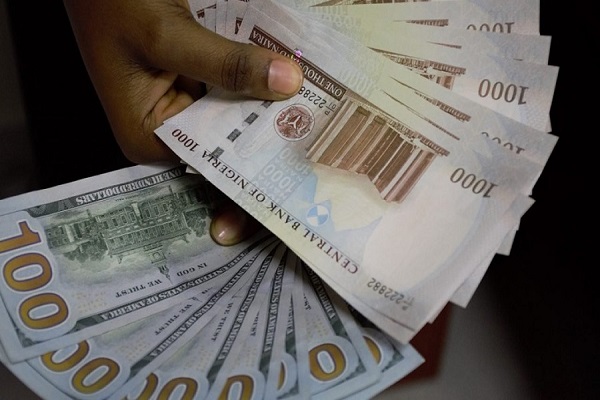
The Naira on Friday experienced huge appreciation at the official market, trading at N1,142.38 to the dollar.
Data from the official trading platform of the FMDQ Exchange, a platform that oversees the Nigerian Autonomous Foreign Exchange Market (NAFEM), revealed that the Naira gained N88.
23.This represents a 7.16 per cent gain when compared to the previous trading date on Monday, April 8, exchanging at N1,230.
61 to a dollar before the Sallah holiday.The total daily turnover increased to $281.34 million on Friday up from $125.55 million recorded on Monday.
Meanwhile, at the Investor’s and Exporter’s (I&E) window, the Naira traded between N1,265 and N1,100 against the dollar.
Economic experts have continued to praise both fiscal and monetary policies of President Bola Tinubu’s administration responsible for the steady Naira appreciation.
The CBN, during its policy meetings held in February and March, implemented a total of 600 basis points in interest rate increases.
This helped tackle dollar scarcity, reduced volatility, and decreased reliance on parallel markets. (NAN)

By Tony Obiechina, Abuja
Geregu Power Plc has generated N50.4bn on electricity sales and capacity charges to Nigerians in the first quarter of 2024.
The power company which is the first listed power company of the Nigerian Exchange Ltd disclosed the performance in its Q1, 2024 financial statement.
The company grew its Q1 revenue by 225 per cent from N14.
2bn in 2023 to N50. 4bn in 2023.A breakdown reveals that Geregu Power sold energy worth N31bn and received N19bn as revenue from capacity charge.
Recall that the power company posted an annual revenue of N82.9bn in the full year of 2023 but it has covered half of the amount in Q1.
The revenue was above the company’s forecast for Q1 2024 when it projected its revenue to rise to N31.24bn.
Geregu Power recorded a profit before tax of N21.9bn up from the N5.3bn recorded in Q1 of last year, reflecting 307.8 per cent growth.
During the period underreview, the company saw its profit after tax rose by 307.3 per cent to N14.46bn from N3.54bn recorded in Q1 of last year. In the full year 2023, the company made N16.1bn net profit.
The net profit was above the company projection of N5.5bn.
Geregu Power took an income tax charge of N7.43bn, up from the N1.8bn in Q1 2023. The tax charges were higher than the N2.7bn projected for Q1 2024.
The company also spent N21.5bn on the cost of sales involving gas supply and transportation, up from the N6.6bn spent on gas supply and transportation in Q1 2023.


Enugu Govt Warns Water Tanker Drivers over Failure to Colour-Coat daily
ShareFrom Sylvia Udegbunam, EnuguThe Enugu State government has issued the last warning to tanker drivers operating across the state over...

Kogi Unveils Online Registration for Students’ Bursary Award 2024
ShareFrom Joseph Amedu, LokojaThe Kogi State Government has begun online registration for student indigens in tertiary institutions across the country...


Nigeria, Major Global Trafficking Hub for Wildlife- Benue Rep
ShareBy Ubong Ukpong, AbujaVice Chairman of the House Committee on Environment in the House of Representatives, Rep Terseer Ugbor (APC,...

Sack Underperforming Appointees, El-Rufai Urges Tinubu
ShareBy Lubem Myaornyi, Abuja Former governor of Kaduna State Nasir El-Rufai yesterday urged President Bola Tinubu to sack appointees who...

Kano APC Suspends National Chairman, Ganduje Over Alleged Corruption
ShareThe National Chairman of the ruling All Progressives Congress (APC), Dr Abdullahi Umar Ganduje has been suspended as a member...


NSA Receives 22 Rescued Zamfara Varsity Students, Staff
Share The National Security Adviser (NSA), Malam Nuhu Ribadu, on Monday received 22 abducted students and staff of Federal University,...


Q1:PTML Customs Rakes N66.9b, Surpasses 2023 Revenue
ShareThe Port Terminal Multiservices Ltd. (PTML) Command of Nigeria Customs Service (NCS) has recorded N66.9 billion revenue in the first...
Gov Sule Raises Concern over Increase Cases of Kidnapping
Share Gov. Abdullahi Sule of Nasarawa State, has expressed concern over recent increase in cases of kidnapping in the state....

Ex- governorship Candidate Rallies Support for Ododo
Share Rep. Leke Abejide, the African Democratic Congress (ADC) candidate for the Nov. 11 Kogi governorship election, has urged the...
Newly Elected Bayelsa LG Chairmen Receive Certificate of Return
ShareThe Bayelsa Independent Electoral Commission (BYSIEC) on Monday presented Certificates of Return to winners of the state April 6 local...