
POLITICS
Senate Okays ₦140bn SEDC Proposal, Warns on Fiscal Discipline

By Eze Okechukwu, Abuja
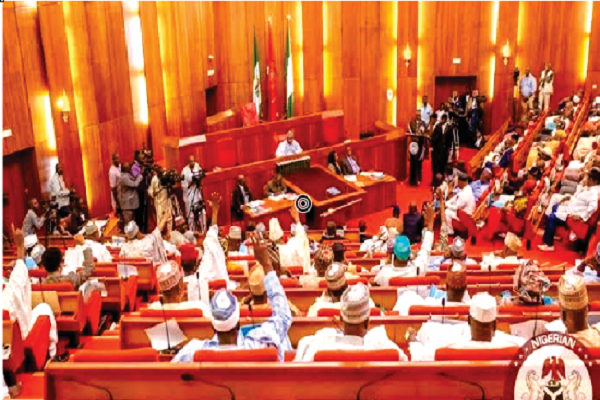
The Senate has endorsed the proposed ₦140 billion 2026 budget of the South East Development Commission (SEDC), while issuing strong warnings on fiscal discipline, measurable security outcomes and urgent ecological intervention across the region.
The budget was presented by the Managing Director/Chief Executive Officer of SEDC, Mr.
Mark Okoye, who outlined a development-driven financial plan anchored on infrastructure renewal, industrialisation, private sector-led growth and regional integration.The budget breakdown
Of the ₦140 billion proposal shows
₦106.
The Commission stated that the 2026 budget is structured around five strategic pillars: infrastructure development, economic empowerment, environmental sustainability, social development, and security/peace building.
In his presentation, the MD unveiled a long-term roadmap to build a $200 billion South East economy by 2035, revealing that central to this vision is the establishment of a proposed South East Investment Corporation (SEIC), projected to drive a $150 billion capital base and position the region as Africa’s preferred investment destination.
He disclosed that the Commission is targeting a $1 billion regional investment threshold and intends to structure major infrastructure projects to attract international financing rather than rely solely on federal allocations.
Although the 2025 fiscal year recorded zero capital releases, Okoye explained that the Commission utilised the period to prepare feasibility studies and “bankable documents” to drive large-scale projects, including a proposed regional gas pipeline network estimated to cost between $1.5 billion and $2 billion.
Key Allocations in the 2026 Proposal
Notable provisions include:
Community Social Development Programme – ₦3.3 billion
South East Venture Capital Fund – ₦3.5 billion
Youth Entrepreneurship Programme – ₦2.5 billion
Grassroot Recreation Infrastructure – ₦7 billion
Headquarters and Zonal Offices Setup – ₦2.9 billion
Operational Vehicles – ₦4.1 billion
Climate Sustainability and Green Economy – ₦500 million
Regional Security Programme – ₦2.5 billion
M.I. Okpara Fellowship (Leadership Development) – ₦660 million
While commending the clarity and ambition of the proposal, lawmakers raised concerns about spending priorities and measurable impact.
Senator Tony Nwoye stressed that without security, development efforts would not yield meaningful results. He demanded clarity on how the ₦2.5 billion Regional Security Programme would translate into visible improvements, especially in areas severely affected by insecurity. He also sought details on collaboration mechanisms with existing security agencies.
On the ₦3.5 billion South East Venture Capital Fund, Nwoye warned against politicisation, insisting it must operate strictly on merit to support genuine innovators in commercial hubs such as Onitsha, Aba and Nnewi.
Environmental sustainability drew sharp criticism, with lawmakers describing the ₦500 million allocation as grossly inadequate for a region battling thousands of erosion sites, often referred to as Nigeria’s erosion epicentre. Senators urged the Commission to prioritise life-threatening ecological challenges.
Senator Kenneth Eze urged the Commission to treat public funds with the discipline of a private enterprise. While praising the Managing Director’s strong presentation, he cautioned against spreading limited resources across too many projects, warning that such an approach could lead to abandoned initiatives.
He advised management to match projects strictly with available resources and focus on realistic, measurable outcomes rather than excessive stakeholder engagements and conferences.
In his remarks, Senator Victor Umeh described the proposal as visionary and aligned with the historic economic revival model of the South East, expressing confidence in the management team once funds are released.
For the Chairman of the Senate Committee and former Abia State Governor, Orji Uzor Kalu, he commended the management for presenting what he described as a “bankable document” capable of attracting global financing institutions.
He emphasized that the Commission was established as a development institution, not a political platform, and reiterated that it was entrusted to the region by President Bola Ahmed Tinubu.
“Our rules are simple. Compliance, oversight and feedback. This Committee will be ruthless in oversight. We will not look at anybody’s face. This Commission must not be a place for siphoning money. It must rekindle hope and drive economic development,” Kalu said.
He encouraged transparency, collective leadership among executive directors and readiness for oversight visits. He also defended the preparatory feasibility studies, describing them as essential groundwork for attracting institutions such as the World Bank and Afreximbank and for integrating projects into national borrowing frameworks.
 | Thanks for sharing!Mail received.Many thanks for sharing. |

By Julius Tambaya, Abuja
The presidential candidate of the Young Progressive Party (YPP), Peter Agada, has pledged to usher in a fresh era of transparent, technology-driven governance if elected President of Nigeria in the 2027 general elections.
Agada, a former Director of Finance for the Obidient Movement in the 2023 elections, voiced strong optimism about defeating his political rivals.
He made the commitment while unveiling his bold policy roadmap tagged “Labour Direct” , a people-centered agenda designed to tackle Nigeria’s most pressing challenges head-on.The YPP presidential flag bearer who, spoke in an exclusive interview with DAILY ASSET, stated that his administration would be anchored on an “open-network governance” model, emphasizing total inclusivity, accountability, and direct citizen engagement through the ‘Labour Direct’ framework.
He further stressed the urgent need to align skills development with current market demands. He further called for a complete overhaul of the public service, advocating for a merit-based recruitment system to replace favoritism and mediocrity.
“As an accomplished professional architect with vast international experience, I will approach national security through a smart blend of community-based intelligence and cutting-edge technology,” Agada noted.
He also highlighted massive job creation plans, with a strategic focus on agricultural industrialization and the solid minerals sector—two areas he believes hold the structural key to absorbing Nigeria’s teeming youthful population
On the alleged politicization of the Independent National Electoral Commission (INEC) by the current administration, Agada revealed ongoing, high-level international collaborations aimed at restoring public confidence in the nation’s electoral process.
“We are already working with corporate development partners and the governments of the United States and China to build and deploy a robust, technology-based system,” Agada declared. “This will ensure prompt, transparent, and tamper-proof transmission of election results.”
Positioning himself as a bridge between competence and compassion, the YPP candidate promised a government that works for every citizen, irrespective of tribe, religion, or political affiliation.
African Democratic Congress (ADC) has dismissed the claims by a rival group of uploading presidential nomination details to the Independent National Electoral Commission (INEC) portal, describing it as false.
Consequently, the party has urged INEC to investigate what it described as forgery and unauthorised use of documents it purportedly issued.
The party’s National Publicity Secretary, Mallam Bolaji Abdullahi, in a statement issued on Monday in Abuja, said it was not true that a group, led by Nafiu Bala, uploaded names of presidential and other candidates into the INEC nomination portal.
According to him, INEC cannot issue nomination portal access or nomination codes to a leadership it does not officially recognise under the Electoral Act.
He said that the commission would not issue separate nomination portal codes to different groups claiming leadership of the same registered political party.
“The claim is a blatant lie. INEC does not issue nomination portal access or nomination codes to a leadership it does not recognise,” Abdullahi said.
He challenged those making the allegation to provide credible evidence showing that an unrecognised group successfully accessed and uploaded nominations on the commission’s portal.
The spokesman said the party had formally notified INEC of what it considered apparent forgery and unauthorised use of documents bearing the commission’s identity.
“We trust that the commission will investigate this matter and take necessary steps to correct this blatant misrepresentation,” he said.
Abdullahi declared that ADC was not factionalised, insisting that INEC recognised only one leadership which had completed its nomination process lawfully.
He said the party had already uploaded details of its presidential candidate, Alhaji Atiku Abubakar and vice-presidential candidate, Rotimi Amaechi, on the INEC portal.
“Our focus remains firmly on presenting Nigerians with a credible alternative that can restore security, revive the economy and create jobs in 2027,” he said.
The spokesman urged party members, supporters, the media and the public to disregard contrary claims and rely only on official communications issued through authorised ADC channels.

By David Torough, Abuja
The Court of Appeal in Abuja on Monday, upheld a Federal High Court judgment restraining the Independent National Electoral Commission (INEC) from recognising or participating in state congresses organised by committees appointed by the Senator David Mark-led caretaker leadership of the African Democratic Congress (ADC), in a ruling that has deepened the party’s internal leadership crisis ahead of the 2027 general elections.
In a split two-to-one decision, the appellate court affirmed the April 29, 2026 judgment of Justice Joyce Abdulmalik, which barred the caretaker leadership from interfering with the tenure and functions of the party’s duly elected state executive committees and prevented INEC from recognising any state congresses conducted under the caretaker arrangement.
Delivering the lead majority judgment, Justice Okon Abang held that the power to conduct state congresses resides with the party’s elected state executive committees and not the national caretaker leadership. He ruled that the ADC violated Section 223(1)(a) of the Constitution and breached its own constitution by appointing a caretaker committee to conduct state congresses while the tenure of elected state executives remained valid.
Justice Abang, who delivered the judgment supported by Justice Donatus Okorowo, held that once constitutional violations are alleged, disputes within political parties cease to be mere internal affairs and become justiciable. He stressed that judicial intervention was necessary to safeguard democratic principles and prevent anarchy.
The appellate court consequently dismissed the appeal filed by the ADC, upheld the restraining orders issued by the Federal High Court, and awarded N10 million costs against the party in favour of the plaintiffs.
However, the Presiding Justice, Abba Mohammed, dissented, maintaining that the dispute was an internal affair of the party beyond the jurisdiction of the courts. He argued that the plaintiffs failed to exhaust the party’s internal dispute resolution mechanisms before instituting the suit and described both the trial court’s judgment and the majority decision as erroneous.
The suit was instituted by aggrieved members of the ADC, who challenged the constitution of committees by the Senator David Mark-led caretaker leadership to conduct state congresses. They argued that only duly elected party organs recognised by the party’s constitution possess such powers. The Federal High Court agreed, nullifying all processes initiated by the caretaker leadership in relation to the state congresses.
Despite the setback, the ADC dismissed suggestions that the judgment could affect its preparations for the 2027 general elections.
In a statement, the party’s National Publicity Secretary, Bolaji Abdullahi, insisted that the judgment dealt solely with congresses for the election of ward, local government and state executive committees and had no bearing on the direct primaries through which the party’s candidates emerged.
He announced that the party had commenced the process of appealing the judgment at the Supreme Court, describing the Court of Appeal’s decision as legally unsustainable while expressing confidence in the dissenting judgment.
“The judgment has no effect whatsoever on the direct primaries through which the party’s candidates have emerged at all levels,” Abdullahi said, urging party members and supporters to remain calm and focused on the party’s mission of providing Nigerians with a credible political alternative.
Former Vice President Atiku Abubakar also sought to reassure supporters, saying the ruling did not invalidate the ADC’s primary elections or the emergence of its candidates for the 2027 polls.
In a statement by his Senior Special Assistant on Public Communication, Phrank Shaibu, Atiku described reports suggesting that the judgment had nullified the party’s presidential ticket as misleading propaganda.
According to him, the appellate court ruled only on the legality of the party’s state congresses and the tenure of state executives, stressing that congresses for electing party officials are legally distinct from statutory primary elections conducted to nominate candidates under the Electoral Act.
He maintained that only issues placed before a court can be determined and insisted that any attempt to interpret the judgment as invalidating the party’s primaries amounted to a misrepresentation of the law.
Atiku affirmed the party’s decision to approach the Supreme Court and urged supporters not to be discouraged, insisting that the ADC remained committed to pursuing its political objectives through constitutional and legal means as preparations for the 2027 general elections continue.



Abuja Court Dismisses Age Falsification Case Against Senior Police Officers
Share Justice Yusuf Haliru of the Federal Capital Territory,( FCT) High Court Abuja, has dismissed a case brought against some...


World Cup 2026: France Set to Clash with Spain in Epic Battle
ShareTwo-time World Cup champions France will on Tuesday take on Spain, the reigning European champions and 2010 FIFA World Cup...
State Police and Fear of Governors’ Abuse
ShareBy Tochukwu Jimo Obi The debate over the creation of state police in Nigeria has continued to generate intense public...


FG Withdraws Registration Fees Hike on WASSCE, NECO, SSCE
ShareBy Tony Obiechina, Abuja The Federal Government has suspended the proposed review of registration fees for the 2027 West African...


Education Stakeholders Split over FG’s N50,000 WAEC, NECO Examinations Fee
ShareThe Federal Government’s approval of a N50,000 registration fee for National Examinations Council (NECO) and West African Examinations Council (WAEC)...


Triple Murder Suspect Appears in South Africa Court
ShareA man suspected of killing his wife and two daughters in Bedfordshire has been in court in South Africa after...


England to Wear All-white Kit against Argentina
ShareEngland will wear their all-white home kit to face Argentina in the semi-finals of the World Cup in Atlanta on...

CAF President Mourns South Africa W’Cup Player, Jayden Adams
ShareConfédération Africaine de Football Président Dr. Patrice Motsepe has expressed sadness over the death of South Africa international and Mamelodi...


2027: YPP Presidential Candidate Pledges Inclusive Governance
ShareBy Julius Tambaya, Abuja The presidential candidate of the Young Progressive Party (YPP), Peter Agada, has pledged to usher in...


ADC Dismisses Rival Nomination Portal Claim, Urges INEC to Probe Alleged Forgery
ShareAfrican Democratic Congress (ADC) has dismissed the claims by a rival group of uploading presidential nomination details to the Independent...