
NEWS
Stakeholders Explore Potential in New EIA Initiative

Stakeholders in the environmental sector have explored the potential of a new Environmental Impact Assessment (EIA) initiative in Nigeria.
The stakeholders said this at the Inclusive Environment Nigeria Workshop organised by the University of Derby, Renevlyn Development Initiative and the Environmental Defenders Network on Tuesday in Lagos.
The initiative aims to address long-standing issues of community exclusion and environmental injustice in development projects across the country.
It is anchored on findings from a 12-month research led by Dr. Eghosa Ekhator of the University of Derby and other scholars.
The 2023 research adopted co-production principles through extensive engagement with communities and key stakeholders.
The outcome is the Inclusive Environments (Environmental Justice) Framework designed to promote equitable environmental decision-making.
Speaking at the workshop, Ekhator said the framework provides a structured approach for inclusive and accountable environmental governance.
He said the tool draws from equality impact assessment models but tailored for environmental sustainability challenges.
Ekhator added that the framework is flexible and can be adapted to different national and institutional contexts, including Nigeria.
The Executive Director of Renevlyn Development Initiative, Philip Jakpor, who moderated the workshop, said the failure to involve communities in decision-making around development projects remains a “sore point” nationwide.
Jakpor noted that although EIAs are legally required for projects with significant environmental impact—such as oil and gas exploration, mining, and large-scale construction—implementation in Nigeria is often flawed.
“Community people are supposed to be part and parcel of the process. Their views should inform whether a project goes forward or not.
“Where projects must proceed despite concerns, safeguards should be agreed upon with the communities,” Jakpor said.
He, however, lamented that in practice, communities are largely sidelined.
“What we see in Nigeria is limited or no community involvement in EIA processes and a total lack of transparency by project implementers. In many cases, the so-called EIA reports cannot even be found,” he said.
Jakpor cited several examples across the country—from the Niger Delta to northern mining regions—where communities claim projects were imposed on them without consultation.
“The process is treated as a mere formality. Companies only inform communities instead of engaging them as stakeholders whose views matter,” he added.
He stressed that the exclusion of communities makes it difficult for them to seek justice when their environmental rights are violated, noting that companies are rarely penalised for breaching EIA requirements.
“These gaps are largely responsible for the environmental degradation we see across the country,” Jakpor said.
An Ogoni environmental activist, Chief Eric Dooh, decried what he described as a long-standing conspiracy between government authorities and oil companies, which has left host communities to bear the brunt of environmental damage.
Dooh said there was little or no consultation with communities before the commencement of oil exploration activities in Ogoniland.
“There were no discussions with the people who own the environment. What we saw was a high-level arrangement between the government and companies, without considering the impact on communities,” he said.
Dooh recounted his personal journey in environmental advocacy, which began after taking over from his father, who had initiated legal battles against oil companies over environmental pollution.
“My father had taken Shell to court several times. When he became too weak, I took over the struggle. It has not been easy—seeking justice in Nigeria is very difficult,” he said.
He noted that decades of oil exploration have devastated the local economy, which once thrived on fishing and farming.
“That environment sustained us before—it supported fishing and farming. Today, it was destroyed. We have lost so much,” he lamented.
The activist called for a more inclusive approach to resource management, urging the government and companies to actively involve communities in decision-making processes.
“If development must continue, then communities must be carried along. They should be involved in project planning, empowerment programmes, and environmental management.
That is the only way to ensure peace and sustainability,” he said.
The workshop brought together policymakers, academics, community representatives and civil society organisations.
Participants called for stronger collaboration among government, civil society and host communities.
They stressed that development must not marginalised vulnerable populations but ensure equitable outcomes.

The Nigerian Maritime Administration and Safety Agency (NIMASA) said it has received over 60 applications since launching the Cabotage Vessel Financing Fund (CVFF) in January.
The agency disclosed this in a statement issued by its Head of Public Relations, Edward Osagie, on Tuesday in Lagos.
Director-General, Dr.
Dayo Mobereola, assured that the CVFF disbursement process would be transparent and strictly monitored.Mobereola said this followed a sectoral meeting with the Minister of Marine and Blue Economy, Dr Adegboyega Oyetola, and the signing of performance bonds by agencies.
He reaffirmed NIMASA’s commitment to accountability, improved performance, and sustained maritime sector growth through its 2026 Sectoral Performance Bond.
“The performance bond is a key governance instrument for tracking deliverables, strengthening accountability, and aligning operations with national priorities,” Mobereola said.
He added that ongoing reforms were driven by purposeful leadership and ministerial support, noting alignment with President Bola Tinubu’s Renewed Hope Agenda.
On maritime security, Mobereola said Nigeria recorded zero piracy incidents in territorial waters over the past four years.
He attributed the achievement to enhanced surveillance systems and improved inter-agency collaboration.
Mobereola said NIMASA was at an advanced stage of automating ship registry processes to improve efficiency, reduce delays, and boost global competitiveness.
He noted that Nigeria had deposited three conventions with the International Maritime Organization, with three others awaiting Federal Executive Council approval.
According to him, Nigeria’s election into Category C of the IMO Council in November 2025 restored its voice in global maritime governance.
In his remarks, Oyetola reiterated the Federal Government’s commitment to using the maritime sector to drive economic diversification, job creation, and foreign exchange earnings.
“The performance bonds are binding commitments that will be closely monitored. Accountability is not optional,” Oyetola said.
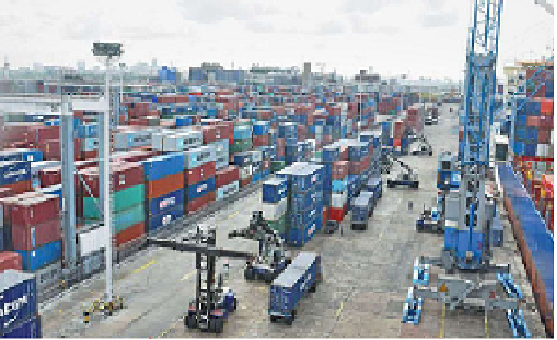
The Nigerian Ports Authority (NPA) said it facilitated export of over 500,000 tonnes of petroleum products from Dangote Refinery to African countries in March.
NPA Managing Director, Dr Abubakar Dantsoho, disclosed this in a statement issued on Tuesday by Ikechukwu Onyemekara, General Manager (Corporate Communications and Strategy).
Dantsoho spoke at a stakeholders’ engagement organised by the Ministry of Marine and Blue Economy in Lagos.
He said in spite of the Middle East conflict affecting global vessel movement, Nigeria remained resilient in supplying petroleum products locally and for export.
He attributed the achievement to the implementation of the One-Stop-Shop (OSS), introduced by the Minister of Marine and Blue Economy, Dr Adegboyega Oyetola.
According to him, the OSS ensures all stakeholders operating at the Dangote Refinery align seamlessly in their operations.
“In many countries today, workers operate remotely, while others face energy queues, but Nigeria has not experienced such disruptions.
“As a matter of fact, in the past month, we exported over 500,000 tonnes of petroleum products from Dangote Refinery to African countries.
“The exports are handled by ships, supported by the NPA’s capacity in port and cargo operations,” Dantsoho said.
He said the policies driving the achievement were approved by the minister, including the OSS hosted by the NPA.
“This system operates similarly to the National Single Window, ensuring efficiency and coordination,” he said.
Dantsoho noted that all stakeholders now operate in sync with Dangote Refinery’s distribution framework.

The National Insurance Commission (NAICOM) has issued new guidelines for the collection, management and administration of the Insurance Policyholders’ Protection Fund (IPPF), to strengthen protection for policyholders in the country.
In a circular dated April 7, 2026, and addressed to all insurance institutions, the commission said the directive was in exercise of its powers under the Nigerian Insurance Industry Reform Act 2025 and other extant laws.
The circular was signed by John Falade, Deputy Director, Special Risk and Security Analysis, NAICOM, on behalf of the Commissioner for Insurance.
NAICOM stated that the guidelines provide a comprehensive regulatory framework to ensure clarity, enhance compliance and streamline the administration of the fund across the insurance sector.
According to the commission, the fund serves as a statutory safety net designed to protect policyholders in the event of distress or insolvency of a licensed insurer or reinsurer.
It added that the guidelines also include provisions for the reimbursement of loans by insurers and reinsurers under the scheme.
The commission directed that IPPF assessment returns for the 2025 financial year must be submitted on or before May 31.
It noted that subsequent submissions would be made in line with Section 4.3 of the guideline on the Insurance Policyholders’ Protection Fund.
NAICOM urged all insurers, reinsurers and other relevant institutions to ensure strict compliance with the new guidelines.


NIMASA Records 60 CVFF Applications, Pledges Transparency
ShareThe Nigerian Maritime Administration and Safety Agency (NIMASA) said it has received over 60 applications since launching the Cabotage Vessel...
NPA Facilitates 500,000 Tonnes Petroleum Export from Dangote Refinery
ShareThe Nigerian Ports Authority (NPA) said it facilitated export of over 500,000 tonnes of petroleum products from Dangote Refinery to...

NAICOM Issues Guidelines on Policyholders’ Protection Fund
ShareThe National Insurance Commission (NAICOM) has issued new guidelines for the collection, management and administration of the Insurance Policyholders’ Protection...

Navy Seeks Partnerships to Boost Indigenous Shipbuilding, Operations
ShareThe Nigerian Navy has expressed readiness to partner with relevant organisations to strengthen indigenous shipbuilding capacity and enhance naval operations....

Dangote Hikes Petrol Price to N1,275, Diesel N1,950
ShareThe Dangote Petroleum Refinery has again increased the gantry price of petrol and diesel, further tightening pressure on consumers and...


Bandits Abduct Couple on Farm in Kaduna
ShareBandits have abducted a man, Bitrus Jayawa and his wife, Martha Bitrus, from a farm in Katambi community in Kachia...


NBTE Inaugurates Nigeria’s First Chip Design Training Programme
ShareThe National Board for Technical Education (NBTE) has inaugurated Nigeria’s first chip design training programme, aimed at equipping young Nigerians...


Enugu Says Science Transformed Health System’s Delivery, Outcomes
ShareFrom Sylvia Udegbunam, Enugu The Enugu State Government said science has transformed the health system’s delivery and general outcomes in...

NSCDC Arrests 20 Foreign Nationals in Kano over Illegal Entry
ShareThe Kano State Command of the Nigeria Security and Civil Defence Corps (NSCDC) has arrested 20 foreign nationals in the...

FG Unveils Digital Platform to Showcase Nigeria’s Culture, Tourism Destinations
ShareThe Federal Government has unveiled a new digital platform, NITOUREY, aimed at showcasing Nigeria’s rich cultural heritage and tourism destinations...