
Education
Taraba is Among States With Highest out-of-School Children


From Victor Gai, Jalingo
The Minister of State for Education, Chukwuemeka Nwajuba has revealed that Nigeria has 10.1 million out-of-school children- the highest in sub-sahara Africa.
He also added that Taraba state is one of those with the highest number of the cases in Nigeria.
The Minister made this disclosure at the flag off of Better Education Service Delivery for All (BESDA) in Jalingo, Taraba state on Monday, with the theme: Eradicating Out of School Children Phenomenon: A Tool for the Achievement of Education 2030 Agenda.
According to the Minister, six states of the north-east, seven states of the north-west and one state from each of the other geo-political zones were targeted by the programme.
He said BESDA became effective in 2018 and that 1,455,000 children were reached in the first cohort states.
Nwajuba while quoting from Chapter 2 of the Nigerian constitution said the “welfare and security of the people is the primary responsibility of government”.He commended President Muhammadu Buhari for his passion for education which gave birth to BESDA.
“Anything you do, you can do it well when you have better education. No nation can rise above its level of education,” the Minister said.
Also speaking during the event, Permanent Secretary, Federal Ministry of Education, Sunday Echono, mentioned the target areas of BESDA to include among others: increasing equitable access to out of school children, improving literacy in the focal states, strengthening the system for accountability in the education sector.
He said the Nigeria Education Data Survey was carried out on all 36 states by BESDA and that the outcome of the exercise would be used to reward states.
Ochonu also appreciated the Taraba state governor, Darius Ishaku, for granting the request to launch BESDA in the State.
Meanwhile, the Taraba state Commissioner of Education (Primary and Secondary) Johannes Jigem, has disclosed that 13 LGAs in the state have been targeted for reduction of out-of-school children and eight others for intensive literacy programme.
Jigem made the disclosure during the flag off of BESDA in Jalingo, the Taraba state capital on Monday.
According to him, non-formal learning centres have been established with a total enrolment of 24,150 children, 650 facilitators. He added that the literacy programme include 1004 schools with a total enrolment of 64,261 students.
“With the support of both state and federal government, the trend is expected to continue on an upward trajectory,” Jigem added.
In its effort at encouraging out-of-school children to enrol in school, the commissioner revealed the efforts the government made.
“To make the programme more appealing, we have paid 350 Alaramas, made conditional cash transfers to another 12,000 and provided 650 facilitators with monthly stipend of 10,000 naira,” he stated.
Jigem then urged the federal government to release more funds to the states in order to ensure the successful implementation of BESDA.
Meanwhile, the flag off of BESDA co-incides with the meeting of the National Council on Education which is due to hold in Jalingo.







The Joint Admissions and Matriculation Board has announced a slight adjustment to the arrival time for candidates sitting the 2026 Unified Tertiary Matriculation Examination, particularly those scheduled for the first session.
In a notice issued via its official X handle on Monday, the board stated that candidates for the first session are now expected to arrive at their examination centres by 7:00 a.
m. , instead of the earlier scheduled 6:30 a.m.JAMB added that the examination will commence at 8:30 a.m. and end at 10:30 a.m.
“Attention 2026 UTME Candidates: This is to notify you of a slight adjustment to the arrival scheduled time, particularly for the first session, which is now 7:00am as against the earlier published 6:30am, while the scheduled start time for the session is now 8:30 am and end time 10:30 am,” the notice read.
The board also clarified that candidates are not required to reprint their examination slips following the adjustment.
The full daily timetable, as shared by JAMB, includes four sessions running from Monday to Friday, with adjusted timings across all batches to ensure smoother operations at Computer-Based Test (CBT) centres nationwide.
This adjustment comes in response to long-standing feedback from candidates and parents regarding the challenges of very early morning travel, including safety concerns on roads before dawn and logistical difficulties for those coming from distant locations.
The UTME is scheduled to be held from Thursday, April 16, to Saturday, April 25, 2026.

By Tony Obiechina, Abuja
The Federal Ministry of Education has announced the commencement of applications for the second cohort of the National Technical and Vocational Education and Training (TVET) Programme.
The ministry said the programme is part of efforts to boost skills acquisition and tackle unemployment among Nigerian youth.
In a statement issued by the ministry’s Director of Press and Public Relations, Boriowo Folasade on Monday, the ministry said the applications will open on Monday, April 13, 2026, at 4 pm.
It further invited interested Nigerians to participate in the nationwide initiative aimed at strengthening technical capacity, promoting entrepreneurship, and enhancing job creation.
The Minister of Education, Maruf Alausa, described the programme as a key strategy for human capital development.
She said the initiative is designed to equip young Nigerians with industry-relevant skills needed to succeed in a rapidly evolving economy.
Alausa said the programme aligns with the Renewed Hope Agenda of President Bola Tinubu, adding that it reflects the administration’s commitment to expanding access to skills-based education and fostering sustainable livelihoods.
He also said the Federal Government is investing in the productive capacity of young people through practical training and recognised certification, creating pathways for self-employment, innovation, and long-term economic growth.
“In strengthening this programme, the Federal Government is investing in the productive capacity of our youth. By providing practical training and recognised certification, we are creating pathways for self-employment, innovation, and long-term economic growth,” the Minister said.
The statement noted that as part of efforts to expand opportunities in emerging sectors, the Ministry is collaborating with the Federal Ministry of Arts, Culture and Tourism to strengthen training in creative and cultural industries, with a view to unlocking the potential of Nigeria’s creative economy.
According to the statement the TVET Programme will provide intensive six-month and one-year hands-on training in accredited centres across the 36 states and the Federal Capital Territory. He added that participants will receive a monthly stipend of N22,500 and a nationally recognised certificate upon successful completion.
Boriowo added the training areas include construction, ICT, automotive technology, creative media, agriculture, fashion and garment production, cosmetology, tourism and hospitality, catering services, and leather works.
The Ministry further stated that applicants are required to demonstrate commitment to the programme and must be available for full participation throughout the training period, adding that attendance will be monitored using biometric verification systems, with stipends tied to compliance.
By Tambaya Julius, Abuja
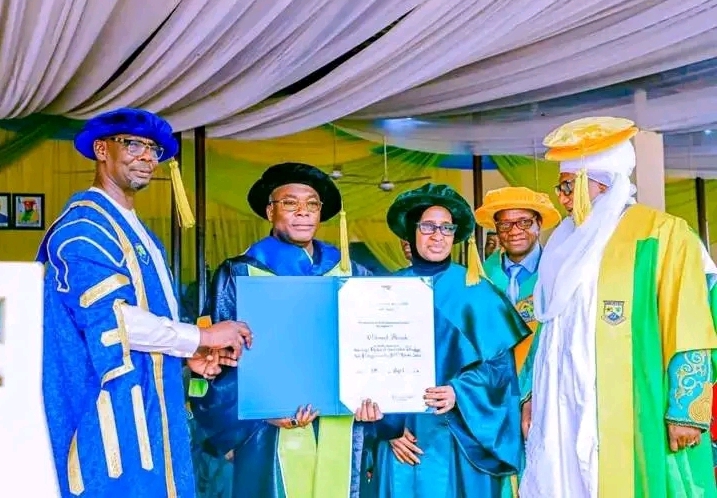
The Nasarawa State University, Keffi over the weekend celebrated its 25th silver jubilee anniversary and combined 8th convocation ceremony, where over 25,000 students were awarded with various academic degrees.
The grand event, held over the weekend at the school main Campus Keffi, was confirmed and honoured with Doctor of Philosophy (PhDs), Master’s degrees, First Degrees, and Postgraduate Diplomas on graduating students across different faculties.
The ceremony also confirmed honorary doctorate degrees on prominent personalities for their contributions to global leadership, business, and development.
Among the prominent personalities honoured were the President of Tanzania, Samia Suluhu Hassan; Abdul Samad Rabiu, Chairman of BUA Group; and Mahmood Ahmad.
The awards recognised their outstanding contributions to global leadership, development, and their roles in advancing socio-economic development both within Africa and globally.
During the ceremony, the Governor of Nasarawa State, Abdullahi Sule, awarded a cash prize of five hundred thousand Naira (N500,000) each to 82 first-class graduates, while the overall best graduating student was awarded N1 million.
The governor explained that the initiative was designed to promote excellence among students and aligns with the state government’s broader agenda of investing in education and human capital development. According to him, recognising academic achievement is essential in inspiring younger generations to pursue excellence.
Sule emphasised that rewarding hard work and dedication would encourage students across the state to strive for distinction in their academic pursuits. He noted that such incentives serve as a catalyst for improved performance and a stronger educational system.
As part of activities marking the institution’s 8th convocation and 25th anniversary celebrations, the governor commissioned several infrastructure projects at the University.
The newly inaugurated projects include the Alumni Secretariat, the Department of Accounting Postgraduate E-Library, as well as the university’s second gate and access road. He commended the university management for its commitment to infrastructural development and academic excellence.
The two-day celebration attracted a wide array of dignitaries from across Nigeria, including Governors, Ambassadors, Vice-chancellors, professors, traditional rulers, Business Men, and key stakeholders in the education sector.
In her address, the Vice-Chancellor of Nasarawa State University, Keffi, Prof. Sa’adatu Hassan Liman, warmly welcomed guests and expressed appreciation to the university’s leadership for their continued support.
She specifically acknowledged the Chancellor, HRH. Shehu Chindo Yamusa the Emir of Keffi, as well as the Pro-Chancellor, Prof. Atahiru Jiga, and members of the governing council for their impactful leadership.
Liman credited the institution’s progress to strong governance and visionary leadership, noting that both staff and students have benefitted from an enabling academic environment.
“I have acquired knowledge and experience in this institution due to impactful and good leadership,” she said.
She further urged students to prioritise their education and draw inspiration from the leadership and values upheld by the university. According to her, such commitment is essential for contributing meaningfully to Nigeria’s academic advancement and global competitiveness.
“Apply your knowledge positively, contributing to the advancement and educational success of Nigeria and the global community,” she appealed.



Joseph Undu Bags National Safety Personality Award in Lagos
ShareBy David Torough, Abuja Award-winning Nigerian journalist and security analyst, Joseph Saater Undu, has been shortlisted for the prestigious Safety...

FG Reaffirms Commitment to ACReSAL Project at Mid-Term Review in Kaduna
ShareBy David Torough, Abuja The Federal Ministry of Water Resources and Sanitation has reaffirmed its commitment to the successful implementation...

Mutfwang Holds Close Door with Former State Governors
ShareFrom Jude Dangwam, Jos Plateau State Governor, Caleb Mutfwang has convened a strategic meeting with former governors of the state towards addressing the security challenges bedevilling the state. The meeting held...

Lobi Stars Trim Squad to Push for Promotion
ShareThe Nigerian National League (NNL) side, Lobi Stars Football Club of Makurdi, has trimmed its squad and retained a few quality players to push for promotion to the...


Pope Criticises ‘Tyrants’ Who Spend Billions on Wars after Trump Spat
SharePope Leo has criticised leaders who spend billions on wars and said the world was “being ravaged by a handful of tyrants” in unusually forceful comments during a...


Nigerian Men Scared of Bold, Confident Women, Phyna Claims
ShareFormer Big Brother Naija winner, Josephine Otabor, popularly known as Phyna, has claimed that she is still single because Nigerian...


Residents Decry Persistent Power Outage in Abuja Community
ShareBy Raphael Atuu, Abuja Residents of Waru District in Apo, within Nigeria’s Federal Capital Territory, are raising the alarm over what they...


2027: Tinubu Meets Coordinators, Renews Plea for Unity, Rule of Law
ShareBy David Torough, Abuja President Bola Tinubu has called for unity, resilience and renewed commitment to nation-building, urging Nigerians to...

Gunmen Abduct 14 UTME Candidates in Benue Enroute Exams Centre
ShareFrom Attah Ede, Makurdi A wave of concern has trailed the ongoing Unified Tertiary Matriculation Examination (UTME) nationwide following the...


Army Honours Fallen Heroes as Brig. Gen. Braimah, Others Laid to Rest in Maiduguri
ShareFrom Muhammad Muhammad Al-amin, Maiduguri The Nigerian Army has conducted a solemn burial ceremony for Brigadier General Oseni Braimah, Captain...