
NEWS
Tinubu Orders Recovered EFCC Funds, Unclaimed Dividends to NELFund

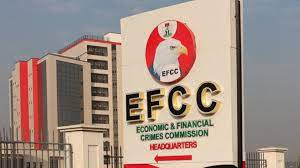
President Bola Tinubu has directed that liquid funds recovered by the Economic and Financial Crimes Commission (EFCC) be channeled to the Nigerian Education Loan Fund (NELFund).
The Minister of Education, Dr Tunji Alausa, disclosed this on Wednesday while briefing State House correspondents after the Federal Executive Council (FEC) meeting presided over by Tinubu in Abuja.
Alausa said the President also directed that unclaimed dividends from the Capital Market Trust Fund and Dormant Account Trust Fund be channeled to NELFund.
He, however, clarified that the directive applied only to liquid, unencumbered funds that were not subject to legal disputes or other restrictions.
“The President, in his benevolence, has now directed that all funds recovered by the Economic and Financial Crimes Commission be diverted to NELFund to continue to support its funding,” Alausa said.
He said the President had also directed the Ministers of Finance and Justice, the Debt Management Office and other relevant agencies to work with the Education Ministry on the legal and operational framework.
According to him, the Justice Minister, Lateef Fagbemi will review the laws establishing the two trust funds to determine how the unclaimed dividends can legally be transferred to NELFund.
He said the Attorney-General would also work with the EFCC Chairman to identify eligible liquid funds recovered by the commission for transfer to NELFund.
“Note, and the President was very clear, not seized properties, or recovered looted funds, but liquid funds, from the EFCC will now be transferred to NELFund,” the minister said.
Alausa said the decision would strengthen NELFund’s financial capacity as demand for student loans continued to grow, adding that more than 1.2 million Nigerian students had benefited from the scheme.
He said NELFund had also disbursed more than N93 billion in stipends to students in federal and state public institutions and over N250 billion in institutional fees.
The minister said the development demonstrated Tinubu’s commitment to fulfilling his campaign promise of expanding access to quality higher education through sustainable student-loan financing.
“The education of our children cannot wait, is of utmost importance to him, and he will do anything and everything to protect the future of every single Nigerian child, every single Nigerian student,” he said.
Alausa also disclosed that FEC approved the transformation of the Suleja Academy into the Nigeria Academy for the Gifted and Talented, to provide specialised support for exceptionally gifted Nigerian children.
He said the academy would operate autonomously, with its own governing structure and diversified funding sources, including government appropriation, endowment and donations.
“We need to do this because we have to look for every single genius in this country and bring them in, nurture them, and let them help create the Nigeria of tomorrow,” he said.
The minister said FEC also approved the augmentation of the existing contract for completion of the National Library of Nigeria, which had been abandoned for about 18 years.
He said construction of the library began in April 2006, with a projected two-year completion period, but work stopped in October 2008.
Alausa noted that funds had been sourced from the Tertiary Education Trust Fund (TETFund), while additional support had been mobilised from the First Lady, Oluremi Tinubu, to enable work to resume on the project.
He also disclosed that FEC approved the deployment of an entrepreneurship, innovation and business incubation certification programme in 14 federal universities.
According to him, the technology-driven programme will equip students with entrepreneurship, innovation, enterprise development and digital skills, alongside mentorship and incubation support.
He said the programme, which had been tested at the University of Lagos, was designed to transform students from job seekers into job creators and innovators.
The 14 universities include Ahmadu Bello University, Bayero University Kano, Nnamdi Azikiwe University, Obafemi Awolowo University, University of Abuja, and University of Benin.
Others are University of Ibadan, University of Ilorin, University of Jos, University of Lagos, University of Maiduguri, University of Nigeria Nsukka, University of Port Harcourt and Usmanu Danfodiyo University, Sokoto.
By David Torough, Abuja
The Nigerian Ports Economic Regulatory Agency (NPERA), has reiterated its commitment to transparency, accountability and responsible management of public resources as it settles into its new role as Nigeria’s port economic regulator.
The Director-General/Chief Executive Officer of NPERA, Dr.
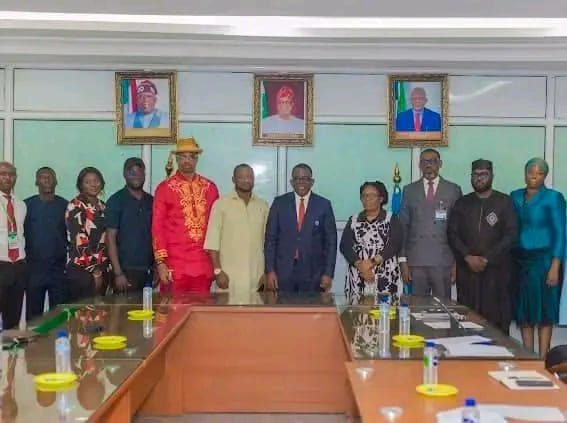
Akutah Pius, stated this when he received a delegation from the Civil Society Coalition for Transparency and Good Governance (CSCTGG), led by its Executive Director, Comr. Success Uko, on a courtesy visit to the Agency’s Abuja Liaison Office.Akutah said the Nigerian Shippers’ Council had transitioned into NPERA under the new legal and regulatory framework, positioning the Agency to provide stronger economic regulation of Nigeria’s port sector.
He assured the delegation that NPERA remained committed to responsible management of public funds in the discharge of its statutory responsibilities, as well as promoting regulatory practices that enhance confidence and efficiency in the maritime sector.
The DG/CEO said the Agency would give due consideration to the Coalition’s request for collaboration and take appropriate formal steps to explore areas of partnership that align with NPERA’s mandate.
Earlier, the Executive Director of CSCTGG, Comr. Success Uko, said the Coalition was seeking a working relationship with NPERA to promote transparency, accountability, public awareness, stakeholder participation and good governance in the maritime sector.
Uko described NPERA as a critical stakeholder in Nigeria’s transport and maritime sector, noting that effective regulation and access to accurate information were important to improving service delivery and strengthening public confidence.
He said the Coalition had developed initiatives focusing on transparency, accountability, good governance and community development, and sought NPERA’s support towards their implementation and wider impact.
According to him, the proposed collaboration would also promote greater awareness among shippers, importers, exporters, transport operators and other stakeholders about policies, procedures, rights and responsibilities within the maritime sector.
He assured NPERA of the Coalition’s readiness to support legitimate programmes and initiatives of the Agency that are consistent with its statutory mandate.

The Independent National Electoral Commission (INEC) has appealed to political parties, candidates and voters to ensure peaceful conduct before, during and after the 2027 general election.
Resident Electoral Commissioner (REC) of INEC in Ondo State, Dr Mutiu Agboke, made the appeal at a major stakeholders meeting on Thursday at the commission’s offices at Akure South and North Local Government Area of the state.
Political parties, security agencies, traditional rulers, religious leaders, NYSC members, National Association of Transport Owners (NATO) and other drivers union, among others were present.
Agboke, who visited the traditional ruler of Iju and Ita-Ogbolu in Akure North Local Government Area, said the stakeholders meeting became necessary to ensure the forthcoming election was free, fair and credible.
According to him, credible elections are a collective responsibility and that security, traditional institutions and transport unions all play a critical role in protecting voters, officials and election materials.
The REC, who said INEC would remain neutral and transparent, warned that the commission would not tolerate partisan leaning, vote-buying, intimidation or any act capable of undermining the credibility of the poll.
“This advocacy is for the commission and our major stakeholders to be on the same page because our expectation is to let votes count.
“The recent elections conducted by INEC are enough proof to show that people’s votes determine the direction of who wins.
“Meanwhile, we don’t want them to engage in violence, nobody should allow him or herself or wards to be used for violence and desist from engaging in vote buying.
“It is only votes lawfully cast and duly counted would determine winners,” he said.
He, therefore, assured that INEC officials had been trained to adhere strictly to the Electoral Act and its guidelines, while the commission’s doors remained open for questions and clarifications to avoid misinformation.
Agboke reiterated INEC’s promise of neutrality, saying that preparations for the 2027 general elections had already begun in earnest.
According to the REC, the success recorded in recent by-elections in the state will be built upon to deliver free, fair and inclusive polls that reflect the will of the people.
In their separate responses, Oba Idowu Faborode, The Ogbolu of Ita-Ogbolu; Oba Amos Farukanmi, The Okiti of Iju and religious leaders, pledged to sensitise their subjects and congregations on non-violence.
Also, Dr Gbenga Jemiloye, Akure South Local Government Chairman of All Progressive Congress (APC), applauded the commission for the meeting, saying it showed INEC was ready for the election.
The security agencies and drivers union assured of adequate deployment across the state, while the transport unions committed to timely movement of personnel and materials.(NAN)

By David Torough, Abuja
The management and staff of DAILY ASSET have announced the death of the newspaper’s Political Editor, Mike Odiakose, who passed away in the early hours of Thursday at the Federal Medical Centre, Keffi, following a brief illness.
Odiakose, aged 63, was described by the management of DAILY ASSET as an accomplished journalist, who served with dedication across various media organisations in Nigeria before joining the newspaper two years ago.
In a statement personally signed by the Publisher and Editor-in-Chief of DAILY ASSET, Dr.
Cletus Akwaya, the newspaper expressed sadness over the death of the veteran journalist, saying he would be deeply missed by his colleagues and members of the wider media community.“Management and Staff of DAILY ASSET regret to announce the sudden passing of our Political Editor, Mr Mike Odiakose in the early hours of today (Yesterday), following a brief illness at the Federal Medical Centre Keffi,” the statement said.
The management noted that Odiakose’s contributions to journalism extended beyond DAILY ASSET, where he worked for two years, having previously served with dedication in several media organisations across the country.
He is survived by his wife and children.
The newspaper prayed for the peaceful repose of his soul and offered its condolences to his family, colleagues and associates.
“May his gentle soul rest in perfect peace. Amen,” the statement added.



NPERA Deepens Transparency, Accountability in Port Sector
ShareBy David Torough, Abuja The Nigerian Ports Economic Regulatory Agency (NPERA), has reiterated its commitment to transparency, accountability and responsible...


Troops Rescue Wounded Civilians, Recover 117 Cows, Stolen Vehicle in Zamfara
ShareBy David Torough, Abuja Troops of Sector 2, Operation FANSAN YAMMA, have recorded a series of operational successes in Zamfara...


Minister Warns Envoys against Unguarded Comments Ahead 2027 Elections
ShareThe Minister of Foreign Affairs, Ambassador Bianca Odumegwu-Ojukwu, has warned foreign diplomatic missions against making unguarded comments, disparaging remarks or...

Shettima Holds Northern Governors in High Regard, Aide Clarifies
ShareSenior Special Assistant to the President on Media and Communications, Stanley Nkwocha, said Vice President Kashim Shettima holds northern governors...


World Bank Mobilises $112bn Private Capital in FY26
ShareThe World Bank Group said it mobilised a record 112 billion dollars in private capital in fiscal year (FY) 2026,...


Oluremi Welcomes FOPSHAN’s Endorsement of Tinubu for Second Term
ShareThe First Lady, Sen. Oluremi Tinubu on Thursday in Abuja, welcomed the endorsement of the President for a second term...


Why APC Govs Oppose Wike — Tinubu’s Ex-spokesman
ShareA former South-East spokesman to President Bola Tinubu, Denge Onoh, has attributed the growing face-off between the Minister of the...
Nigeria, State Capture and the Implications on 2027 Elections
ShareBy Uche Igwe An interesting trend is going on in Nigeria in the name of democracy. Many observers have noticed...
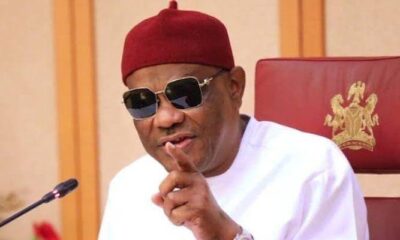

Wike, His Rainbow Coalition and the Politically Lazy Governors
ShareBy Hajia Hadiza Mohammed Nyesome Wike, the current Minister of the Federal Capital Territory (FCT) will go down in Nigeria...

2027: INEC Appeals for Peaceful Conduct, Promises Neutrality
ShareThe Independent National Electoral Commission (INEC) has appealed to political parties, candidates and voters to ensure peaceful conduct before, during...