
COVER
Tinubu Sacks Maikudi as UniAbuja VC, Approves Changes in Other Varsities


By Tony Obiechina Abuja
President Bola Ahmed Tinubu has relieved Professor Aisha Sani Maikudi of her position as the Vice Chancellor of the University of Abuja, now Yakubu Gowon University.
In the same vein, the president has sacked Professor Polycarp Emeka Chigbu, as the Acting Vice Chancellor of the University of Nigeria (UNN), Nsukka.
The significant leadership changes at several federal universities, takes immediate effect, according to a statement by Presidential Adviser on Information and Strategy, Bayo Onanuga.
The statement reads: “At Yakubu Gowon University, President Tinubu dissolved the entire governing council and relieved Professor Aisha Sani Maikudi of her duties as Vice-Chancellor.
”Senator Lanre Tejuoso, currently Pro-Chancellor of the University of Agriculture, Makurdi, has been appointed Pro-Chancellor of the Yakubu Gowon University. He will be succeeded in Makurdi by Senator Joy Emordi, now pro-chancellor of Alvan Ikoku University of Education.
To succeed Maikudi, President Tinubu appointed Professor Lar Patricia Manko as Acting Vice Chancellor at the Yakubu Gowon University for a six-month term.
She will not be eligible to apply for the substantive Vice Chancellor position when it becomes available.
Professor Chigbu’s tenure as Acting Vice-Chancellor at UNN was to end on February 14.
Professor Oguejiofor T. Ujam has been appointed as his successor for six months and will not be eligible to apply for the permanent position.
The leadership changes at UNN extend to the role of Pro-Chancellor, with Gen. Ike Nwachukwu reassigned to Pro-Chancellor at the University of Uyo.
Tinubu appointed Engineer Olubunmi Kayode Ojo as the new Pro-Chancellor of UNN. Previously, Ojo held the same position at the Federal University of Lokoja and the Federal University of Oye-Ekiti.
Professor Zubairu Tajo Abdullahi, the Pro-Chancellor of the University of Uyo, has been appointed to succeed Ojo at the Federal University of Lokoja.
Senator Sani Stores is the new Pro-Chancellor of Alvan Ikoku University of Education, succeeding Senator Joy Emordi. Senator Stores is a Council Member at the University of Nigeria, Nsukka.
Additionally, Barrister Olugbenga Kukoyi, a current Council Member at UNN, Nsukka, has been appointed the new Pro-Chancellor of Nnamdi Azikiwe University in Awka, Anambra State.
All fresh appointments and reassignment decisions are with immediate effect.
“The restructuring aims to strengthen governance and academic excellence within Nigeria’s tertiary education sector”, the statement added.
By Tony Obiechina, Abuja
The Development Bank of Nigeria Plc (DBN) has launched DAWN: DBN Action for Women in Nigeria, unveiled its Impact Report and presented MSME Data Assets at the seventh edition of Annual Lecture held in Abuja.
DBN, in a statement on Thursday, said while delivering a welcome address, its Managing Director and Chief Executive Officer, Dr Tony Okpanachi, said the central challenge was no longer reforms themselves but ensuring benefits reach businesses at end of the chain.
He asked how to make sure benefits reach traders in Onitsha, fabricator in Aba, farmer in Kebbi and young founder in Yaba, noting that MSMEs accounted for about half of Nigeria’s GDP and more than eight in every ten jobs, adding that when reform works for MSMEs it works for most Nigerians.
He explained that reform becomes prosperity only when entrepreneurs can act on it whether through long tenor loans to buy equipment, banks willing to take risk or skills and records needed to grow.
He said working through Participating Financial Institutions DBN provides longer term funding, partial credit guarantees through subsidiary Impact Credit Guarantee Limited and capacity building including Entrepreneurship Training Programme.
He disclosed that as at December 2025 DBN had disbursed a cumulative N1.4 trillion to MSMEs through 84 Participating Financial Institutions creating about 1.6 million jobs nationwide.
Under the new five year strategy, the Bank aims to reach more than two million MSMEs with deliberate targets for women led businesses, youth led businesses and underserved states.
On DAWN, Okpanachi said finance alone had not enabled enough women-led businesses to scale.
He said initiative brings together financing, guarantees and credit support, technical assistance, outcome linked grants and market linkages delivered through banks, microfinance institutions, fintechs, aggregators, cooperatives and direct channels.
Its priority sectors are agriculture and exports, healthcare, arts and creatives, technology and green business.
He said DAWN is about moving gender focused lending beyond intention and turning access into opportunity.
On the sidelines of the lecture DBN and African Development Bank held a signing ceremony of AfDB DBN 61 million United States dollars Gender Line of Credit development that reinforces Bank commitment to women led enterprises.
Okpanachi urged Participating Financial Institutions to extend lending into sectors and states where access to finance has been limited, policymakers and regulators to measure reform by what changes for business at end of chain and MSMEs to formalise, keep good records and use support now available.
The Vice President as Special Guest of Honour was represented by Dr Fred Iklaga Senior Technical Adviser in the Office of Special Adviser to the President on Economy.
Keynote speakers were Chief Executive Officer of MTN Nigeria, Dr Karl Toriola, and Chairman of Nigeria Sovereign Investment Authority, Dr Segun Ogunsanya.
Fireside chat featured Chief Executive Officer of Sterling Bank Abubakar Suleiman, manufacturing and trade entrepreneur Mrs Omoyemi Chukwurah and by video Kola Masha of Babban Gona.
The Secretary to the Government of Federation, represented by Augusta Warren Bekaredebo, said 2026 tax reforms would bring relief to many small businesses expressing optimism that a lot of businesses will be smiling by next year because they will be exempted from tax.
By Tambaya Julius, Abuja
The Nigeria Labour Congress (NLC) has threatened possible nationwide industrial action following the failure of talks with the Federal Government over workers’ welfare, petrol prices and other outstanding labour demands.
The warning came after a meeting between the government and organised labour at the Ministry of Labour in Abuja on Thursday, October 22, ended without an agreement.
The congress has given the Federal Government until Tuesday, October 27, to make meaningful progress on the issues, warning that its relevant organs would decide the next line of action if the next meeting fails to produce concrete commitments.
The NLC has also directed its affiliates, state councils and civil society allies to begin mobilising members for possible nationwide action.
In a statement issued after the meeting, the NLC Acting General Secretary, Benson Upah, expressed disappointment over what he described as the government delegation’s lack of preparedness for the negotiations.
According to the congress, organised labour presented its demands in good faith but left the meeting without any concrete commitments from the government.
The demands include a reduction in petrol prices to 2024 levels, renegotiation of the national minimum wage, implementation of agreed tax relief measures and resolution of the terms of settlement involving the Joint Health Sector Unions (JOHESU).
The congress also called for the resolution of issues raised by the Joint Public Service Negotiating Council (JPSNC) over peculiar allowances, wage awards and hazard allowances.
The NLC said the government delegation lacked the necessary authority to engage meaningfully on the issues presented by labour representatives.
“The meeting between the Federal Government and organised labour, convened at the Ministry of Labour in Abuja on 22nd October 2026, has ended without resolution,” the statement said.
It added that the Minister of Labour requested that the meeting be adjourned until October 27 to allow the government to prepare adequately for further discussions.
The preparations, according to the statement, would include bringing relevant ministers and heads of departments and agencies to the negotiating table.
The congress said it remained open to dialogue but would not accept continued delays in addressing workers’ concerns.
“We will report back to our organs, and if no meaningful progress is made on Tuesday, the relevant organs of the NLC will decide the next line of action,” it said.
The labour body urged workers and members of the public to remain calm while the negotiations continue, even as it directed its affiliates and allies to prepare for possible industrial action.
“However, we urge all affiliates of NLC and TUC; all state councils and our civil society allies to be alert and start mobilising for a possible action across the nation while we hope that the tenets of our demands are met by the government,” the statement added.
The October 27 meeting is expected to provide another opportunity for both sides to address the outstanding issues and prevent a possible escalation of the dispute.
However, the NLC’s decision to begin mobilisation suggests that tensions could rise if the next round of talks fails to produce meaningful progress.
The Federal Road Safety Corps (FRSC) has barred its personnel from escorting politicians during campaigns for the 2027 general elections.
Zonal Commanding Officer, RS6, ACM Abimbola Owolabi, gave the directive during her maiden visit to the Cross River Command in Calabar on Wednesday.
Owolabi said patrol vehicles and sirens must not be used for political activities or private engagements, including weddings and funeral processions.
She directed officers deployed to campaign venues to focus exclusively on traffic management to prevent congestion and road crashes.
The zonal head warned personnel against leading political convoys or providing escorts for politicians, stressing that official vehicles must not be used for unauthorised purposes.



Nigerian Military Rescues 47 Kidnap Victims, Arrests Suspects in Nationwide Operations
ShareBy David Torough, Abuja The Armed Forces of Nigeria (AFN) have rescued 47 kidnapped persons, including 29 children, neutralised several...

Nigerian Army Inducts 6,419 New Soldiers as Force Expands to 12 Divisions
ShareBy David Torough, Abuja The Chief of Army Staff (COAS), Lieutenant General Waidi Shaibu, has inducted 6,419 newly trained soldiers...


Troops Rescue 14 Kidnap Victims in Kaduna, Hunt for Others
ShareBy David Torough, Abuja Troops of the Nigerian Army have rescued 14 passengers abducted by kidnappers at Kurmin Goro in...


A Year Never to be Forgotten in My Lineage — Pastor Komaiya
ShareBy David Torough, Abuja The Senior Pastor of Masters Place International Church, Pastor Korede Komaiya, has described 2026 as an...


PAP Phase Two Chairman Hails Otuaro over Aberdeen University Engagement
ShareFrom Seyi Tayese, Yenagoa The National Chairman of the Presidential Amnesty Programme (PAP) Phase Two, Ibena Rufus Salvation, has commended...

Henry Okeke Welcomes Tinubu to Enugu, Hails Mbah’s Development Efforts
ShareBy Raphael Atuu The Convener of New Enugu Group Barrister Henry Okeke, has welcomed President Bola Ahmed Tinubu to Enugu...

COAS Sharpens Combat Edge of Expanding Nigerian Army, Graduates 91 RRI CTCOIN Recruits
ShareBy David Torough, Abuja The Chief of Army Staff (COAS), Lieutenant General Waidi Shaibu, has highlighted the importance of specialised...

FOOG Women Support Group for Tinubu Commends Babangida, Abdulsalami Over Tinubu’s 2027 Endorsement
ShareBy Francis Sadhere, Delta The FOOG Women Support Group for Tinumbu has commended former Nigerian military Heads of State, Generals...
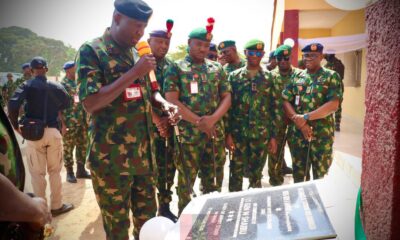

COAS Strengthens Troops Welfare, Commissions Training Infrastructure atDepot Nigerian Army Zaria
ShareBy David Torough, Abuja The Chief of Army Staff (COAS), Lieutenant General Waidi Shaibu, has strengthened the Nigerian Army’s drive...

Benue IDPs Praise UNICEF over Provision of Facilities
ShareFrom Attah Ede, Makurdi Internally Displaced Persons (IDPs) in Benue State have poured praises on the United Nations Children’s Fund...